Lecture 23 Ecosystem Management
 Call Kai
 Learn
Learn Practice Test
 Spaced Repetition
 Match
Match Flashcards
 Knowt Play
1/22

There's no tags or description
Looks like no tags are added yet.
Name | Mastery | Learn | Test | Matching | Spaced | Call with Kai |
|---|
No analytics yet
Send a link to your students to track their progress
23 Terms
Landscape ecology
examines spatial patterns and their relationship to ecological processes.
Ecosystem management:
A collaborative process with the maintenance of long-term ecological integrity as its core value.
Designing Natural Reserves
Biodiversity can best be sustained by large reserves connected across the landscape and buffered from areas of intense human use and Design of nature reserves focuses on core natural areas, where conservation of biodiversity and ecological integrity take precedence over other uses.
Reserve design
Conservation Biologists often start by considering "the four Rs"
Representation:
Biodiversity
Resiliency:
Large enough to keep characteristics even if climate changes.
Redundancy:
Enough examples of each aspect of biodiversity.
Reality:
Sufficient resources to regulate and manage the area
Reserve design
Some principles of reserve design have been proposed based in part on theories of island biogeography of MacArthur and Wilson (1967)
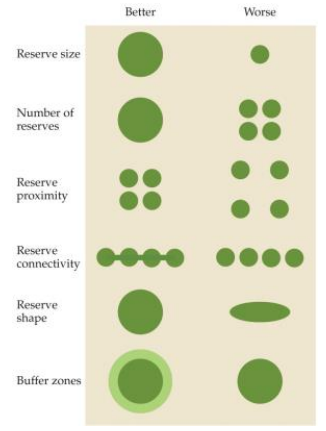
The Best Spatial Configurations for Habitat Reserves
Look at images
Habitat corridors:
Linear patches that connect blocks of habitat.
Connectivity can reduce
the effects of fragmentation by preventing isolation of populations. Increase inmmigration and prevent local extinctions
IUCN:
A clearly defined geographical space, recognized, dedicated, and managed, through legal or other effective means to achieve the long-term conservation of nature with associated ecosystem services and cultural values.
The world’s terrestrial (green) and marine (blue) protected areas
Almost every country currently has one or more protected areas, but the proportion of land strictly protected varies dramatically among countries.
Effectiveness of protected areas
About half of the protected areas have been reasonably effective at protecting biodiversity. but the other half are experiencing species declines.
Buffer zones
around protected areas, in which only lower-impact land uses are allowed.
Creating new protected areas requires…
1.Establishing priorities for conservation: Distinctiveness (or irreplaceability) Endangerment (or vulnerability) *Utility
2. Identifying high priority areas that should be protected. The Species approach:
Rare species, Endangered species, Keystone species, Culturally significant species, Indicator species, Flagship species, Umbrella species.
The Hotspot approach:
Areas with high levels of species richness and endemism. Biodiversity indicator…
The Ecosystem approach
Representative sites
The Hotspot approach applied to individual countries
Peaks of species richness in the United States, calculated by employing an index that gives extra weighting to rare species.
Creating new protected areas requires… 3. Selecting new protected areas by filling gaps and developing conservation networks.
1.Sites that are not already protected. 2.Maximize linkages among protected areas to create networks. 3. Are located where creation of a protected area is both practical and cost-effective. 4. Ensure that investments toward protection are spread adequately and not overly concentrated in a small number of areas
Geographic information systems (GIS)
Tool for GAP Analysis. Provide a method for integrating a wide variety of data for analysis and display on maps and highlight critical areas that need to be protected