BOC Molecular Biology - All Questions
 Call Kai
 Learn
Learn Practice Test
 Spaced Repetition
 Match
Match Flashcards
 Knowt Play
1/68

There's no tags or description
Looks like no tags are added yet.
Name | Mastery | Learn | Test | Matching | Spaced | Call with Kai |
|---|
No analytics yet
Send a link to your students to track their progress
69 Terms
c. cytosine
MOLECULAR SCIENCE
Which nucleotide has a high frequency of mutation in human chromosomal DNA?
a. adenine
b. thymine
c. cytosine
d. guanine
a. precursor mRNA
(alternative answer: Heteronuclear RNA)
Intervening sequences are found in:
a. precursor mRNA
b. mature mRNA
c. ribosomal RNA
d. transfer RNA
c. methylation of CpG in the promoter region of a gene
Which is considered an epigenetic modification of DNA?
a. transversion of an A nucleotide to a T in an exon of a gene
b. transition of an A to a G in an intron of a gene
c. methylation of CpG in the promoter region of a gene
d. insertion of a nucleotide into the coding region of a gene
c. RNA-dependent DNA polymerase
RT synthesizes a DNA molecule from an RNA template.
Reverse transcriptase would best be described as a:
a. DNA-dependent DNA polymerase
b. DNA-dependent RNA polymerase
c. RNA-dependent DNA polymerase
d. RNA-dependent RNA polymerase
c. 50
One X chromosome is passed on to all sons by the mother; since she is a carrier of a mutant X allele, 50% of her sons will be affected.
The 2 alleles for a sex-linked recessive disease are X and x. The mutant allele is x. What is the percentage of male offspring that would be expected to be affected by the disease from parents who have the following genotypes?
mother Xx
father xY
a. 0
b. 25
c. 50
d. 100
d. hemizygous
Males are hemizygous for X-linked alleles because they have only one copy of the X chromosome.
The term that best describes males regarding X-linked genes is:
a. heterozygous
b. homozygous
c. haplozygous
d. hemizygous
d. maternal
All mitochondria are passed on from a mother to her children, but not by a father to his children
The mode of inheritance of mitochondrial DNA is:
a. dominant
b. recessive
c. codominant
d. maternal
a. RNA:RNA duplexes
Which structure is most resistant to denaturation?
a. RNA:RNA duplexes
b. RNA:DNA duplexes
c. DNA:DNA duplexes
d. all are equally resistant to denaturation
d. phosphodiester bond
What chemistry joins successive nucleotides of DNA?
a. glycosidic bond
b. ionic bond
c. hydrogen bond
d. phosphodiester bond
a. adenine
Which of the following nucleotides is a purine?
a. adenine
b. cytosine
c. thymine
d. uracil
d. 3'-CCC TAG CTA CGG GGA ATT TCT CAA ATG-5'
Which sequence represents the replicate DNA strand of 5'-GGG ATC GAT GCC CCT TAA AGA GTT TAC-3'
a. 5'GGG ATC GAT GCC CCT TAA AGA GTT TAC-3'
b. 5'-CCC TAG CTA CGG GGA ATT TCT CAA ATG-3'
c. 3'-GGG ATC GAT GCC CCT TAA AGA GTT TAC-5'
d. 3'-CCC TAG CTA CGG GGA ATT TCT CAA ATG-5'
c. DNA - mRNA - protein
Which of the following best depicts the general route of production in a human cell?
a. mRNA - DNA - protein
b. protein - mRNA - DNA
c. DNA - mRNA - protein
d. DNA - protein - mRNA
a. purine:purine
There is a bulge in the DNA double helix at positive 292 of a gene. This bulge is most likely due to which type of base mispairing?
a. purine:purine
b. purine:pyrimidine
c. pyrimidine:pyrimidine
d. adenine: thymine
b. UNG will regain activity if temperatures drop below 55C
Which of the following is a known limitation of the uracil-N-glycosylase (UNG) chemistry commonly used for PCR contamination containment?
a. Taqman probes are not compatible
b. UNG will regain activity if temperatures drop below 55C
c. dUTP substitution increases affinity of probes
d. UNG inactivates GC residues of naturally occurring DNA
b. CG
Spontaneous deamination of methylcytosine results in thymine formation; it occurs 2.5x more frequently than any other single nucleotide mutation.
Which nucleotide pair has a high frequency of mutation in human chromosomal DNA?
a. CC
b. CG
c. CA
d. CT
d. tetraploid
The G2 phase of the cell cycle follows the S phase, where DNA content goes from 2N to 4N or from diploid to tetraploid.
During the G2 phase of the cell cycle, the DNA content of a cell is:
a. haploid
b. diploid
c. triploid
d. tetraploid
b. submetacentric
Chromosomes with clearly defined short and long arms are known as submetacentric chromosomes.
A metaphase chromosome with primary constriction that gives the chromosome clearly defined short and long arms is considered:
a. acrocentric
b. submetacentric
c. metacentric
d. telocentric
b. high temperature, low salt concentration
High temperature and low salt concentration in the wash buffer favors dissociation of the probe: DNA targets that are not completely base-paired along the length of the probe. This will give the lowest nonspecific or background hybridization.
MOLECULAR TECHNIQUES
Which condition has the highest stringency for DNA probe hybridization?
a. low temperature, low salt concentration
b. high temperature, low salt concentration
c. high temperature, high salt concentration
d. low temperature, high salt concentration
b. to label DNA probes by random primer labelling
Klenow fragment lacks 5'->3' exonuclease activity and is therefore used for random primer labeling.
The Klenow fragment of Escherichia coli DNA polymerase I is used:
a. to make cDNA from an RNA template
b. to label DNA probes by random primer labelling
c. in quantitative real time PCR
d. to label a DNA probe by nick translation
c. 2
2 volumes of ethanol are used to precipitate DNA, whereas 2.5 volumes are used to precipitate RNA
How many volumes of ethanol are added to 1 volume of a DNA: salt solution to cause the DNA to precipitate?
a. 1
b. 1.5
c. 2
d. 2.5
c. 50 ug/mL
The absorptivity constant for DNA is 50 μg/mL.
When quantifying the amount of genomic DNA in a sample by spectrophotometry, an OD 260 of 1.0 corresponds to what concentration of DNA?
a. 10 ug/mL
b. 20 ug/mL
c. 50 ug/mL
d. 100 ug/mL
b. 25 ug
(OD260 x 40 x 40)/2 = (0.03125 x 40 x 40)/2 = 50/2 = 25 μg
A RNA sample is isolated from a peripheral blood cells of a patient. When performing spectrophotometric analysis to determine the yield of RNA in the sample you find the 1:40 dilution of the 0.5 mL sample gives an OD 260 reading of 0.03125 and an OD 280 reading of 0.01760. What is the total amount of RNA contained in the 0.5 mL sample?
a. 50 ug
b. 25 ug
c. 12.5 ug
d. 5 ug
c. STR are analyzed by capillary electrophoresis
Which statement is true concerning the analysis of short tandem repeats (STR)?
a. STR are amplified by reverse transcriptase PCR
b. STR code for small cytokines
c. STR are analyzed by capillary electrophoresis
d. STR analysis requires high molecular weight DNA
c. Molecular Beacon
Reporter and quencher fluorochromes are separated from one another when the beacon anneals its target.
Which reagent generates a signal during the annealing stage of a quantitative real time PCR reaction?
a. SYBR Green
b. Hydrolysis (TaqMan) probes
c. Molecular Beacon
d. Scorpions primers
a. hydrogen bonds between nitrogenous bases in base-paired nucleotides
Hydrogen bonds hold the 2 strands of DNA together in a double-stranded DNA molecule.
Denaturation of DNA during a PCR reaction refers to breaking:
a. hydrogen bonds between nitrogenous bases in base-paired nucleotides
b. phosphodiester bonds between nitrogenous bases in base-paired nucleotides
c. covalent bonds between nitrogenous bases in base-paired nucleotides
d. peptide bonds between nitrogenous bases in base-paired nucleotides
b. annealing temperature
Annealing temperature determines the amount of mismatch tolerated between the primers and the target.
What is the most critical step in determining the specificity of a PCR reaction?
a. denaturation temperature
b. annealing temperature
c. extension temperature
d. number of cycles in the PCR reaction
a. multiplex PCR reaction
PCR reactions in which multiple loci are amplified in the same reaction by multiple sets of primers are known as multiplex PCR.
A PCR reaction in which 4 different sets of primers are used to simultaneously amplify 4 distinct loci in the same reaction tube is known as a:
a. multiplex PCR reaction
b. heteroplex PCR reaction
c. polyplex PCR reaction
d. quadraplex PCR reaction
c. FRET
FRET stands for fluorescent resonance energy transfer. One probe has a donor fluorophore at its 5' end and the other has a reported fluorophore at its 3' end. When both probes anneal to one strand of an amplicon, the donor and reported fluorophores achieve the correct geometry to generate a signal.
Probes are often used during real time PCR to quantitate the formation of specific amplicons during the reaction. Which system involves the use of 2 distinct probes to generate a fluorescent signal?
a. hydrolysis (Taqman) probes
b. molecular beacon
c. FRET
d. Scorpions primers
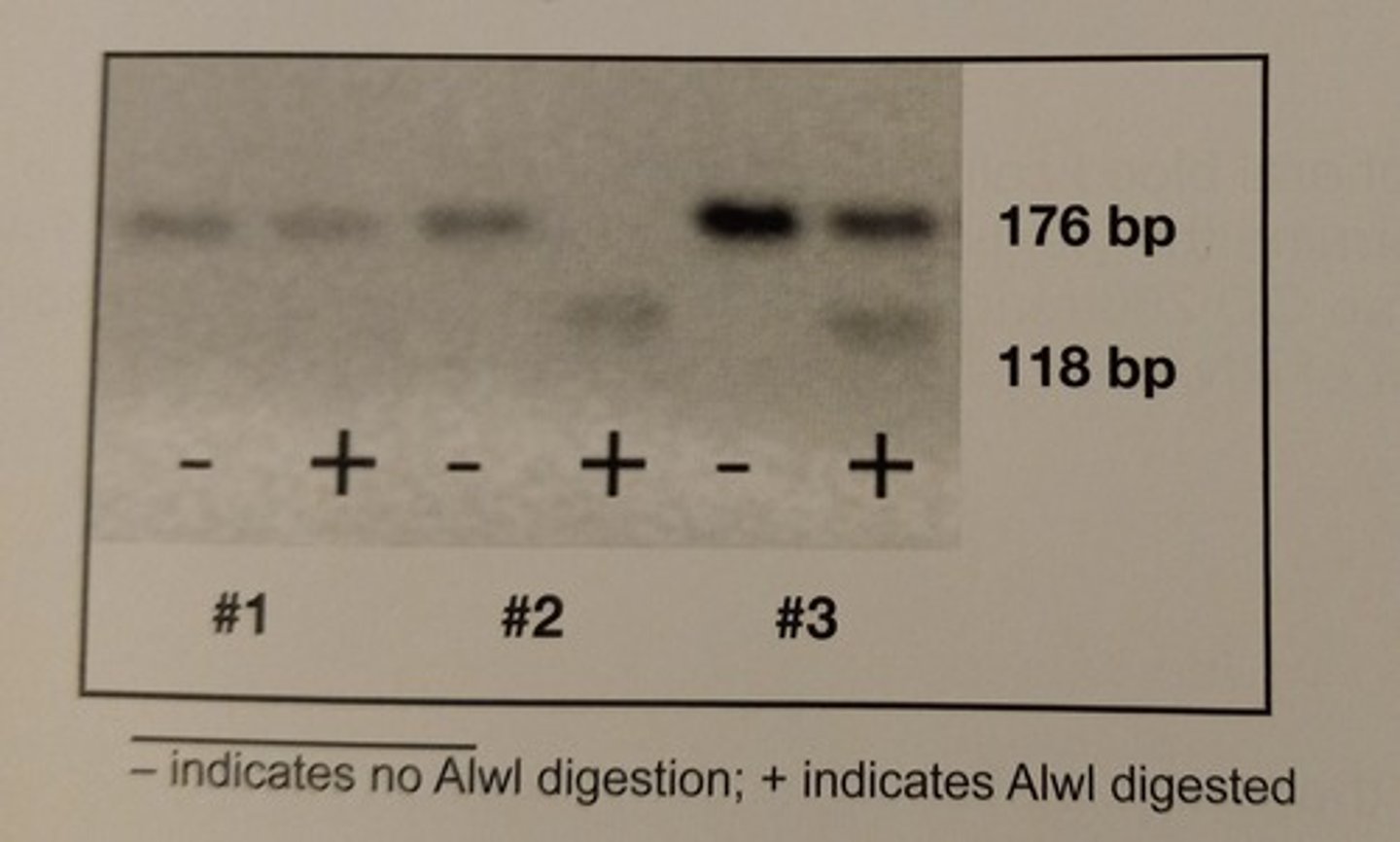
b. patient is heterozygous for X and x
The amplicon from X would not be digested by Alwl because it lacks the enzyme recognition site and thus remains 176 bp in size. The amplicon for allele x would give the 118 bp and 58 bp fragments. Since the patient has bands of all 3 sizes on the gel he/she must be heterozygous, having one X allele and one x allele.
Refer to the figure. An amplicon for gene X is 176 base pairs (bp) in size. A variant allele x, gives the same size amplicon but has an AIwI restriction enzyme recognition site that is not present in the amplicon arising from allele X. A PCR reaction is run on a DNA sample isolated from 3 patients. The sample is digested with AIwI after the PCR is complete and products of the digestion are resolved on a 4.0% agarose gel. Assuming all appropriate controls have worked correctly, what is the interpretation of the genotype of patient #3 with regards to alleles X and x?
a. patient is homozygous for X
b. patient is heterozygous for X and x
c. patient is homozygous for x
d. patient's genotype cannot be determined
c. bisulfite sequencing
Bisulfate sequencing is a modified chain terminator method specifically designed to detect methylated nucleotides.
Methylation of cytosine residues is involved in the alteration of gene expression in a number of cancers. Which sequencing technique is best suited to determine if methylation of cytosine residues has taken place in the promoter region of a given gene?
a. Maxam/Gilbert chemical cleavage
b. Sanger dideoxyterminator
c. bisulfite sequencing
d. pyrosequencing
b. to remove any previously generated amplicons containing dUTP from PCR reactions
UNG digests amplicons containing dUTP as part of a system to prevent contamination of PCR products generated in previous round of PCR in a lab.
What is the purpose of the enzyme uracil-N-glycolase in a molecular diagnostics laboratory?
a. to lower the melting temperature of RNA:DNA hybrids in reverse transcriptase PCR reactions
b. to remove any previously generated amplicons containing dUTP from PCR reactions
c. to remove contaminating genomic DNA from a reverse transcriptase PCR reactions
d. to melt double-stranded DNA to single-stranded DNA in PCR reactions
a. use of upstream and downstream primers that span an exon-intron-exon region of the target
When primers span an in exon-intron-exon boundary, amplicons generated from genomic DNA would be larger than the specific amplicon generated from a mature mRNA.
What is the best method to rule out the possibility of genomic DNA giving a false-positive result in a reverse transcriptase (RT) PCR reaction?
a. use of upstream and downstream primers that span an exon-intron-exon region of the target
b. treatment of RNA that will be used in the RT reaction with RNase
c. addition of uracil-N-glycolase to the RT reaction
d. omission of Taq DNA polymerase from the PCR reaction
d. single-stranded
What is the ccnformation of DNA at 95C?
a. double-stranded
b. fragmented
c. hairpin loop
d. single-stranded
a. endonuclease
What type of enzyme can be used to cut a chromosome into smaller fragments of DNA without removing any nucleotides or functional groups?
a. endonuclease
b. exonuclease
c. ligase
d. phosphatase
d. mercuric chloride
Which method of tissue preservation is inappropriate for molecular testing?
a. snap freeze
b. ethanol
c. formaldehyde
d. mercuric chloride
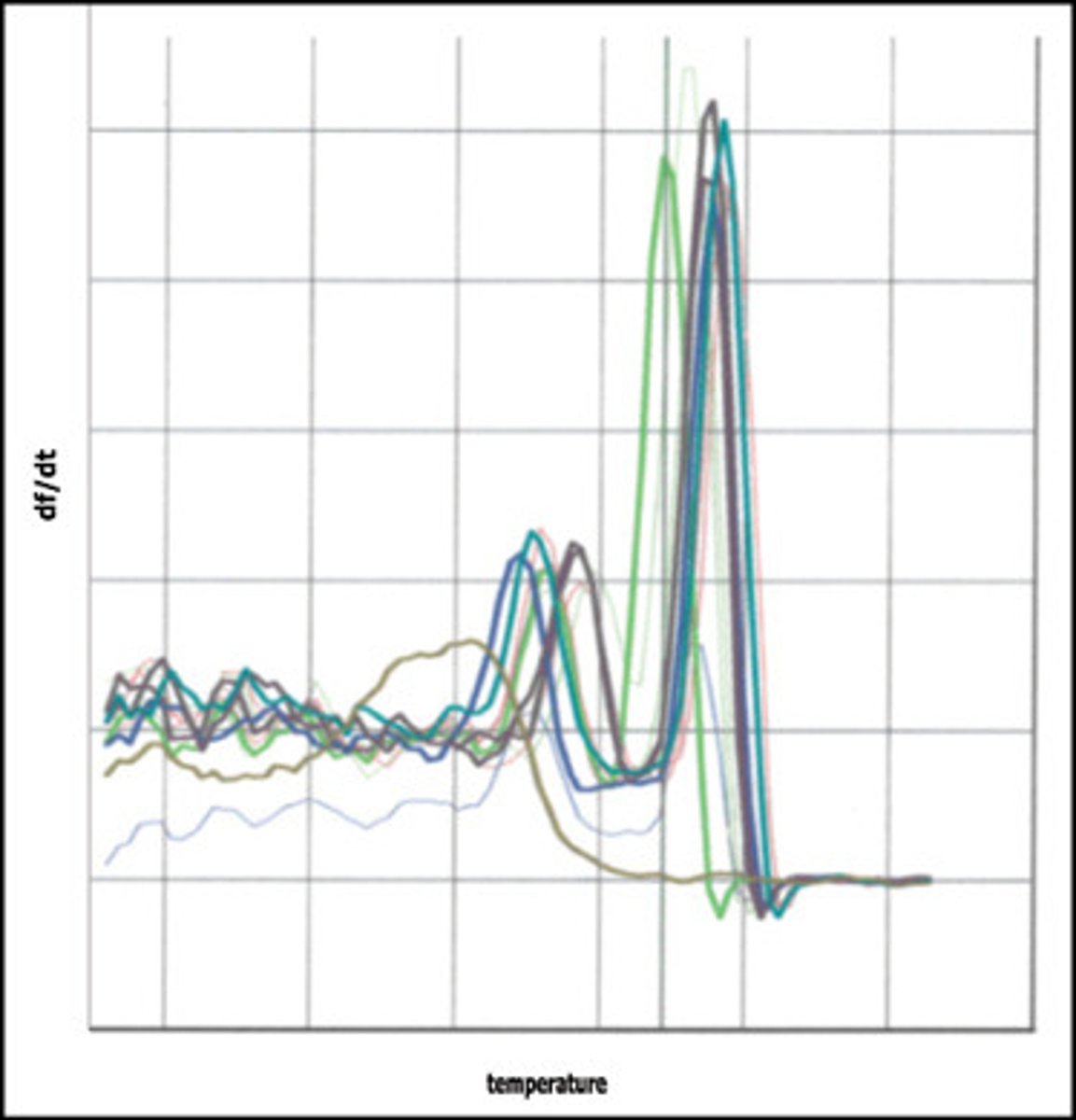
c. melt curve analysis
What process does the fluorography represent?
a. amplification plot
b. fragment analysis
c. melt curve analysis
d. pyrosequencing
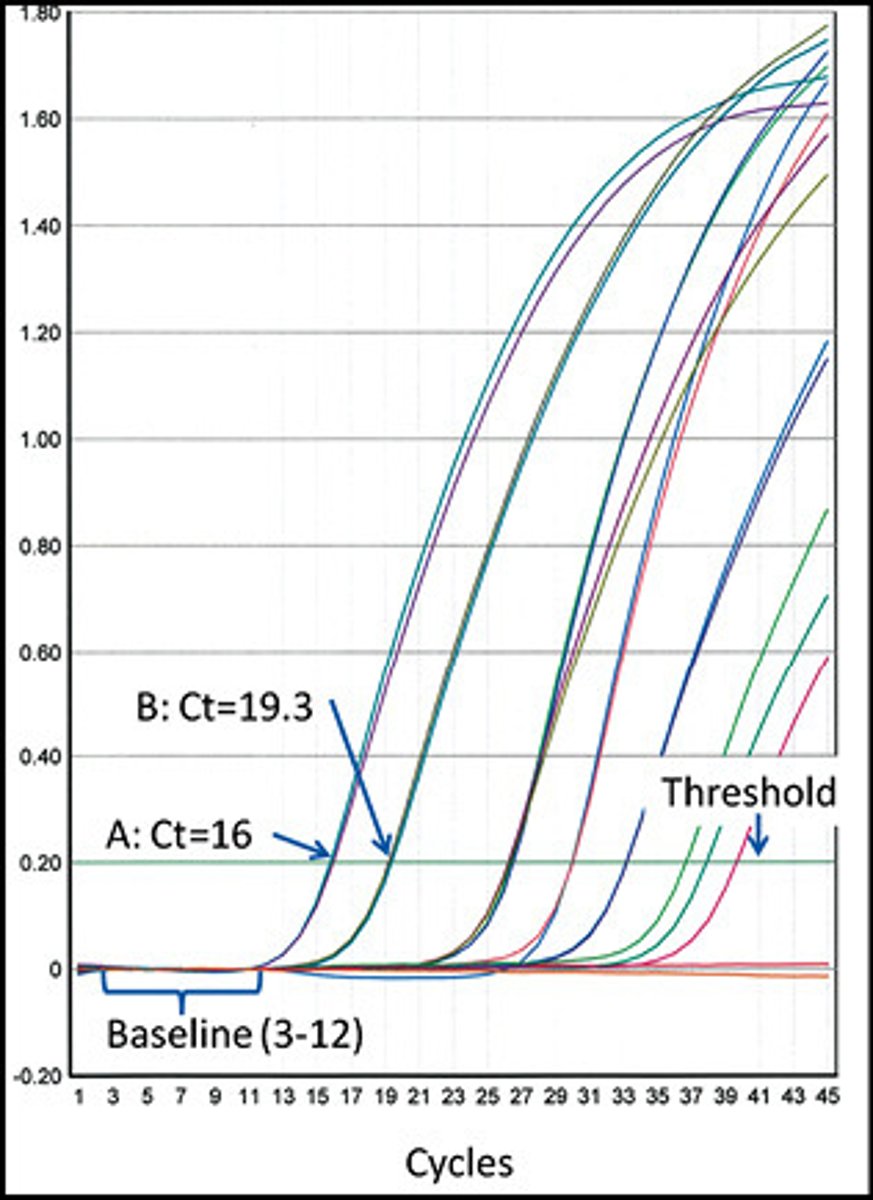
c. 10-fold
The real time PCR curves represent dilutions of a single sample. Assuming PCR efficiency of 100%, what dilution is represented between aliquot A and aliquot B?
a. 2-fold
b. 5-fold
c. 10-fold
d. 50-fold
c. as the concentration of agarose in the gel increases, the smaller the size of DNA that can be resolved on the gel
The greater the concentration of agarose, the smaller the size of DNA that can be resolved.
Which statement concerning the resolution of DNA on an agarose gel is true?
a. the polymerization of agarose is initiated by adding TEMED and ammonium persulfate to agarose monomer in solution
b. agarose gel electrophoresis can resolve smaller molecules of DNA compared to acrylamide gel electrophoresis
c. as the concentration of agarose in the gel increases, the smaller the size of DNA that can be resolved on the gel
d. DNA must be denatured before being loaded into the sample wells of an agarose gel
b. Southern blot
RFLP analysis is performed on DNA. Southern blotting is the method used to separate DNA fragments by size, transfer the DNA fragments to a solid support, and then hybridize with a probe specific for the gene of interest.
An RFLP is most likely detected using which of the following methods?
a. Northern blot
b. Southern blot
c. Western blot
d. Southwestern blot
d. attaching multiple probes to a nitrocellulose membrane and then hybridizing a single labeled patient sample to the multiple probes
A reverse dot blot allows for the screening of several different mutations at one time by putting probes specific for different mutations on the membrane and then hybridizing a labeled patient DNA sample to the membrane.
The methodology of performing a reverse dot blot is best described as:
a. attaching many patient DNA samples to a nitrocellulose membrane and hybridizing the patient samples with a single labeled probe
b. attaching multiple patient samples to a nitrocellulose membrane and hybridizing multiple labeled probes to the patient samples
c. attaching multiple labeled probes to a nitrocellulose membrane and hybridizing a patient sample to the multiple labeled probes
d. attaching multiple probes to a nitrocellulose membrane and then hybridizing a single labeled patient sample to the multiple probes
b. gel mobility shift assay
A gel mobility shift assay involves mixing a labeled oligonucleotide with a protein extract to see if specific protein:nucleic acid interaction occurs. The oligonucleotide will exhibit an apparent increase in molecular size on a gel due to its association with a protein should such an interaction occur.
What is a solution hybridization method for the detection of nucleic acid:proteins interactions?
a. RNase protection assay
b. gel mobility shift assay
c. strand displacement amplification assay
d. hybrid capture assay
b. alpha satellite DNA probe
Alpha satellite probes are centromere-specific and can be used to identify specific chromosomes. A chromosome 21-specific alpha satellite probe would give 3 distinct dots in interphase cells. Chromosome paint probes have greater utility in metaphase spreads to detect translocations or other alterations in chromosome structure. A unique sequence probe specific for chromosome 21 could also theoretically be used, but would give a weaker signal compared to the alpha satellite probe due to the highly repetitive nature of the alpha satellite sequence.
Which probe is most often used to detect trisomy 21 by interphase FISH?
a. locus-specific probe
b. alpha satellite DNA probe
c. chromosome paint probe
d. spectral karyotyping probe
c. extract DNA from cells
Chelex resin is often used to extract DNA from forensic samples, but may also be used for clinical samples.
Chelex 100 resin is used to:
a. purify mRNA from total RNA
b. extract total RNA from cells
c. extract DNA from cells
d. remove unincorporated primers from PCR reactions prior to gel analysis of PCR products
d. SYBR green
SYBR green is the most sensitive of the listed dyes.
The fluorescent dye that exhibits the greatest sensitivity for quantization of DNA is:
a. ethidium bromide
b. Hoechst 33258
c. propidium iodide
d. SYBR green
c. nested PCR
When target sequences are limited, 2 successive PCR reactions can be performed using primer pairs that are 3' to the first set of primers in the second round of PCR. This is called a nested PCR reaction.
A variation of a standard PCR reaction that can increase the sensitivity and specificity of a low copy number target in a patient sample is known as:
a. branched PCR
b. RT-PCR
c. nested PCR
d. cleavage-based PCR
a. branched DNA analysis
Branched DNA analysis is performed by capturing a target nucleic acid onto a microtiter plate and then adding an amplifier probe to greatly increase the signal resulting from the captured nucleic acid. PCR and NASB amplifications amplify the target nucleic acid sequence, whereas the ligase chain reaction amplifies the amount of probe in the reaction when the target is present.
Which technique employs the amplification of the signal resulting from probe:target hybridization rather than by amplifying the target or the probe?
a. branched DNA analysis
b. polymerase chain reaction
c. ligase chain reaction
d. nucleic acid sequence-based amplification
d. single-strand conformational polymorphism
SSCP is a screening test in which the exact nature of a mutation does not need to be known in order to detect the presence of a mutation.
Which method is best suited to screen for mutations in a gene having multiple possible mutations?
a. comparative genome hybridization
b. allele-specific PCR
c. real time PCR
d. single-strand conformational polymorphism
c. epidemiological typing of bacterial strains
PFGE after digestion of bacterial chromosomes with restriction enzymes is used to determine similarity between bacterial isolates.
APPLICATIONS OF MOLECULAR TESTING
A common use for pulsed-field gel electrophoresis is:
a. DNA fingerprinting
b. mitochondrial DNA typing
c. epidemiological typing of bacterial strains
d. tumor cell phenotyping
a. Bordetella pertussis
IS481 is found in both B pertussis and B homesii and IS1001 is found in B homesii and B parapertussis, but not in B pertussis. IS481 is not found in B parapertussis.
Molecular based testing was performed on a nasopharyngeal swab sample taken from a patient. Results are reported as positive for IS481 and negative for IS1000. These results indicate the patient's nasopharynx is colonized with:
a. Bordetella pertussis
b. Bordetella holmesii
c. Bordetella parapertussis
d. Bordetella spp.
c. mecA
mecA is the gene responsible for resistance in Staph aureus; vanA for vancomycin resistance in Enterococcus; inhA for isoniazid in Mycobacterium tuberculosis; and rpoB for rifampin in Mycobacterium tuberculosis.
DNA-based testing for the presence of MRSA uses PCR with primers specific for which gene?
a. vanA
b. inhA
c. mecA
d. rpoB
c. 9;22
The 9;22 translocation creates the BCR/ABL1 fusion gene in CML.
A translocation in which chromosome pair creates a BCR/ABL1 fusion gene product associated with chronic myeloid leukemia?
a. 11;18
b. 14;18
c. 9;22
d. 9;14
b. 16S
Only 16S ribosomal RNA is found in prokaryotes and is the target; the others listed are eukaryotic RNA subunits.
The molecular based diagnostic test for Mycobacterium tuberculosis uses ribosomal RNA as the target. Primers are made to be specific for which RNA subunit?
a. 5.8S
b. 16S
c. 18S
d. 28S
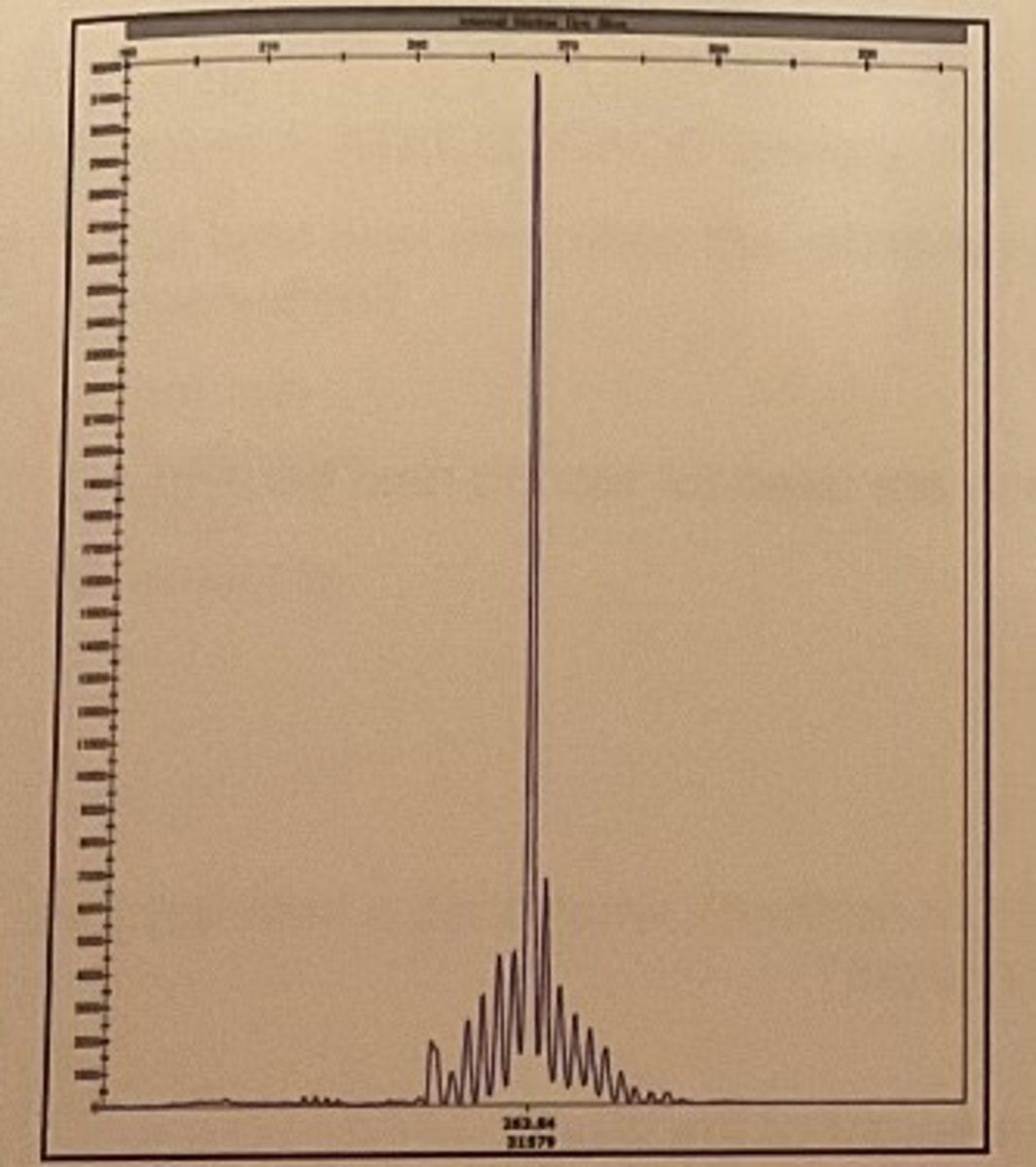
d. patient has a monoclonal population of B cells
The presence of a distinct band along with the smear indicates at least 1% of the patient's B cells have a monoclonal rearrangement of the Ig heavy chain.
A PCR-based assay is performed to determine the clonality of B cells in a patient using a forward primer specific for the innermost framework region and a reverse primer complimentary to the joining region (of the immunoglobulin heavy chain). The resulting electropherogram was obtained. Assuming all controls worked properly for the assay, what is your interpretation of the results for this patient?
a. patient is normal
b. patient has mononucleosis
c. patient has a polyclonal population of B cells
d. patient has a monoclonal population of B cells
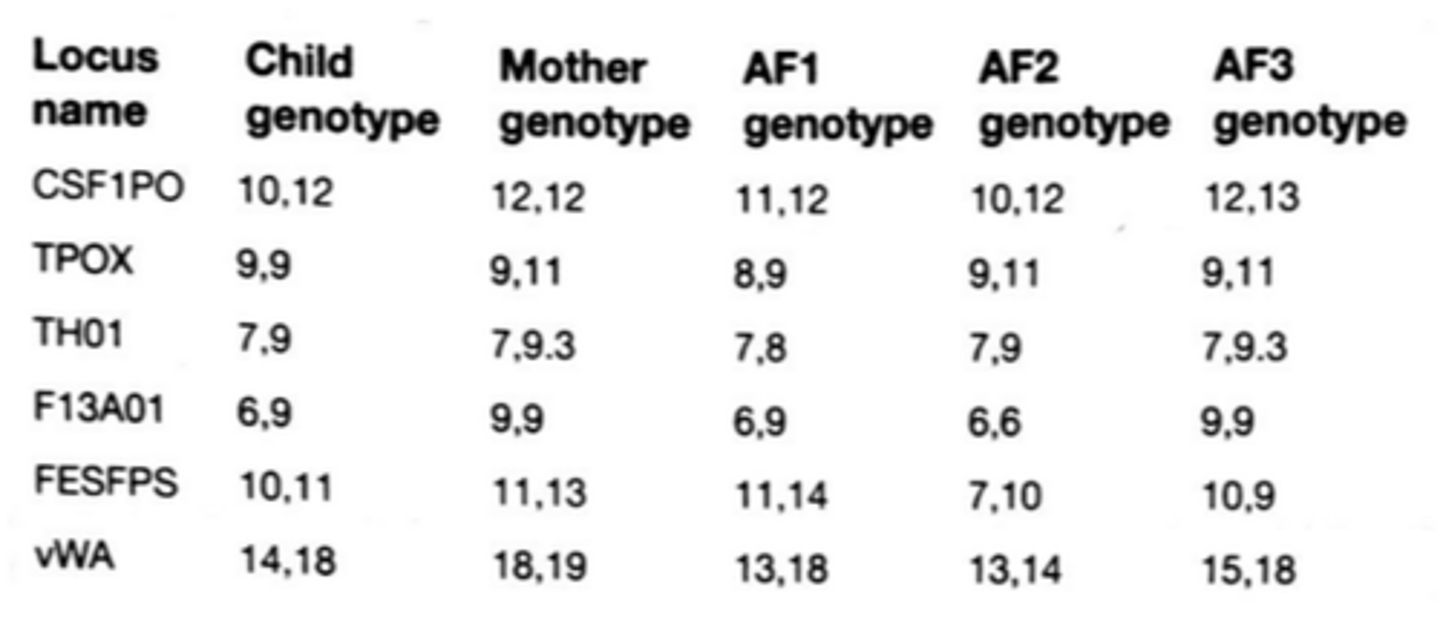
b. AF2 is most likely the father of the child
AF2 could possibly have contributed all of the alleles inherited by the child after the alleles the child inherited from the mother have been considered.
The results of STR typing of a child, the child's mother and 3 alleged fathers (AF) of the child are listed in the table below. Which of the statements below is correct concerning the alleged fathers?
a. AF1 is most likely the father of the child
b. AF2 is most likely the father of the child
c. AF3 is most likely the father of the child
d. none of the alleged fathers is likely the father of the child
d. detection of polymorphisms in human mitochondrial DNA
HV1 and HV2 are portions of the mitochondrial genome that are sequences to determine mitochondrial inheritance.
DNA sequencing of hypervariable regions 1 and 2 (HV1 and HV2) is used to:
a. detect polymorphisms in human TP53
b. genotype strains of Mycoplasma
c. to monitor chemotherapy for B cell lymphoma
d. detection of polymorphisms in human mitochondrial DNA
a. amelogenin
Amelogenin gives different sized amplicons based on whether it is amplified from the X or Y chromosomes, so males would have 2 bands on a gel at the amelogenin locus, while females would have only 1.
Which locus is used to identify the gender of the individual from whom a DNA sample is obtained?
a. amelogenin
b. CSF1PO
c. TPOX
d. vWA
b. intercalating dyes
Which method for quantifying DNA would be most appropriate when testing small FFPE tissue sections by next generation sequencing?
a. agarose gel
b. intercalating dyes
c. real-time PCR
d. UV adsorption
b. FASTQ
What type of short read files with quality scores are used for storing next generation sequencing read data?
a. FASTA
b. FASTQ
c. RRBS
d. WGBS
c. 2 peaks of equal height at the same position
In dideoxy chain termination sequencing (Sanger method), what does a heterozygous nucleotide position look like on an electropherogram?
a. 1 peak twice the height of those around it
b. 2 peaks in the same positive, one twice the height of the other
c. 2 peaks of equal height at the same position
d. 3 peaks of equal height at the same position
d. real-time nucleic acid amplification
(alternative answer: NABSA)
The HIV genome is RNA, so only real-time nucleic acid amplification/NABSA would allow direct detection.
Monitoring the load of HIV circulating in a patient's plasma would best be accomplished using which method?
a. ELISA
b. DNA sequencing
c. northern blot
d. real-time nucleic acid amplification
a. 2.5
A patient sample contains 500 particles/mL. 200 uL of sample is extracted, and DNA is eluted into 200 uL. 5 uL of DNA is added per PCR reaction. Calculate the average number of viral particles added per PCR reaction, assuming 100% extraction efficiency.
a. 2.5
b. 25
c. 250
d. 2500
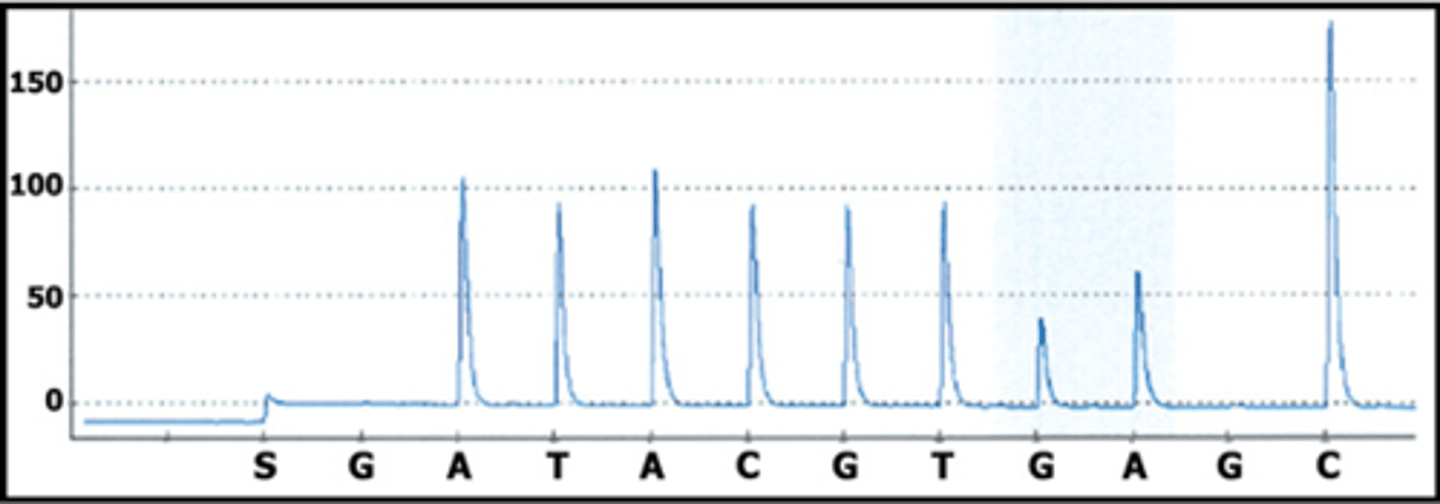
b. allele 1: ATACGTGCC allele 2: ATACGTACC
What is the sequence of the DNA shown in this pyogram?
a. allele 1: ATACGTGCC allele 2: ATACGTGCC
b. allele 1: ATACGTGCC allele 2: ATACGTACC
c. allele 1: ATACGTGAGC allele 2: ATACGTGAGC
d. allele 1: ATACGTGACC allele 2: ATACGTGACC
d. similarity
What term best describes the relatedness of sequences the percent identity or conservation?
a. domain
b. homology
c. motif
d. similarity
c. 3
Bacterial genotyping by PFGE follows the rule of three, so 3 or more differences indicate the test strain is different from the reference strain.
When genotyping strains of bacteria by PFGE, what is the minimum number of genetic differences that mut be observed between a reference strain and a test strain before it can be determined that the test strain is unrelated to the reference strain?
a. 1
b. 2
c. 3
d. 4
d. heterologous intrinsic
Human DNA (extrinsic to the target DNA) would be expected to be collected along with the Mycoplasma DNA (intrinsic to the sample).
A human actin gene may be used as an amplification control when performing PCR testing for Mycoplasma pneumoniae in a bronchoalveolar lavage taken from a human patient. The type of amplification control is describes as:
a. homologous extrinsic
b. homologous intrinsic
c. heterologous extrinsic
d. heterologous intrinsic
b. patient is a female with Turner syndrome
Turner syndrome females have a 45X genotype.
After performing interphase FISH with X chromosome-specific and Y chromosome-specific alpha satellite probes, it is determined that nuclei in cells from your phenotypic female exhibit only 1 bright fluorescent spot with the X chromosome-specific probe and do not react at all with the Y-specific probe. Assuming all controls have worked correctly, what is the most likely diagnosis for this patient?
a. patient is a genetically normal female
b. patient is a female with Turner syndrome
c. patient is a female with fragile X syndrome
d. patient is a male who suffers from androgen insensitivity due to the lack of a Y chromosome
b. Down syndrome
Robertsonian translocations involving chromosome 21q account for about 4% of the cases of Down syndrome.
A Robertsonian translocation may be associated with which genetic disorder?
a. Turner syndrome
b. Down syndrome
c. Angelman syndrome
d. Cri du chat syndrome
a. sequence-specific PCR
Sequence-specific PCR in 96-well plates is commonly performed to determine polymorphisms in class I and class II DRB and DRQ genes.
A molecular-based test commonly used in testing donors and recipients prior to organ transplantations is:
a. sequence-specific PCR
b. allele-specific PCR
c. real time PCR
d. reverse transcriptase PCR
d. paternity index is calculated for the alleged father using all loci tested, even if one of the loci does not directly match the child
A paternity index is calculated even with 1 or 2 mismatches because germ line mutations could have occurred during the formation of sperm in the father.
Which statement is true concerning molecular-based paternity testing?
a. paternity testing is typically performed using VNTR loci in the mother, child and alleged father
b. single mismatch between an allele in the child (that must have come from the father of the child) and the alleged father is sufficient to exclude the alleged father
c. match between the alleged father and the child at a rare allele carries less weight in paternity than does a match involving a higher frequency allele
d. paternity index is calculated for the alleged father using all loci tested, even if one of the loci does not directly match the child