CIE IGCSE ECONOMICS CHAPTER 4 Government and the Macroeconomy
 Call Kai
 Learn
Learn Practice Test
 Spaced Repetition
 Match
Match Flashcards
 Knowt Play
1/52

Earn XP
Name | Mastery | Learn | Test | Matching | Spaced | Call with Kai | Chat |
|---|
No analytics yet
Send a link to your students to track their progress
53 Terms
What are the 6 macroeconomic aims of government?
Economic growth-Increased GDP and long-term growth of economic stability
Low Unemployment-Leads to higher GDP and Product Possibility
Stable Prices-Measured in CPI; overall change in costs
Balance of Payment Stability-A stable export and import ratio
Redistribution of Income-through taxes/ progressive taxes
Environmental Stability-Keeping resources intact for the future
What are the 4 conflicts of interest in Government economic aims?
Full employment vs. Stable Prices
Wage inflation
Demand can increase faster than supply
Firms may not be able to attract skilled labor
Economic Growth vs. Environmental Stability
Economic Growth vs. Stable Prices
Full Employment vs. Balance of Payment Stability
Wages tend to increase leading higher import inflation and costs for trading partners making the nation less competitive in international trade
What is a governmental budget?
A government’s budget is the financial plans in terms of revenue and expenditure
What is a budget surplus’s effect?
A large boom in the economy
Able to pay off debts
What does a budget deficit mean?
Recession
Gain Debts
What are the reasons for government spending?
-Essential services
-Welfare
-Intervening in Market failure
Reasons for Taxation
Raising revenue
Discouraging demerit goods
reducing imports
redistributing income
influencing total demand
encouraging environmental stability
What are tax burdens for countries, firms, and households?
Country=Total tax revenue/GDP
Firms=Total Value of Tax
Households=Total value of tax
What is the difference between direct and indirect taxes
Direct-paid from income, wealth, or profit
Indirect-imposed on goods and services
What are the three different types of taxation?
Proportional, Regressive, and Progressive
What are the 7 things taxes influences and how?
Price and Quantity for Consumer
lower supply
more expensive
Impact on Economic Growth
tax cuts grow economy and create growth
lower incentives to work
Impact on Inflation
lower spending=lower inflation
Business Location
multinational corporations choose the best for them
Behavior
tax against harmful actions
Tax avoidance/evasion
evasion illegal
avoidance legal
more tax more tax avoidance/ evasion
redistribution of wealth
used to redistribute income
What are fiscal policies?
-Taxation and government expenditure policies used to influence the economy to achieve macroeconomic aims
What are the two types of fiscal policies?
Expansionary policies
increase spending and lowering taxation to stimulate economy
used in recessions
Contractionary policies
slow down growth through more taxes
Used to control markets and slow down economy
stop rising prices and inflation
How are fiscal policies used to achieve macroeconomic aims?
-Economic Growth
attracting foreign investment, boosting economy through infrastructure
-Low inflation
stable prices
-Employment
can be used as incentive
-Balance of payments
can lower tax rates to be competitive
-Redistribution
-Environment
What is money supply?
An amount of money in an economy at a certain time
What are the 3 main monetary measures that governments can take?
Interest rates
money supply
exchange rates
What are characteristics of monetary policies?
-Most nations rely on manipulating interest rates because they control the central banks
What are the two types of monetary policies?
Expansionary policies-reduce interest rates
Contractionary polices-increase interest rates
What are the effects on Macroeconomics?
-Economic Growth-more spending less interest more spending and borrowing
-Low unemployment-More spending creates jobs
-Stable Prices-High interest rates slow down inflation
-Balance of Payments-Lower rates improve competition
What are the inefficiencies of monetary policies?
Lags
Other factors
Conflicts with other interests
What are supply side policies?
-Long-term strategies aimed at increasing productive capacity in an economy through quality and quantity increases
-Creates an outward shift in PPC
What are supply side policies examples?
Education and Training
Improves quality
Often funded by governments
Labor Market Reform
unemployment benefits
minimum wages
Trade Union
Boosts employment in the long run
Lower Direct Taxes
incentives to work
Deregulation
increase in competition
Incentives to Invest
Subsidies
Enterprise zones
lower corporate tax
Privatization
state owned to private owned
increased efficiency
changes in spending infrastructure
Effects on the macroeconomy through supply-side policies?
Increase PPC
Increased Jobs
Prevents inflation from rising too high
Improved competition
Investment in education and training redistribution
Environment-subsidies and incentives
Define Economic Growth
Annual Increase in national output/change in GDP
Long-term productive shifts
Measurements of Economic Growth?
-Real GDP or GDP per Capita
-Nominal GDP-monetary values produced in a year
What are the factors of Nominal GDP?
C-Consumption expenditure
I-Investment expenditure
G-Government Spending
X-Export Earnings
M-Import Expenditures
How to calculate Net exports?
x-m
How to calculate GDP
C+I+G+(X-M)
What’s the difference between Real GDP and GDP per Capita?
GDP per Head/Capita is GDP/Population
Real GDP is GDP adjusted for inflation
What are business cycles made of; draw a graph?
Cycles of Peaks, Recessions, Slumps, Booms, and recoveries
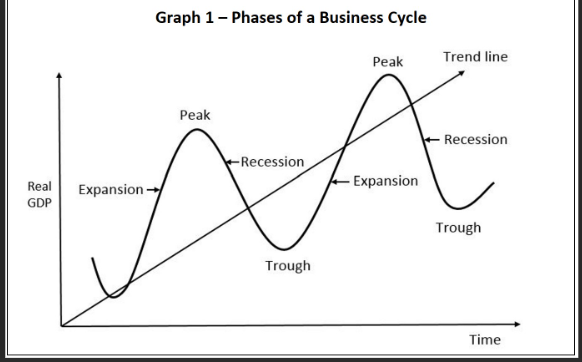
What are causes of business cycles?
Any GDP factor
Changes in quality/quantity
Total Demand may cause economic growth
What are the factors of economic growth?
Factor endowment-quality and quantity of a country’s factors of production
The Labor Force-the size, skill, and mobility of country’s labor force
Labor Productivity-Output per worker/ GDP/Labor Force
Investment expenditure-Helps country’s productive capacity, helps improve, Labor productivity, and is a measure of overall demand
Positive consequences of economic growth
Standards of living
Employment
tax revenues
Negative consequences of economic growth
-environment
inflation
inequality
resource depletion
What is a recession?
A fall in GDP for 2 quatres in succession
What are causes of recession?
unemployment
high interest
low investments
falling population
low government expenditure
decline in export demand
low confidence
demand for imports
wars, natural disasters
higher income tax
corporate tax
decline in resource quality
What are consequences of recession?
Consumers-closed shops, loss of savings, less spending
Workers-wages not increasing, lack of job security, unemployment
Producers-closed firms
Government-decrease tax revenue, more welfare costs, worse deficits
What are policies to grow the economy?
Monetary, supply side, and Fiscal
-tariffs
What is the definition of unemployment?
when willing, able, working aged people cannot find a job
What is a minimum working age?
15
What is employment?
Economic use of labor as a factor of production
What factors determine unemployment?
Willing and Able
able to start in 2 weeks
waiting to start work in the next 2 weeks
actively looking for work within 4 weeks
How to calculate unemployment?
Number of unemployment/Work Force x 100
What are the 4 types of unemployment?
Frictional Employment-between jobs
Seasonal unemployment-seasonal changes
structural-continual fall in demand from producers
cyclical-lack of demand, fall in national income
What are the consequences of employment?
Personal Costs
emotional
low income
Social costs
economic shutdown
Economic consequences
lower levels of consumer spending
more welfare
loss for taxpayers
less competitive in the international market
GRAPH UNEMPLOYMENT
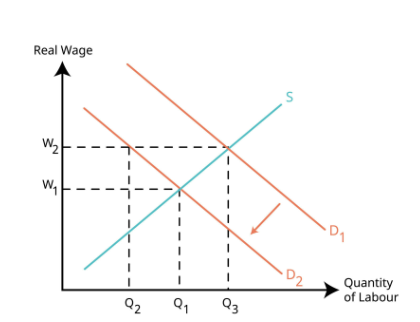
Why reduce unemployment?
raise living standards
promotes growth
less financial burden
less brain drain
lower wealth inequality
How to rectify unemployment?
monetary, fiscal supply side, and protectionism
What are characteristics of inflation?
Sustained rise in general price level
2-3 percent is healthy
causes money to be worth less
Hyperinflation-insanely high rates without control
deflation persistent fall
Disinflation= fall in inflation rate
How to measure inflation?
CPI
Measures the changes in price representative of an average household
base year
collecting data
assigning weights
%2-%1/%1 × 100
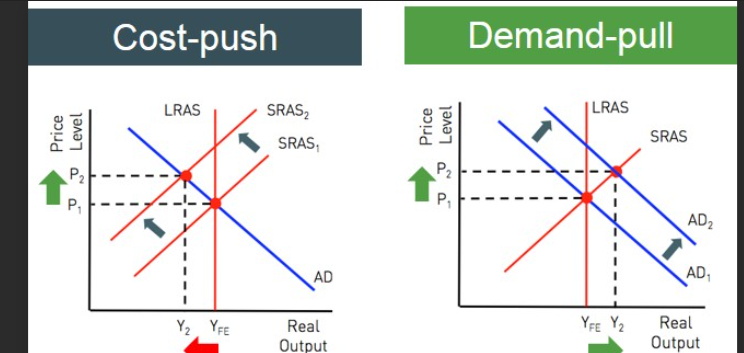
What are the different types and causes of inflation?
Cost-Push
firms raise price to maintain margin of profit after rising costs of production
Demand Pull
Rise in demand causes rise in spending
Other causes
Monetary issues
Imported inflation
What are the consequences of inflation
Consumers
fall in real income and spending power
Workers
Higher PED
Weaker bargaining power
Lowers spending power
more real wages and real increases
Wage Price Spiral
higher demand for a rise in wages causes inflation
Firms
wages rise
competition falls
lower growth
lower purchasing power
Savers
money worth less
Lenders and borrowers
repay worthless (better)
lose out on repayments
Economy
worsens
Policies to rectify inflation
-monetary
tighten economy
Fiscal
manipulate interest rates to increase costs of borrowing
Supply side
subsidies
innovation