working memory model
 Call Kai
 Learn
Learn Practice Test
 Spaced Repetition
 Match
Match Flashcards
 Knowt Play
1/5

There's no tags or description
Looks like no tags are added yet.
Name | Mastery | Learn | Test | Matching | Spaced | Call with Kai |
|---|
No analytics yet
Send a link to your students to track their progress
6 Terms
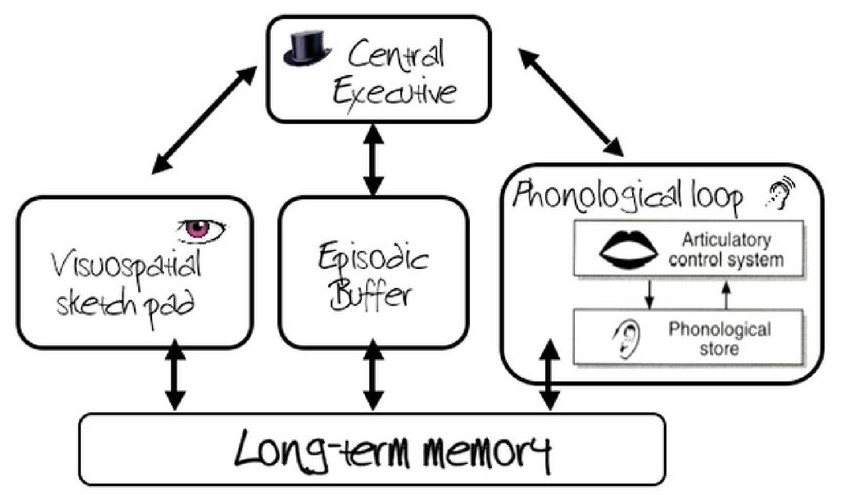
what is the WMM and who proposed it
BADDELEY and HITCH
-explanation for how stm is organised and how it functions
-focuses on when your mind is active to temporarily store and manipulate info e.g. when playing chess
what is the central executive
the director/ head of the model, it receives and filters incoming information and then directs our attention towards one of the slave systems: phonological loop, VSS, episodic buffer
has a limited capacity and can only hold one piece of information at a time
what is the phonological loop
deals with auditory info, subdivided into:
phonological store - stores words you hear
articulatory process - maintenance rehearsal = repeats information you hear in a loop to keep them in the stm
what is the visuospatial sketchpad VSS
deals with visual info, subdivided into:
visual cache - stores visual info
inner scribe - allows you to visualise your surroundings and the arrangement of things
what is the episodic buffer
temporarily stores and combines all types of information such as chronological info e.g. the order in which events happen
added to wmm later on due to: central executive can only hold one piece of info at a time & slave systems only store a specific type of information phonological loop (only deals with auditory info) and visuospatial sketchpad (only deals with visual info)
what do the 3 slave systems connect to and why is this important
visuospatial sketchpad, episodic buffer and phonological loop all connected to LTM which allows for:
elaborative rehearsal, when information is encoded with meaning so passes straight from stm to ltm
retrieval, passing info back into stm so it passes through maintenance rehearsal in a loop