Organism And Populations
 Call Kai
 Learn
Learn Practice Test
 Spaced Repetition
 Match
Match Flashcards
 Knowt Play
1/71

Earn XP
Description and Tags
Name | Mastery | Learn | Test | Matching | Spaced | Call with Kai | Chat |
|---|
No analytics yet
Send a link to your students to track their progress
72 Terms
What is an ecosystem?
Ecology is a subject
which studies the interactions among organisms and between the
organism and its physical (abiotic) environment.
What is a biome?
Large unit of environment consisting of a major vegetation type and its associated fauna in specific climatic zone.
Why are night-blooming flowers generally white?
Because they don't have to expend resources secreting coloured pigments to be visible to insects at night, night blooming flowers are usually white, and the white colour refracts light, making them visible for pollination.
Night-blooming plants are often white, but have a pleasant odour, as insects cannot see at night but are attracted to their scent. White is a good light reflector and a hue that a variety of pollinators prefer to view at night.
How does the bee know which flower has nectar?
The nectar that flowers produce is a sweet energy source for bees. Honeybees can detect nectar in a flower by the reflection of ultraviolet light, or by the tone the flower is emitting as it tries to attract the pollinators. This is how the bees come to know which flower has nectar.
Why does cactus have so many thorns?
It is an adaptation in the cactus plant that helps in protection of the plant form danger, minimising the water loss in plants, provides shade from getting exposed to direct sunlight.
How does the chick spures recognise her own mother ?
Chick recognises her mother through the process called “Imprinting”. The process of Imprinting involves a combination of using vision, hearing, olfaction (smell) and touch.
Concerns of ecology
1.Organisms
2.Populations
3.Communities
4.Biomes.
An important area because it links ecology to population genetics
and evolution.
An important area because it links ecology to population genetics
and evolution.
If in a pond there were 20 lotus plants last year and through
reproduction 8 new plants are added, what is the birth rate?
Taking the current population to 28, we calculate the birth rate as 8/20 = 0.4 offspring per lotus per year
If 4 individuals in a laboratory population of 40 fruit flies died during a specified
time interval, say a week, the death rate in the population during that period
is?
4/40 = 0.1 individuals per fruitfly per week.
Age pyramid
A population at any given time is composed of individuals of different ages. When the age distribution is plotted for the poulation, the resulting structure is called age pyramid.
Population vs Individuals
A population has certain attributes whereas, an individual organism
does not. An individual may have births and deaths, but a population has
birth rates and death rates. In a population these rates refer to per capita
births and deaths.Another attribute characteristic of a population is sex ratio. An
individual is either a male or a female but a population has a sex ratio.
Representation of age pyramids for human
Expanding:
1. No of pre-reproductive individuals is very large
2. Reproductive is moderate
3. Post-reproductive are fewer
4. Population is growing and shows rapid increase
5. Also known as triangular shaped pyramid
Stable
1. Remains stable, neither growing nor diminishing
2. All groups are evenly balanced
3. Also known as bell shaped pyramid
Declining:
1. Population is declining or decreasing showing negative growth.
2. Also known as urn shaped pyramid.

Father of ecology
Ramdeo Misra
What is Population?
Total number of individuals of a species in a specific geographic area, sharing or competing for similar resources which can interbreed under natural conditions to produce fertile offspring and function as a unit of biotic community.
Characteristics of population
*Population size or density
*Birth or natality
*Death or Mortality
*Sex ratio
What is population density? Why is it not necessary to be in numbers?
Population size, technically
called population density (designated as N), need not necessarily be
measured in numbers only. Although total number is generally the most
appropriate measure of population density, it is in some cases either
meaningless or difficult to determine. In an area, if there are 200 carrot
grass (Parthenium hysterophorus) plants but only a single huge banyan
tree with a large canopy, stating that the population density of banyan is
low relative to that of carrot grass amounts to underestimating the
enormous role of the Banyan in that community. In such cases, the per
cent cover or biomass is a more meaningful measure of the population
size?
If you have a dense laboratory culture of bacteria in a petri dish what is
the best measure to report its density
By CFU
CFU is Colony Forming Unit. It is by diluting the culture 100 times.
CFU = No. of colonies dilution factor / Volume of plated
How is tiger population estimated?
The tiger census in our national parks and tiger reserves is often based on pug marks and
fecal pellets.
What is four basic processes in population
(i) Natality refers to the number of births during a given period in the
population that are added to the initial density.
(ii) Mortality is the number of deaths in the population during a given
period.
(iii) Immigration is the number of individuals of the same species that
have come into the habitat from elsewhere during the time period
under consideration.
(iv) Emigration is the number of individuals of the population who
left the habitat and gone elsewhere during the time period under
consideration.
Population density and formula
If N is the population density at time t, then its density at time t +1 is
Nₜ₊₁ = Nₜ + [(B + I) – (D + E)]
![<p>If N is the population density at time t, then its density at time t +1 is</p><p>Nₜ₊₁ = Nₜ + [(B + I) – (D + E)]</p><p></p>](https://assets.knowt.com/user-attachments/3608b130-63dc-410e-85dd-0d21968d6f73.png)
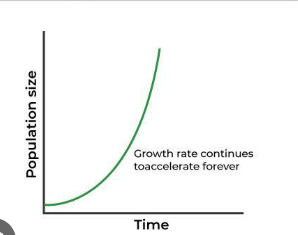
Exponential growth model
*Also known as geometric model
*Food & space is unlimited (resources)
*J shaped curve is formed
*If in a population of size N, the birth rates (not total number but per
capita births) are represented as b and death rates (again, per capita
death rates) as d, then the increase or decrease in N during a unit
time period t (dN/dt) will be
dN/dt = (b – d) × N
Let (b–d) = r, then
dN/dt = rN
The r in this equation is called the ‘intrinsic rate of
natural increase’ and is a very important parameter
chosen for assessing impacts of any biotic or abiotic
factor on population growth
*The integral form of the exponential growth equation as
Nₜ= N₀ eʳᵗ where,
Nₜ= Population density after time t
N₀= Population density at time zero
r = intrinsic rate of natural increase
e = the base of natural logarithms (2.71828)
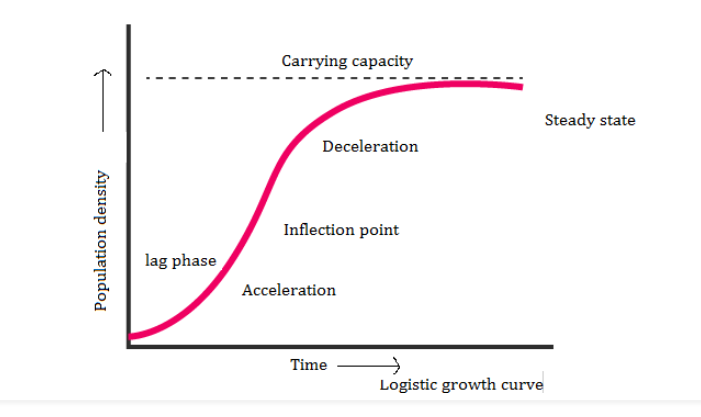
Logistic growth model
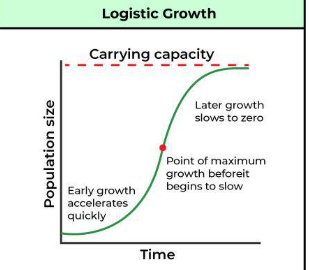
*Also known as reaslistic growth or Verhulst-Pearl logistic growth
*Resources become limited
*The graph is sigmoidal
*dN/dt = rN(K-N/K),where
N = Population density at time t
r = Intrinsic rate of natural increase
K = Carrying capacity
*Initially a lag phase, phases of acceleration, deceleration, and asymptote.
*Carrying capacity In an ecosystem/habitat/environment has enough resources to support a maximum possible number beyond which no further growth is possible. This limit is called carrying capacity.
Norway rat r value
0.015
Flour beetle r value
0.12
Human in India r value
0.0205
Breed only once in their entire lifetime.
{{Pacific salmon fish}} and {{Bamboo}} breed only once in their entire lifetime.
Produces a large number of small-sized offspring are {{}} and {{}}
Oysters and Pelagic fishes
Produces small number of large-sized offspring are {{}} and {{}}
Bird and Mammals
Population Interactions
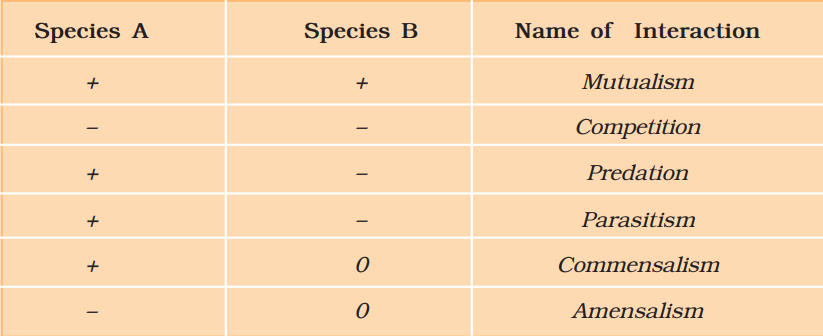
Interspecific interactions arise from the interaction of populations of
two different species. They could be beneficial, detrimental or neutral
(neither harm nor benefit) to one of the species or both. Assigning a ‘+’
sign for beneficial interaction, ‘-’ sign for detrimental and 0 for neutral
interaction.
Both the species benefit in mutualism and both lose in competition in
their interactions with each other. In both parasitism and predation only
one species benefits (parasite and predator, respectively) and the interaction
is detrimental to the other species (host and prey, respectively).
The interaction where one species is benefitted and the other is neither
benefitted nor harmed is called commensalism. In amensalism on
the other hand one species is harmed whereas the other is
unaffected. Predation, parasitism and commensalism share a common
characteristic– the interacting species live closely together.
Role of Predation
*Keeps prey population under control
*Helps in maintaining species diversity
*Acts as conduits of energy transfer across trophic level
*Helps in species diversity in a community
Example of predation
When certain exotic species are introduced into a
geographical area, they become invasive and start spreading fast
because the invaded land does not have its natural predators. The
prickly pear cactus introduced into Australia in the early 1920’s
caused havoc by spreading rapidly into millions of hectares of
rangeland. Finally, the invasive cactus was brought under control
only after a cactus-feeding predator (a moth) from its natural habitat
was introduced into the country.
Prey Defence Mechanism
* Camouflage- frogs and insects
*Monarch butterfy- Chemical present -> poisonous (feeding-> caterpillar stage) for birds
*Thorns and Spines - Acacia and Cactus
*Calotropis produces cardiac glycosides which are highly poisonous to keep away the browsers.
*Some produce nicotine, quinine, strychnine, caffeine and opium are also produced to keep away the browsers.
Example of predation 2
In the rocky intertidal
communities of the American Pacific Coast the starfish Pisaster is
an important predator. In a field experiment, when all the starfish
were removed from an enclosed intertidal area, more than 10 species
of invertebrates became extinct within a year, because of interspecific competition.
What does Gause state?
Two closely related species competing for the same resources cannot co-exist indefinitely, and the competitively inferior one will be eliminated eventually. Ex. Abingdon tortoise became extinct after goats which had greater browsing efficiency were introduced.
Competitive Release
A species whose distribution is restricted to a same geographical area because of presence of competitvely superior species is found to expand it's distributional range dramatically when the competing species is experimentally removed.
Resource partitioning
Mc. Arthur showed that five closely related species of warblers living on a tree could avoid competition and coexist due to behavioural difference in their foraging.
Competiton Examples
*Visiting Flamingoes and resident fishes - zooplanktons _ South American Lake
*Abingdon tortoise(extinct) and Goats-grass, some greens - Galapagos Islands
*Balanus (superior barnacles) and Chathamalus (inferior barnacle), Barnacle dominates and excludes the smaller barnacle from that zone - Rocky sea costs of Scotland
Usually affected category
Herbivores and Plants
Parasite Adaptation
*loss of unnecessary sense organs
*presence of adhesive organs or suckers to cling on the host
*loss of digestive system
*high reproductive efficiency
*loss of chlorophyll and leaves (cuscuta)
Why are parasite's life cycle complex?
. The life cycles of parasites are often complex, involving one or two intermediate hosts
or vectors to facilitate parasitisation of its primary host. The human
liver fluke (a trematode parasite) depends on two intermediate
hosts (a snail and a fish) to complete its life cycle. The malarial
parasite needs a vector (mosquito) to spread to other hosts.
Ecto parasites and Endo Parasites
Parasites that feed on the external surface of the host organism
are called ectoparasites. Ex. lice on humans, ticks on dogs, marine fish are
infested with ectoparasitic copepods, and Cuscuta- a parasitic plant
that is commonly found growing on hedge plants
What is brood parasitism?
Brood parasitism in birds is a fascinating example of
parasitism in which the parasitic bird lays its eggs in the nest of
its host and lets the host incubate them. During the course of
evolution, the eggs of the parasitic bird have evolved to resemble
the host’s egg in size and colour to reduce the chances of the host bird detecting the foreign eggs and ejecting them from the nest. Ex. Cuckoo and Crow
What is Ammensalism and example
Ammensalism is an interspecific interaction where one species is harmed while the other is
unaffected. Ex. Penicillium notatum which produces Penicillin kills bacteria but the mold is unaffected
Commensalism examples
Orchid and mango- Orchid acts as an ephipyte and takes nutrition and shelter from mango
Barnacles and Whale- Barnacles grow on whale and it gets shelter, and also can locomote.
Grazing Cattle and Cattle egret - Cattle while grazing stir up the grass and flush out the insects which the cattle egret eats
Sea anemone and Clownfish - Fish gets protection from predators cuz of the stinging tentacles.
Mutualism examples
*Lichen- fungi and photosynthetic algae. Fungi provide food and shape (mycobiont) and algae produce food through photosynthesis.
*Mycorrhiza-Fungi and roots of higher plants. Fungi helps in absorption of nutrition while plant provides fungi with energy yielding carbohydrates.
*Plants and Animals (pollination and nectar) Ex. Fig and wasp -> one-to-one relationship.
What does sexual deceit mean?
The Mediterranean orchid Ophrys
employs ‘sexual deceit’ to get pollination done by a
species of bee. One petal of its flower bears an uncanny
resemblance to the female of the bee in size, colour and
markings. The male bee is attracted to what it perceives
as a female, ‘pseudocopulates’ with the flower, and
during that process is dusted with pollen from the
flower. When this same bee ‘pseudocopulates’ with
another flower, it transfers pollen to it and thus,
pollinates the flower.
What does pseudocoupulate mean?
Pseudocopulation is a botanical phenomenon where a flower, typically an orchid, tricks a male insect into attempting to mate with it by mimicking the appearance, scent, or texture of a female insect. It is a form of sexual deception used for pollination, where the insect transfers pollen while attempting to mate.
Exercise q1 List the attributes that populations possess but not individuals.
A group of entities belonging to the same species, residing in a specific geographical area at a particular time, together functioning as a unit can be termed a population.
Listed below are the attributes that a population exhibits:
Natality or Birth rate
It can be given by the ratio of live births in a particular area to the population of that area. The birth rate can be expressed as the number of individuals added to the population in terms of members of the population.
Mortality or Death rate
It is the ratio of deaths in a region to the population of a region. The death rate can be expressed as the loss of individuals in terms of members of the population.
Age distribution
It can be given by the percentage of individuals of various ages in a given population. A population consists of individuals at any given time who are present in different age groups. Typically, an age pyramid can be used to depict the age distribution pattern.
Sex ratio
It is the count of females or males per thousand individuals.
Population density
It is given by the number of individuals in a population per unit at a particular time.
Exercise q2 If a population grows exponentially double in size in 3 years, what is the intrinsic rate of increase (r) of the population?
If an adequate quantity of food resources is available to individuals in a population, it grows exponentially. The integral form of the exponential growth equation can be used to estimate the exponential growth, which is as follows:
Nt = No ert ————– equation (1)
Where Nt is the population density after ‘t’ time.
No is the population density at time zero.
e is the base of natural logarithm = 2.71828
r is the intrinsic rate of natural increase.
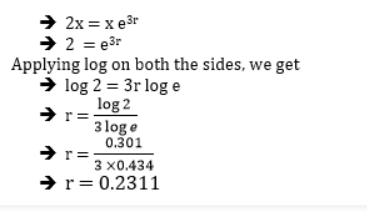
Let the current population density be ‘x’.
∴ The population density after two years will be 2x, and the t given is 3 years.
Substituting these values in equation (1)
Therefore, the intrinsic rate of natural increase of the population is 0.2311.
Exercise q3 Name important defence mechanisms in plants against herbivory
A state of feeding on plants is known as herbivory. Many plants have evolved mechanisms, both chemical and morphological, to safeguard themselves against the act of herbivory. Listed below are the defence mechanisms of a few plants:
Chemical defence mechanisms
Caffeine, nicotine, opium, and quinine are some chemical substances that are produced in plants in response as part of their defence mechanism.
All of the parts of Calotropis weeds consist of lethal cardiac glycosides that demonstrate to be fatal if consumed by herbivores.
Morphological defence mechanisms
Opuntia or cactus leaves are altered into thorns or sharp spines to prevent herbivores from feeding on them.
Margins of leaves in some plants are spiny, having sharp edges, preventing herbivores from feeding on them.
Sharp thorns with leaves are found in Acacia to prevent herbivores from feeding on them.
Exercise q4 An orchid plant is growing on the branch of a mango tree. How do you describe this interaction between the orchid and the mango tree?
An epiphyte, or air plant, is an entity growing on other plants. An orchid growing on the branch of a mango tree is an epiphyte. Such plants derive their nutrition and moisture from air, water and rain or from the debris around them and not from the plant on which it is growing. Hence, the relationship between a mango tree and an orchid is an example of commensalism, wherein one species receives its benefits, and the other stays unaffected. In the given interaction, the orchid is benefitted, as it gets physical support from the mango tree, but the mango tree is unaffected.
Exercise q5 What is the ecological principle behind the biological control method of managing pest insects?
Predation is the ecological principle behind the biological control method of managing pest insects. Predation is referred to as the biological interaction between a predator and a prey wherein the predator feeds on the prey, thereby regulating the population of pest insects. Example: The Gawbusia fish checks the mosquito larvae in water bodies.
Exercise q6 Define population and community.
Population – It can be defined as a group of individuals of the same species inhabiting a particular geographical area at a given time, functioning as a unit.
Community – It can be defined as a group of individuals of various species living in a certain geographical region. These individuals can be dissimilar or similar but cannot reproduce with members of other species.
Exercise q 7 Define the following terms and give one example for each:
(a) Commensalism
(b) Parasitism
(c) Camouflage
(d) Mutualism
(e) Interspecific competition
(a) Commensalism
The interaction between two species wherein one species is benefited and the other remains unaffected is known as commensalism. Examples: Barnacles attached to a whale’s body and an orchid growing on the branches of a mango tree
(b) Parasitism
The interaction between two species wherein one species is positively affected (typically the smaller one) and the other is negatively affected (typically the larger one) is known as Parasitism. Example: Liver fluke is a parasite living within the body of the host and deriving nutrition from it. Here, the parasite benefits from the host, as it derives nutrition from it, while the host is affected negatively as the parasite reduces the host’s fitness causing its body to get weak.
(c) Camouflage
It is a tactic taken up by the prey to escape from predators. Intrinsically, organisms are coloured to easily blend with their surroundings and escape from their predators. Several insects and frog species camouflage to escape their predators.
(d) Mutualism
An interaction between two species wherein both species involved are benefited is Mutualism. Example: Lichens exhibit a mutual symbiotic relationship between blue-green algae and fungi. Here, both equally benefit from each other.
(e) Interspecific competition
Interaction between individuals of different species wherein both are negatively affected is interspecific competition. Example: The competition between resident fishes and flamingoes in South American lakes for shared food resources, that is, zooplankton.
Exercise q 8 With the help of a suitable diagram, describe the logistic population growth curve.
The logistic population growth curve is usually observed in yeast cells cultivated in laboratory conditions and includes five phases, namely:
The lag phase – The population of a yeast cell is small initially as resources are limited in the habitat.
Exponential phase – In this stage, the population of the yeast cell suddenly rises as a result of rapid growth leading to exponential population growth due to the availability of enough food resources and consistently favourable environmental conditions without any interspecific competition. This results in the curve rising upwards steeply.
Positive acceleration phase – At the start of this phase, cell growth is limited. The yeast cell adjusts to the new environment and grows its population.
Negative acceleration phase – The environmental resistance increases, and the growth rate of the population decline as a result of increased competition between the yeast cells for shelter and food.
Stationary phase – The population is stable in this phase. The count of cells generated in a population is equivalent to the number of cells that die out. Additionally, the species’ population is said to have touched nature’s carrying capacity in its habitat. The S-shaped growth curve is also referred to as the Verhulst-pearl logistic curve
Exercise q9 Select the statement which explains best parasitism.
One organism is benefited, and another is affected.
List any three important characteristics of a population and explain.
A group of entities belonging to the same species, residing in a specific geographical area at a particular time, together functioning as a unit can be termed a population. Example: All humans living in a particular area at a specific time comprise the population of humans.
Listed below are the attributes that a population exhibits:
Natality or Birth rate
It can be given by the ratio of live births in a particular area to the population of that area. The birth rate can be expressed as the number of individuals added to the population in terms of members of the population.
Mortality or Death rate
It is the ratio of deaths in a region to the population of a region. The death rate can be expressed as the loss of individuals in terms of members of the population.
Age distribution
It can be given by the percentage of individuals of various ages in a given population. A population consists of individuals at any given time who are present in different age groups. Typically, an age pyramid can be used to depict the age distribution pattern.
List the different ways by which organisms cope with abiotic stress in nature, explain any three ways.
There are various ways by which organisms respond to abiotic factors. They are regulate, conform, migrate and suspend.
(i) Regulate : Some organisms are able to regulate homeostasis by physiological means they maintain constant body temperature and ionic/osmotic balance. Eg : Birds, mammals, a few lower vertebrates and invertebrate species.
(ii) Conform : The animals which cannot maintain constant internal environment confirm with external. Their body temperature changes with ambient temperature. In aquatic organisms the osmotic concentration of body fluid change with change in osmotic concentration of environment. Such animals are known as conformers. Eg : Fishes and aquatic invertebrates.
(iii) Migrate : Some animals move to safe habitat temporarily from stressful habitat and return to original habitat when the condition become favourable. Eg : Migratory birds.
(iv) Suspend : If an organism is not able to migrate, it may avoid stress by becoming inactive. It is seen in hibernation (winter sleep) Eg : bears and Aestrivation (Summer sleep) Eg : Snail.
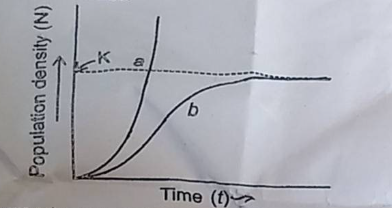
A population of 100 spotted deer was living without any carnivores in an enclosure of a few hectares of rich tropical forest land. Deer census was taken after a few years. a. Identify the growth curve that represents the deer population. b. Is it a realistic one? Justify.
a. Identify the growth curve that represents the deer population.
The growth curve representing the deer population in an enclosure without any carnivores is the exponential growth curve (also called J-shaped curve). This is because, without predators, the population grows rapidly as there is no natural check on their numbers.
b. Is it a realistic one? Justify.
No, the exponential growth curve is not realistic in the long term because resources such as food, space, and water are limited. Eventually, these limitations cause the population growth to slow down and stabilize, leading to a logistic growth curve (S-shaped curve). In nature, populations cannot grow exponentially forever due to environmental resistance
W.s 4 Explain the defence mechanism evolved in preys to avoid over population of their predators
These adaptations act at different stages of the predation cycle:
Avoiding Detection: Camouflage (cryptic coloration) allows prey to blend into surroundings, while nocturnality and living underground limit encounters.
Preventing Attack (Signaling): Aposematism (warning coloration) signals that the prey is toxic, poisonous, or foul-tasting, deterring predators from attacking.
Preventing Capture: Physical defenses like armor (pangolins), thorns, or speed (antelopes) make capture difficult.
Mimicry: Harmless species, like the viceroy butterfly, mimic the appearance of toxic species to gain protection, say Aakash.
Behavioral Defense: Group living (schooling fish), schooling, or startling predators (startle displays) helps reduce the risk of individual capture.
Mam -* Camouflage- frogs and insects
*Monarch butterfy- Chemical present -> poisonous (feeding-> caterpillar stage) for birds
*Thorns and Spines - Acacia and Cactus
*Calotropis produces cardiac glycosides which are highly poisonous to keep away the browsers.
*Some produce nicotine, quinine, strychnine, caffeine and opium are also produced to keep away the browsers.
In a pond there were 200 frogs, 40 more were born in a year. Calculate the birth rate of the population.
In a pond with 200 initial frogs, if 40 more are born in a year, the birth rate is 0.2 frogs per frog per year 20%, calculated as 40/200
How does the Mediterranean orchid Ophrys ensures its pollination by bees?
Mediterranean orchid Ophrys is cross-pollinated with the help of bees. Bees by chance pollinate the Mediterranean orchid Ophrys because according to the bee, it was a process of copulation. The flower of the Mediterranean orchid Ophrys resembles totally the female structure of the bee. Bees misinterpret it as a female bee and perform a copulation process. This is known as pseudocopulation and in this way, the flower is pollinated. When the male wasp sees it gets attracted and proceeds to copulate it. When it copulates the pollen grain of various species falls on the flower with the male wasp thus the flower gets pollinated and cross-fertilization is completed.
(a) (i) Describe the population growth curve applicable in a population of any species in nature that has unlimited resources at its disposal. (ii) Explain the equation of this growth curve. (iii) Name the growth curve and depict a graphical plot for this type of population growth.
nature, when a population has unlimited resources, it can grow exponentially. This means that the population increases at a constant rate over time, leading to a J-shaped curve when plotted on a graph. The growth is initially slow, but as resources are abundant, the population grows rapidly.
The equation that describes this growth is derived from the exponential growth model, which is given by:
N(t)=N0ert
where:
N(t) is the population size at time t,
N0 is the initial population size,
r is the intrinsic growth rate,
e is the base of the natural logarithm,
t is time.
Population Growth Curve: The population growth curve for a species with unlimited resources is characterized by exponential growth.
The equation N(t)=N0 e rt
indicates that the population size at any time t is equal to the initial population size multiplied by the exponential function of the growth rate multiplied by time. This shows that as time increases, the population grows faster and faster.
Graphical Representation: The graphical plot of this growth curve is a J-shaped curve, where the x-axis represents time and the y-axis represents population size. Initially, the curve rises slowly, then steeply increases as the population grows exponentially.
The growth curve is called Exponential Growth, and it is depicted as a J-shaped curve on a graph.
Explain how the interaction between a fig tree and its tight one to one rationship with the pollinator species of wasp is one of the best example of mutualism
The interaction between fig trees and their specific pollinator wasps is a prime example of mutualism, where both species benefit from the relationship. Fig trees produce a unique structure called a syconium, which houses the flowers and seeds. Female wasps enter the syconium to lay their eggs and, in the process, pollinate the flowers inside. The fig tree provides a safe environment and food for the wasps' larvae, while the wasps ensure the fig tree's reproduction by facilitating pollination. This interdependence highlights how mutualism can drive the evolution and survival of both species.
A group of individuals belonging to the same species, occupying a specific area, and interacting with each other is called a:
Population
Which of the following is not a characteristic of a population?
Stratification
An orchid plant growing on a mango branch is an example of
Commensalism
Nearly how many percent of insects are phytophagus?
25
Phytophagus
Feeding of plant sap and other plant part
Mediterranianean Orchid
Ophrys