Unit Five: 37
 Call Kai
 Learn
Learn Practice Test
 Spaced Repetition
 Match
Match Flashcards
 Knowt Play
1/36

There's no tags or description
Looks like no tags are added yet.
Name | Mastery | Learn | Test | Matching | Spaced | Call with Kai |
|---|
No analytics yet
Send a link to your students to track their progress
37 Terms
LIGHT-DEPENDENT REACTION:
In thylakoid membrane.
Chlorophyll absorbs light —> photoionisation of chlorophyll.
Energy released from e- during photoionisation, some conserved for the production of ATP and NADPH. Photophosphorylation.
Production of ATP involves transfer of e- down ETC and passage of of protons across chloroplast membranes.
Energy used to actively pump protons (from photolysis) through thylakoid membrane from the stroma to lumen.
Catalysed by ATP synthase embedded in these membranes (chemiosmotic theory).
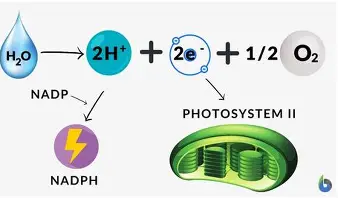
Photolysis of water, producing protons, electrons, and oxygen.
Protons from photolysis + NADP + electrons released at end of ETC = NADPH.
Protons accumulate in thylakoid lumen, steep concentration gradient between thylakoid lumen and chloroplast stroma.
Protons diffuse into stroma through proteins containing ATP synthase.
PHOTOIONISATION:
Molecule of chlorophyll is ionised.
It absorbs light energy causing a pair of electrons in it to become excited, raised to higher energy level, and leave the molecule.
Energy lost during eedox reactions in the ETC.
WHAT ARE THE PRODUCTS OF PHOTOLYSIS AND HOW ARE THEY USED?
Electrons produced here used to replace those lost from chlorophyll, allowing it to absorb light energy continually.
Protons + NADP + electrons released at end of ETC = NADPH.
Oxygen used in respiration or diffuses out of leaf as a waste product of photosynthesis.
ETC:
Series of proteins with two roles:
Can accept electrons from one molecule and donate them to another.
Can use energy from excited electrons to pump H+ from one side of the thylakoid membrane to the other.
Series of redox reactions.
Each carrier is reduced when it receives an electron.
Then reverts to oxidised state when electron passed on.
Each new carrier is at a slightly lower energy level than the previous one, so that the electrons lose the energy they gained from light at each stage.
This energy used to actively pump protons (from photolysis) through th thylakoid membrane from stroma to lumen of thylakoid.
HOW ARE PRODUCTS OF LDR USED IN LIR?
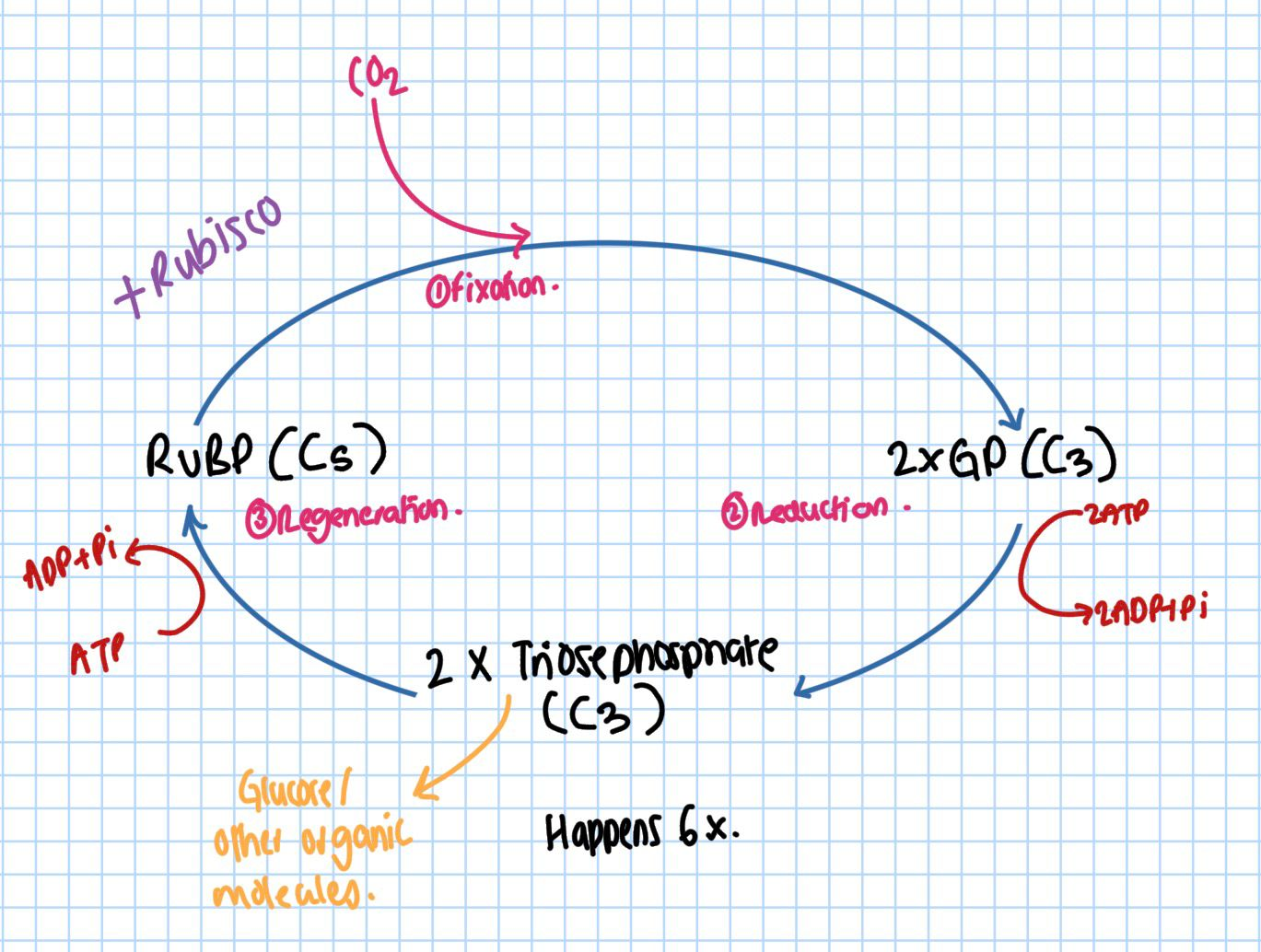
ATP and NADPH provide energy and hydrogen to reduce C02 from atmosphere, forming it to carbohydrates.
This energy has been transferred from the photon of light originally absorbed by the chlorophyll.
PHOTOPHOSPHORYLATION:
As protons pass through ATP synthase.
Portion of it revolves.
Transferring the energy from the proton gradient.
Enzyme attach Pi groups to ADP.
LIR:
In stroma.
HOW CAN LIPIDS OR PROTEINS BE USED AS RESPIRATORY SUBSTRATES?
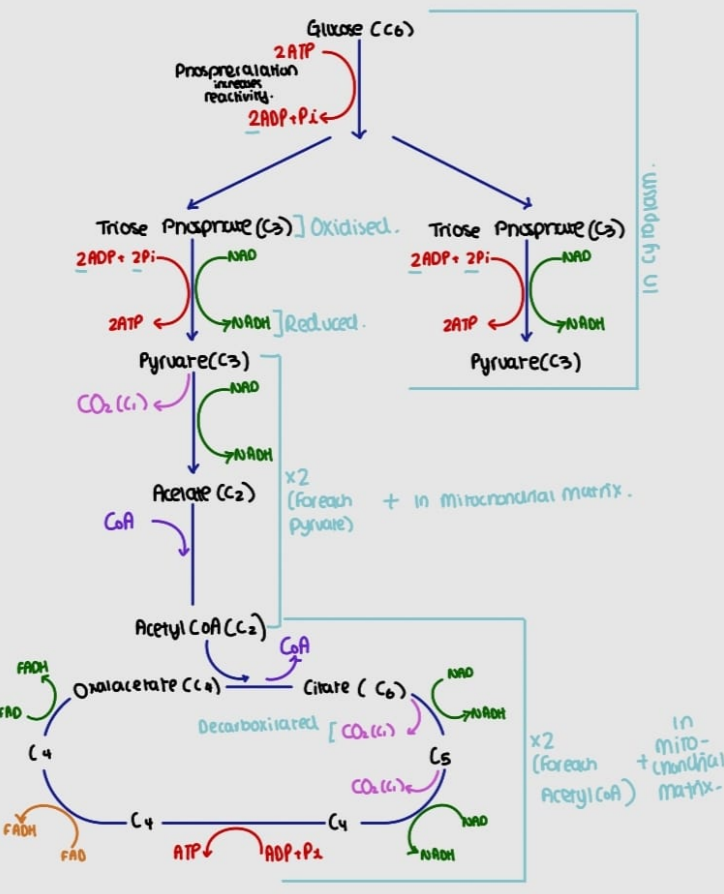
LIPIDS: Hydrolysed and glycerol can be phosphorylated into triose phosphate and enters Krebs.
PROTEINS: Amino acids can be hydrolysed and deaminated (amino group removed) and the carbon compound remaining can enter Krebs.
NAME AND DEFINE THE TWO TYPES OF PHOSPHORELATION?
Substrate level (glycolysis, link, and Krebs) - A single reaction.
Oxidative - A series of redox reactions
OXIDATION?
Loss of H.
Loss of electrons.
Gain of oxygen.
GLYCOLYSIS, LINK, AND KREBS?
OXIDATIVE PHOSPHORELATION:
WHERE?
PROCESS
Inner membrane of the mitochondria.
NADH and FADH release H, which becomes H+ and e-.
Coenzyme returns to matrix to pick up more H.
Electron passed along the electron carrier proteins in the inner membrane, releasing energy as they move.
Some energy is lost as heat.
Energy pumps protons to matric, creating electrochemical gradient.
Chemiosmosis.
Oxygen acts as the final electron acceptor, combining with the H+ and e- to form water.
CHEMIOSMOSIS?
Protons flow through ATP synthase down a proton gradient.
Energy used to combine ADP +Pi.
WHAT HAPPENS IF THERE IS NO OXYGEN?
No final electron acceptor.
Only glycolysis is source of ATP.
Pyruvate must be removed for it to continue.
NADH must be oxidised and recycled to accept further H.
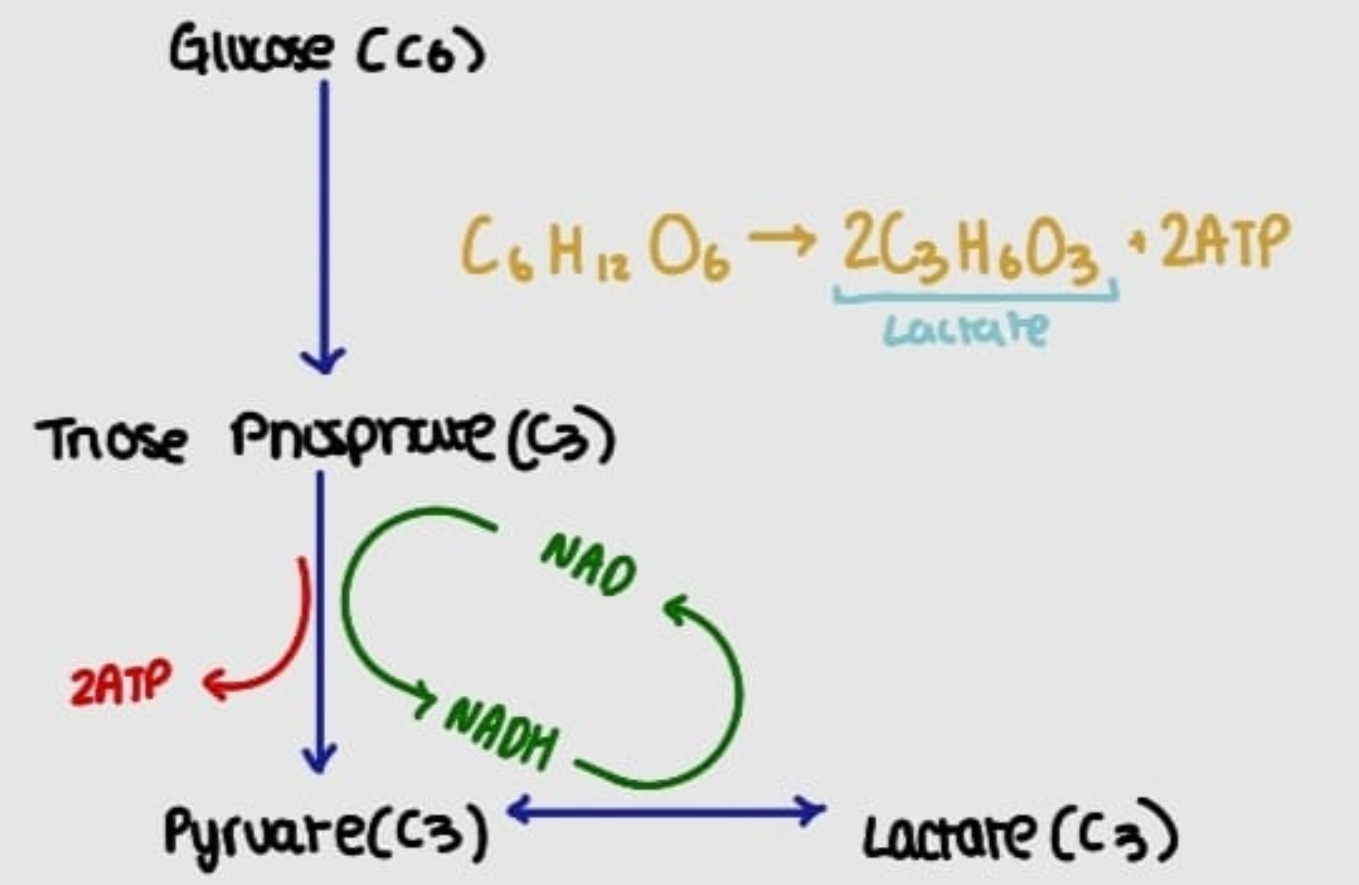
HOW IS PYRUVATE REMOVED FROM GLYCOLYSIS IN ANAEROBIC RESPIRATION?
ANIMALS: It is converted to lactate.
Reaction requires NADH to be oxidised, allowing it to be used again.
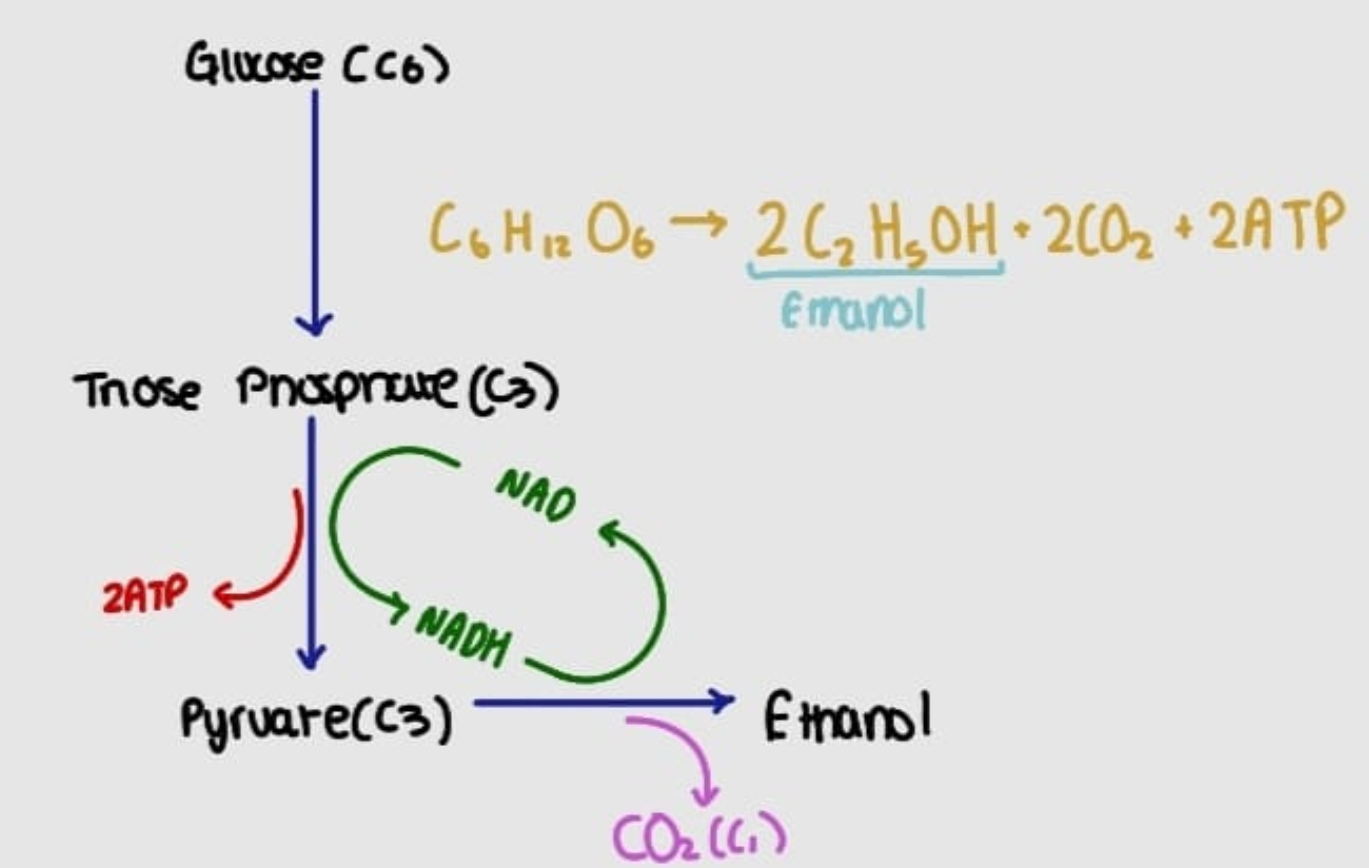
PLANTS: It is converted to ethanol and CO2.
Same result.
ANAEROBIC RESPIRATION IN ANIMAL CELLS:
ANAEROBIC RESPIRATION IN PLANTCELLS:
RESPIRATORY QUOTIENT?
Different respiratory substrates result in a different (CO2 exhaled : O inhaled).
Formula = (Volume of CO2 produced / Volume of O used)
A value greater than 1 indicates anaerobic respiration.
WHERE DO PLANTS SYNTHESIS ORGANIC MOLECULES FROM?
Atmospheric/aquatic CO2.
HOW ARE SUGARS SYNTHESISED BY PLANTS USED?
Mostly as respiratory substrates.
Some used as biological molecules - this forms biomass.
BIOMASS:
Can be measured in terms of carbon mass (/dry tissue mass) per given area.
Can estimate with calorimeter.
GPP:
Chemical energy store in plant biomass in a given area/volume.
NPP:
Chemical energy store in plant biomass AFTER respiratory losses have been taken into account.
::: NPP = GPP - R
WHAT IS NPP AVAILABLE FOR?
Plant growth and reproduction.
Other trophic levels in ecosystem, e.g. herbivores and decomposers.
PRIMARY AND SECONDARY PRODUCTIVITY:
Productivity = Rate of production.
Measured in biomass/area/year (KJ/m/year).
% EFFICIENCY OF ENERGY TRANSFER BETWEEN TROPHIC LEVELS FORMULA:
(Energy available before transfer) / (Energy available after transfer).
TROPHIC LEVELS:
Position of an organism in a food chain.
Energy flows through ecosystems from one trophic level to the next.
FARMIING PRACTICES THAT INCREASE EFFICIENCY OF ENERGY TRANSFER:
Simplifying food webs to reduce losses to non-human food chains.
Reducing R within a human food chain.
WHY IS ONLY A SMALL AMOUNT OF PHOTOSYNTHESIS ENERGY CONVERTED INTO CHEMICAL ENERGY OF GLUCOSE?
Some lost during very inefficient photosynthesis.
May be other limiting factors of photosynthesis.
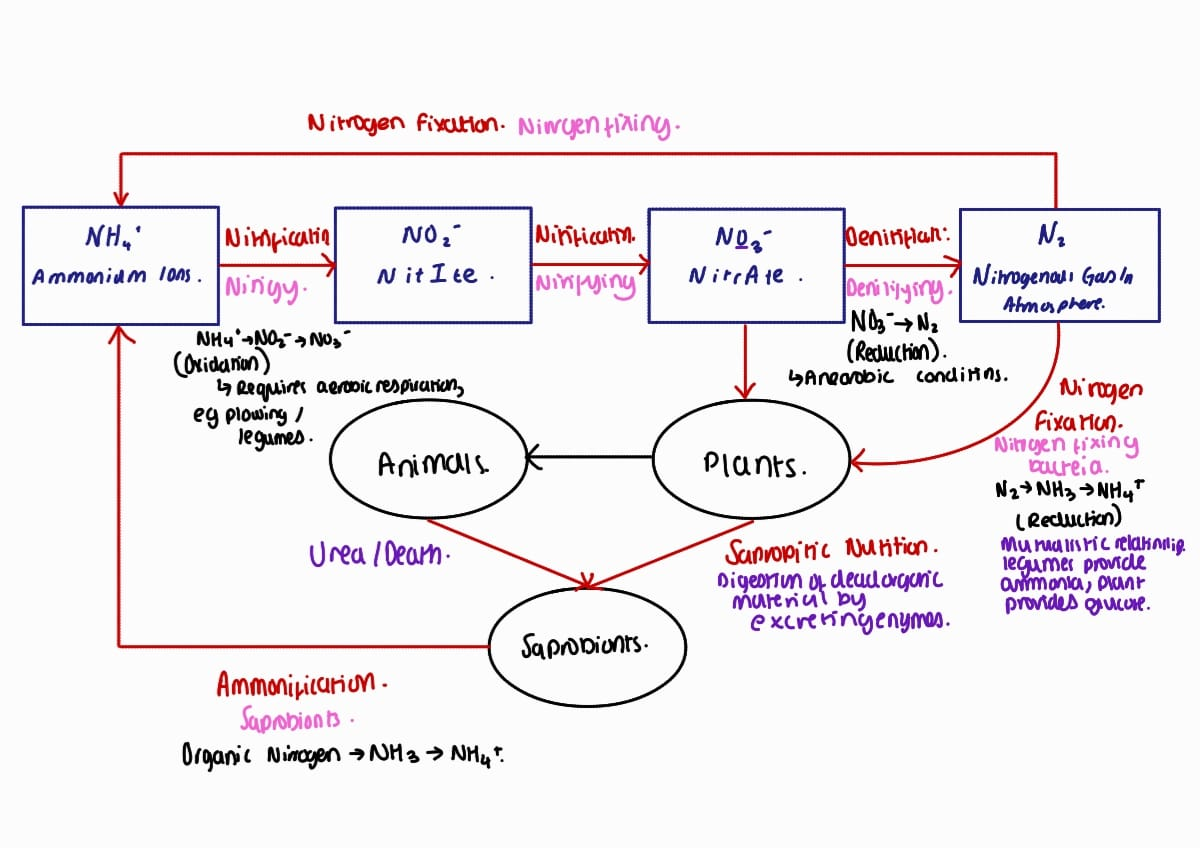
NITROGEN CYCLE:
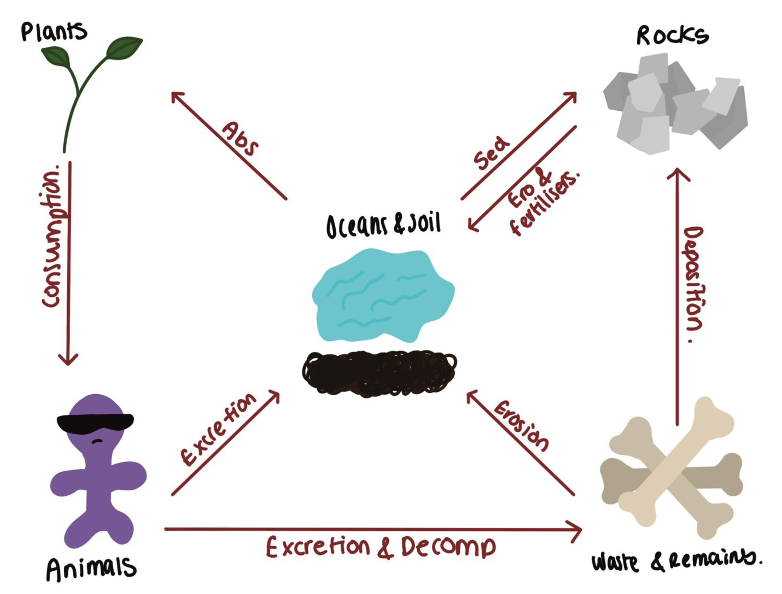
PHOSPHATE CYCLE:
MYCORRHIZAE:
Mutualistic relationship, both sides benefit nutritionally.
Fungus gains carbohydrates.
Plant gains hyphae.
SA ::: faster diffusion.
Better at absorbing mineral ions eg phosphates.
Protection from drought.
CROP ROTATION:
Different crops at different times of the year.
Plowed into the soil and left to decay.
Legumes used a lot for this part.
ORGANIC VS ARTIFICIAL FERTILISER:
Cheap.
Releases slowly, may be too slow.
Humus, contributes to structure.
Hard to distribute, requires machinery.
Unknown concentrations.
Artificial = opposite.
ENVIRONMENTAL CONSEQUENCES OF ARTIFICIAL FERTILISERS:
Reduced species diversity (those with artifertiliser grow rapidly and outcome many other speices, killing them).
Leaching (very soluble in water).
LEACHING:
Process by which nutrients are removed from the soil.
Rainwater dissolves any soluble nutrients and washes them out of the soil.
These leached nutrients find their way into watercourses.
Can then cause EUTROPHICATION.
EUTROPHOCATION:
Minerals are often limiting factors, but after leaching into watercourses they are no longer one and cause exponential growth.
Algal bloom.
Dense layer of algae absorbs sunlight and blocks lower layers.
Plants below cannot photo and die.
Decomp of plants and bacteria population increases.
Increase of aerobic resp by bacteria.
Fish die.