GI motility
 Call Kai
 Learn
Learn Practice Test
 Spaced Repetition
 Match
Match Flashcards
 Knowt Play
1/100

There's no tags or description
Looks like no tags are added yet.
Name | Mastery | Learn | Test | Matching | Spaced | Call with Kai |
|---|
No analytics yet
Send a link to your students to track their progress
101 Terms
what are the 3 layers of a nerve?
epineurum
what is the epineurium
outermost protective layer - dense connective tissue, rich in collagen
what is the perineurium
surrounds each fascicle - an epithelial layer that isolates axon bundles from the surrounding connective tissue
encloses fluid filled space b/w perineurium and underlying nerve axons
what is the connective tissue w/in perineural sheath called?
endoneurium
what is the endoneurium
include seams of loose connective tissue to provide pathways for small arterioles, venules and axons
how are neurotransmitters moved along the neurone?
axoplasmic flow
axonal forward/retrograde transport
what is the neurolemma?
outer most layer of nerve fibres in PNS - cytoplasmic layer of Schwann cells that surround multiple wrapping of myelin
what neurones are contained in the ENS?
sensory, motor and interneurones related to circular and longitudinal layers of smooth muscle.
what are the two plexuses in the ENS?
submucosal
where does the ENS start and end?
starts at the oesophagus
ends at the anal sphincter
what does the ENS have branches to?
liver
gall bladder
biliary tract
pancreas
what is the basis of the GI motility patterns?
peristaltic reflex
what reflex does the ENS trigger for peristalsis?
proximal contraction and distal distension via inhibition
what muscle is associated with peristaltic motion?
circular
what muscle is associated with segmentation motilities?
lognitudinal
how is peristalsis brought about?
distension of gut wall by a bolus
circular muscle layer contracts via mechanosensitive sensory neurone proximally → motor neuron
inhibition of muscle contraction distally
unidirectional movement
why is movement unidirectional in the gut?
the axon/dendrites project proximal for the excitatory neuron and distal for inhibitory neurone
what does each nervous unit in the gut contain?
excitatory motor neuron - more proximal
sensory neuron (middle)
inhibitory motor neuron - more distal
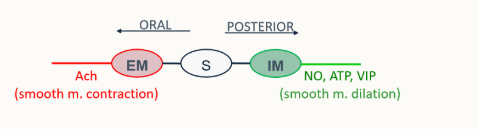
what neurotransmitter results in the excitatory motor neuron effect?
ACh
what neurotransmitters result in the inhibitory motor neuron action?
NO
ATP
VIP
what is the general frequency of peristaltic waves?
3-7/min
what is the function of segmentation?
result in the breaking of ingesta into smaller segments along the intestine, which provides a larger surface area for enzymes to act on → better absorption
what contributes to effective mixing of ingesta contents
segmentation
alternating contraction and relaxation of longitudinal muscle in wall
what is EGC?
equine grass syndrome
what is equine grass syndrome
frequently fatal multisystem neuropathy of equids
unknown aetiology
there’s neuronal degeneration in pre-and post-ganglionic sympathetic and parasympathetic nerves → GI paralysis
what does multisystem neuropathy mean?
something’s gone wrong in the signal transmission in neurons
which species do we see myasthenia gravis?
dog
what is myasthenia gravis in dogs?
decreased functional ACh receptors at NM junction
what may myasthenia gravis cause?
widespread abnormailities with muscle contraction in the GIT → may include megaoesophagus
how do we treat myasthenia gravis?
AChE inhibitors to amplify ACh signal
4 theories of appetite regulation?
lipostat - fat deposits and leptin
gut peptides - CCK
glucostat - glucose/VFA/AAs
thermostat
what is the main regulatory organ for hunger
hypothalamus
where specifically in the hypothalamus does appetite regulation take place
ventromedial nucleus of hypothalamus
what is the lipostat hypothesis of appetite regulation?
leptin is produced by adipose tissue, proportionate to amount of fat
this signal decreases food intake and increases E output
levels increase after a meal and fall in the interprandial period
how do gut peptides regulate appetite
glucagon and CCK - released in response to food → hypothalamus → inhibit food intake
ghrelin - increases before meal and decreases afterwards - also reduced leptin levels.
do we find CCK in the brain? how is it released
yes
it’s released in response to stomach distension after a meal
how do glucostats regulate appetite?:
glucose
FFA
amino acids
increase, stimulates satiety centre. Insulin involved
the same in ruminants
have the same effect as glucose
how is thermostat involved in appetite regulation?
decrease body temp → stimulates appetite (at a certain point)
inhibited above a certain point
what are the three layers of muscles in the GIT
oblique
longitudinal
circular
what are the 3 exocrine cells in the GIT
mucin-producing cells
parietal cells
chief/principal cells
what do principal/chief cells secrete in the GIT
pepsinogen + lipase
what are the endocrine cells in the stomach
histamine producing cells - ECL
gastrin producing cells - G cells
outline the long reflex in the stomach
stomach expansion + peptides → sensory nerve ending stimulation
to CNS
back via vagal nerve → ACh → stimulation of secretion
which nerves are targetted by the long reflex?
submucosal plexus
what is the short reflex in the stomach?
stomach expansion and peptides → gastrin release
also
sensory nerve ending → CNS → vagus nerve → ACh → release
what regulates stomach emptying?
cajal cells that regulate contraction
where are Cajal cells located?
between circular and longitudinal muscle layers
how do Cajal cells stimulate muscle contraction?
gap junctions
with which nerve plexus do Cajal cells interact?
mesenteric nerve plexus
what is stomach emptying inhibited by?
duodenal factors → stim sympathetic fibres
what hormones are involved with inhibited stomach emptying?
secretin
GIP
CKK
which part of the nervous system si involved with stomach emptying?
PSNS
outline the pathway of stomach emptying
food homeostasis change
gastric pH increases, wall distension
mechano/chemoreceptors
influx to submucosal plexus
PSNS influx to stomach effectors
evacuation
what is the production of pancreatic juices maintained by?
vagal nerves
what stimulates hormone production ni the duodenum and what hormones? what further effect do these hormones have
chyme → low pH/FAs/peptides → CKK and secretin release
this furthers pancreatic juice and bile flow into duodenum
what 2 movements take place in the small intestine
segmentation
peristalsis
when does segmentation occur
when mixing stops; once intestine is cleared from nutrient-mechanical aspect
what types of movement take place in the large intestine?
segmentation
peristalsis
antiperistalsis
mass movement
what promotes large intestine contraction?
stomach and duodenum via long reflex mesenteric
what do we call the reflex of the large intestine contraction
gastro-colic reflex
what is the mass movement in the large intestine triggered by?
stretch of wall → sensed by mechanoreceptors
how is vomiting triggered
receptors on floor of the fourth ventricle on the brain act as a chemoreceptor trigger zone
if stimulated → vomiting
where is the vomiting centre located and what does this mean about how it can be triggered?
floor of fourth ventricle OUTSIDE of the BBB
this means that it can be stimulated by blood borne chemicals
what 2 sources of input to the vomiting centre are there in relation to the GIT?
CNX
vagal and enteric NS
how does CNX → vomiting?
activated when pharynx is irritated → gag reflex
how do the vagal and ENS → vomiting?
irritation/infection → 5-HT3 (serotonin) receptor activation
what are the 4 categories of sensory input that initiate vomiting?
sensory vagal and sympathetic
CRTZ
vestibular
cortex
what is the efferent outcome of emetic centre stimulation?
abdominal muscle contraction
oesophageal sphincters (proximal and distal) opening/relaxing
contraction of the duodenum and stomach
gastroesophageal reflex
Where does the sensory information for motion sickness go to within the vomiting pathway:
dogs
cats
CRTZ
emetic centre
where do the sympathetic fibres emerge from that innervate the abdomen?
T2-L3
where does the PSNS supply for the abdomen come from?
the cervical + sacral spinal cord
vagus cranial
pelvic sacral nerves caudally
what is the stomach supplied by (nervous)
PSNS from vagus - drives foregut/midgut digestion, from sacrum - hindgut/colon
SNS from celiac plexus -
ENS - gut motility
what abdominal organs do the spinal nerves from the pelvis supply
bladder
urethra
rectum
anal canal
reproductive organs
where does the sympathetic outflow come from?
L1-L4
what is the role of the sympathetic lumbar outflow?
sympathetic tone to pelvic organs
inhibit detrusor and rectal smooth muscle
excitatory control of internal sphincters
Species differences in sympathetic lumbar outflow:
horses
ruminants
dogs/cats
large caudal mesenteric ganglion - strong hypogastric nerves
more extensive lumbar splanchnic branching
similar pattern but smaller ganglia and plexuses
what are the thoracic sphlanchnic nerves?
paired sympathetic nerves that carry preganglionic fibres from thoracic sympathetic trunk to prevertebral ganglia
what do the thoracic splanchnic nerves supply?
adrenal medulla
nerve plexuses around celiac and cranial mesenteric arteries
what are the groupings of splanchnic nerves?
greater
lesser
least
where do the thoracic splanchnic nerves arise from in:
carnivores
ruminants
equidae
rabbits
6-9th thoracic ganglia
6-10th
6-15th
11th, also from 6-12th ganglia
where does the pelvic splanchnic nerve arise from in the dog
the ventral branch of first and second sacral nerves
why are the pelvic splanchnic nerves unique among splanchnic nerves?
carry preganglionic parasympathetic fibres
where do the pelvic splanchnic nerves exit the pelvis from?
the anterior sacral foramina and enter pelvic cavity
function of the pelvic splanchnic nerves?
supply PSNS innervation to pelvic organs and distal hindgut
what does the pelvic splanchnic nerve supply?
urinary bladder and urethra
distal colon, sigmoid colon + rectum
reproductive organs
ureters
4 things the ENS controls?
motility
microcirculation
immune and inflammatory processes
secretion
function of the ENS in terms of motility?
detect stretch and contents
activates excitatory + inhibitory neurones in myenteric plexus
contraction + relaxation of smooth muscle
generates peristalsis + segmentation
How does the ENS help with microcirculation?
detects local digestive activity
releases neurotransmitters → vasodilation
increase blood flow → active regions
matches blood supply to absorption needs
how is the ENS involved in immune + inflammatory processes
communicatees with immune cells w/in the gut wall
detects inflam mediators and pathogens
alters motility/secretion and blood flow during infection
helps coordinate protective responses such as diarrhoea + increase mucous production
what does electrical coupling in the GIT enable?
coordinated and slow contraction of the GIT
facilitates food movement
allows segmentation
where do we find ICCs, what are these?
ICCs b/w nerve endings and smooth muscle cells w/in muscularis propria
these are the interstitial cells of Cajal
how are the waves of excitation initiated by the ICC cells?
increased internal Ca2+ activates Cl- channels → efflux → depolarisation
depolarisation spreads → smooth muscle cells via gap junctions
threshold reached → smooth muscle contraction
after depolarisation K+ channels open → efflux → membrane potential becomes more negative
consequences of absent/slow waves?
paralytic ileus
stasis of intestinal contents
poor nutrient uptake
delayed gastric emptying
what is segementation and what is its function?
altering contraction and relaxation of smooth circular muscles in SI
mixes and breaks down digestive contents - maximised contact with intestinal wall for nutrient absorption
define propulsive peristalsis
coordinated, wave-like contraction of smooth circular and longitudinal muscles
How does osmotic pressure affect gastric emptying?
high OP → slower emptying
osmoreceptors in duodenum detect high solute conc → inhibitory enterogastric reflex via vagus nerve + hormonal feedback to reduce motility
how does a low osmotic pressure affect gastric emptying, why
increases it
less stimulation of osmoreceptors → less inhibitory feedback
How do each of these chemical components affect gastric emptying:
fats
proteins
carbohydrates
low pH
slows
moderately slows
increases
slows
what is the ‘kiss and run’ mechanism
transient vesicle fusion where a synaptic vesicle only briefly contacts presynaptic membrane - opens a small fusion pore and releases neurotransmitter content and detaches → pore re seals
what is the importance of the ‘kiss and run’ mechanism
as short, allows only a small, controlled amount of neurotransmitter to enter synaptic cleft