Bio Lab Practical 2
 Call Kai
 Learn
Learn Practice Test
 Spaced Repetition
 Match
Match Flashcards
 Knowt Play
1/104

There's no tags or description
Looks like no tags are added yet.
Name | Mastery | Learn | Test | Matching | Spaced | Call with Kai |
|---|
No analytics yet
Send a link to your students to track their progress
105 Terms
A flowering plant is called a(n)
Question options:
gymnosperm
angiosperm
coniferous
bryophyte
angiosperm
On which plant organ will you be labeling the reproductive structures of an angiosperm plant?
Question options:
Root
Leaf
Stem
Flower
Flower
Which of the items below best describes the organ systems of a plant?
Question options:
Root system and shoot system
Monocot and dicot
Ground, dermal, and vascular
Leaves, stems, and roots
Root system and shoot system
Xylem and phloem are considered what type of plant tissue?
Question options:
Dermal
Ground
Vascular
Vascular
You will observe three distinct regions where cells are developing: zone of division, zone of elongation and zone of differentiation/maturation. What plant organ will you be observing to study these zones?
Question options:
Flower
Stem
Root
Leaves
Root
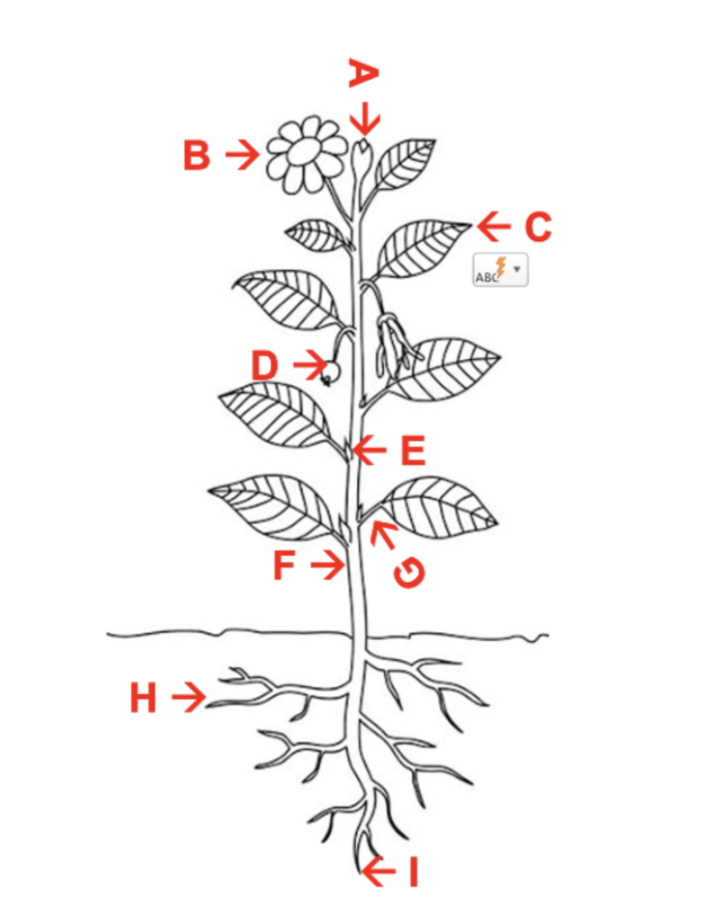
Label this
a: Terminal bud
b: Flower
c: Blade
d: Fruit
e: Node
f: Stem
g: Petiole
h: Root
I: Root cap
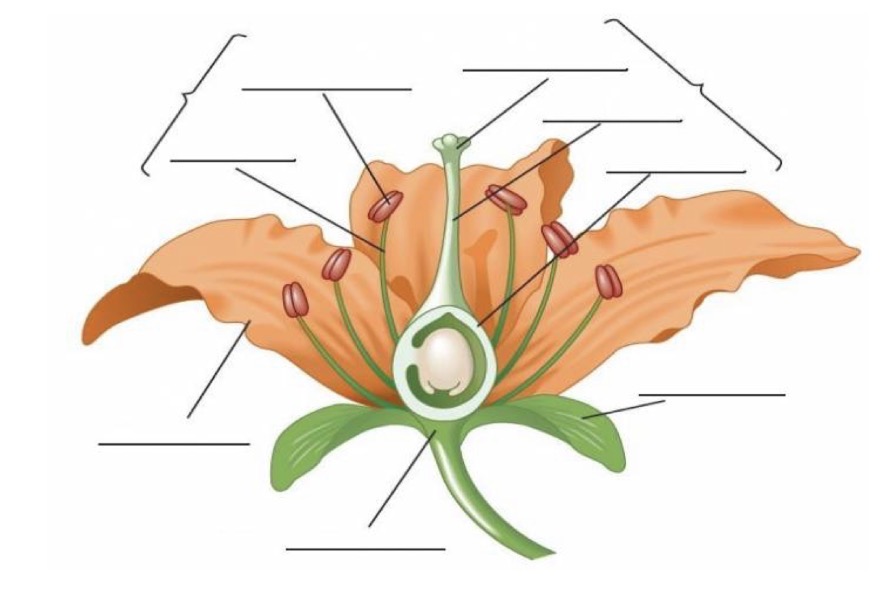
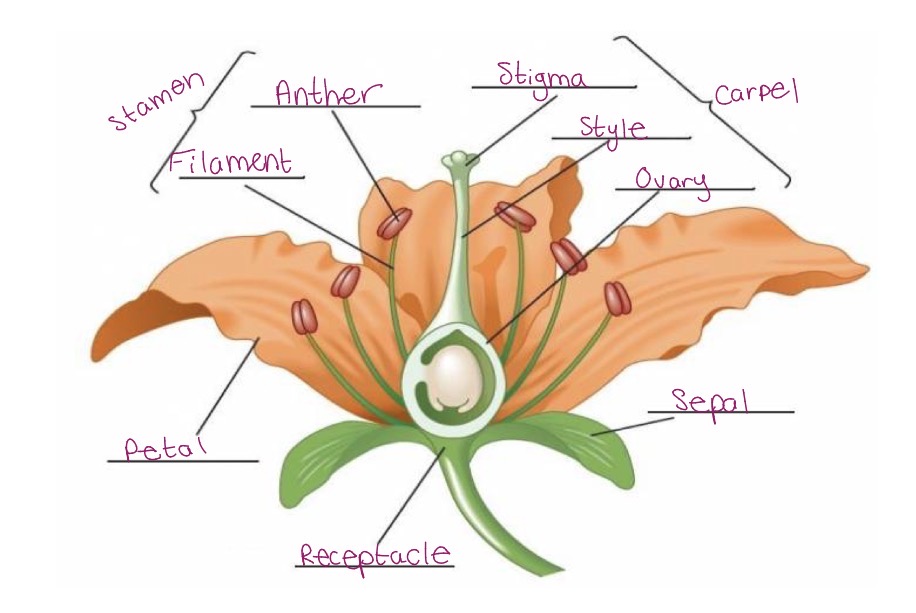
Label this
You come across an unlabeled plant. It has parallel leaf venation, leaves attached vertically to the stem, six flower parts, and a fibrous root system. How many cotyledons would this plant have?
Question options:
one
two
three
four
one
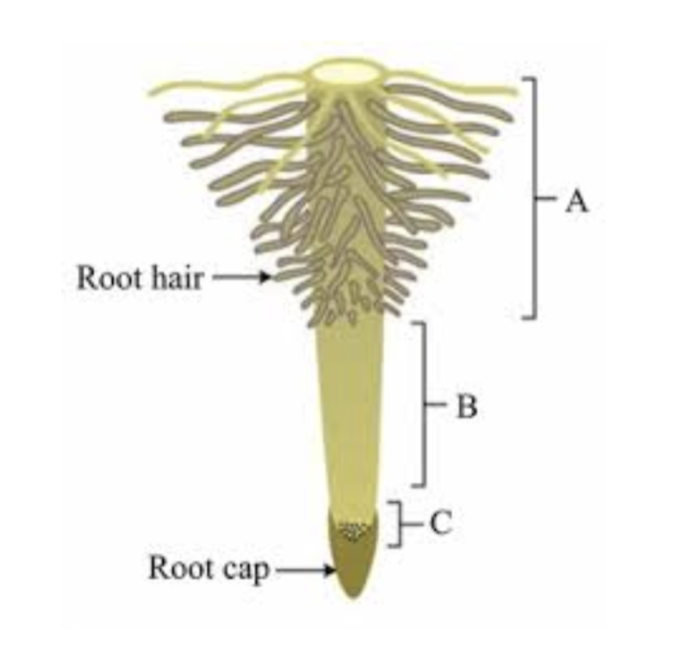
Label the regions
A: Zone of maturation
B: Zone of elongation
C: Zone of cell division
Xylem is the type of vascular tissue that distributes sugars around the plant.
Question options:
True
False
False
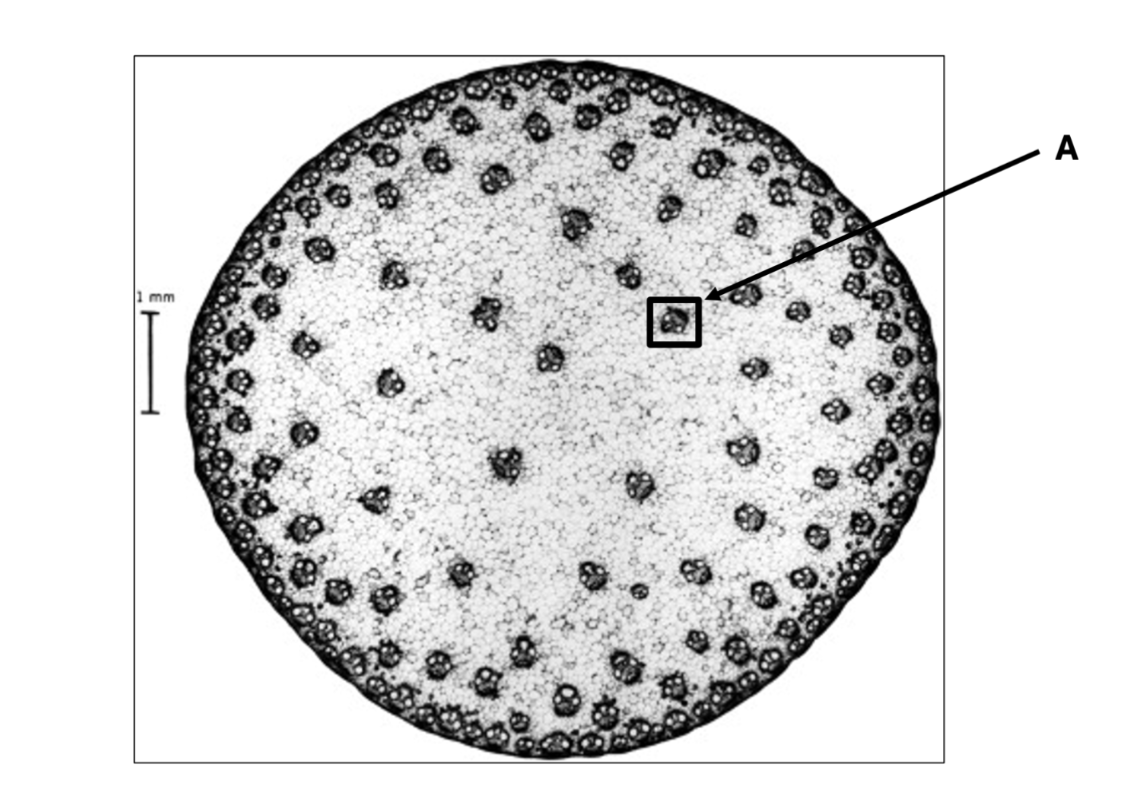
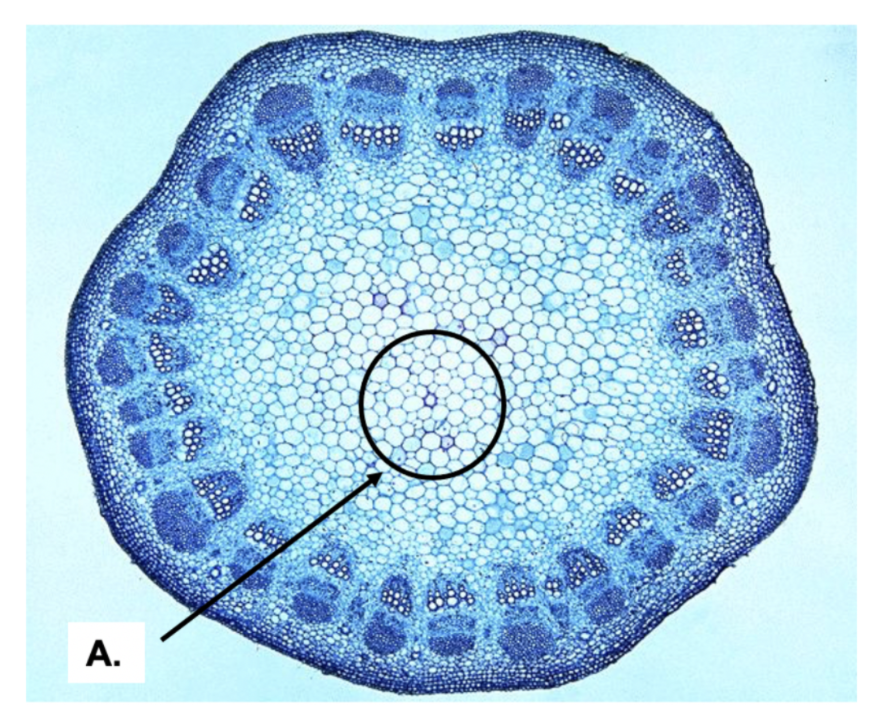
Which type of plant tissue is indicated by the letter A?
Cortex
Vascular
Ground
Dermal
Vascular
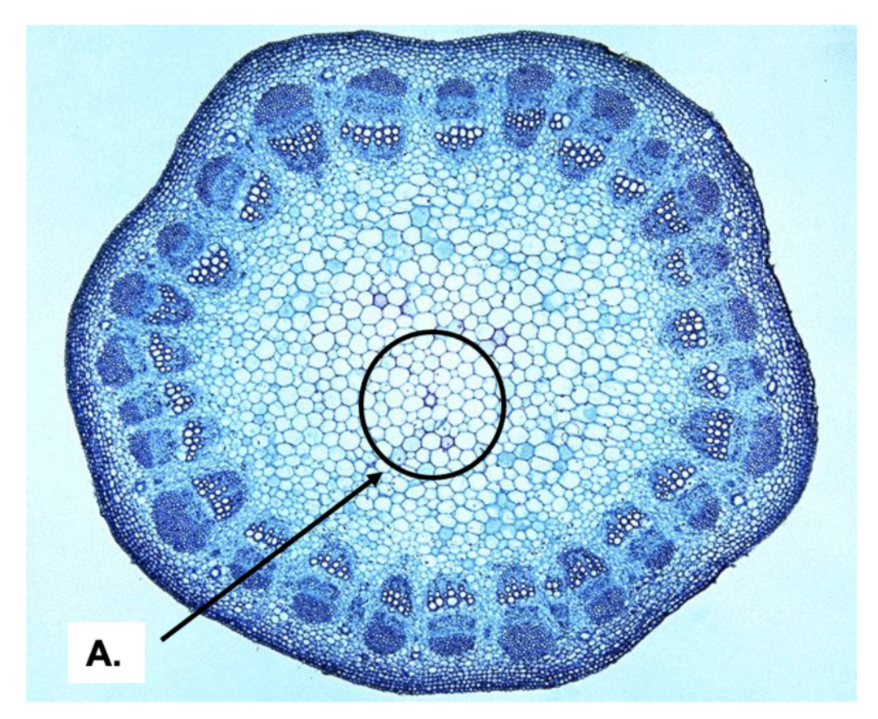
Which type of tissue is indicated by "Letter A" in this image? (Ground, vascular, or dermal)
Is this stem from a monocot or a dicot?
Ground
Dicot (Vascular bundles are located near the outer layer.)
What is the name of the dense mesophyll layer of tissue beneath the cuticle at the top portion of the dicot leaf?
Why would you not expect to find this dense layer of tissue in a monocot leaf?
Palisade Mesophyll
In monocot leaves both the upper and lower surfaces are exposed to similar, high levels of sunlight so there is no specialized upper palisade layer and a lower spongy layer, instead it is comprised of uniform, loosely arranged parenchyma cells.
How does the location of stomata differ between monocots and dicots?
Monocot -> Equal distribution of stomata on both the upper and lower epidermis organized in parallel rows
Dicot -> Have a higher concentration of stomata on the lower surface for water conservation
The site of gas exchange in a plant is the ________, these openings are surrounded by ______
which swell with water.
stoma, gaurd cells
Gymnosperms
“naked seeds”
– Seeds do not develop within an ovary
– Coniferous trees
Ex: Pine trees
Angiosperm
“One whose seed is carried in a vessel”
– Seeds develop within an ovary
– Flowering plants
Male flower parts (Anther, Filament)
Anther: Produces pollen
Filament: Supports the anther
Female flower parts (Stigma, Style, Ovary)
Stigma: Holds the pollen grains
Style: Connects the stigma with the ovary
• Supports the stigma so that it can be pollinated
Ovary: Produces ovules which develop into seeds
Monocot
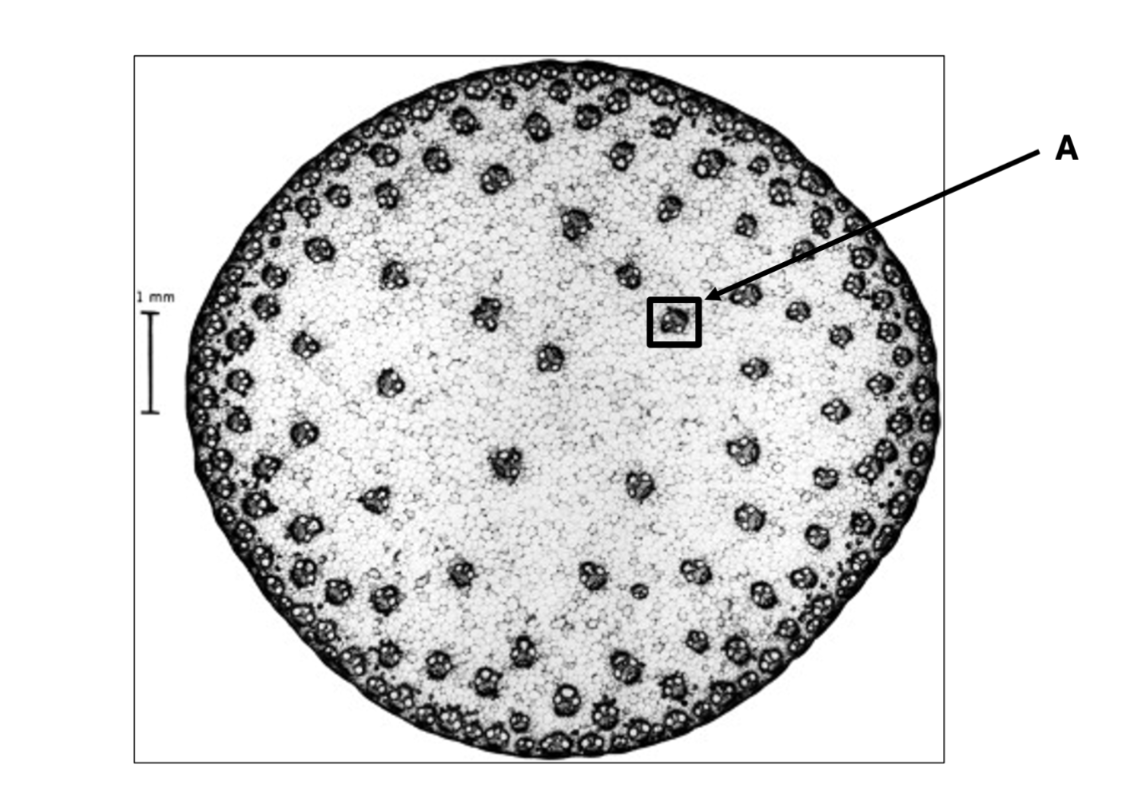
1 cotyledon, paralel (long straight) veins on leaf, scattered vascular bundles in stem, fibrous roots, petals in threes
Dicot
2 cotoledyns, netted veins, vascular bundles in a ring, taproots, petals in 4s or 5s
Dermal tissue
Covers outer surface of herbaceous plants.
• Composed of epidermal cells that secrete the waxy cuticle.
• Waxy cuticle protects against water loss
Ground tissue
Bulk of the primary plant body.
• Composed of parenchyma, collenchyma, and sclerenchyma
Vasular tissue
Transports food, water, hormone, minerals.
• Composed of xylem, phloem, parenchyma, and cambium
Monocot stem
Monocot root
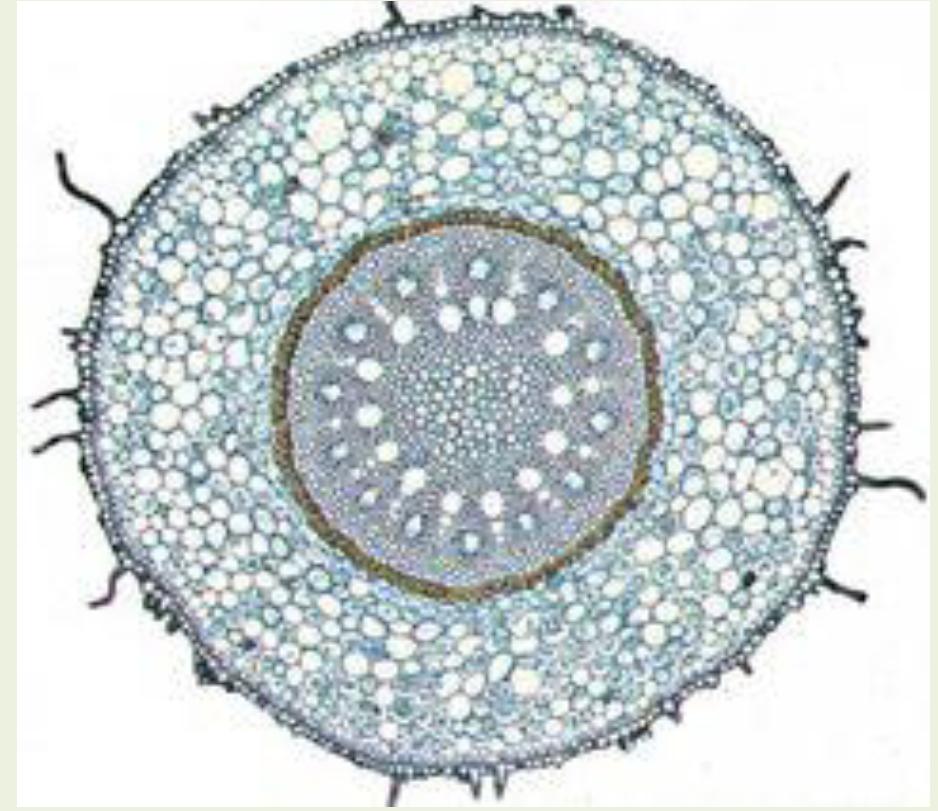
Dicot stem
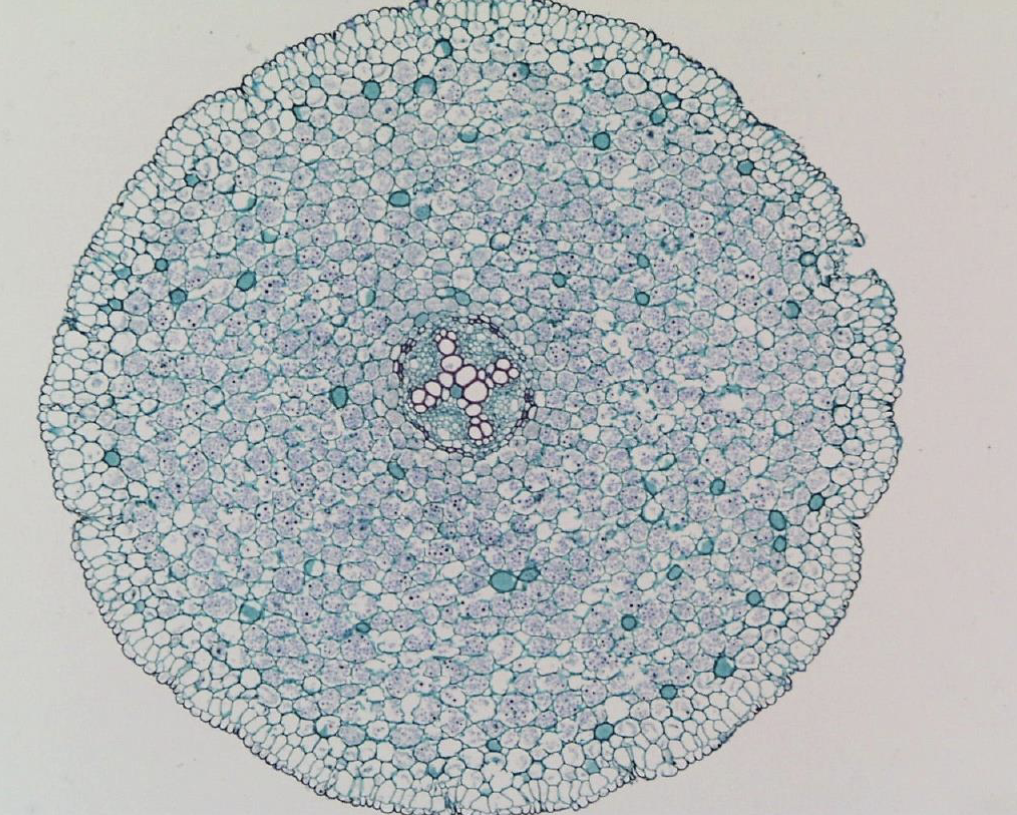
Dicot root
Primary growth
Occurs at apical meristems
• Increase in length of plants
• Allows roots to push downward through the soil
• Allows shoots to grow upward toward the sun
Secondary growth
Increase in thickness of stems and roots
• Occurs at lateral meristems
Petiole
Leaf stalk or part that connects the leaf to the stem.
• Only seen in dicots!
Blade
The large, flat part of a leaf
Midrib
The large center vein on a leaf
Mesophyll
Palisade –
• Primary site of photosynthesis
• Seen in dicots only
Spongy -
• Contains air & chloroplasts
• Site of photosynthesis and gas exchange
True or False
Apical meristematic tissue is located at the tips of roots & shoots; characterized by amount of cell division occurring in the immediate area
True
During secondary growth, what tissue is responsible for producing new secondary xylem and phloem?
Vascular cambium
Before measuring absorbance, what must be done with the spectrophotometer?
Question options:
Set wavelength to 450 nm
Blank using distilled water
Add KMnO₄ to the blank
Shake the cuvette
Blank using distilled water
Why is a blank used in spectrophotometry?
Question options:
To increase absorbance readings
To measure soil color
To account for absorbance of the solvent and cuvette
To dilute the sample
To account for absorbance of the solvent and cuvette
What is the purpose of creating a standard curve?
Question options:
To measure soil pH
To determine the relationship between absorbance and concentration
To mix solutions evenly
To identify soil color
To determine the relationship between absorbance and concentration
A soil sample has a very light purple color after reacting with KMnO₄. What does this indicate?
Question options:
High KMnO₄ remaining and low active carbon
Low KMnO₄ remaining and high active carbon
High nitrogen levels in the soil
The spectrophotometer was not blanked
Low KMnO₄ remaining and high active carbon
KMnO4 will oxidize active carbon in the soil samples and the KMnO4 will be reduced. In this scenario, KMnO4 is
Question options:
gaining electrons.
losing electrons.
continually losing and gaining electrons.
remaining unchanged.
gaining electrons.
As KMnO4 is reduced the color of the solution gets darker.
Question options:
True
False
False
A student forgets to blank the spectrophotometer. How will this most likely affect the results?
Question options:
Absorbance readings will be artificially low.
There will be no effect.
The KMnO4 concentration will increase.
Absorbance readings will be inaccurate due to background interference.
Absorbance readings will be inaccurate due to background interference.
The standard curve is used to determine unknown concentrations from absorbance values.
Question options:
True
False
True
A soil sample produced a very dark purple solution after reacting with KMnO₄. What does this indicate?
Question options:
High active carbon
Low active carbon
High nitrogen levels
High phosphorus levels
Low active carbon
Two samples have the same absorbance, but one used twice as much soil mass. What is the likely outcome? (Hint: Think about the equation for the POXC equation).
Question options:
Both will have identical POXC values.
The sample with more soil will have lower calculated POXC per kg.
The sample with more soil will have higher absorbance.
Soil mass does not affect calculations.
The sample with more soil will have lower calculated POXC per kg.
You are a flower farmer. Despite optimal temperatures and rainfall, you notice your flowers are not producing as many blooms as in years past. What nutrient could your flowers be deficient in?
Question options:
Nitrogen
Phosphorus
Potassium
Phosphorus
Relationship between KMnO₄ concentration, color intensity, absorbance, and active carbon in this lab.
KMnO4 is a deep purple solution, it reacts with active carbon and gets reduced and loses its color
So, soils with higher active carbon cause a greater decrease in color intensity
Higher absorbance on a spectrophotometer means a darker KMnO4 solution (less reaction with carbon) while lower absorbance means that more KMnO4 has reacted meaning there must have been higher active carbon in the soil.
A farmer tests two soils:
Soil A: High POXC, medium nitrogen
Soil B: Low POXC, high nitrogen
A. Which soil is likely to support long-term soil health better? Explain.
B. Suggest one management practice to improve the weaker soil.
A. Soil A is likely to support long-term soil health better. High POXC (active carbon) shows a greater amount of available carbon that increases microbial activity, improves soil structure, and enhances nutrient cycling over time. Even though its nitrogen is only medium, the strong biological activity helps sustain fertility long-term, whereas Soil B's low POXC suggests weaker microbial support and poorer long-term soil function despite its current high nitrogen.
B. To improve the weaker soil (Soil B), the farmer could add organic matter, such as compost to increase active carbon and support microbial activity.
Permanganate oxidizable carbon (POXC)
The carbon in the that is oxidized by potassium permanganate
**An indicator of soil health
As POXC increases, often so does plant productivity
Essential elements of fertilizer
Nitrogen→ Vegetative growth
Phosphorus→ Growth of roots and flowers
Potassium→ Disease resistance and fruit quality
You are a famer growing corn. Despite optimal temperatures and rainfall, you notice your plants have poor growth and a yellowing. Which nutrient are they most likely deficient in (N, P, or K)?
Nitrogen
You are a flower farmer. Despite optimal temperatures and rainfall, you notice your flowers are not producing as many blooms as in years past. What nutrient could your flowers be deficient in (N, P, or K)?
Phosphorus
You are a pumpkin farmer. Despite optimal temperatures and rainfall, you notice your pumpkins are not growing as large in previous years. What nutrient could your pumpkins be deficient in (N, P, or K)?
Potassium
What does K represent in the logistic growth model?
Question options:
Time
Population size
Carrying capacity
Intrinsic rate of growth
Carrying capacity
It is impractical to directly count every individual in a wild population for all of the following reasons except
Question options:
it may not be possible.
it is too expensive.
it is the most inaccurate method.
it is too time consuming.
it is the most inaccurate method.
Quadrat sampling is an appropriate sampling method for plants because
Question options:
plants only cover a small portion of habitats.
plants are motile.
plants always have uniform dispersions.
plants are non-motile.
plants are non-motile.
In order to obtain an accurate population estimate through quadrat sampling, you must select the coordinates
Question options:
of an area that is the easiest to sample.
at random.
of an area with the lowest population of the organism of interest.
of an area with the highest population of the organism of interest
at random.
(Actual population - Population Estimate)/Actual population X 100 represents the equation for
Question options:
logistic growth.
the lincoln index.
percent error.
a quadrat population estimate.
percent error.
The Lincoln Index allows us to make a mathematical estimate of the population size based on
Question options:
only the number of individuals caught during the capture phase that are marked.
only the number of individuals caught during the capture phase that are unmarked.
the ratio between marked and unmarked individuals captured.
the ratio between counted and uncounted individuals in a quadrat.
the ratio between marked and unmarked individuals captured
In lab this week we will use the Lincoln Index to estimate populations through mark and recapture. In the equation for the Lincoln Index, which of the following letters represents the number of marked organisms recaptured
Question options:
R
N
M
C
R
A population ecologist is most likely to study
Question options:
all of the abiotic factors of an ecosystem.
all of the individuals of one species in a given place at a given time.
how communities interact with the abiotic factors of the environment.
all the different populations in a given place at a given time.
all of the individuals of one species in a given place at a given time.
Which of the following is not a likely outcome of high population density?
Question options:
increased competition
mortality decrease
reproduction decrease
excessive waste accumulation
mortality decrease
If a genetic defect impacted the waterbuck population by limiting the number of offspring the waterbucks could produce, which simulator setting below would change?
Time
Maximum per capita growth rate
Initial population size
Carrying capacity
Maximum per capita growth rate
Imagine more land is added to the park, allowing it to support up to 500 waterbucks. Which parameter would this change for your model?
Growth rate
Time
Population size
Carrying capacity
Carrying capacity
Quadrat sampling is most appropriate for
Question options:
Flying birds
Small, motile (moving) animals
Non-motile (non-moving) animals and plants
Large mammals
Non-motile (non-moving) animals and plants
You want to determine the population size of a snail population in your neighborhood. You catch 20, and mark them. A week later, after they have had a chance to disperse into the population, you catch 15, and 6 have marks on them, what is the estimated size of the population?
N = (M*C) / R
N = estimated Number of individuals in the population
M = number of individuals captured and Marked
C = total number Captured the second time (with and without a mark) in second capture
R= number of individuals Recaptured (those with a mark)
Question options:
20
15
50
26
50
You are marking snails in your neighborhood, but the marks on half of your marked individuals wash off in the rain. How will your estimate of population size be affected by the snails losing their marks?
Question options:
The estimate will be too high
The estimate will be too low
No impact
The estimate will be too high
Population
All the individuals of a single species that live together in a given area at a given time
Population ecology
The study of populations in relation to their environment
3 key features of populations:
Size- Number of individuals in an area
Density- Measurement of population per unit area or unit volume
Dispersion- The pattern of spacing among individuals within the boundaries of the population
Variables in a logistic growth curve (t, N0, r, K, N, dN/dt)
t = time
N0 = initial population size
r = max per capita growth rate
K = carrying capacity
N = population size.
dN/dt = population growth rate.
Density-dependent factors
Biotic factors that have an increasing effect as population size increases
• Predation
• Disease
• Competition
Density-independent factors
Abiotic factors in the environment that affect populations regardless of their density
• Weather/climate
• Fire
• Storms and flooding
Lincoln index for mark recapture
Formula: N = MC/R
N = total population size
C = total number of captured organisms in second capture
M = total number of organisms marked
R = number of marked individuals recaptured
If the herbivore population is regulated by the producers, this is called:
bottom-up regulation
If the herbivore population is regulated by the predators, this is called:
top-down regulation
If you were sampling a wild population of fish and the marked individuals were more visible to
predators than the unmarked individuals:
Would your population estimate would be too high or too low? (Think about the
equation!)
Too high → R(marked recaptured) is denominator and will decrease making N increase
Below (I - III) are three examples of population sampling techniques. For a-c below, select the
best sampling method for each scenario.
I. Quadrat sampling
II. Mark and Recapture Sampling (Lincoln Index)
III. Aerial Observations
a. Which of the sampling methods listed above (I – III) would be most appropriate for
monitoring a population of large -mouth bass (a type of fish) in a pond?
b. Which of the sampling methods listed above (I – III) would be most appropriate for
monitoring a population clover (a plant) in a field?
c. Which of the sampling methods listed above (I – III) would be most appropriate for
monitoring a population of elephants migrating across the savannah in Africa?
a) Mark and Recapture Sampling (Lincoln Index)
b) Quadrat sampling
c) Aerial Observations
The beneficial results that come from successful ecosystem interactions are defined as
Question options:
Food webs
Food chains
Ecosystem services
Biodiversity
Ecosystem Services
Which of the following statements best describes heterotrophs?
Question options:
Heterotrophs convert inorganic materials into organic materials.
Heterotrophs feed on organic materials and convert it into different organic materials.
Heterotrophs feed on organic materials from consumers only.
Heterotrophs convert organic materials into inorganic materials.
Heterotrophs feed on organic materials and convert it into different organic materials
A group of individuals of the same species occupying a given area at a given time is most commonly known as
Question options:
a community.
an ecosystem.
a biome.
a population.
a population.
Which of the following is a biotic factor?
Question options:
disease-causing bacteria
temperature
wind
soil-particle size
disease-causing bacteria
Less energy is available at each successive trophic level of the pyramid of energy because __________.
Question options:
only a fraction of the available food is captured by the next trophic level
some of the food that is eaten cannot be digested
only a portion of the food that is digested becomes part of the organism's body
all of the above
all of the above
Which of the following trophic levels in not paired with its corresponding definition?
Question options:
Decomposer - an organism that is responsible for breaking down organic "waste" from other organisms
Primary consumer - carnivore; organism that converts organic material (through the consumption of animals) into different organic material
Teritary consumer - carnivore; organism that converts organic material (through the consumption of other animals) into different organic material
Producer - organism that convert inorganic material into organic material
Primary consumer - carnivore; organism that converts organic material (through the consumption of animals) into different organic material
The three levels of biodiversity are
Question options:
Producer, consumer, and decomposer.
plant, animal, and microbe.
community, population, and ecosystem.
ecological, species, and genetic
ecological, species, and genetic
Which of the following best represents the concept of the "tragedy of the commons"?
Question options:
A conservation area where wildlife protection is the top priority.
A shared grazing land where individual farmers place as many cows as possible.
A privately-owned farm where the owner maximizes crop yield to benefit the community.
A public park where visitors responsibly dispose of their trash.
A shared grazing land where individual farmers place as many cows as possible.
Explain how commercial fishing can be an example of "tragedy of the commons". In your explanation, be sure to define "tragedy of the commons"
The Tragedy of the Commons occurs when individuals overexploit a shared, unregulated resource for short-term gain, ultimately depleting it for everyone. Commercial fishing is a "tragedy of the commons" because individual fishers are incentivized to harvest as many fish as possible for immediate profit, eventually depleting the shared population faster than it can reproduce and leaving the entire industry with nothing
In Ecosystem Jenga (Activity # 6), card # 18 states, "Lots of clear sunny days. More sunlight reaches the ocean surface. Insert one green block back into matching color level." Why did this action result in the addition of a single green block to the Jenga tower?
Question options:
It is the result of abiotic factors decreasing the biomass of producers.
It is the result of biotic factors increasing the biomass of primary consumers.
It is the result of biotic factors increasing the biomass of producers.
It is the result of abiotic factors increasing the biomass of producers.
It is the result of abiotic factors increasing the biomass of producers.
Laws of thermodynamics
1st law: energy is neither created nor destroyed but only changed in form.
2nd law: usable energy is reduced with each energy transfer.
Species Diversity
# of species
– how many species are present
– how abundant is each species
Genetic Diversity
variety of genotypes
– e.g. corn/maize - different versions of genes in individual species
Ecological diversity
community complexity
– how many niches, trophic levels, etc.
Pollution
The introduction of harmful substances or energy (like heat, light, or noise) into the natural environment at a rate faster than they can be dispersed or safely stored
Examples: Acid, organic, thermal, pharmaceutical, salt
Acid pollution
Sulfur and nitrogen oxides react with air in the atmosphere (and potentially the terrestrially via run-off) to form sulfuric and nitric acids which will reenter the environment via rain.
***Side effect of air pollution from industry
Organic Pollution
Organic compounds that are resistant to environmental degradation
Examples: Pesticides, fertilizers (nutrient) , detergents, sewage, farm run-off
Can persist and accumulate causing biomagnification
Eutrophication
The process by which a body of water acquires a high concentration of nutrients, especially phosphates and nitrates
Promote excessive growth of algae.
– Algae die, decompose, increase organic material...therefore resulting in oxygen depletion
Bioaccumulation
Accumulation of a chemical at a rate greater than that at which the substance is lost
obtained from external environment or food
Thermal pollution
Degradation of water quality by any process that changes the ambient water temperature
Cause: use of water as a coolant by power plants and industrial manufacturers
Pharmaceutical pollution
Refers to the presence of medications—like antibiotics, hormones, painkillers, and antidepressants—in the environment, especially in water systems.