Accommodation with Vergence - Diagnosis and Management of Common Ocular Conditions Spring 2026
 Call Kai
 Learn
Learn Practice Test
 Spaced Repetition
 Match
Match Flashcards
 Knowt Play
1/104

There's no tags or description
Looks like no tags are added yet.
Name | Mastery | Learn | Test | Matching | Spaced | Call with Kai |
|---|
No analytics yet
Send a link to your students to track their progress
105 Terms
What is the job of the accommodative system?
to try to create clear retinal images -- to allow us to see clearly
What is the job of the vergence system?
-to align the two eyes very accurately with the target
-to allow us to see single
The vergence system tries to _____ both eyes at the target (to put the image of the target on the fovea of both eyes)
aim
What happens if there are small errors (4 min of arc) in the vergence angle?
can cause diplopia
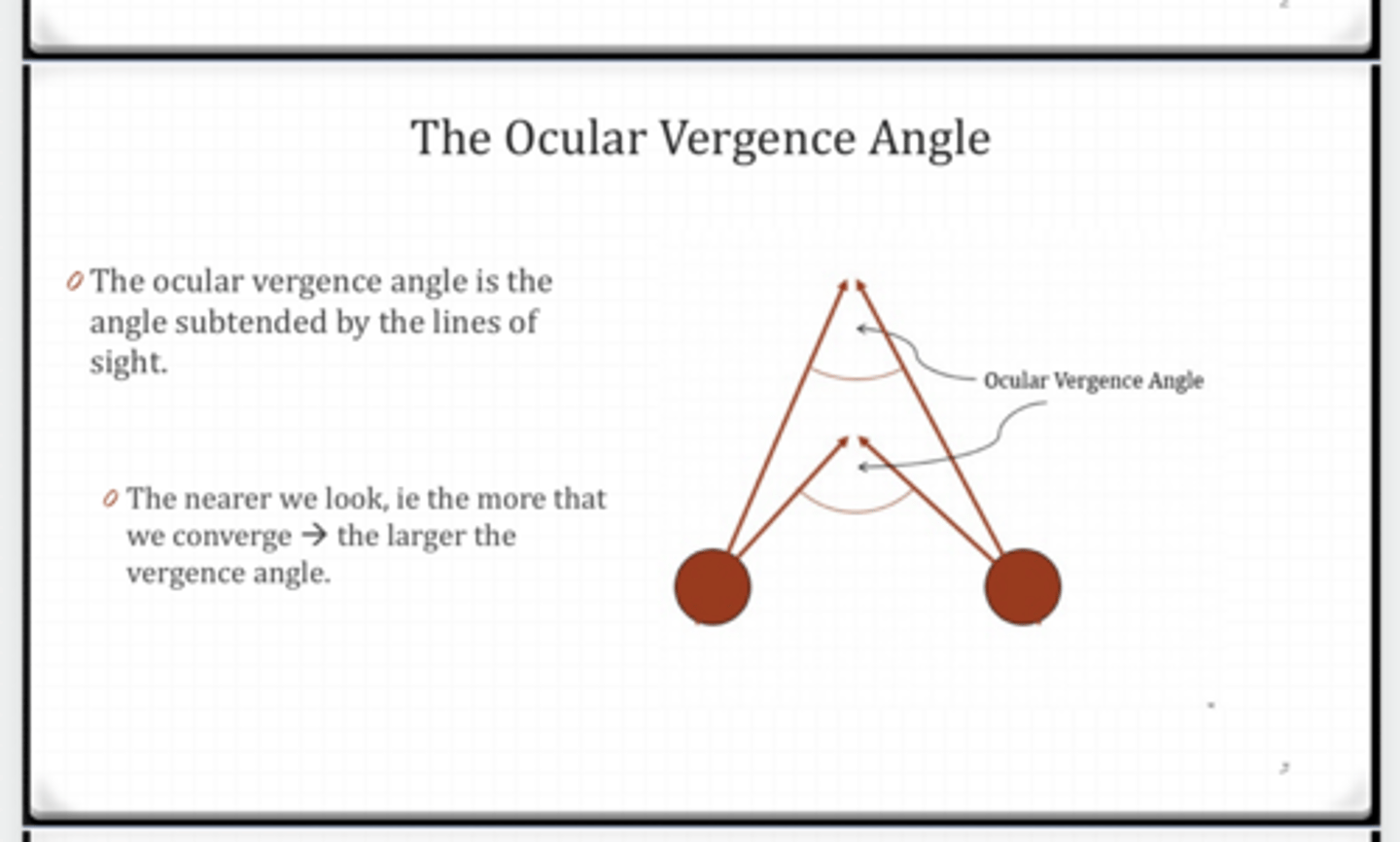
What is the ocular vergence angle?
the angle subtended by the lines of sight
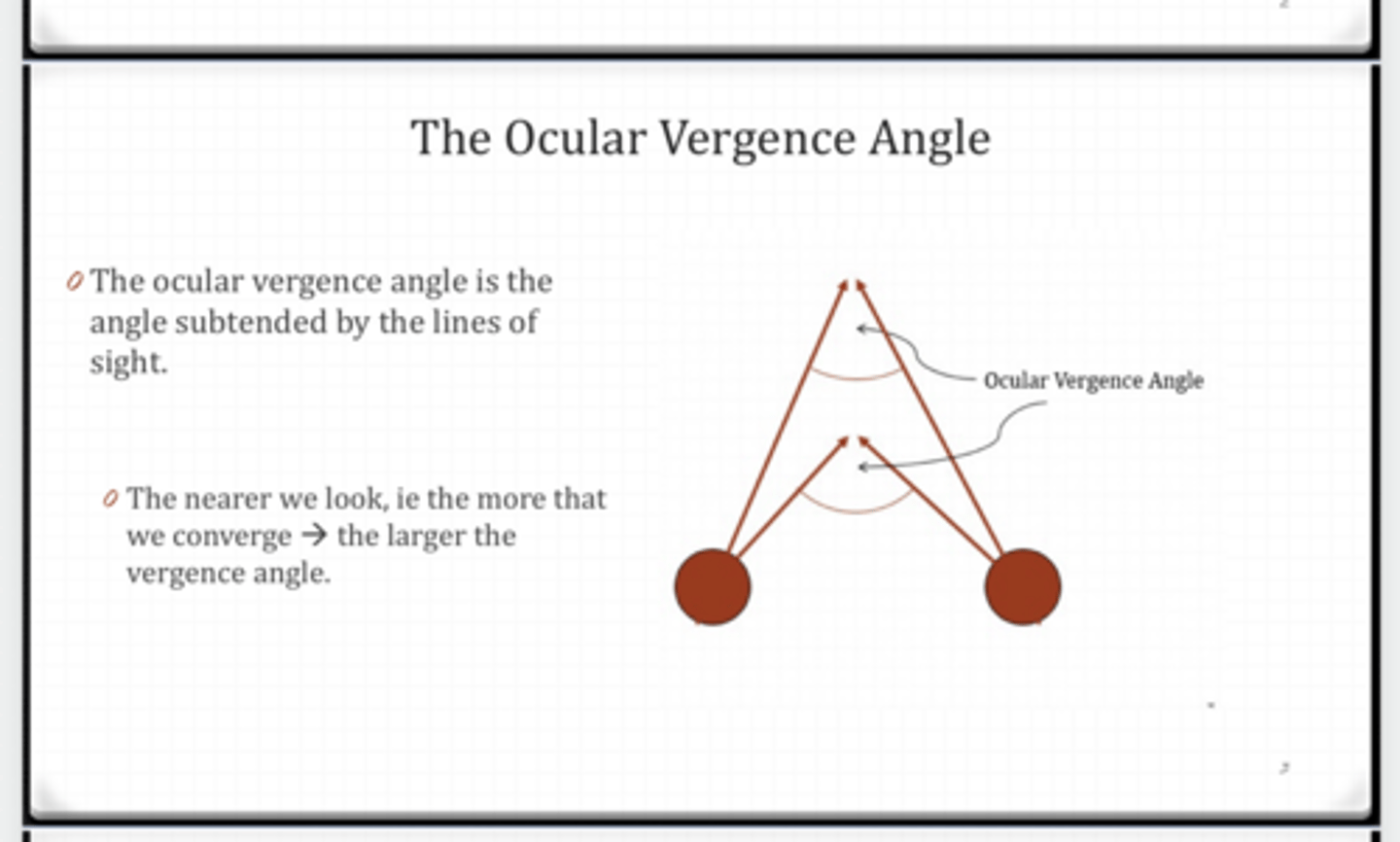
The nearer we look, the more we have to (converge/diverge)
converge
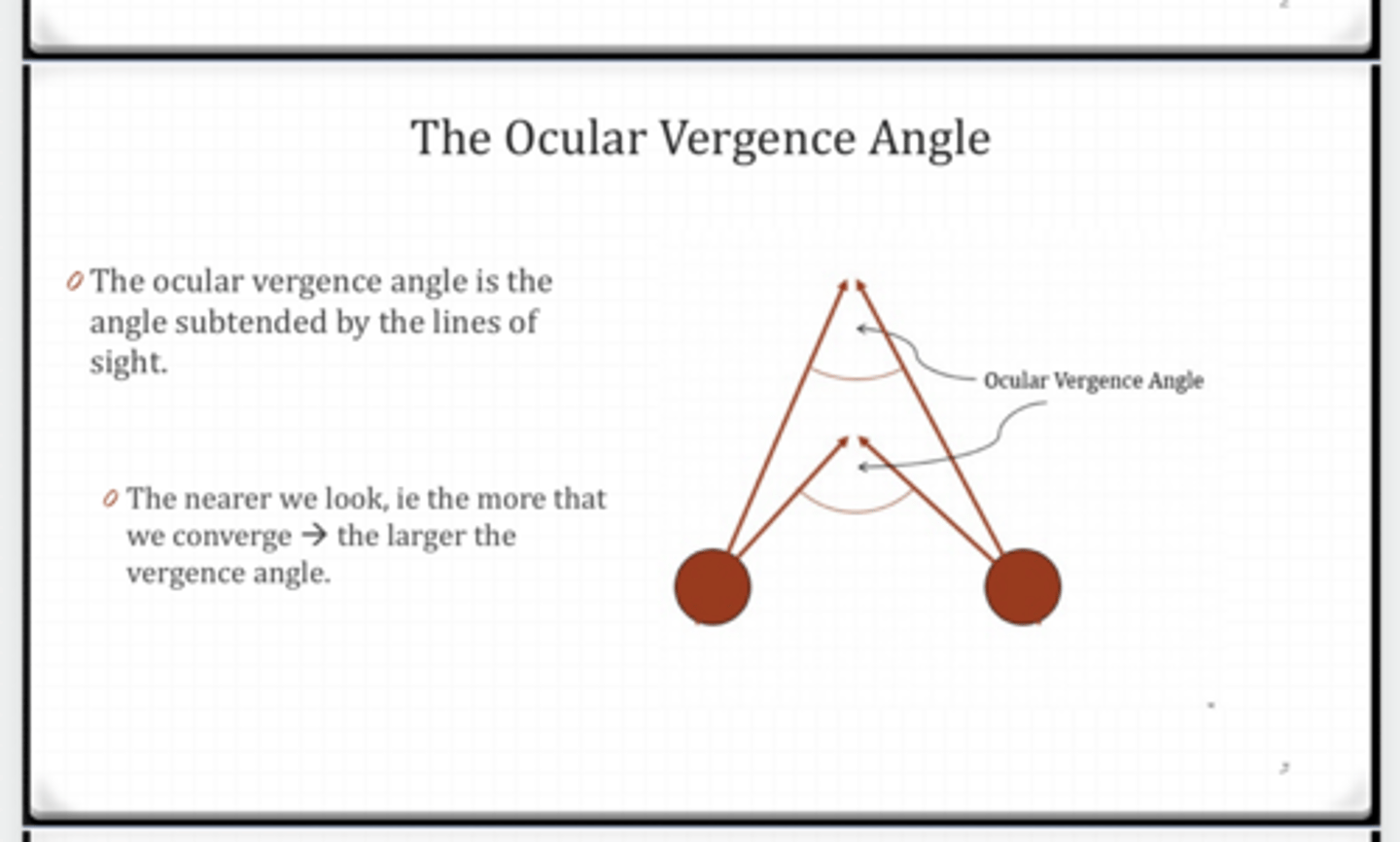
The nearer we look, the (smaller/larger) the vergence angle
larger
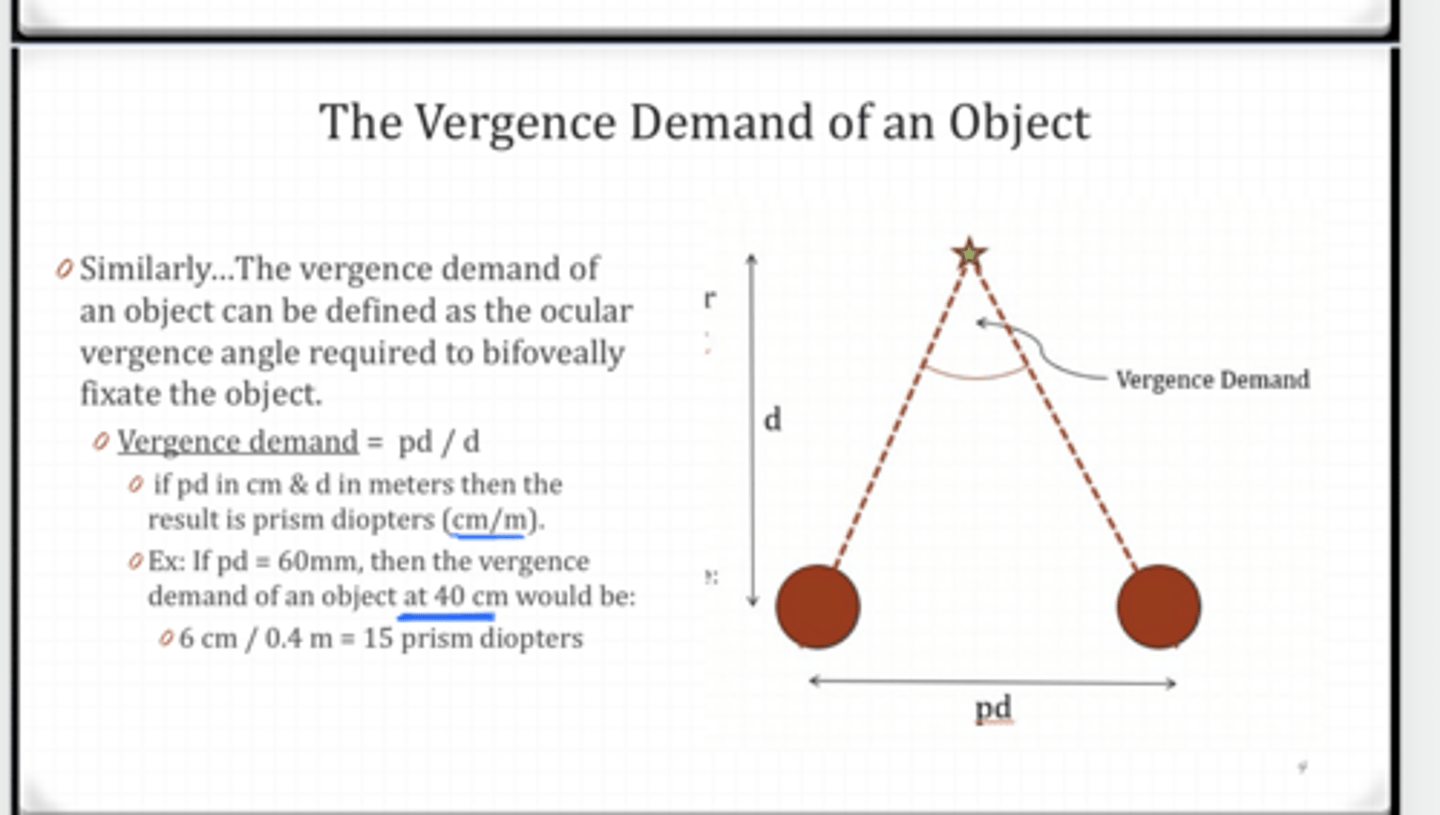
What is the vergence demand of an object?
ocular vergence angle required to bifovally fixate the object
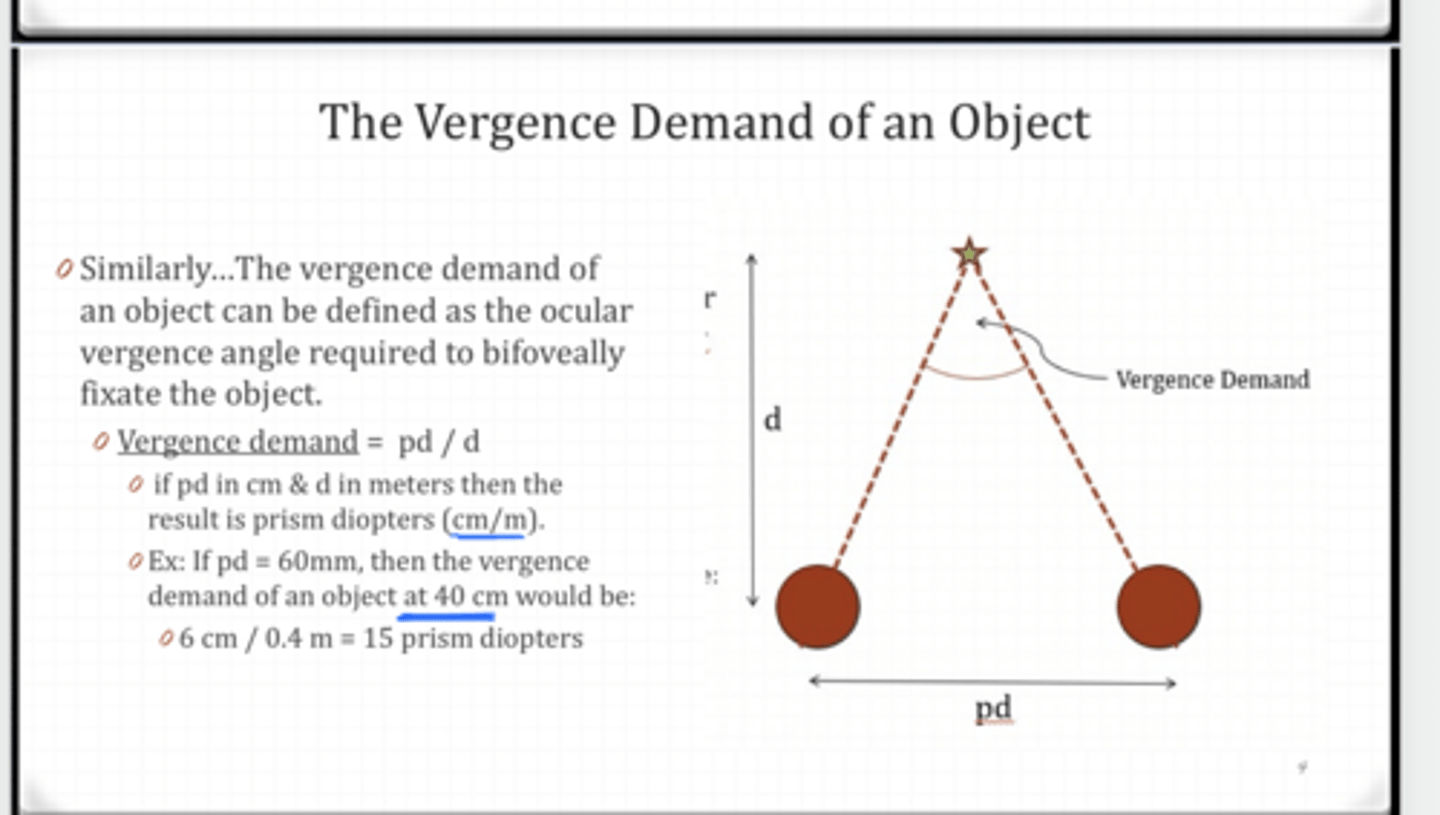
What is the equation for vergence demand?
pd/d
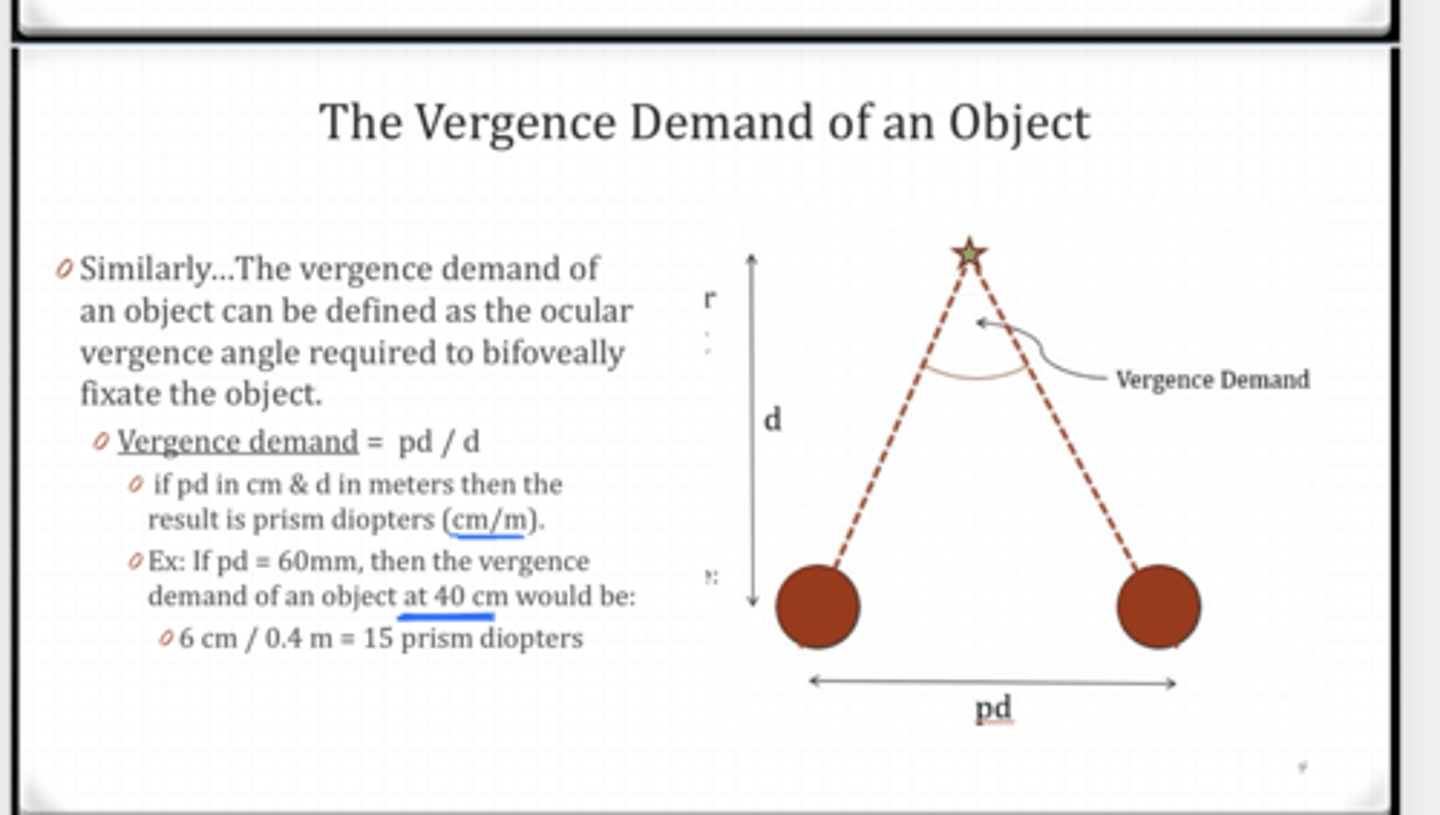
If PD = 60mm, what is the vergence demand of an object at 40cm?
6cm / 0.4m = 15PD
What are the 4 components of the total horizontal ocular vergence?
Fusional vergence
Accommodative convergence
Proximal vergence
Tonic vergence
What is vergence driven by?
accommodation
What is the rate of convergence driven by accommodation?
Accommodative convergence / Accommodation (AC/A Ratio)
What AC/A measurements are often used in clinic?
-calculated AC/A
-gradient AC/A
What is the avg AC/A value?
4pd / D
If a patient's AC/A ratio is 4pd/D, what does this mean?
For every diopter your patient accommodates, 4PD of accommodative convergence will be generated
Is accommodative convergence automatically (passively) generated when we accommodate?
yes -- accommodation is work. If we do the work to accommodate, then accommodative convergence will automatically follow.
What is the stimulus for fusional (disparity) vergence?
binocular disparity (retinal disparity, absolute disparity)
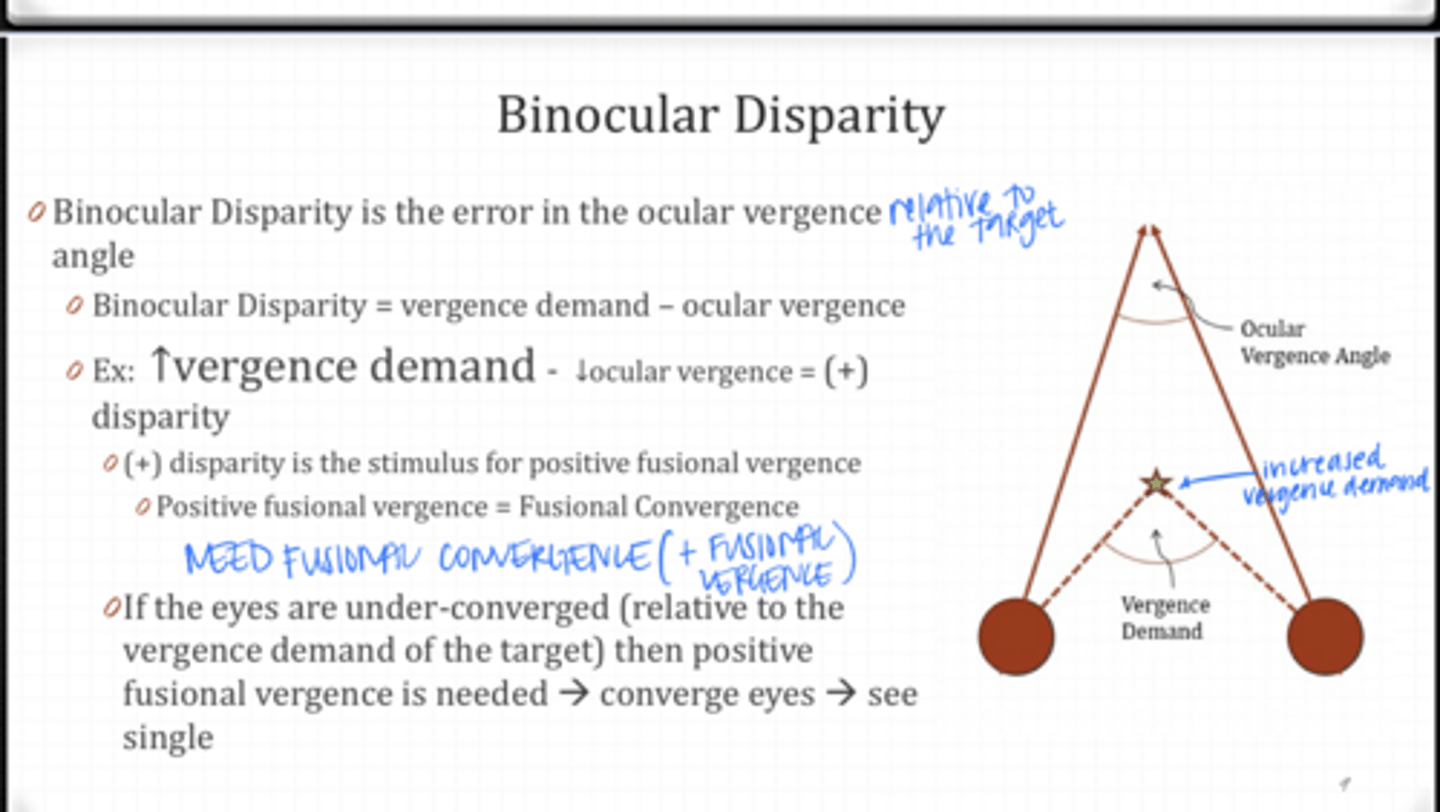
What is binocular disparity?
the error in the ocular vergence angle
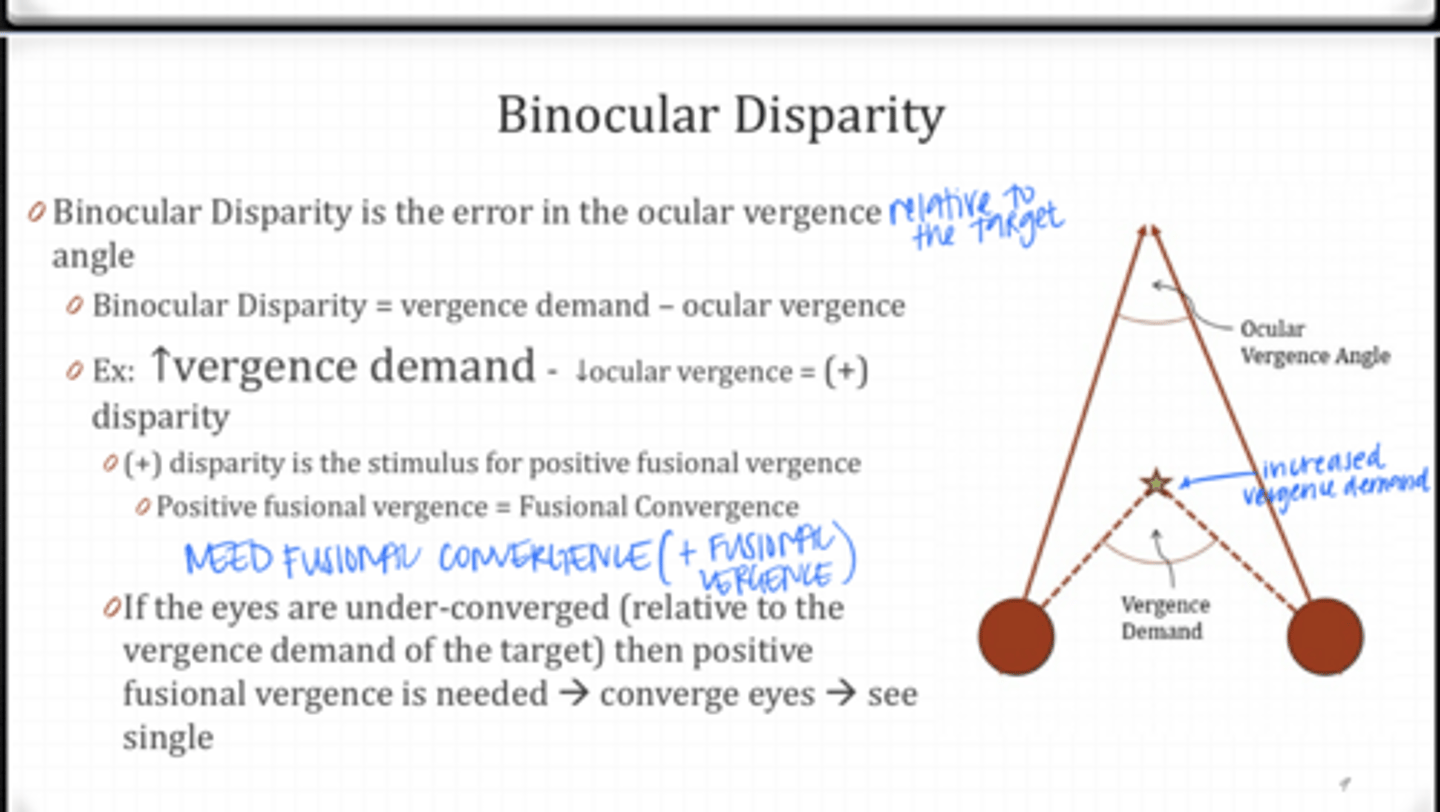
What is the equation for binocular disparity?
Binocular Disparity = Vergence Demand - Ocular Vergence
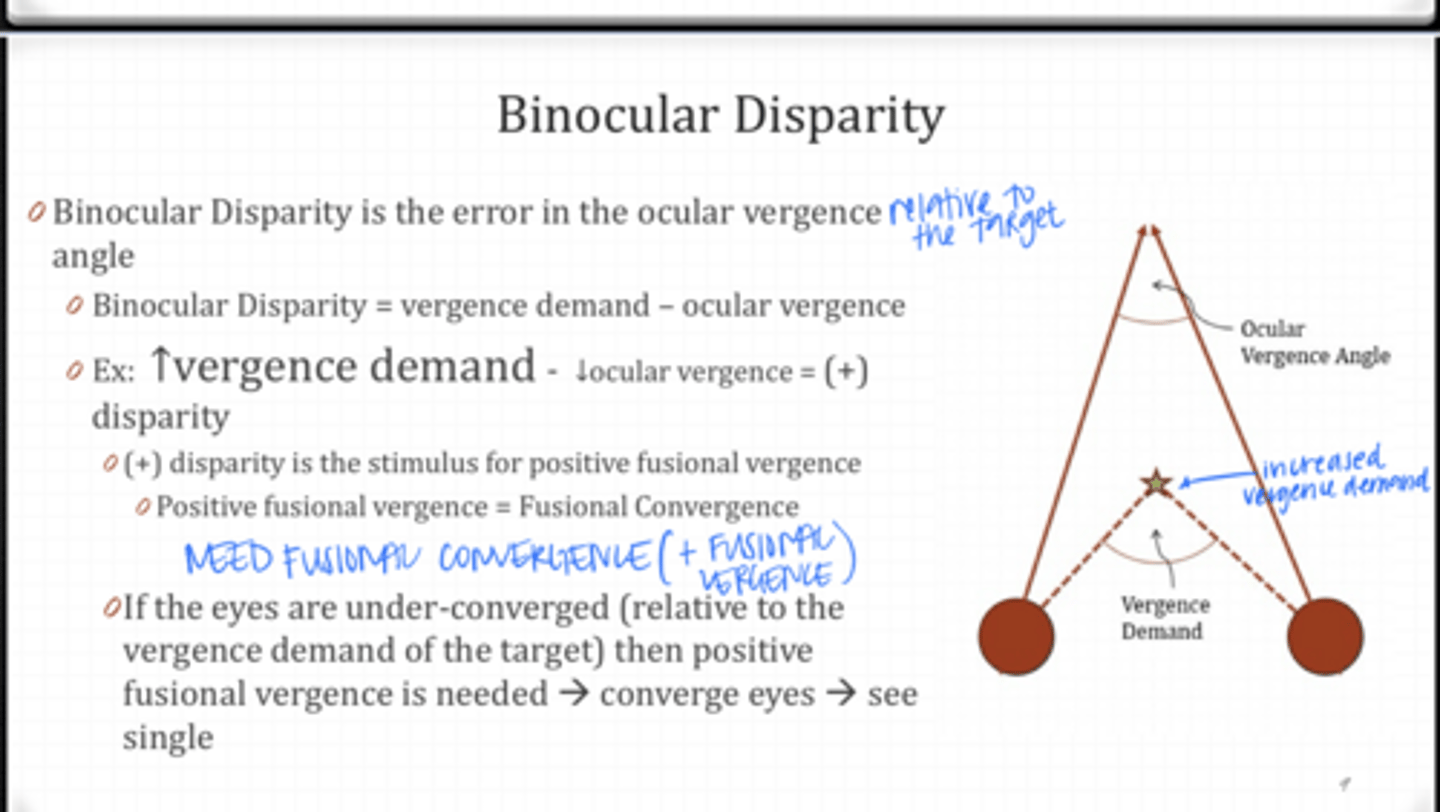
If you increase vergence demand and decrease ocular vergence, will binocular disparity increase or decrease?
increase
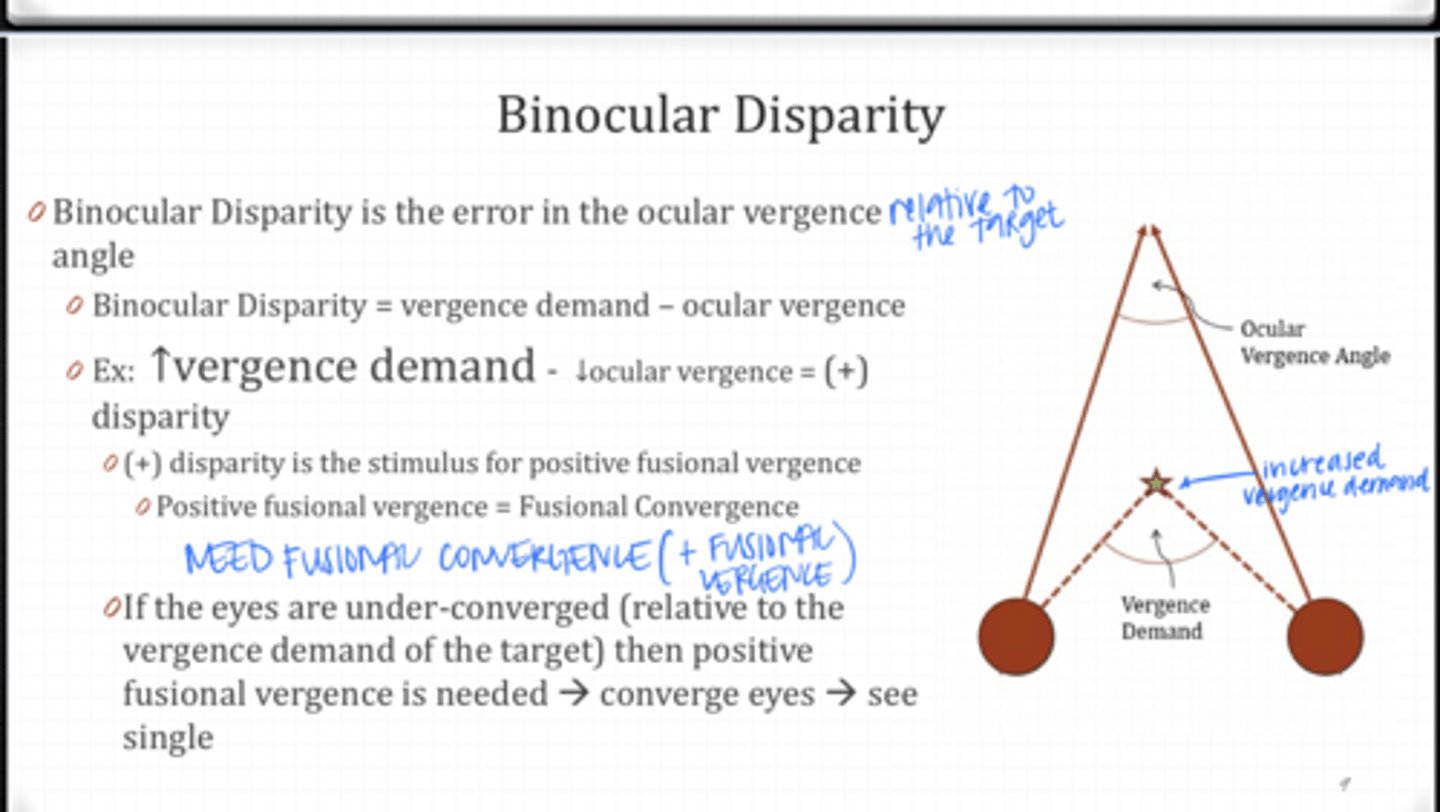
Positive binocular disparity is the stimulus for what?
positive fusional vergence
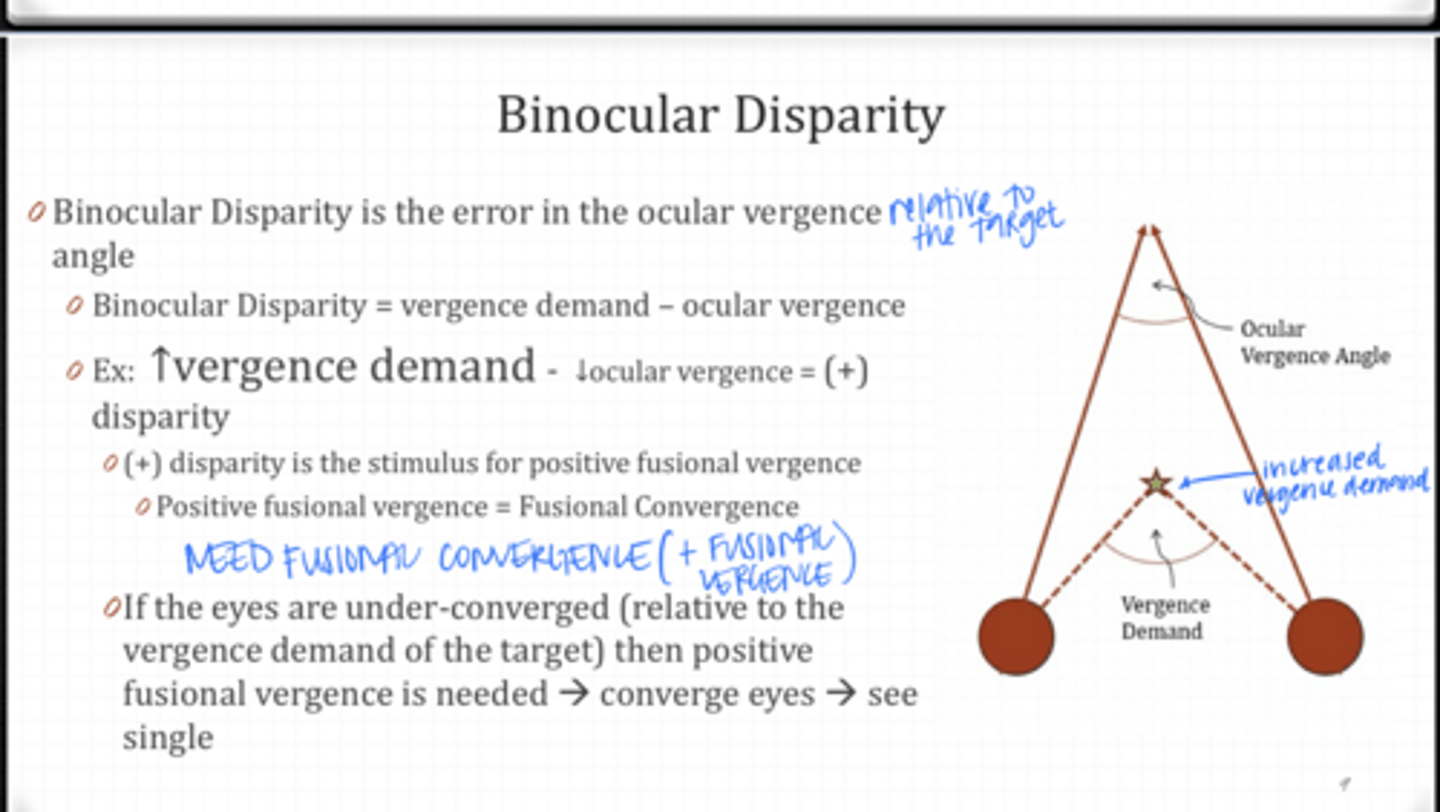
Positive fusional vergence =
fusional convergence
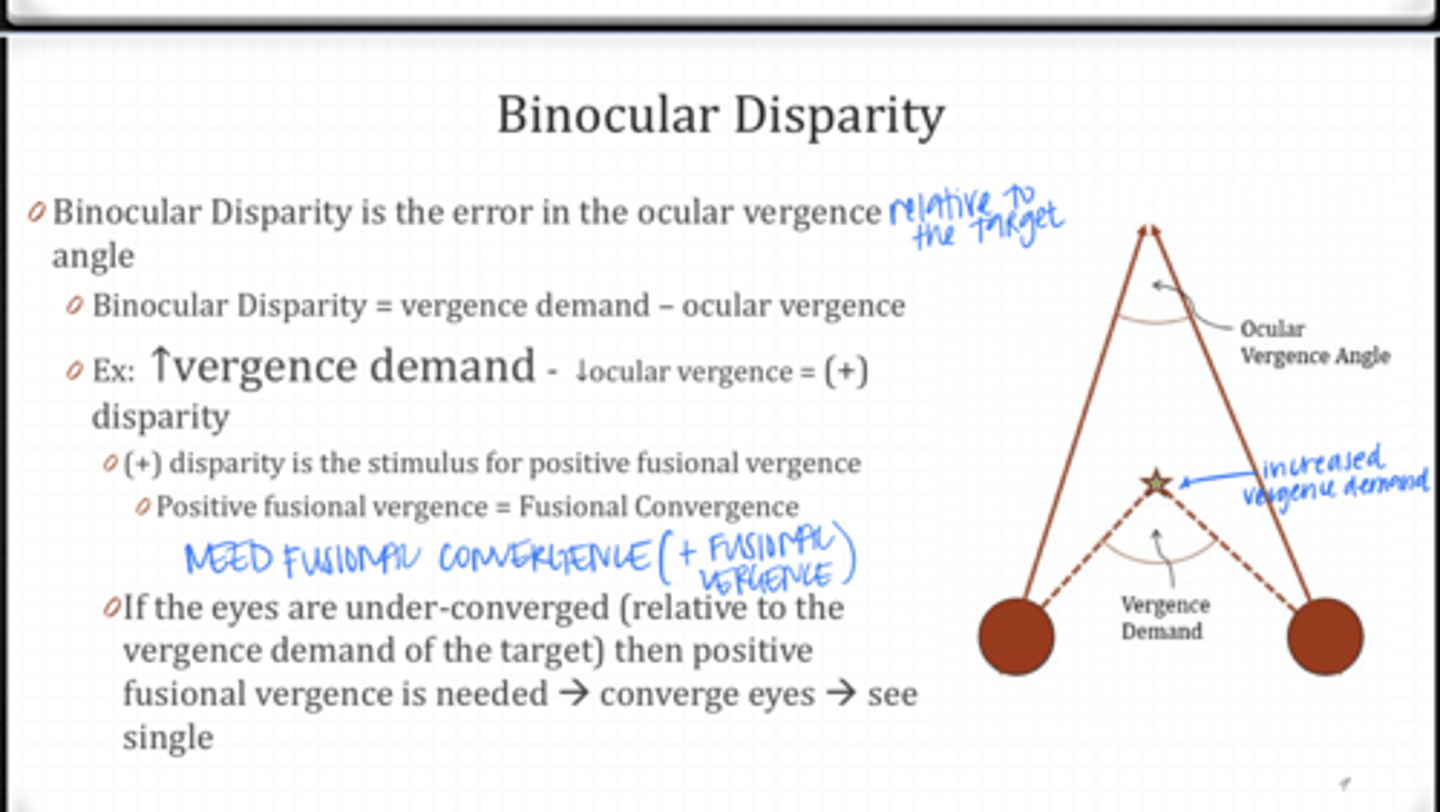
If the eyes are under-converged (relative to the vergence demand of the target) then __________ is needed
positive fusional vergence
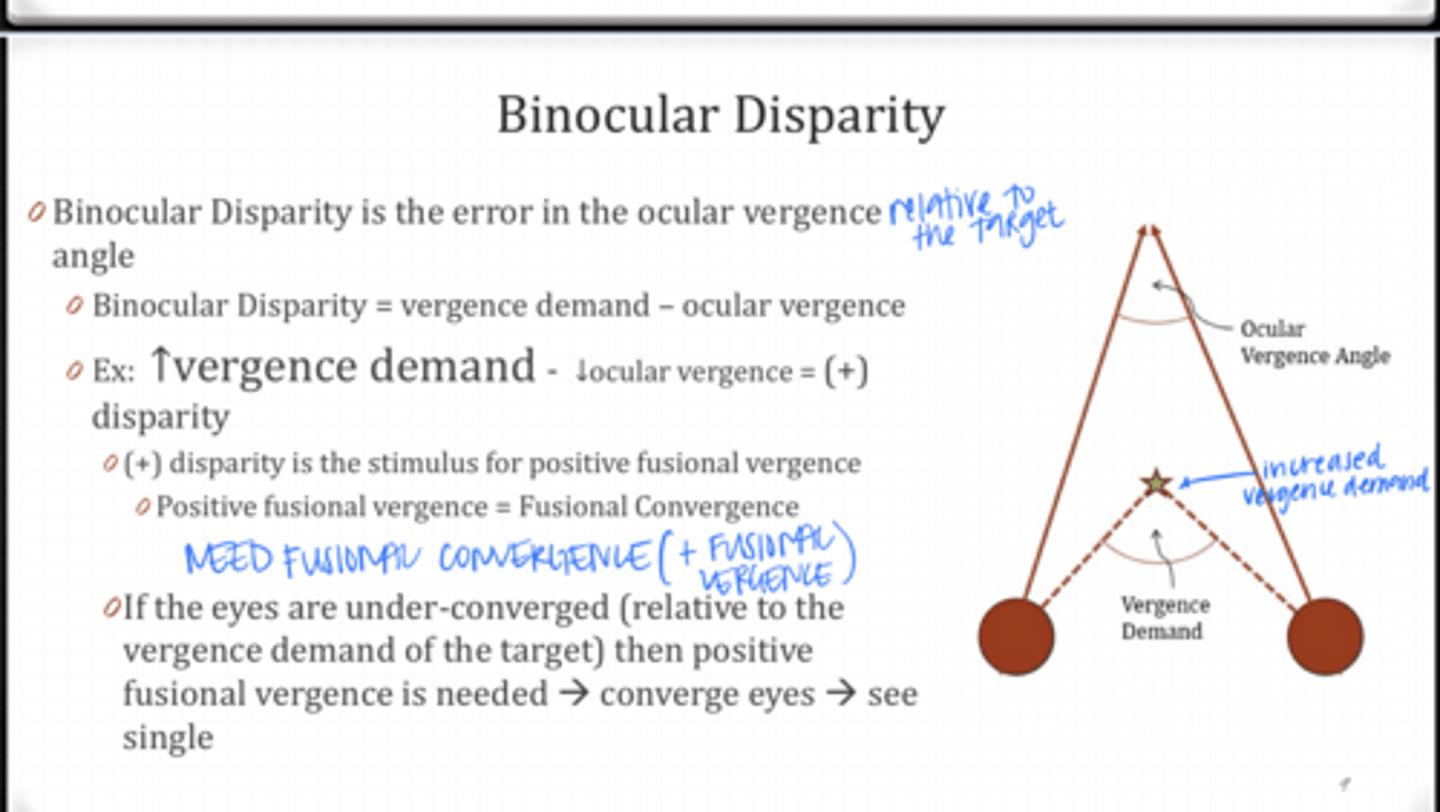
When the eyes use positive fusional vergence, the eyes will (converge/diverge)
converge
When positive fusional vergence is used in a patient who is under-converged, the patient will see ______
single
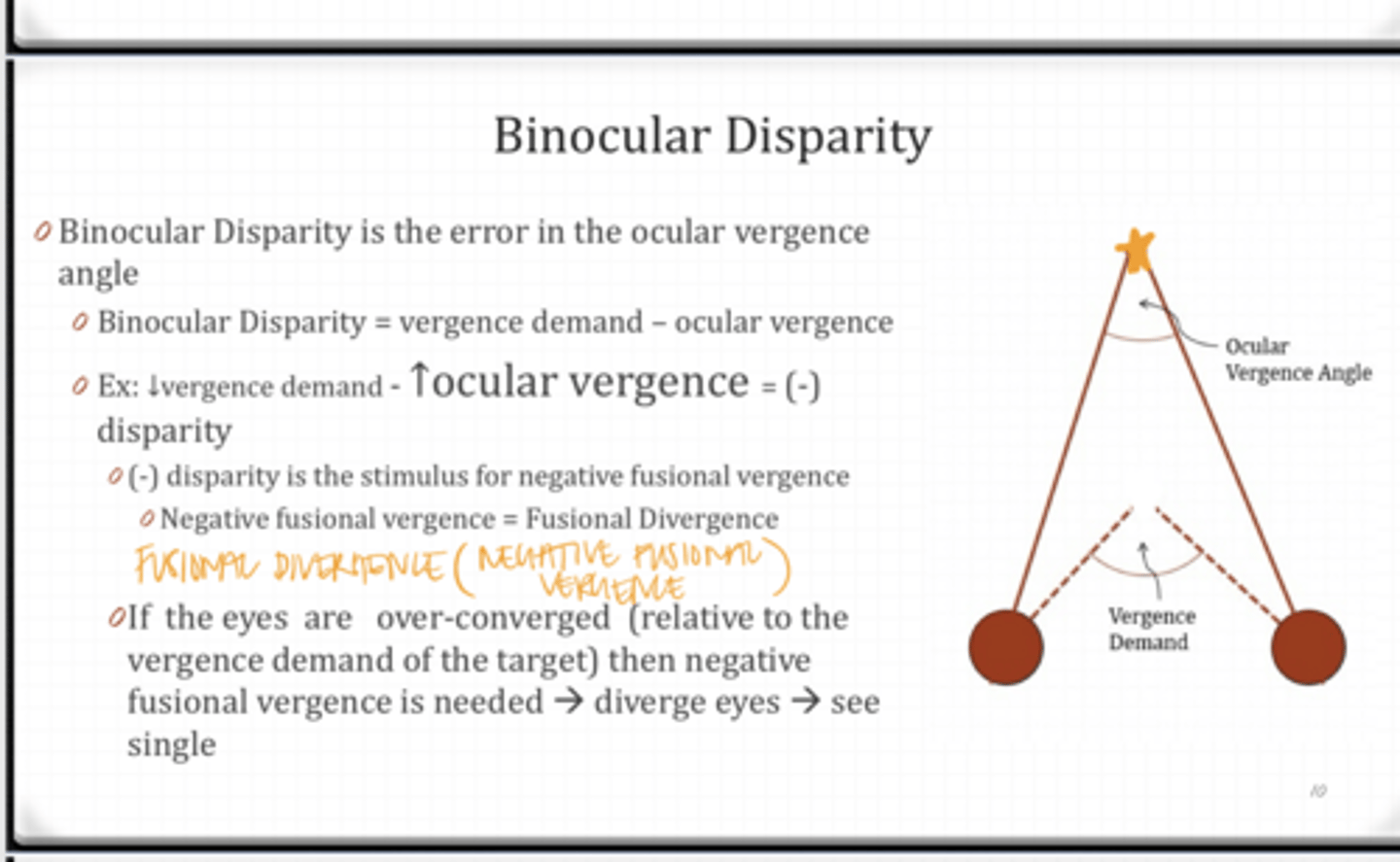
If you decrease the vergence demand of an object and increase the ocular vergence, will binocular disparity increase or decrease?
decrease
Negative binocular disparity is the stimulus for what?
negative fusional vergence
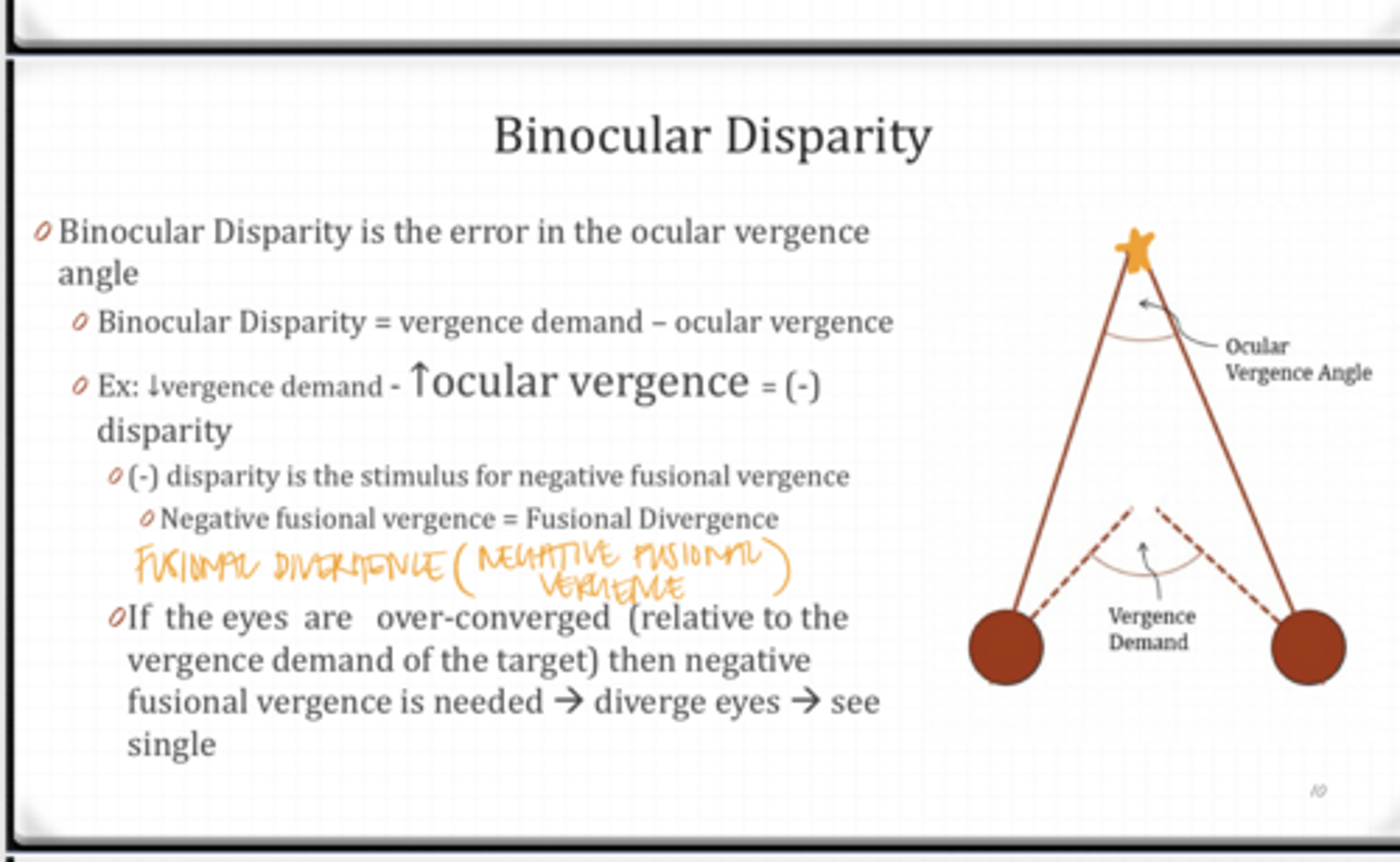
Negative fusional vergence =
divergence
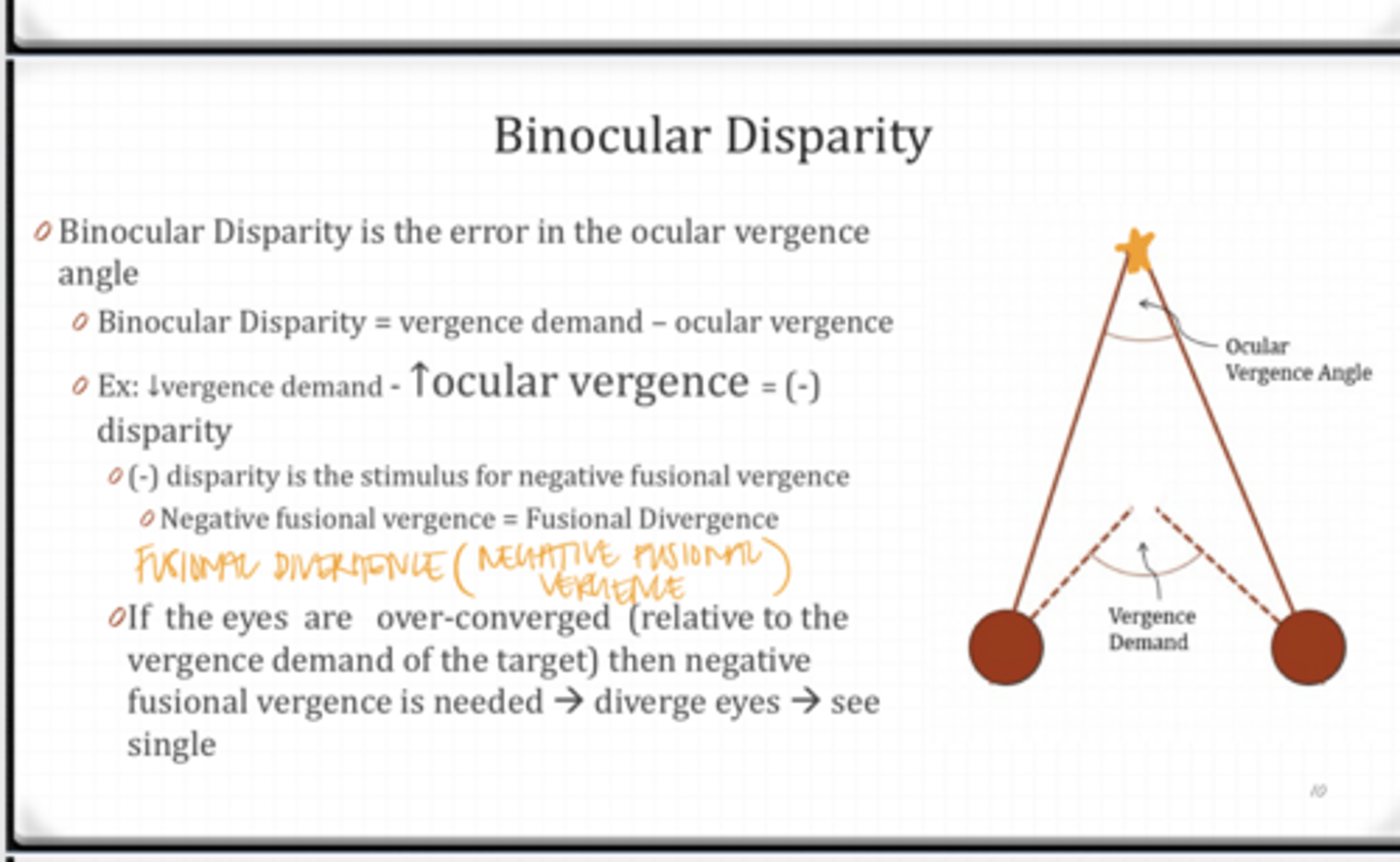
If the eyes are over-converged (relative to the vergence demand of the target), then ______ is needed
negative fusional vergence
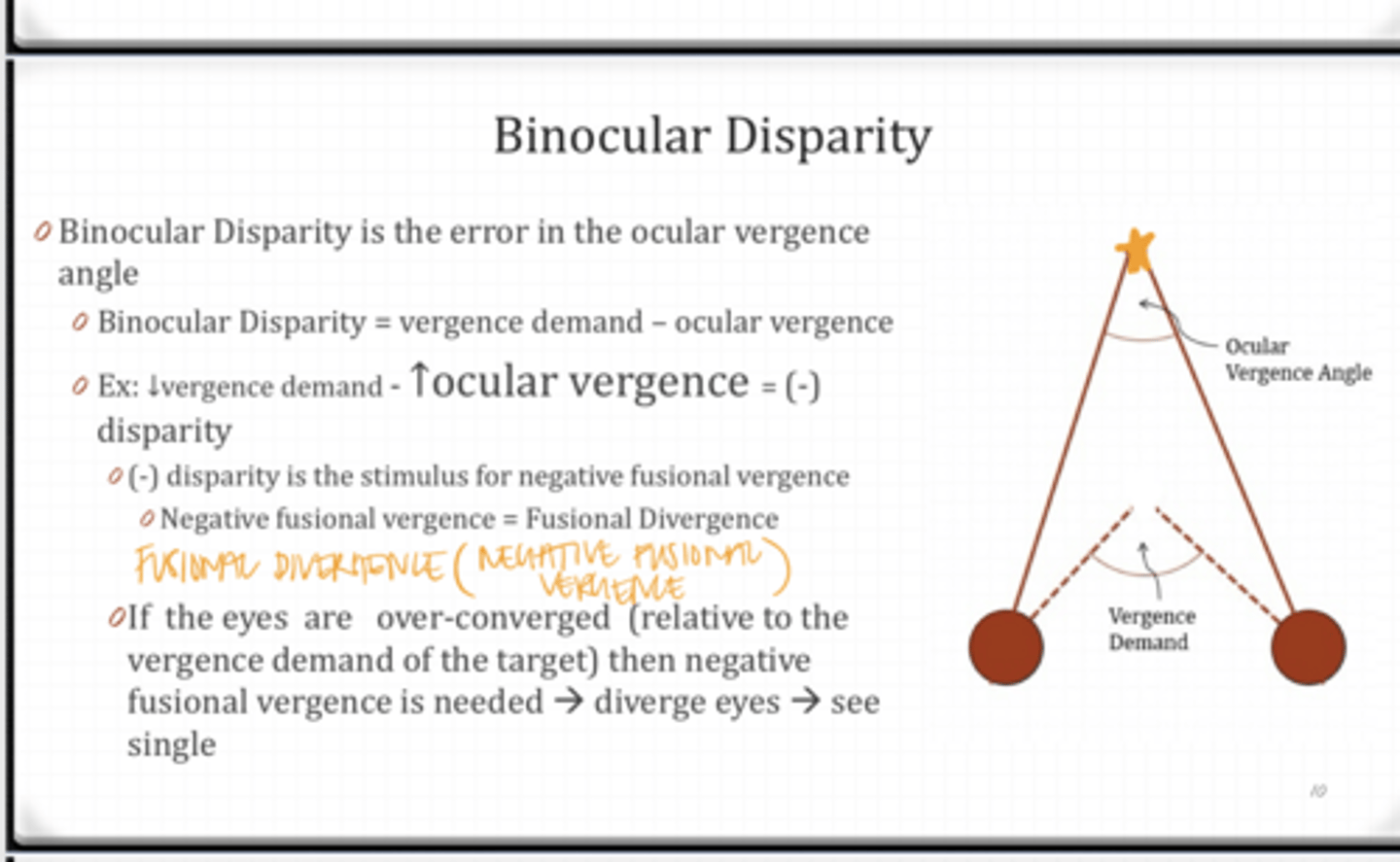
When the eyes use negative fusional vergence, the eyes will (converge/diverge)
diverge
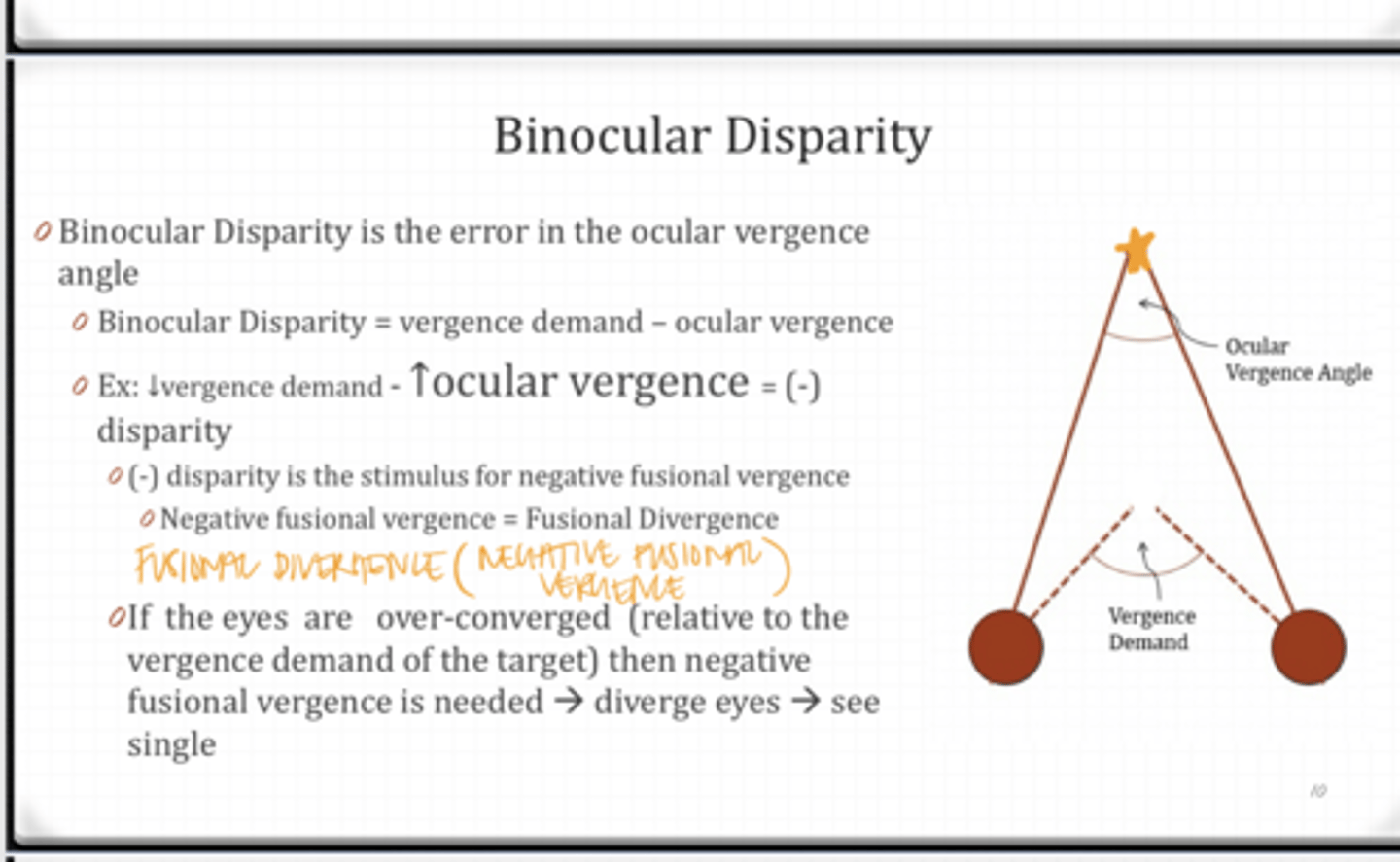
When negative fusional vergence is used in a patient who is over-converged, the patient will see ______
single
What is the only component of vergence driven by a feedback loop?
fusional (disparity) vergence -- we are constantly evaluating disparity and updating fusional vergence
Do we consider using fusional vergence to be work clinically?
yes
In vergence dysfunction, we consider the symptoms to be d/t ______ on the fusional vergence system
strain
What is the main job of the fusional vergence system?
to overcome the phoria -- all of the time!
Is using fusional vergence work?
yes
Can a large phoria cause symptoms?
yes -- d/t stress of the fusional vergence system
When a patient is exophoric, ______ fusional vergence is needed to overcome the phoria
positive
When a patient is esophoric, ______ fusional vergence is needed to overcome the phoria
negative
Is fusional vergence needed ALL THE TIME in a patient who is an EXOphore or ESOphore?
Yes -- in order to see targets as single
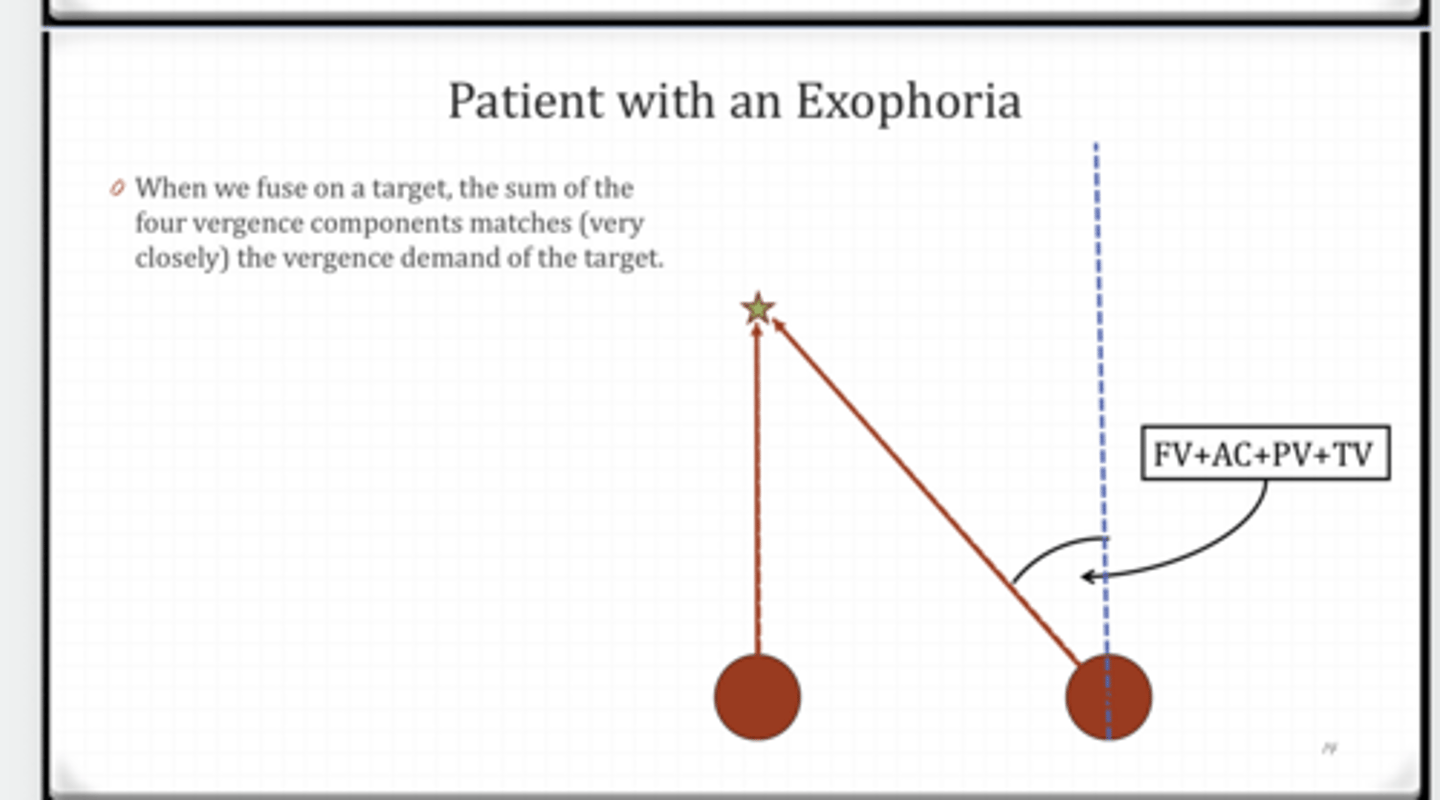
When we fuse a target, the sum of the 4 vergence components (matches/does not match) the vergence demand of an object
matches (very closely)
**FV + AC + PV + TV = total vergence demand
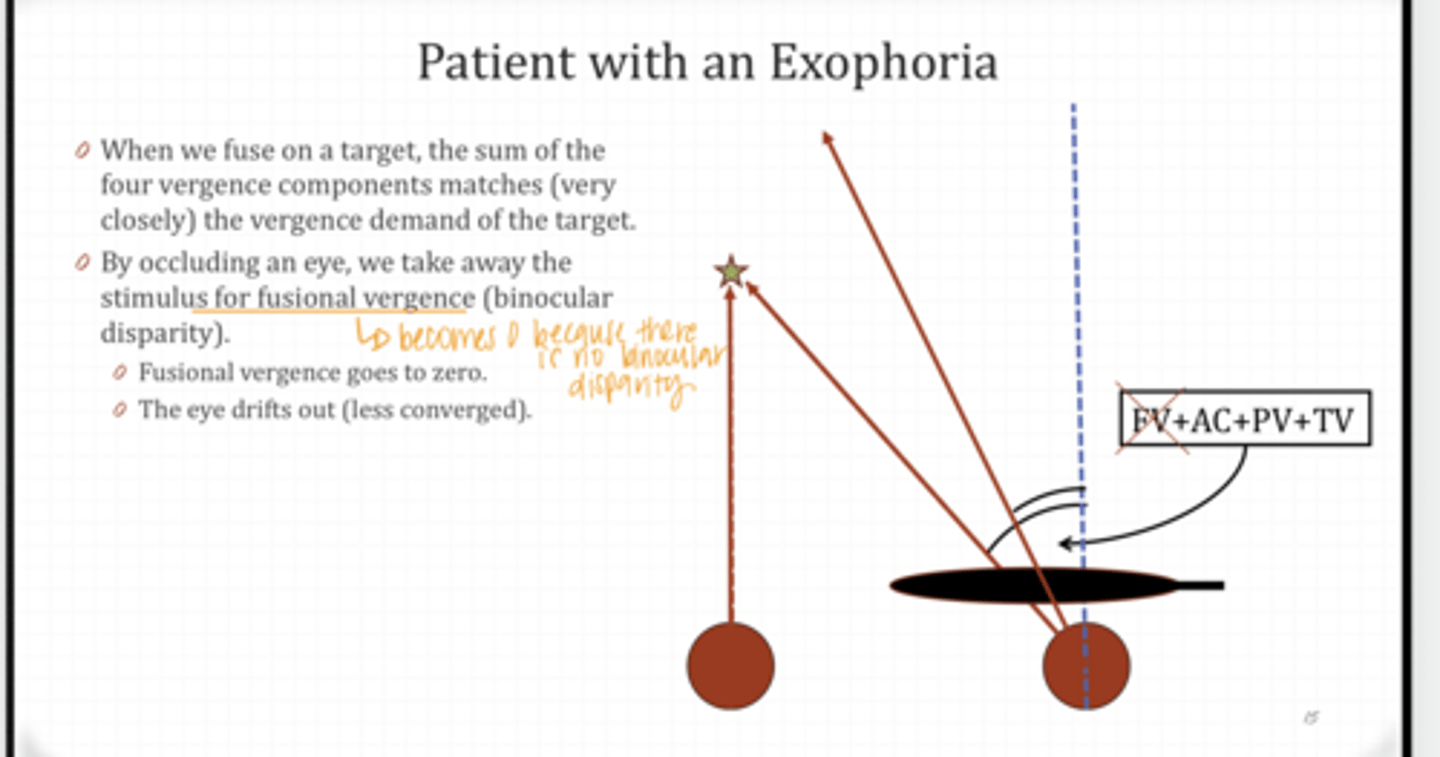
Patient with an EXOphoria Example
By occluding an eye in a patient with an EXO deviation, we will take away what stimulus?
for fusional vergence (binocular disparity)
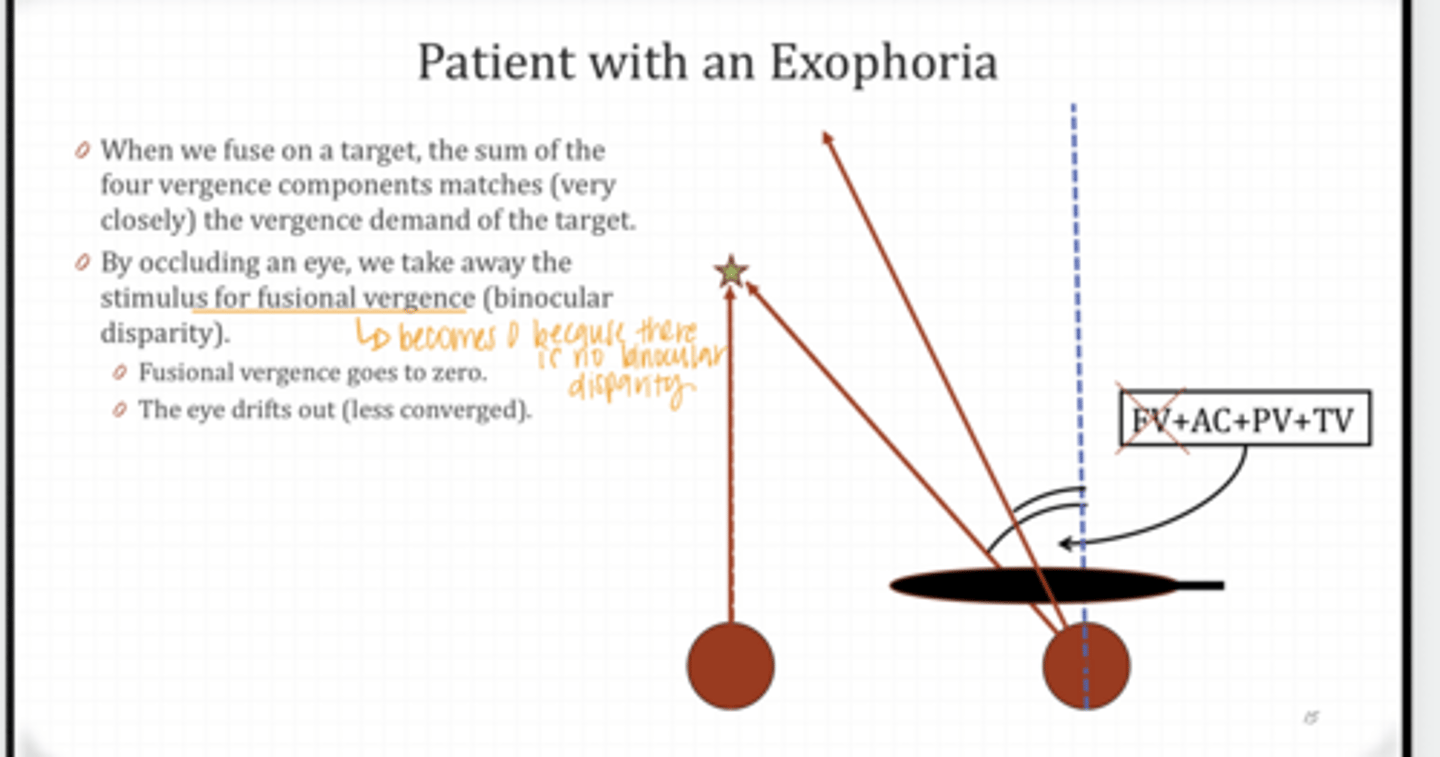
Patient with an EXOphoria Example
The eye will drift where? (more/less) converged?
out -- LESS converged
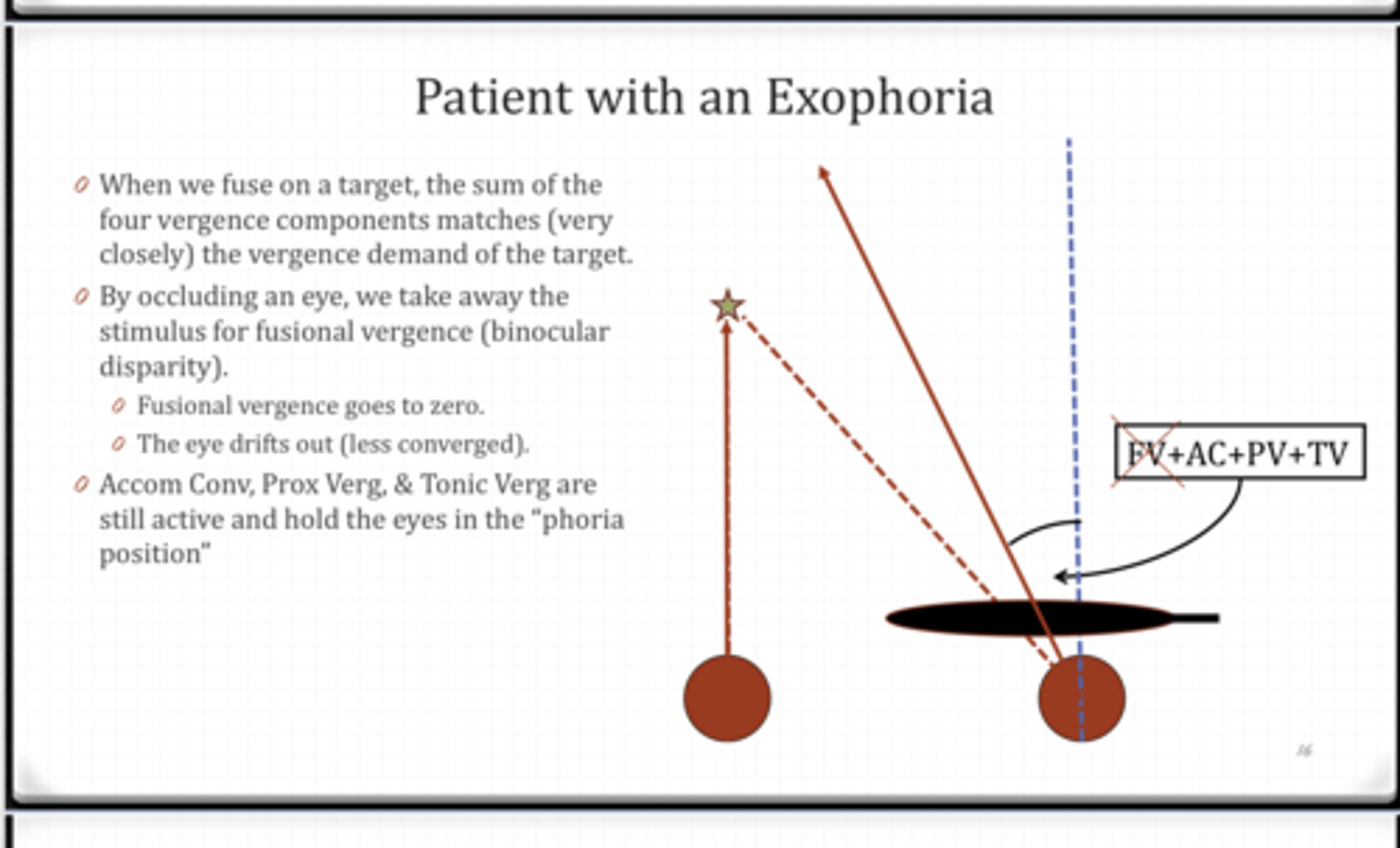
Patient with an EXOphoria Example
If fusional vergence is 0, what is holding the eye in a phoric position?
-accommodative convergence
-proximal vergence
-tonic vergence
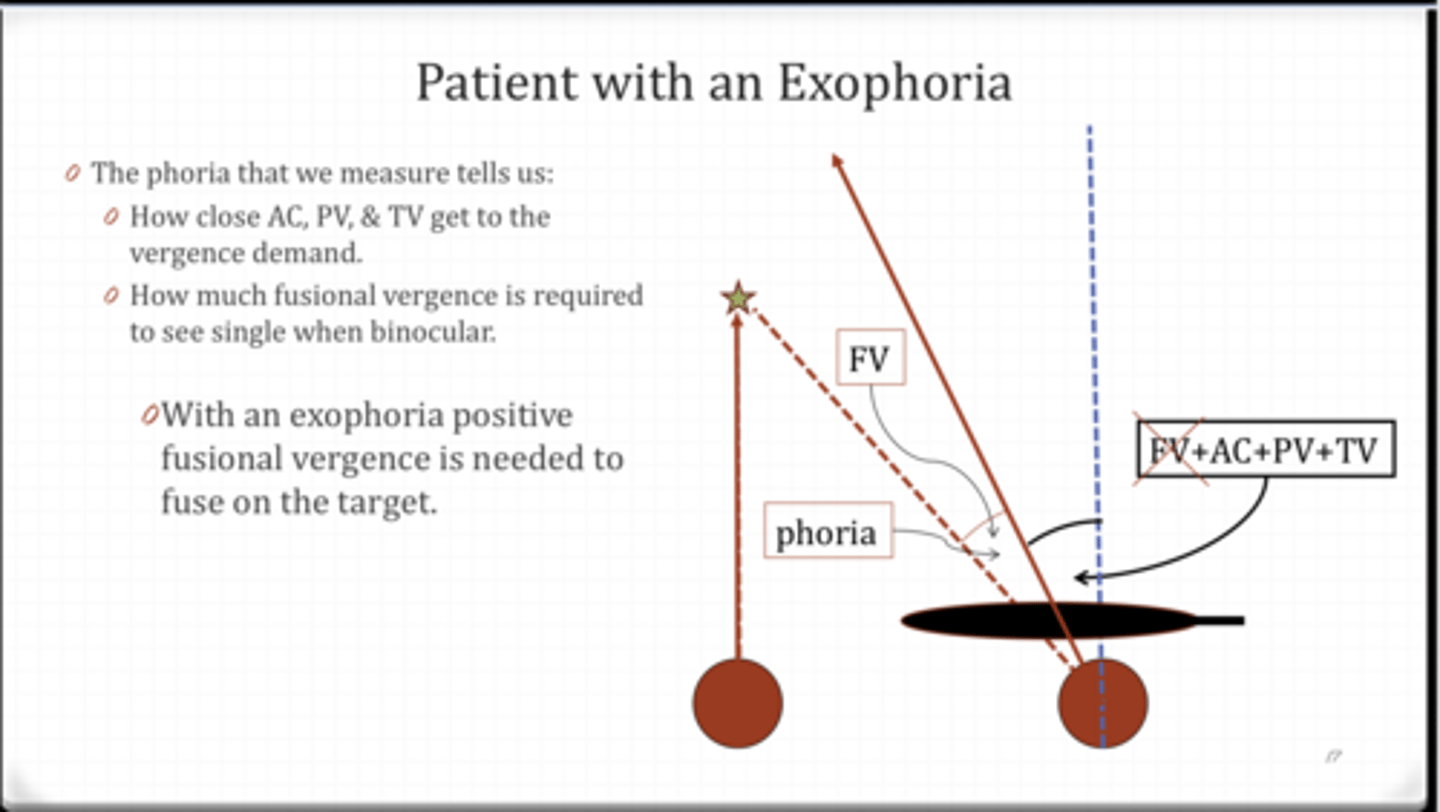
Patient with an EXOphoria Example
What does a phoria that we measure tell us?
-How close AC, PV, TV get to the vergence demand
-How much fusional vergence is needed to see single when binocular
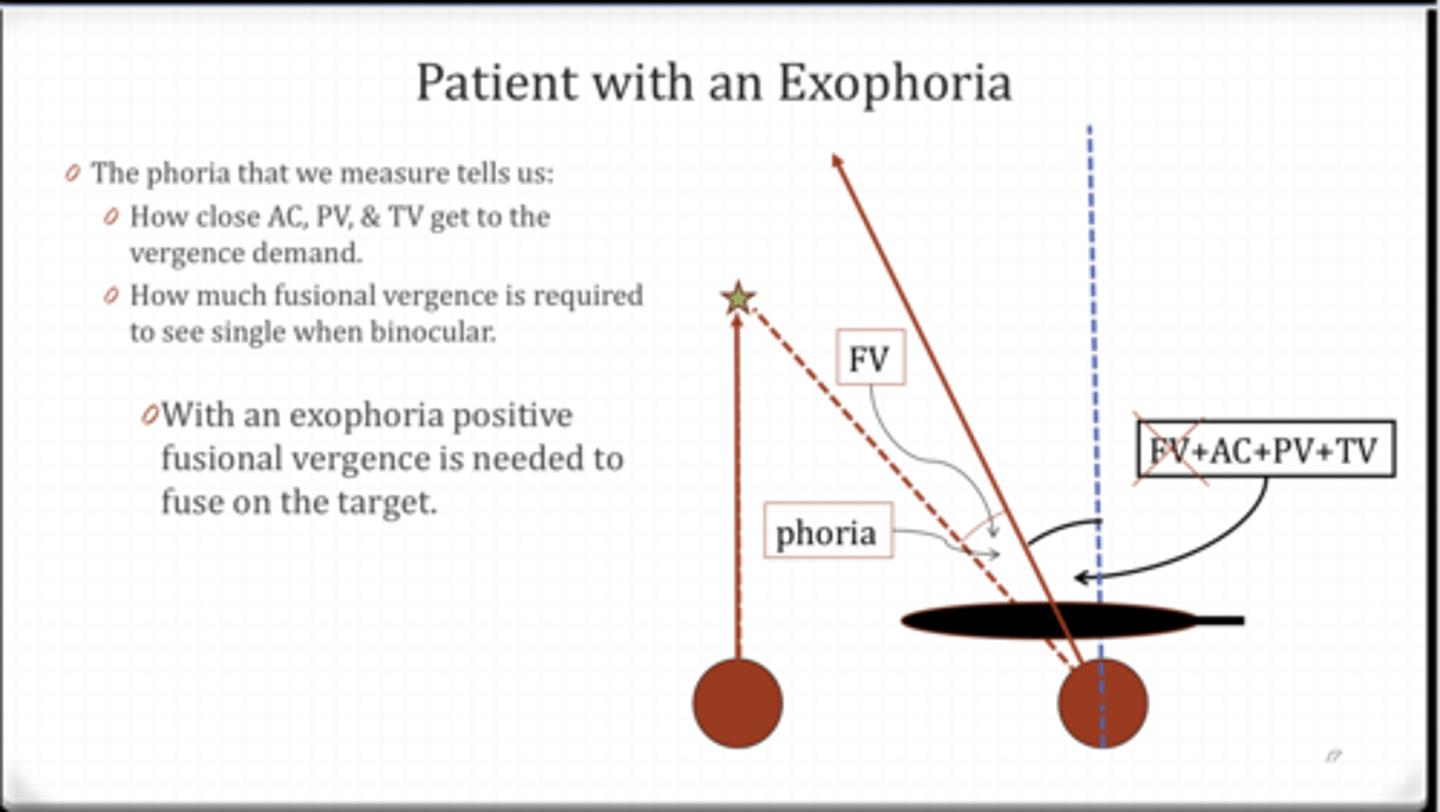
Patient with an EXOphoria Example
With an exophoria (negative/positive) fusional vergence is needed to fuse on the target
positive
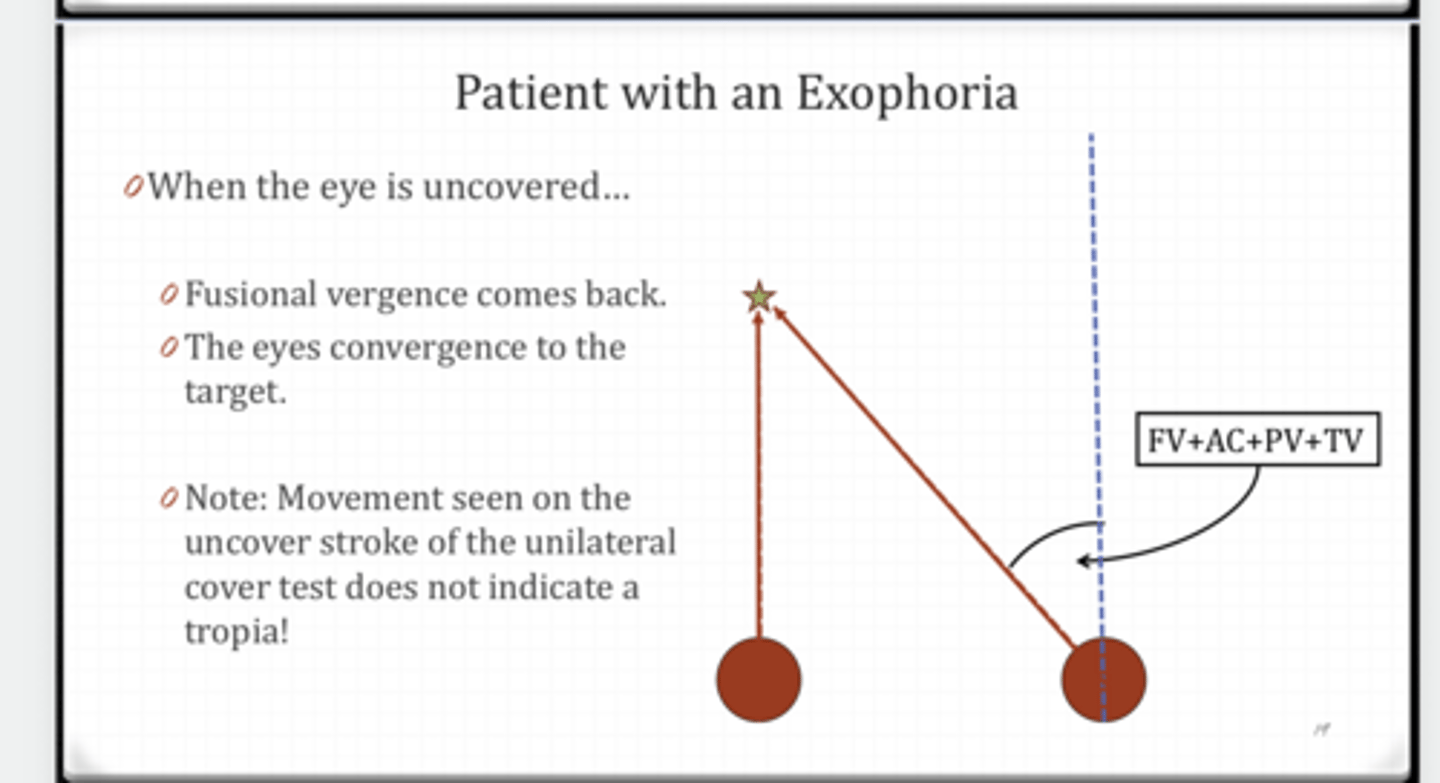
Patient with an EXOphoria Example
When the eye is uncovered what happens?
-Fusional vergence comes back
-The eyes will converge to the target
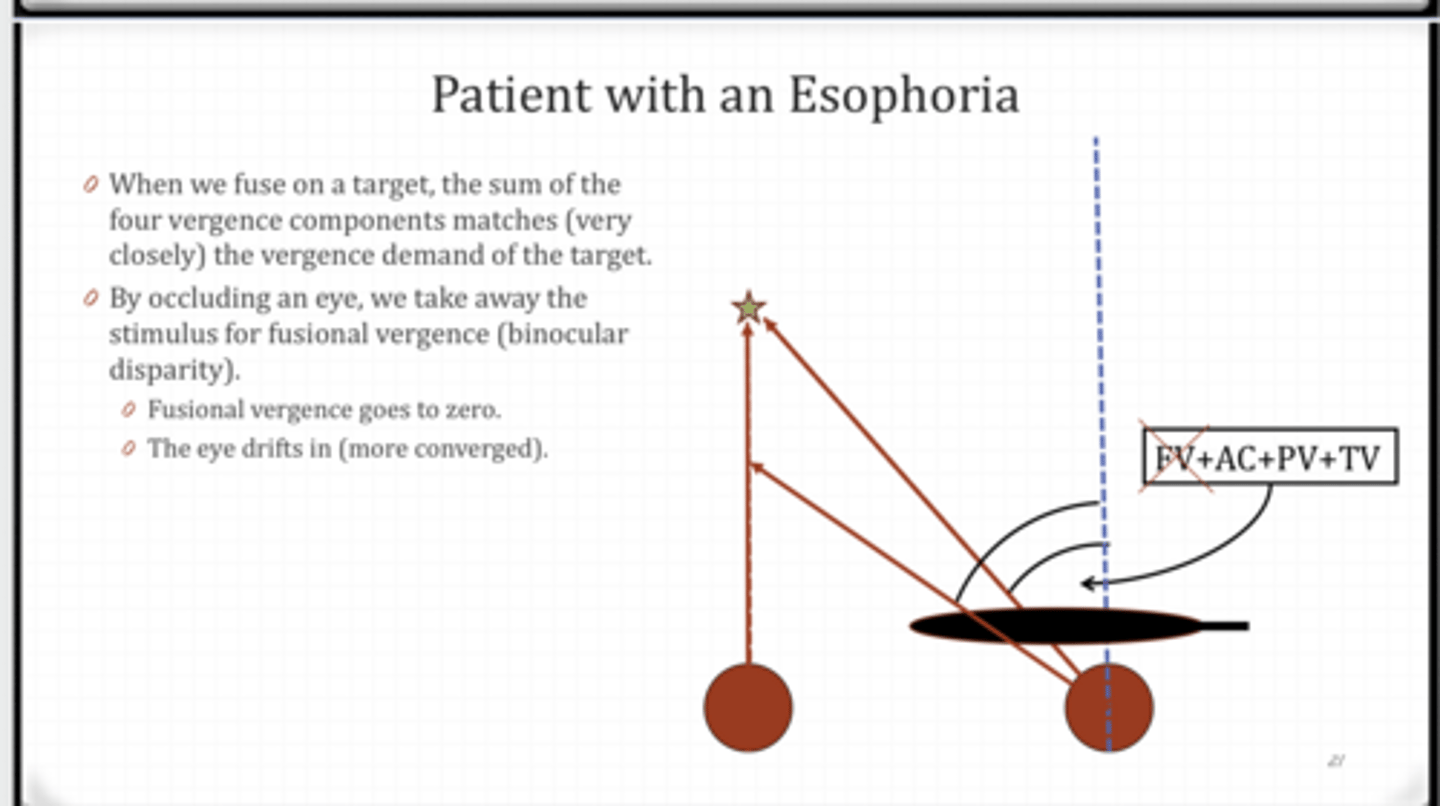
Patient with an ESOphoria Example
By occluding an eye in a patient with an ESO deviation, we will take away what stimulus?
the stimulus for fusional vergence (binocular disparity)
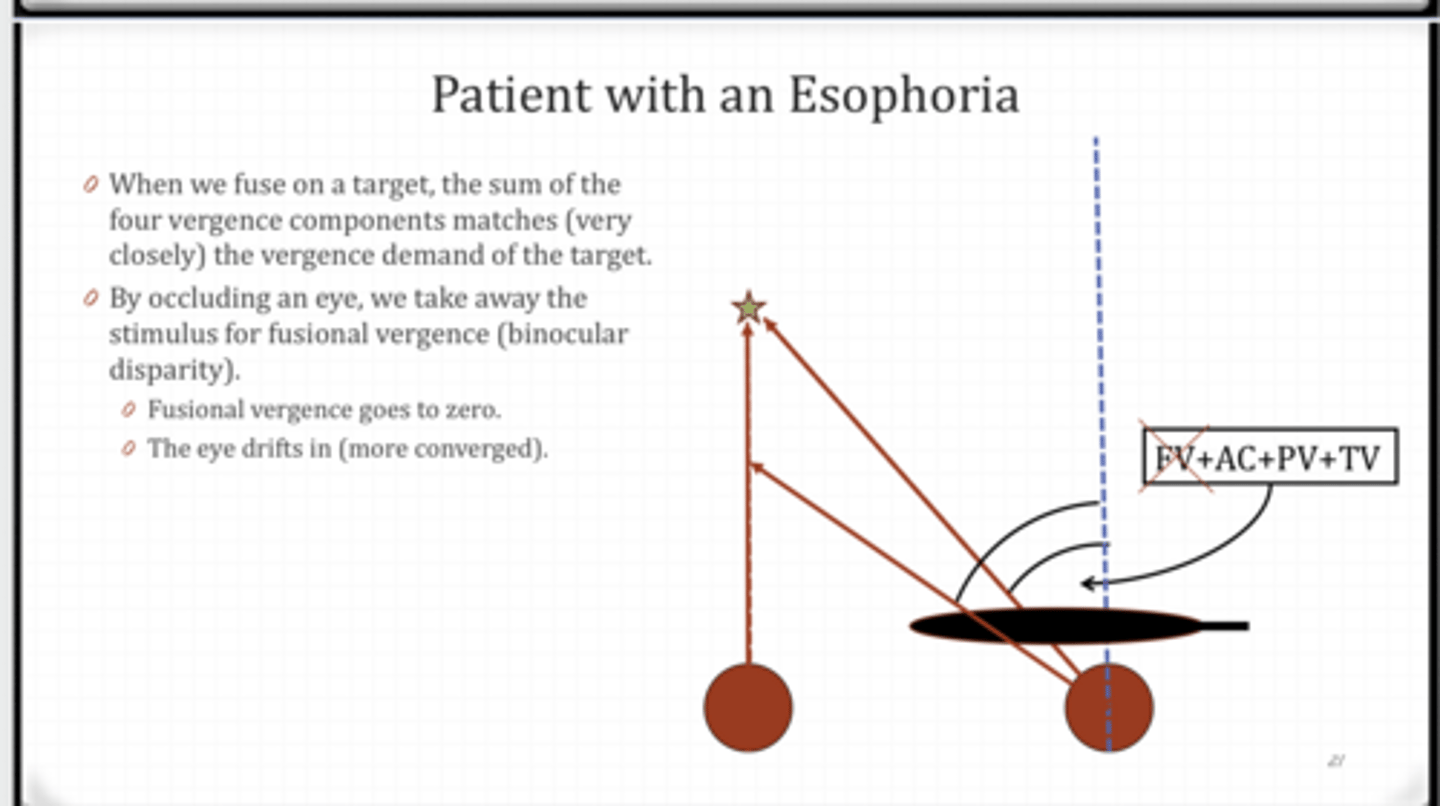
Patient with an ESOphoria Example
The eye will drift where? (more/less) converged?
Eye will drift in -- MORE converged
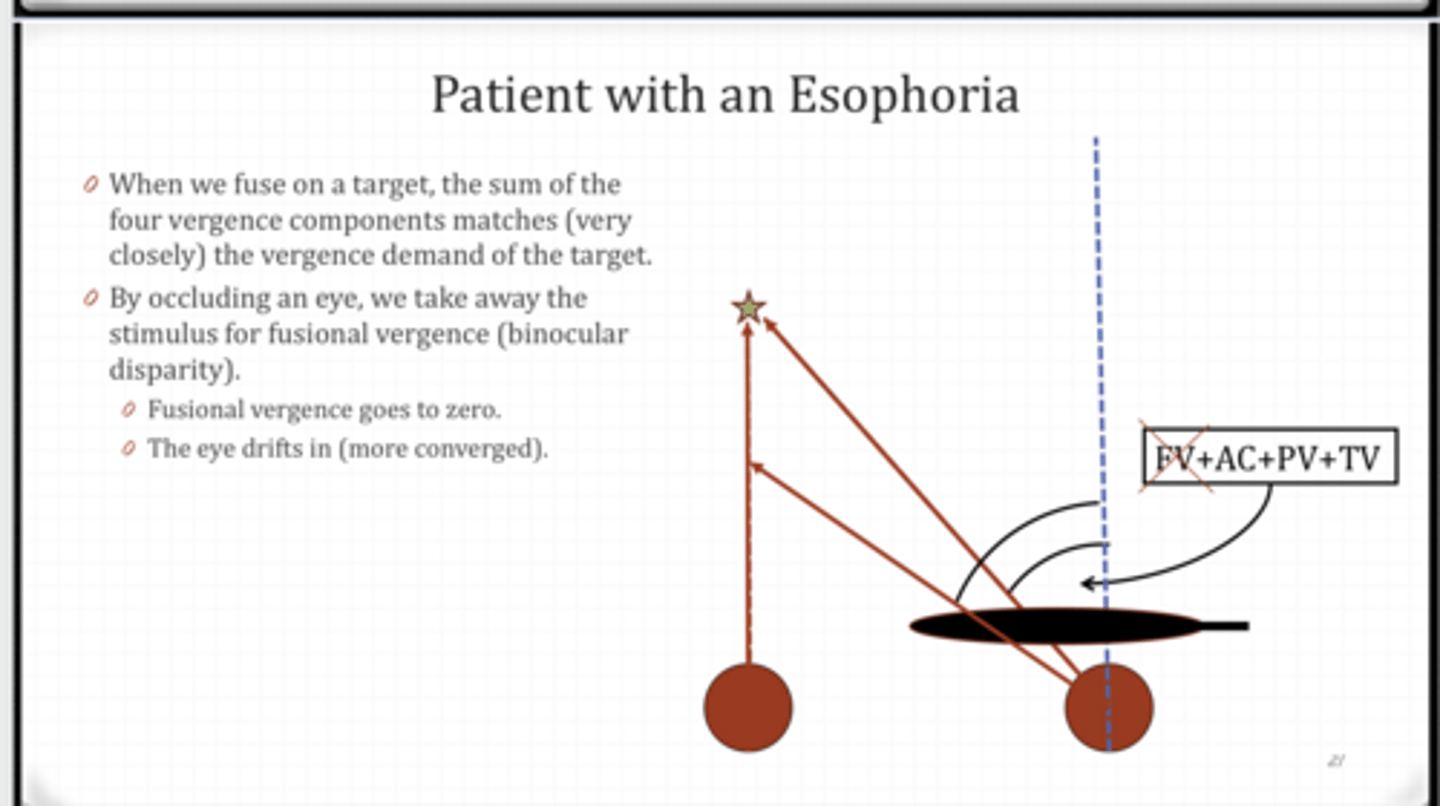
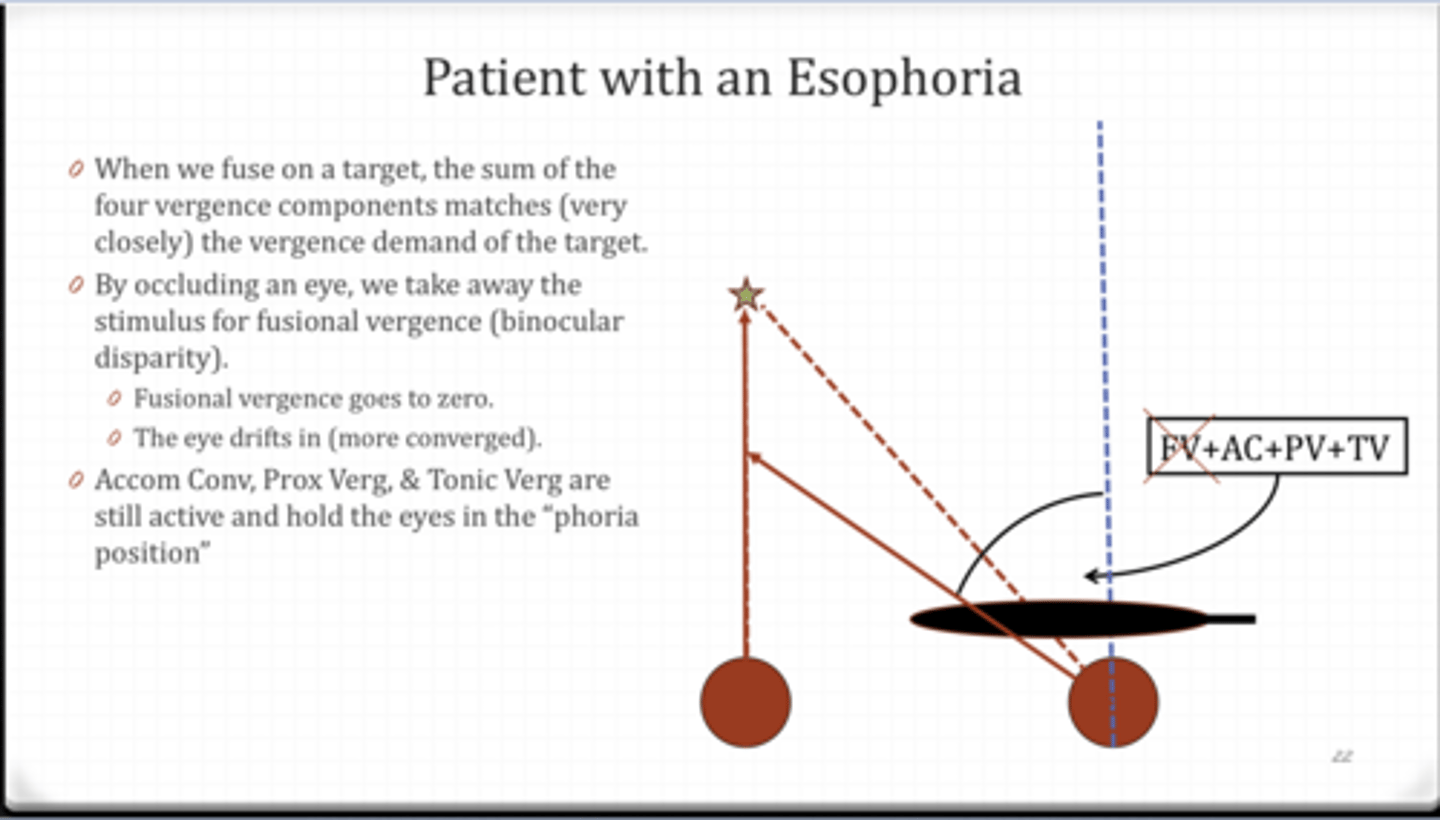
Patient with an ESOphoria Example
If fusional vergence is 0, what is holding the eye in a phoric position?
-accommodative convergence
-proximal vergence
-tonic vergence
Patient with an ESOphoria Example
What does a phoria that we measure tell us?
-How close AC, PV, TV get to the vergence demand
-How much fusional vergence is needed to see single when binocular
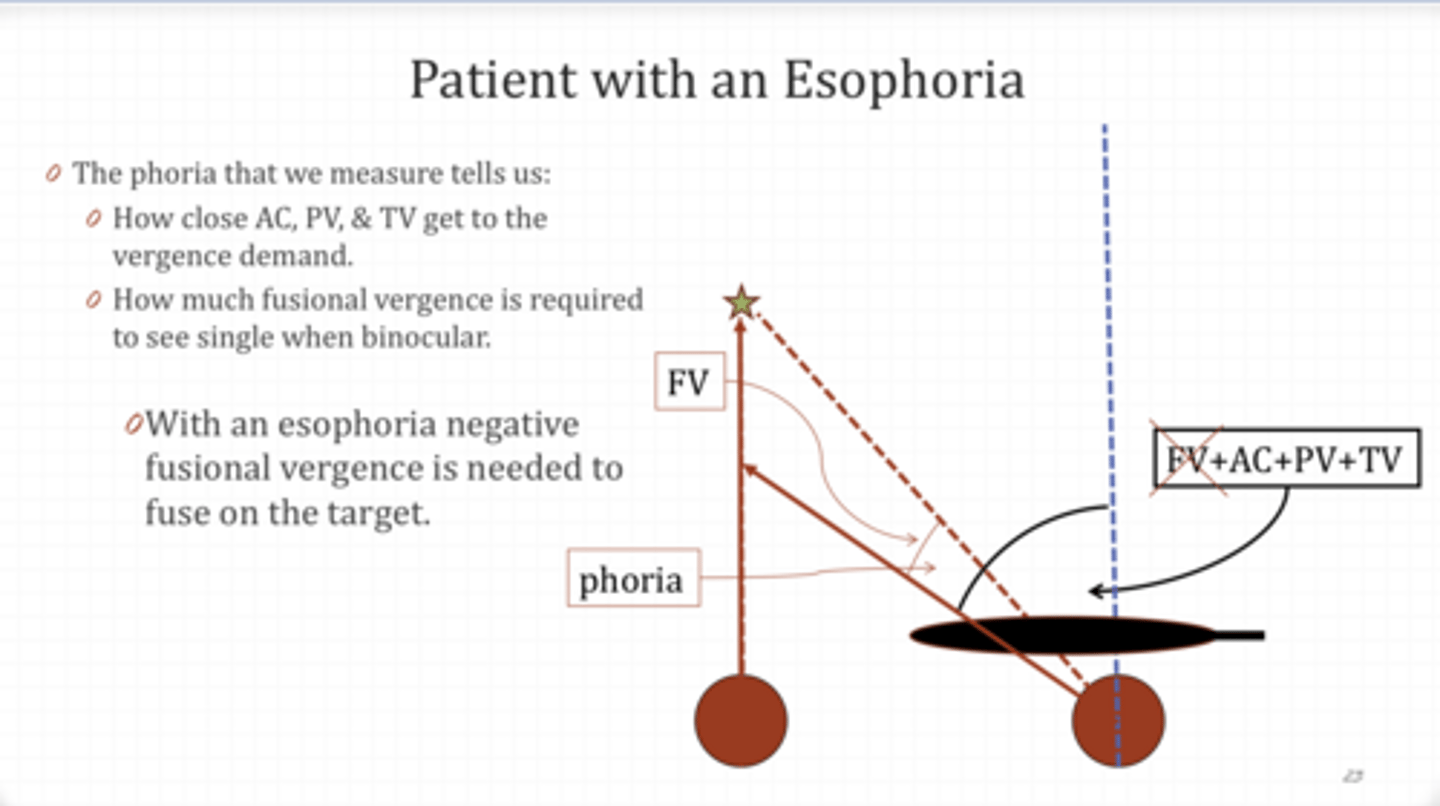
Patient with an ESOphoria Example
With an esophoria (negative/positive) fusional vergence is needed to fuse on the target
negative
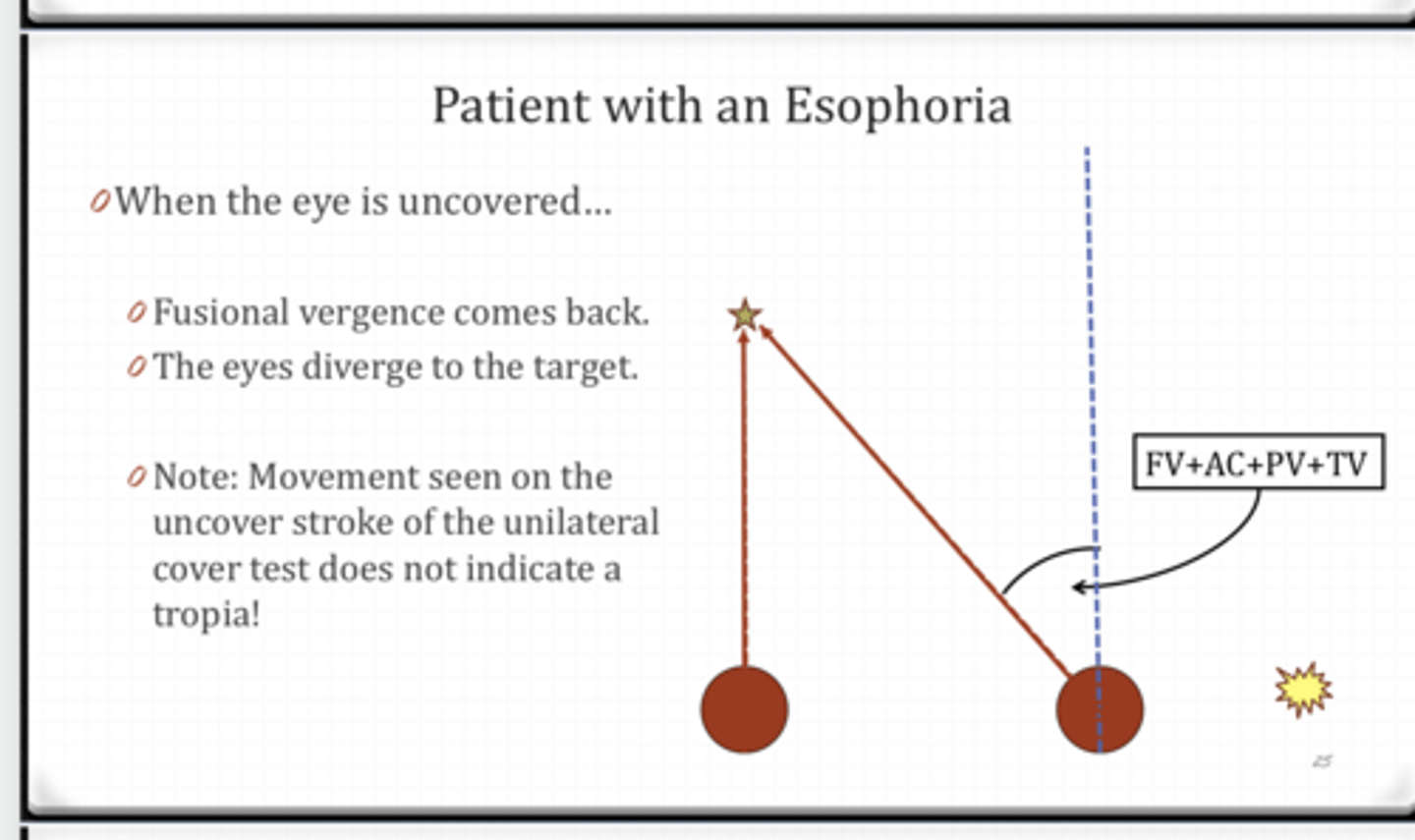
Patient with an ESOphoria Example
When the eye is uncovered what happens?
-fusional convergence comes back
-the eyes diverge to the target
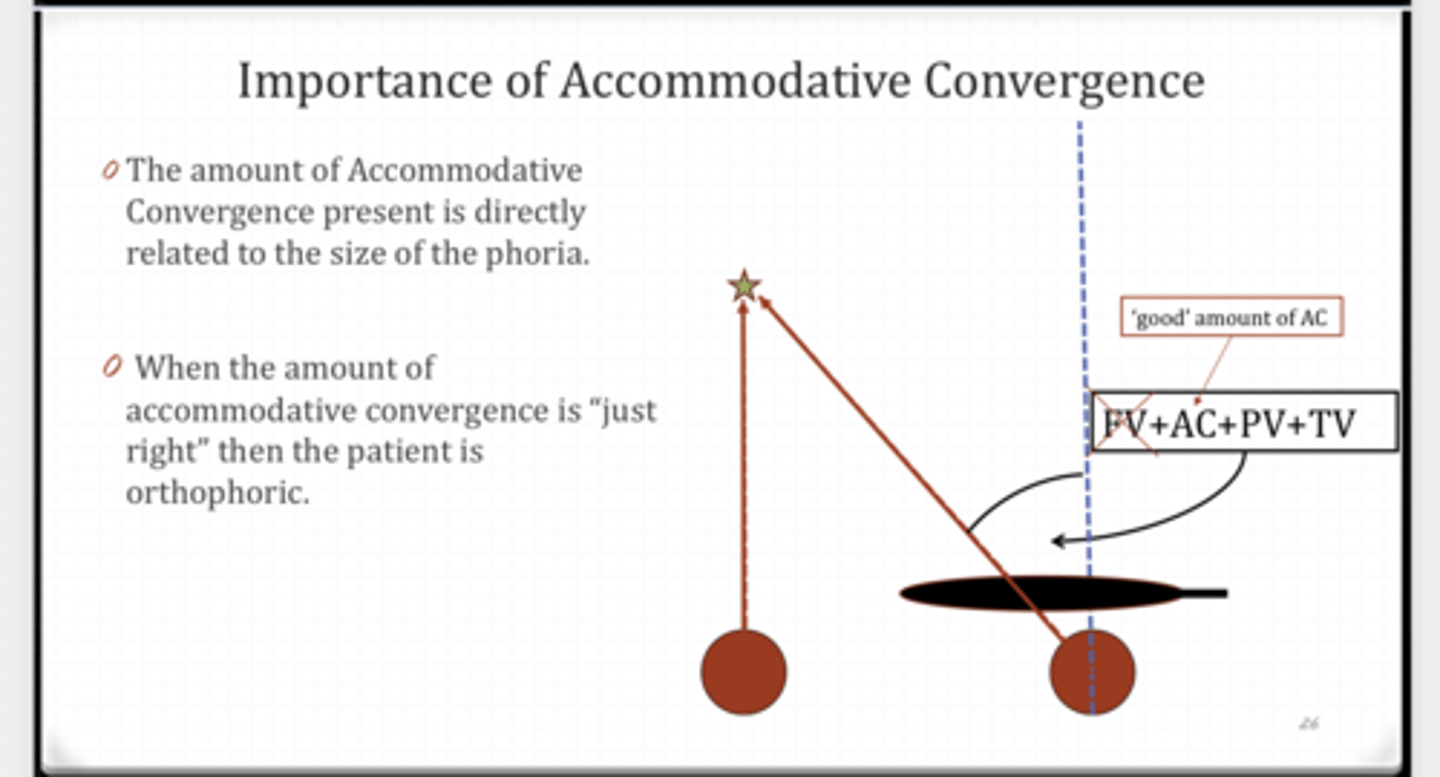
True or False:
The amount of accommodative convergence present is directly related to the size of the phoria
true
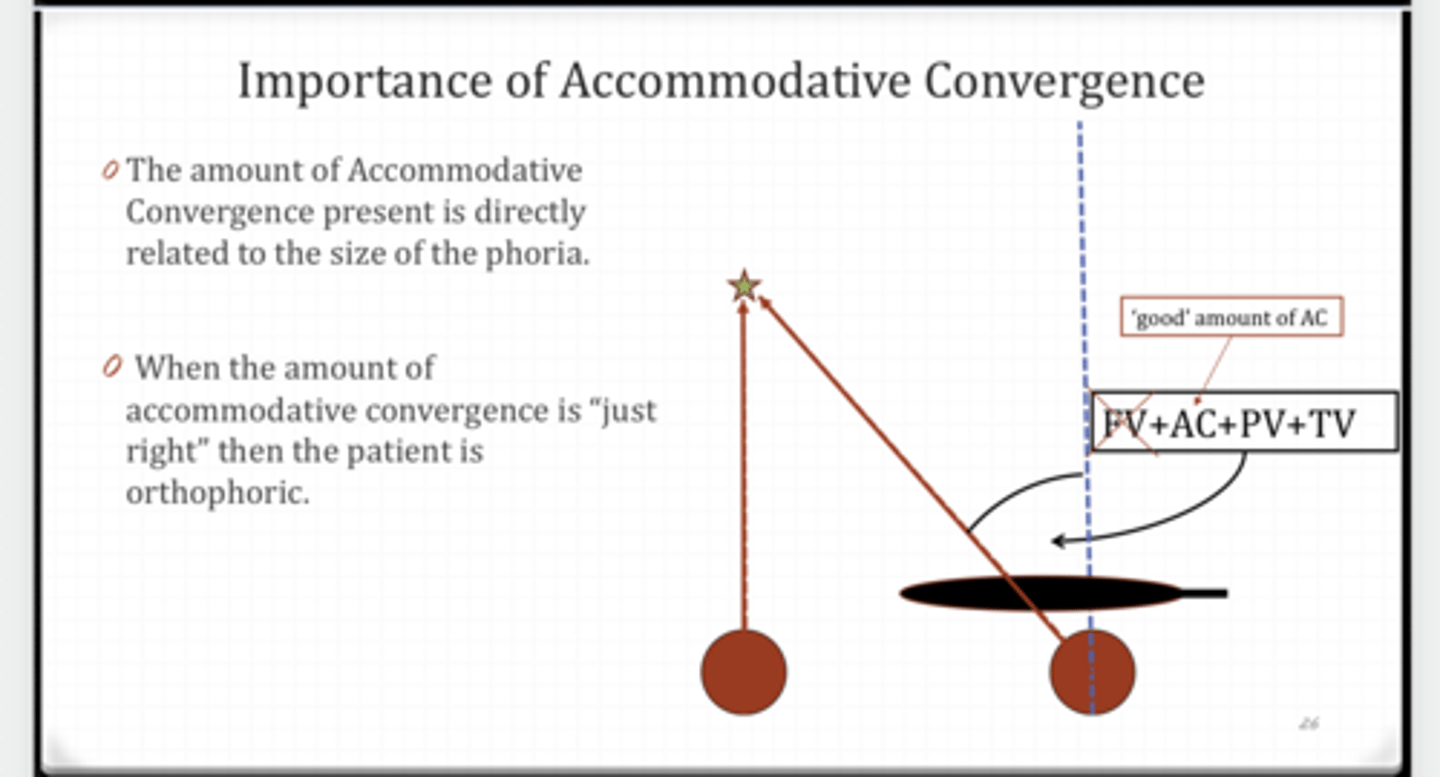
When the amount of accommodative convergence is "just right", the patient will be _______
ORTHO
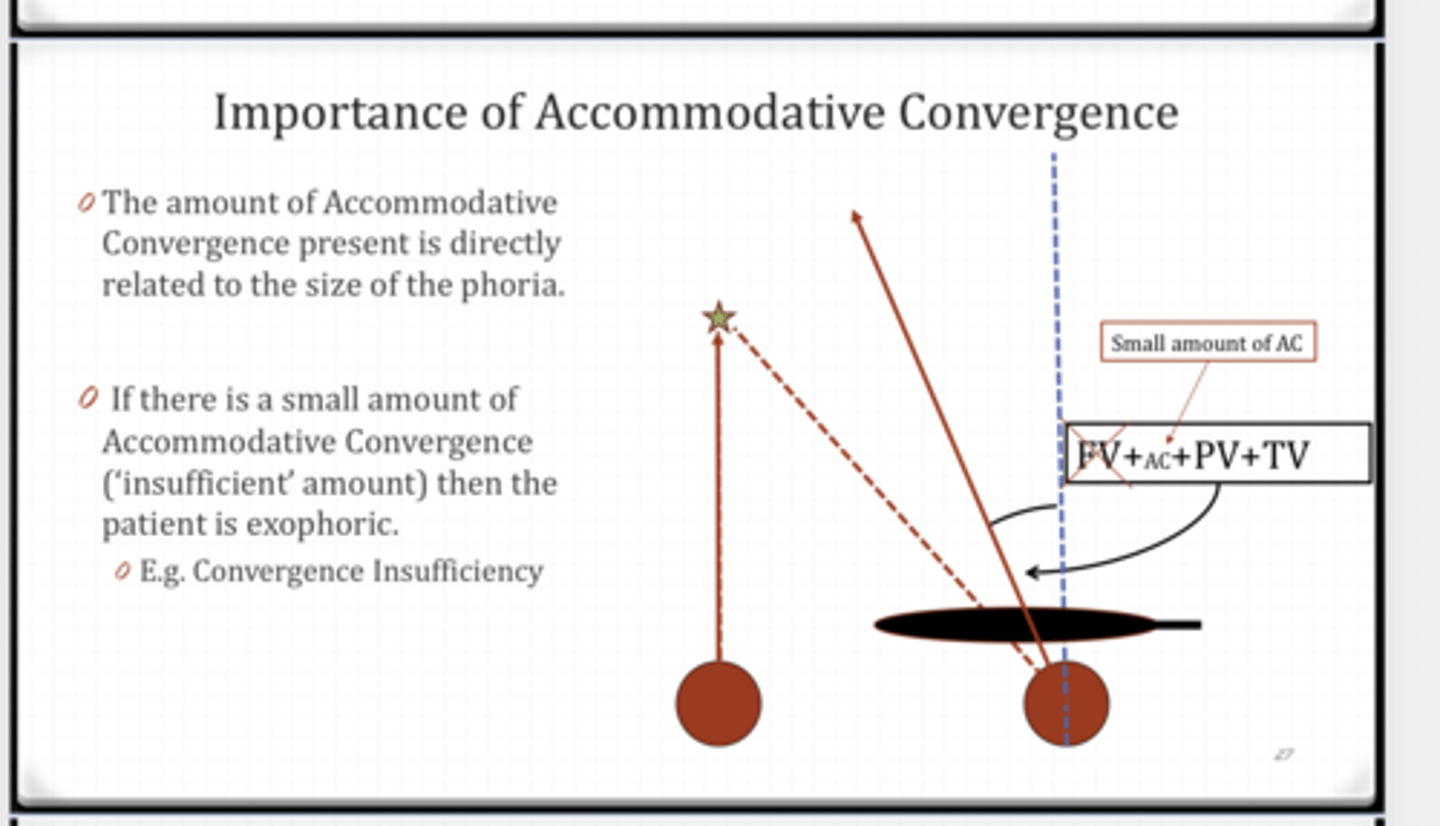
If there is a small amount of accommodative convergence (insufficient), then the patient will be _______
EXOPHORIC -- convergence insufficiency
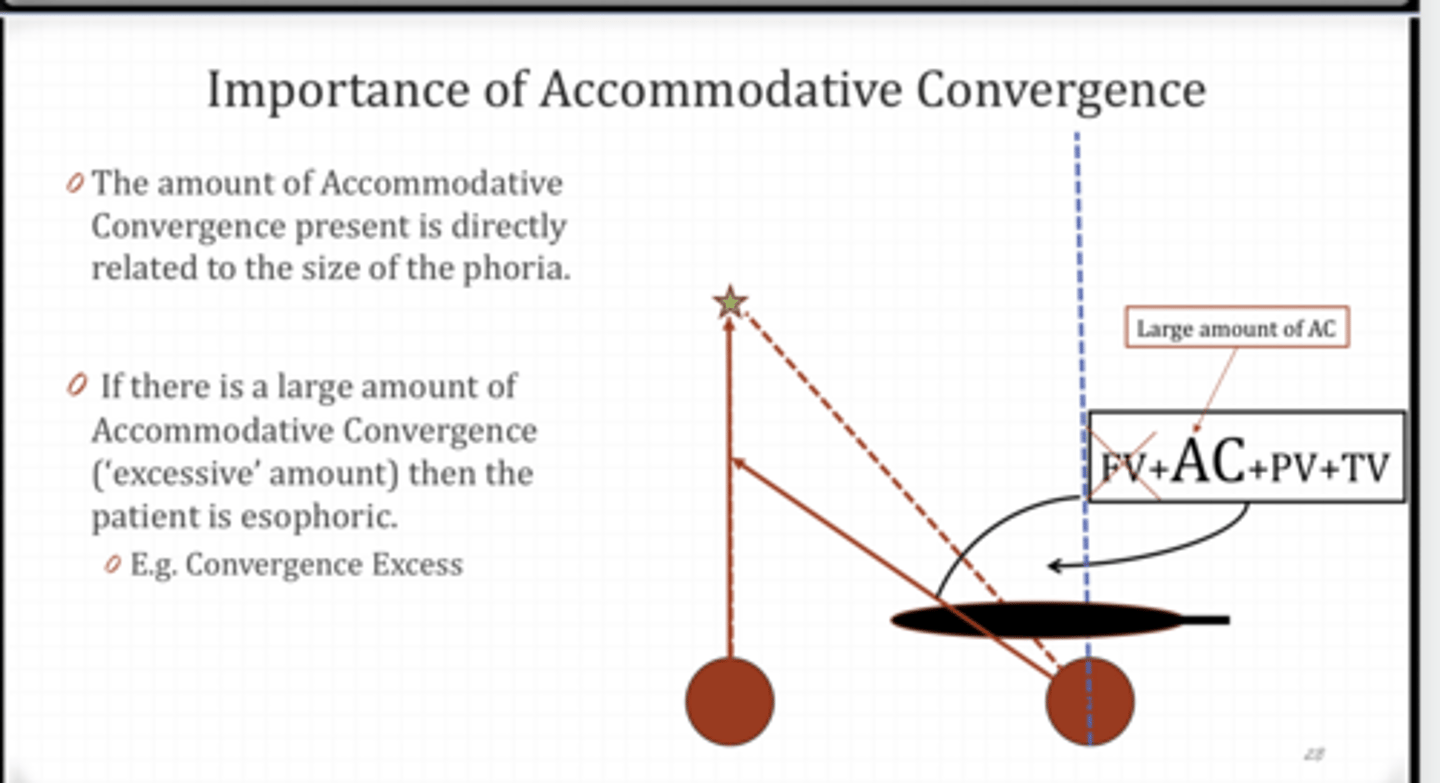
If there is a large amount of accommodative convergence (excessive), then the patient will be _______
ESOPHORIC -- convergence excess
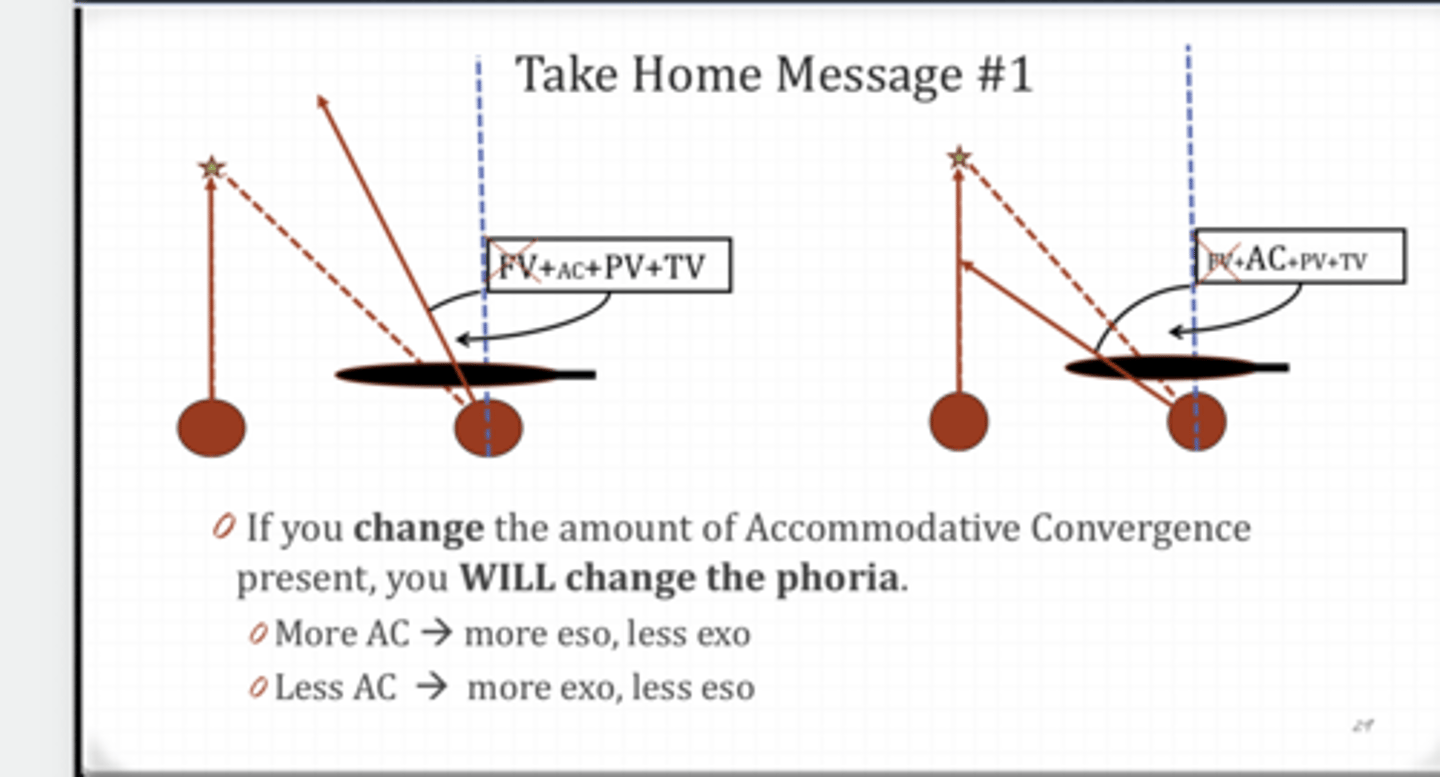
True or False:
If you change the amount of accommodative convergence present, will you change the PHORIA?
yes
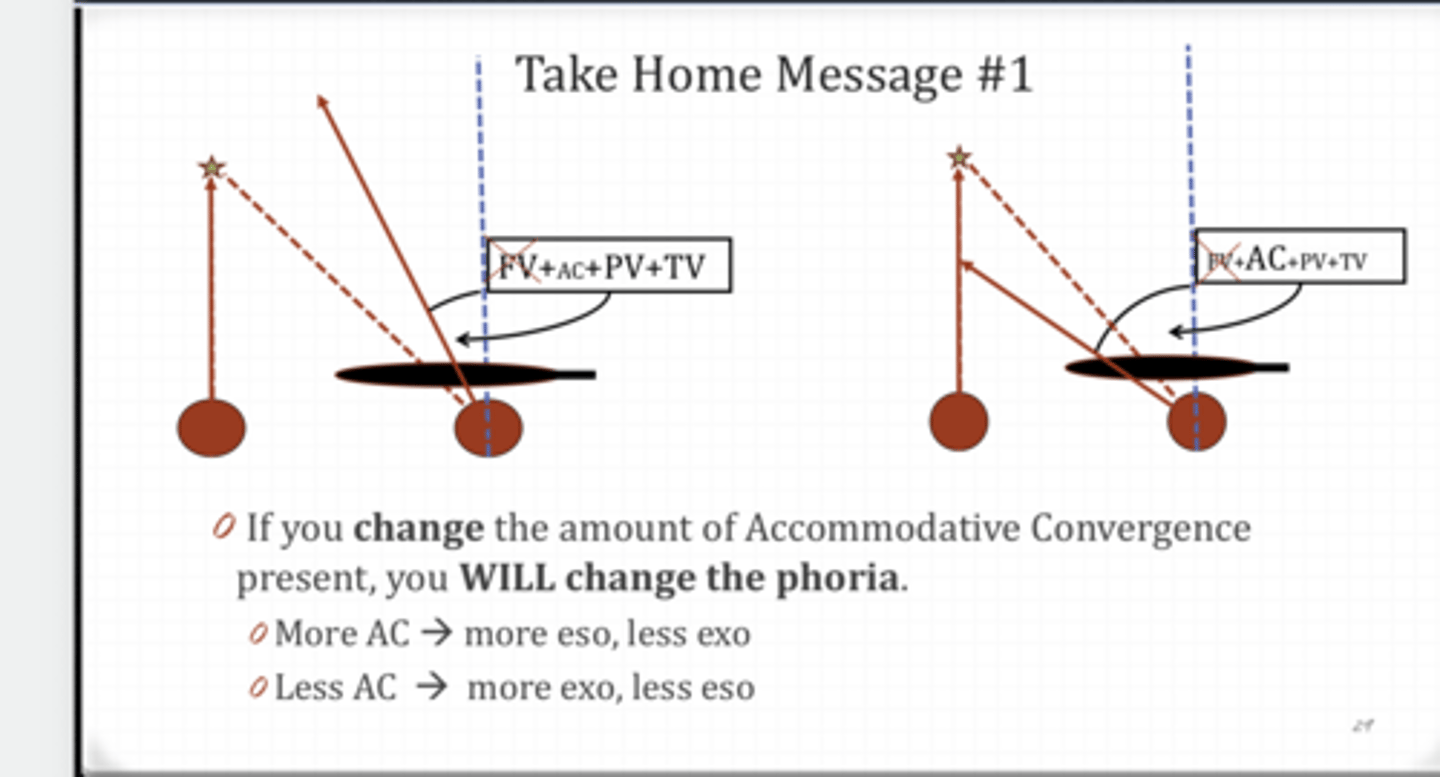
If you have MORE accommodative convergence, what will this do to a patient's phoria?
more eso, less exo
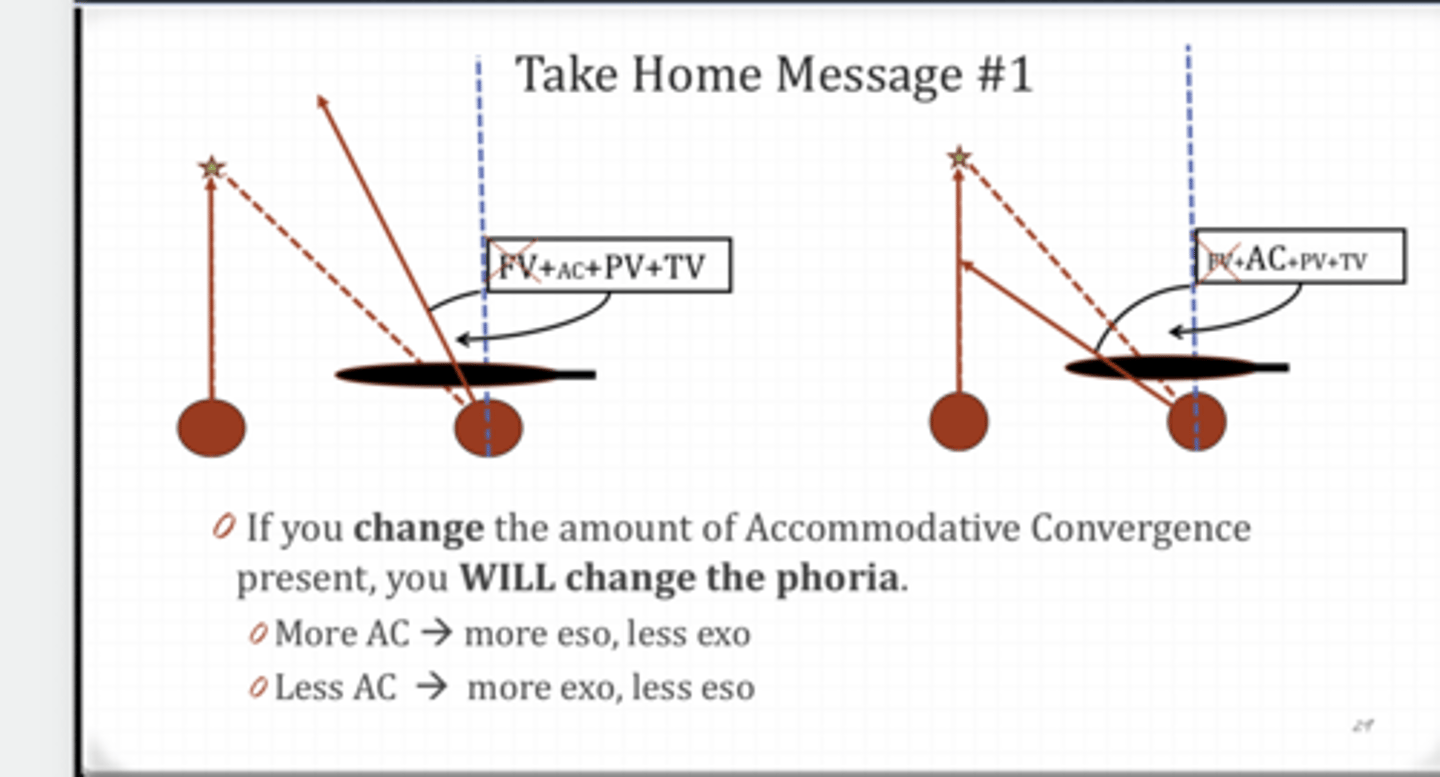
If you have LESS accommodative convergence, what will this do to a patient's phoria?
more exo, less eso
What determines the amount of accommodative convergence present?
-the amount the patient is accommodating
-the AC/A ratio
The more a patient is accommodating, the (more/less) accommodative convergence that is present
more
What is the AC/A Ratio?
the amount of accommodative convergence generated per diopter of accommodation
If the patient has a higher AC/A ratio, there will be a (larger/smaller) amount of accommodative convergence present when looking at near
larger
Accommodative Convergence = ?
Accommodation Amount * AC/A
How can we change the amount of accommodative convergence our patient has?
-We cannot change a patient's AC/A ratio
-We CAN change the amount our patient is accommodating (changing the demand of a target)
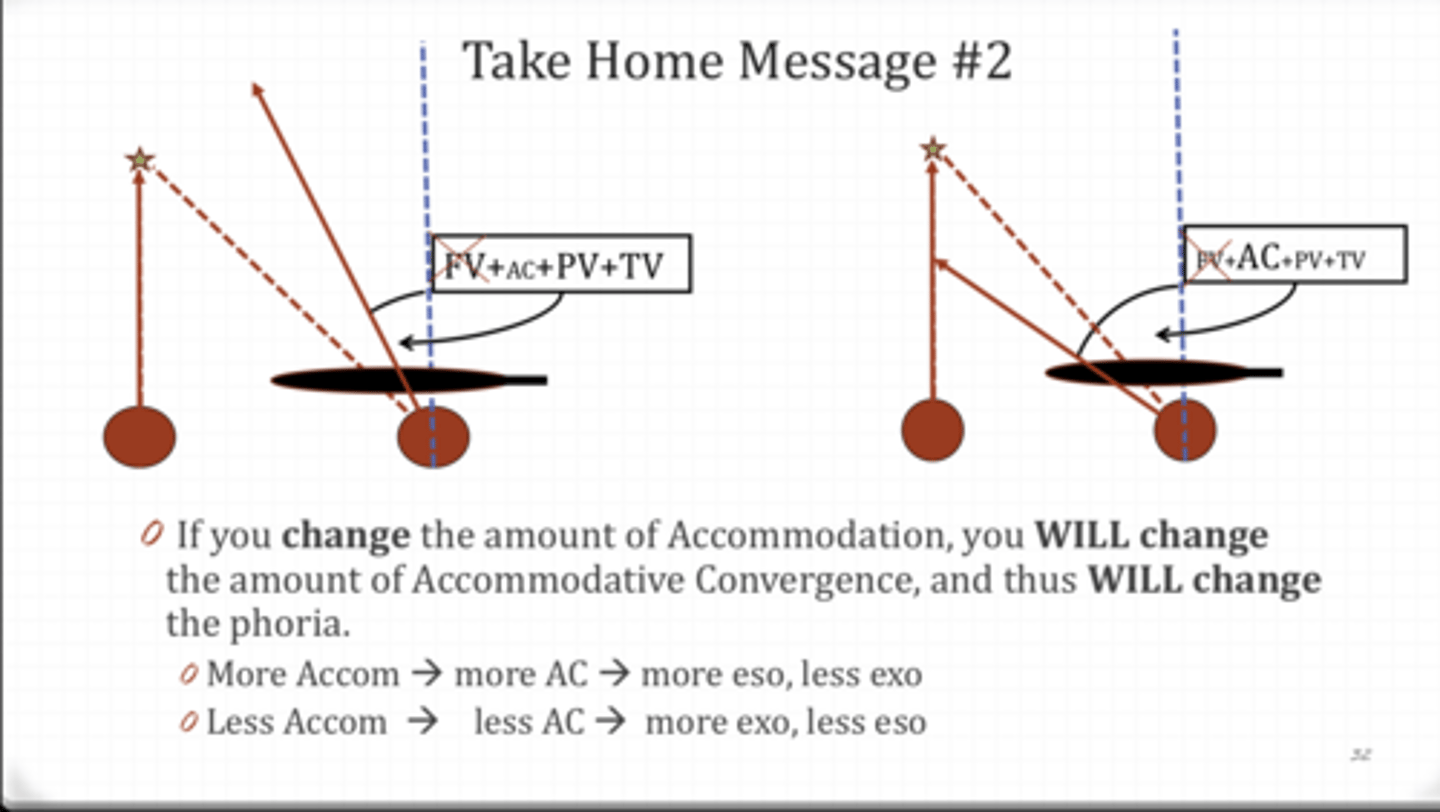
SUMMARY:
If you change the amount of accommodation, you (will/will not) change the amount of accommodative convergence
will
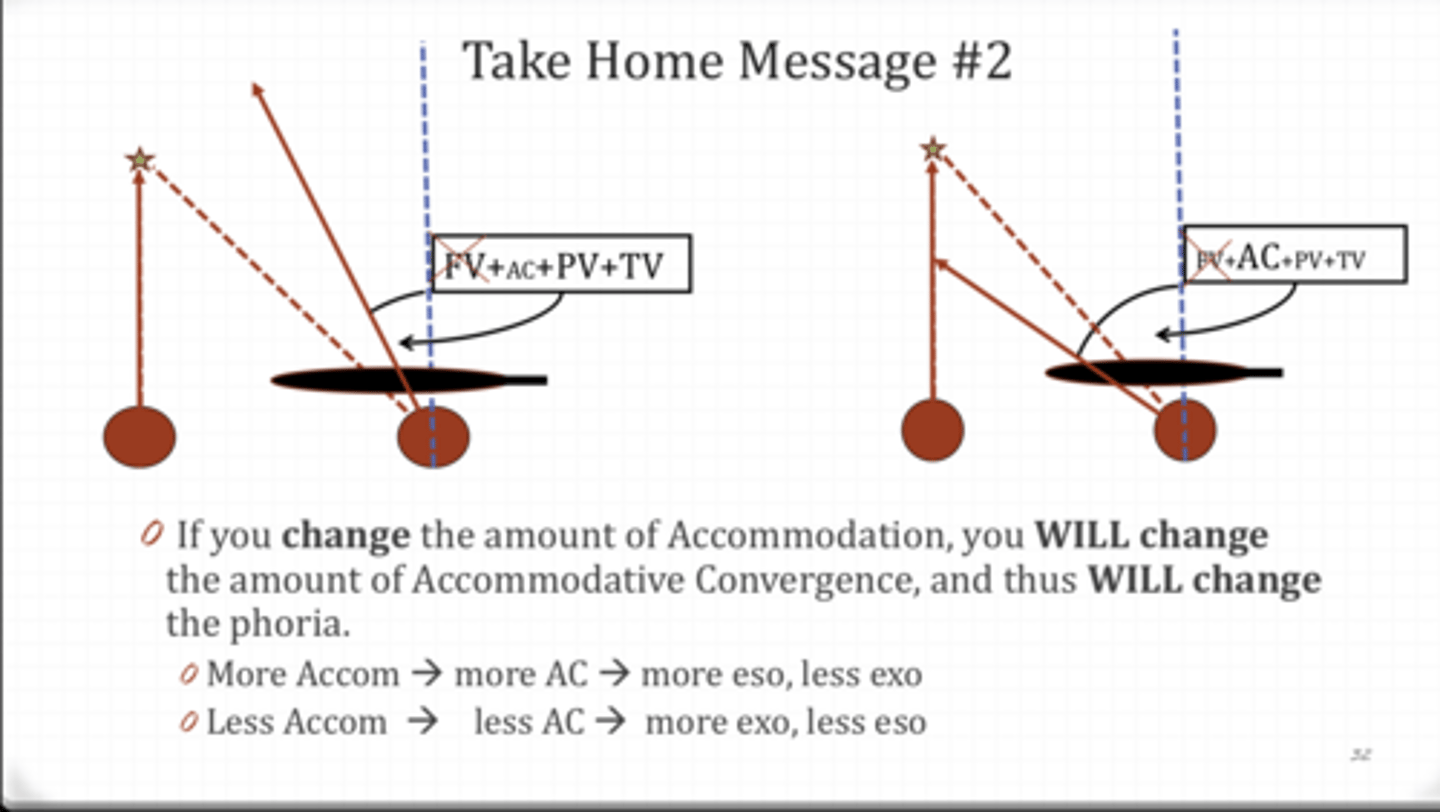
SUMMARY:
If you change the amount of accommodation, you will change the amount of accommodative convergence, thus you (will/will not) change the phoria of the patient
will
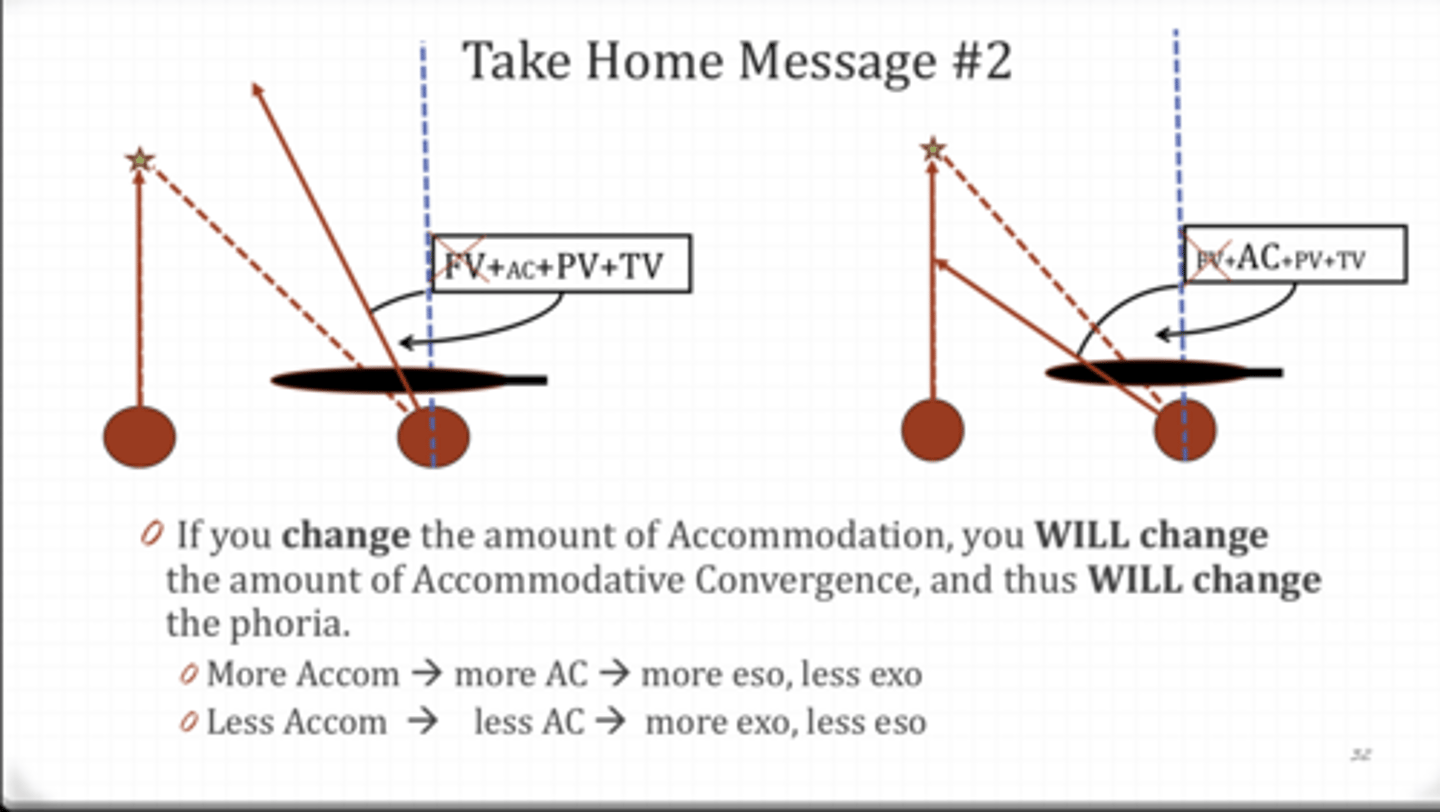
SUMMARY:
If a patient accommodates more, their accommodative convergence will be higher, and thus the patient will be more (eso/exo)?
more eso, less exo
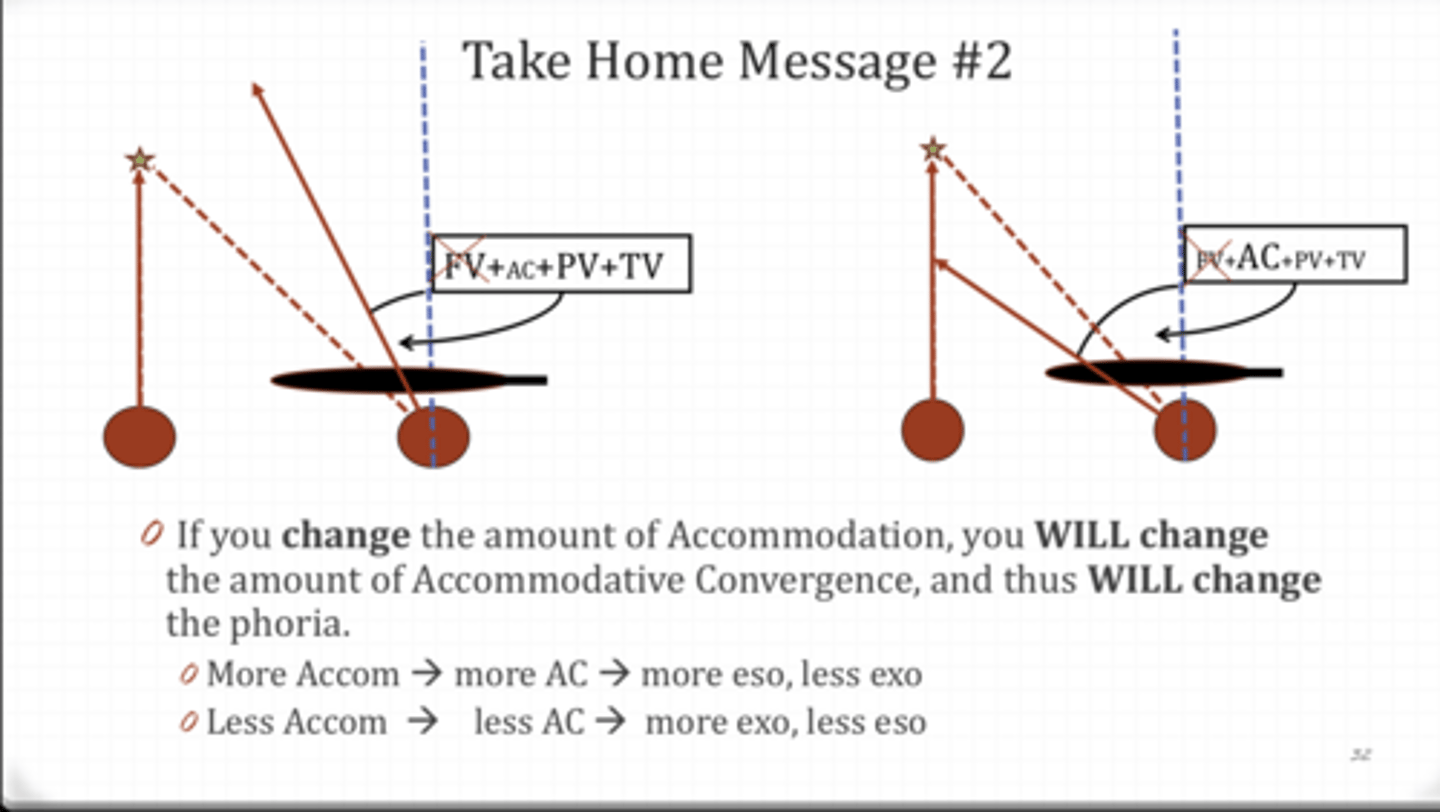
If a patient accommodates less, their accommodative convergence will be lower, and thus the patient will be more (eso/exo)?
more exo, less eso
REVIEW: What does a phoria tell us?
The phoria tell us how much fusional vergence is required for single vision
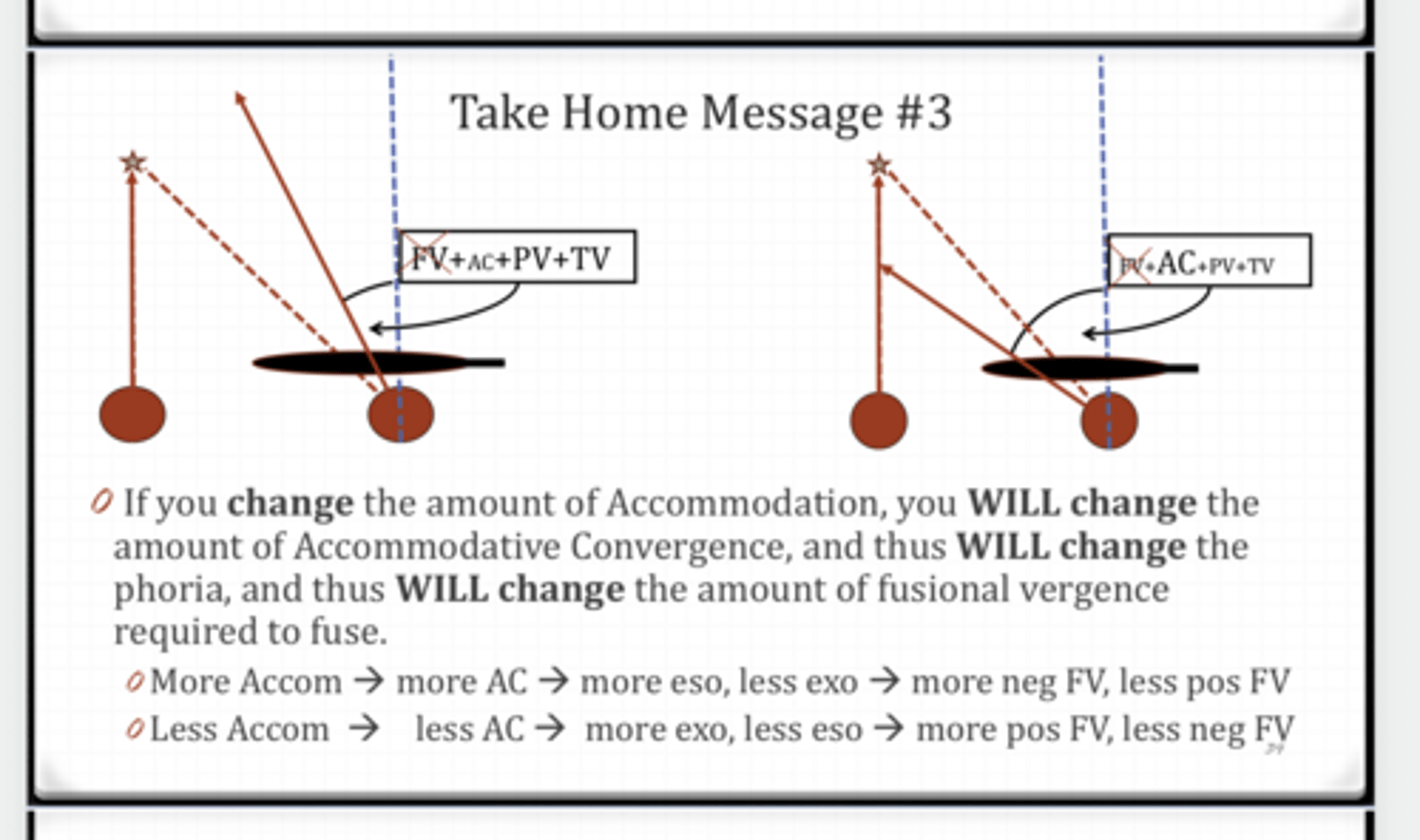
If a patient accommodates more, their accommodative convergence will be higher, and thus the patient will be more eso. They will have to use more (negative/positive) fusional vergence to fuse the target.
negative
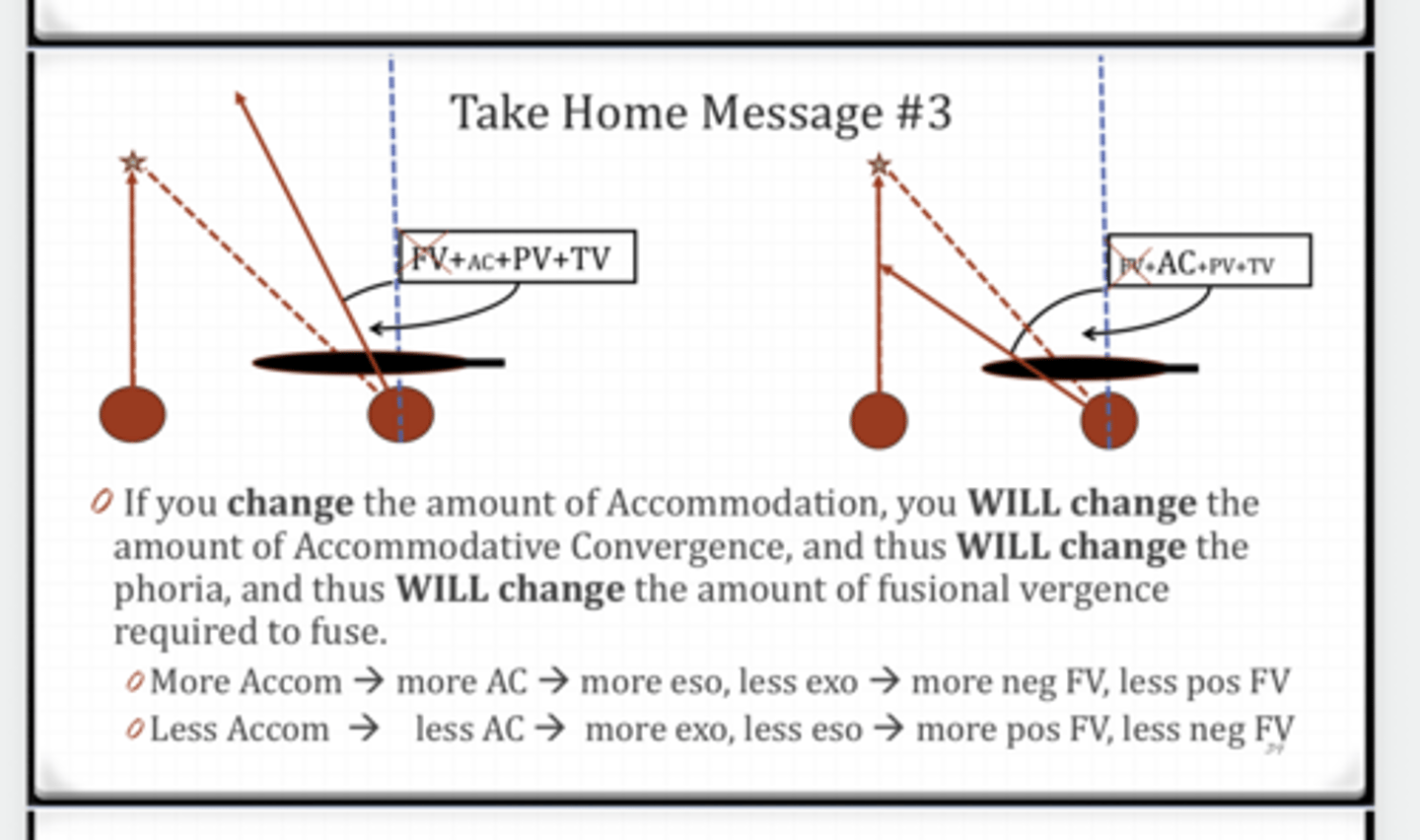
If a patient accommodates less, their accommodative convergence will be lower, and thus the patient will be more exo. They will have to use more (negative/positive) fusional vergence to fuse the target.
positive
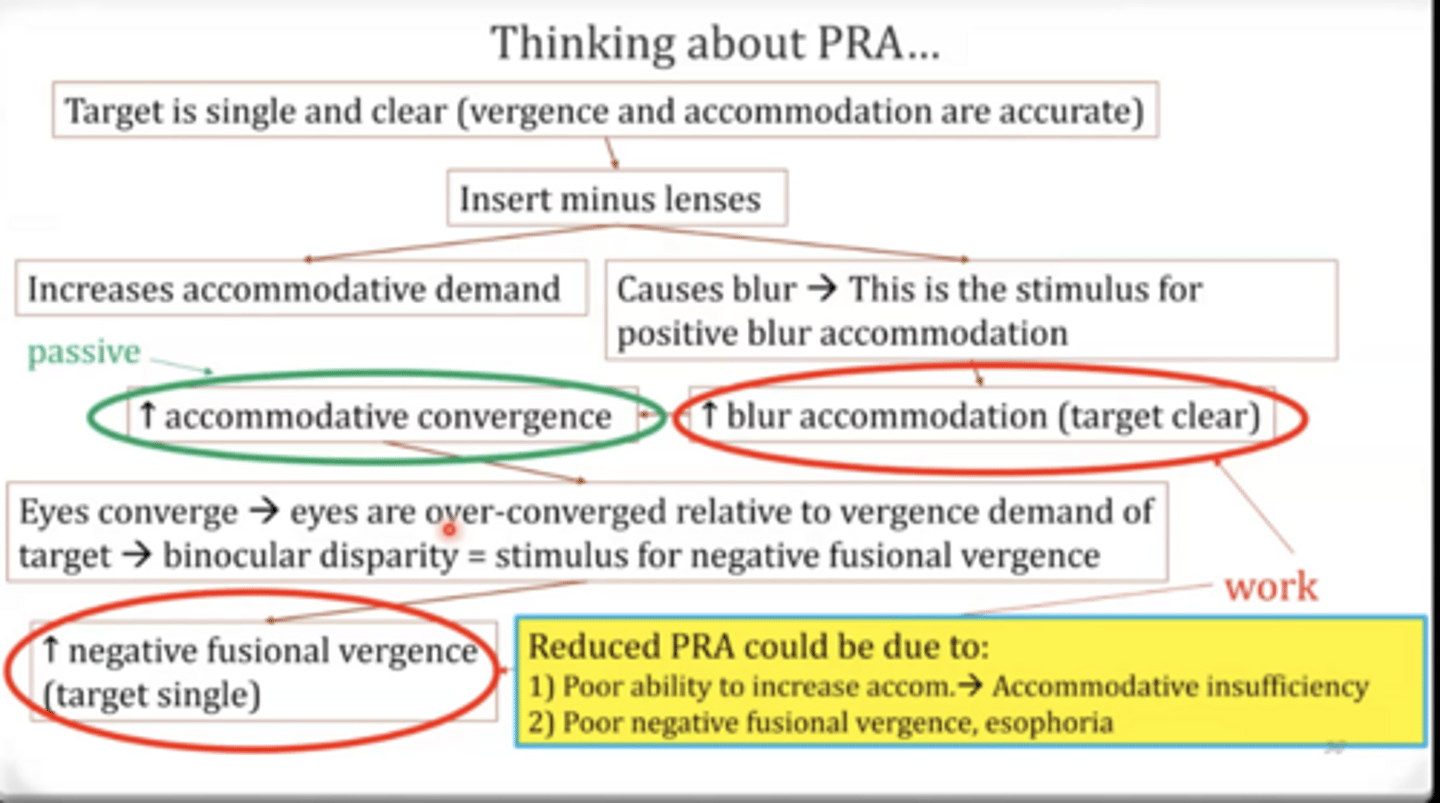
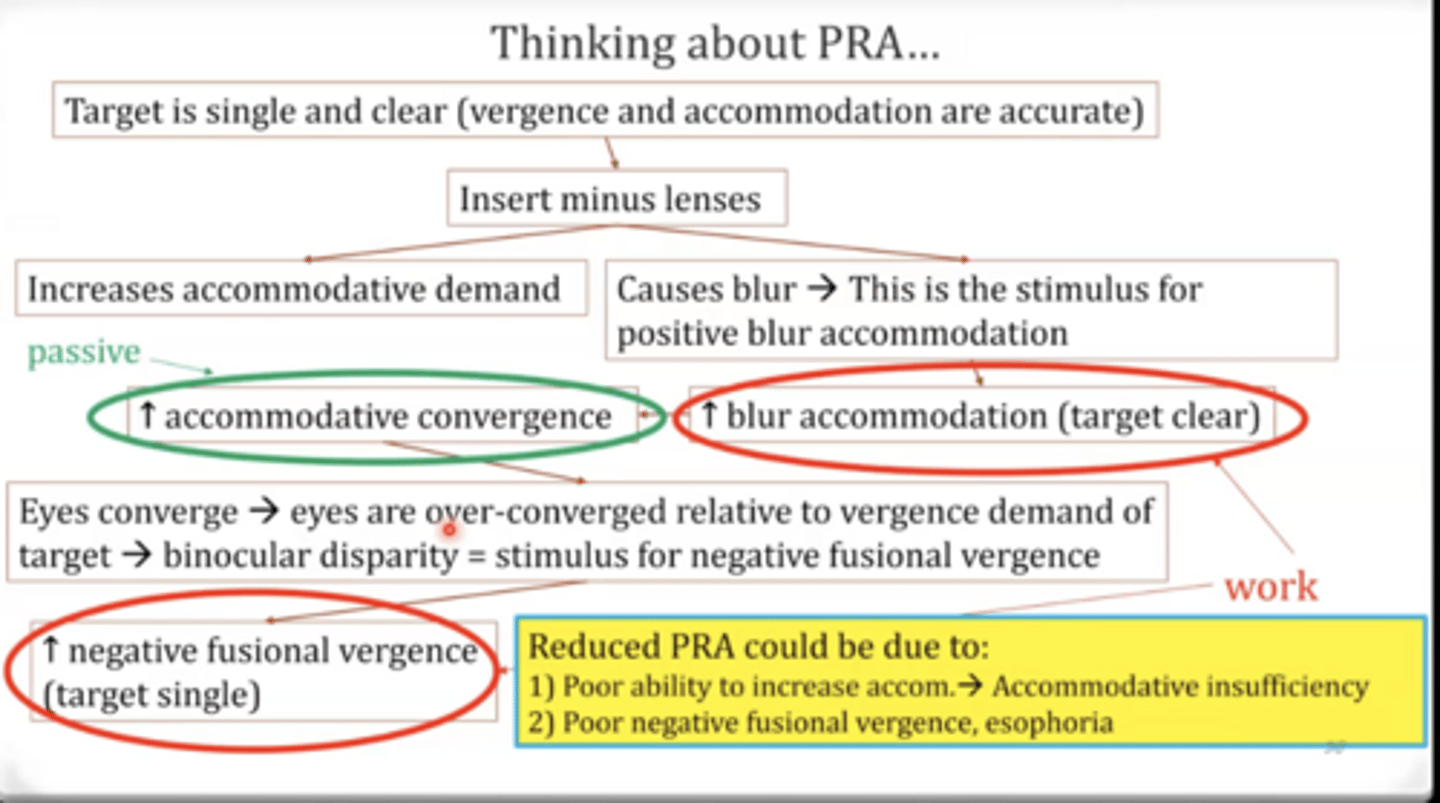
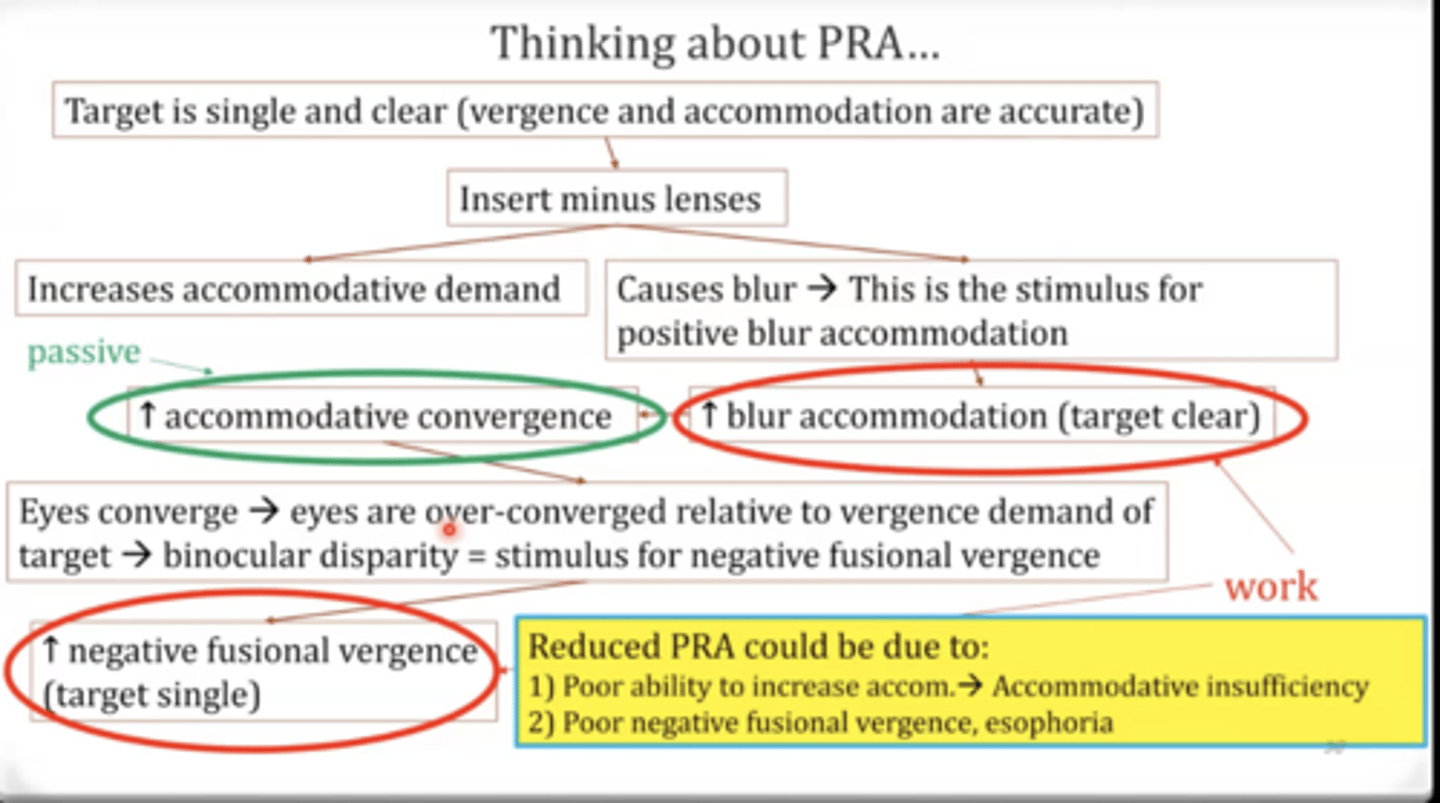
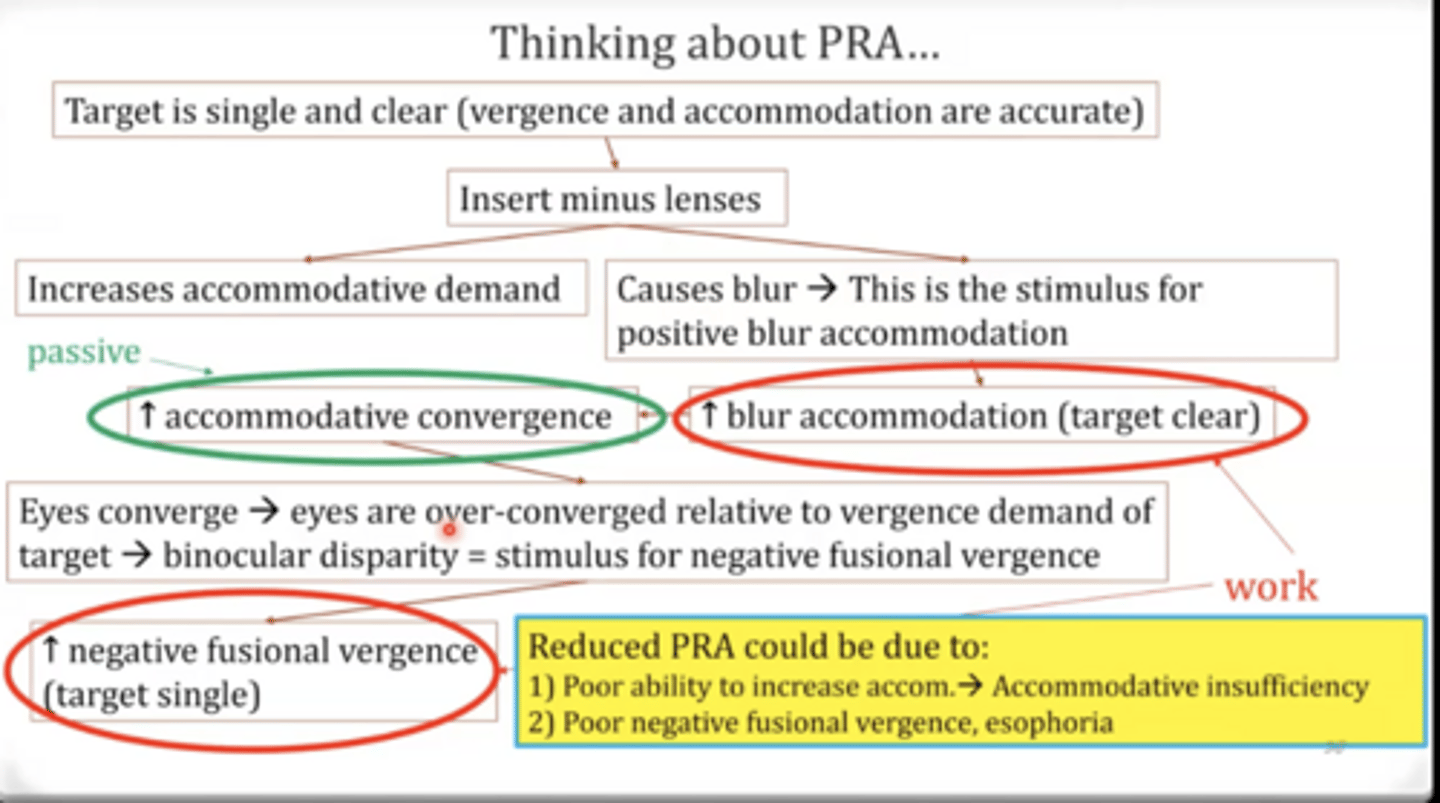
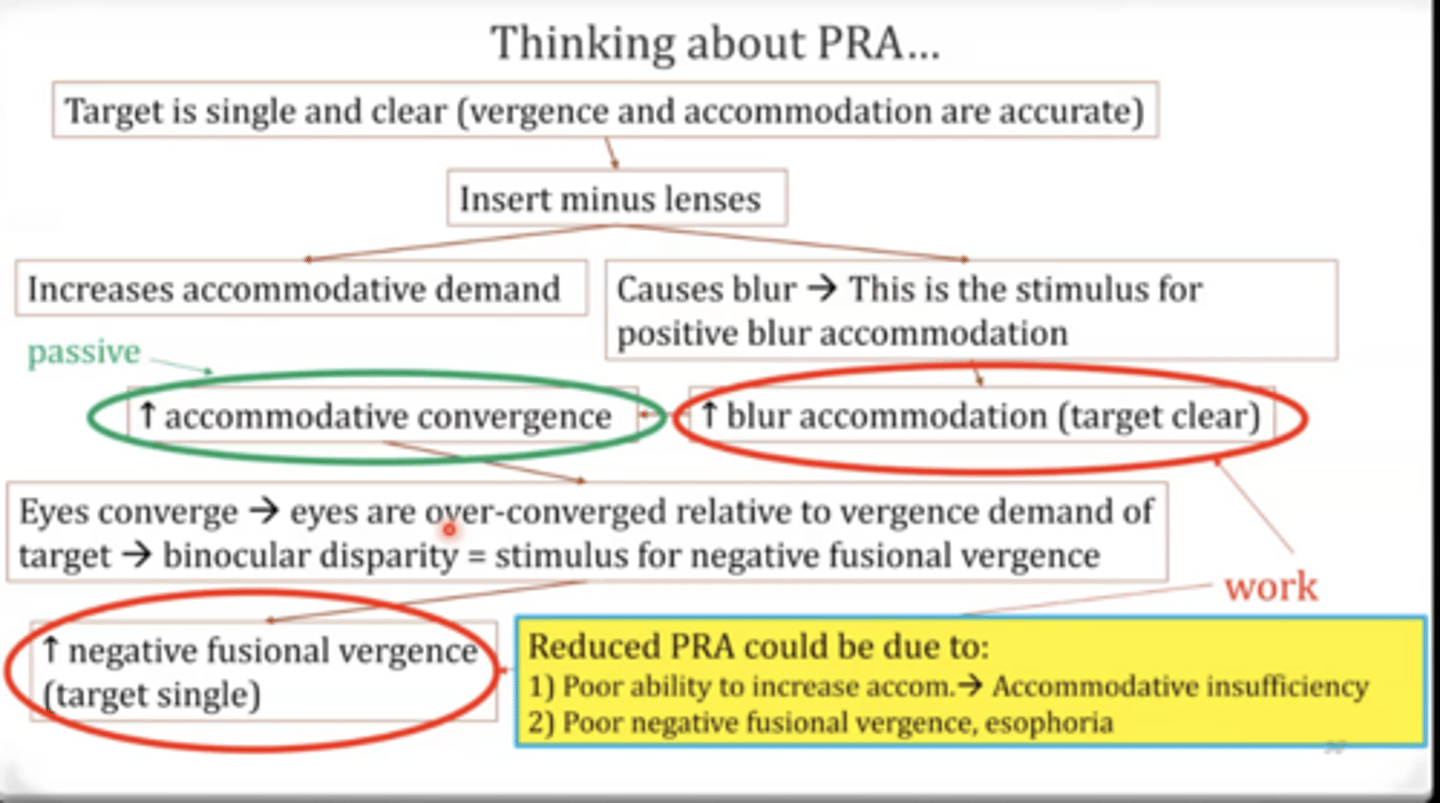
PRA Flowchart
What is the first step in this flowchart to start?
The target is single and clear (vergence and accommodation are accurate)
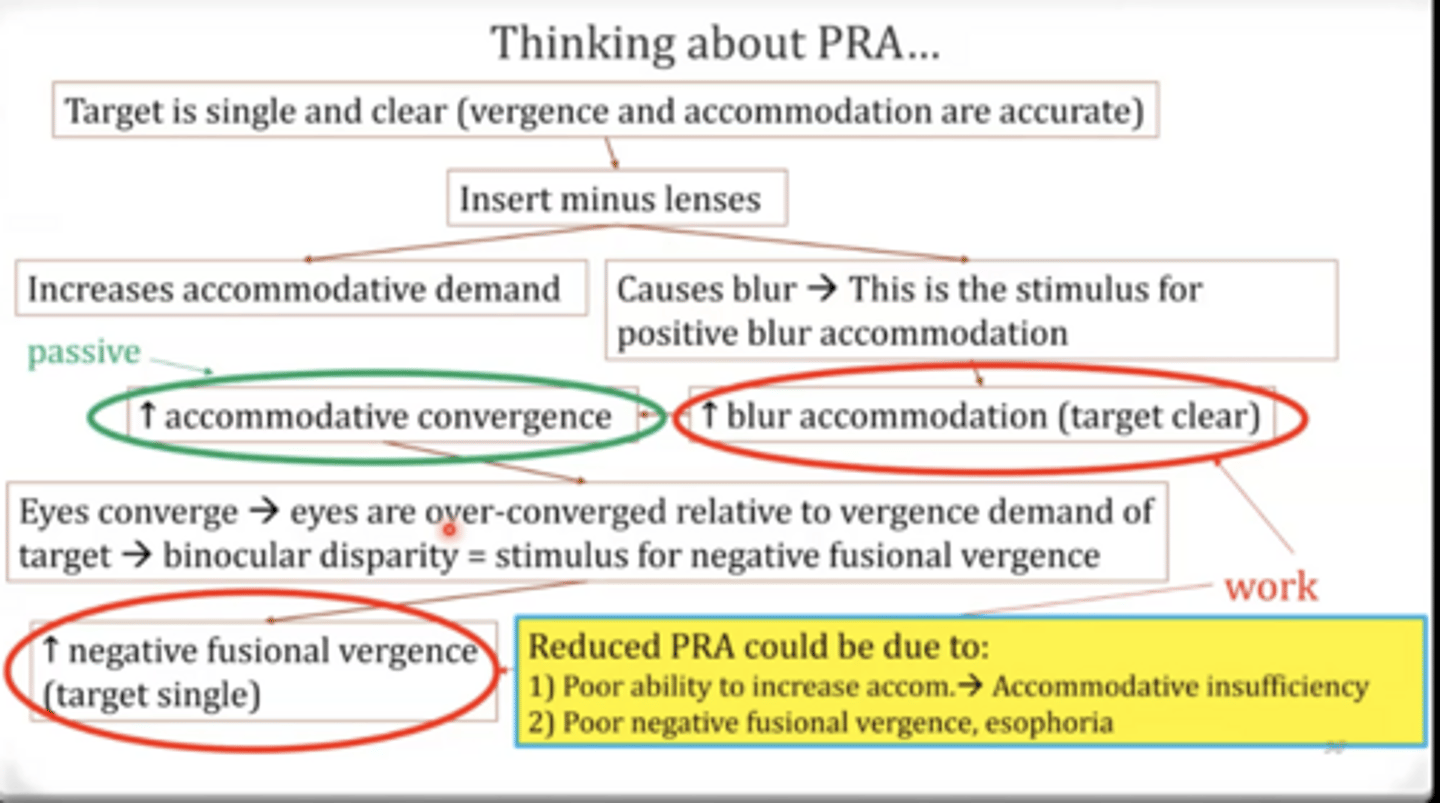
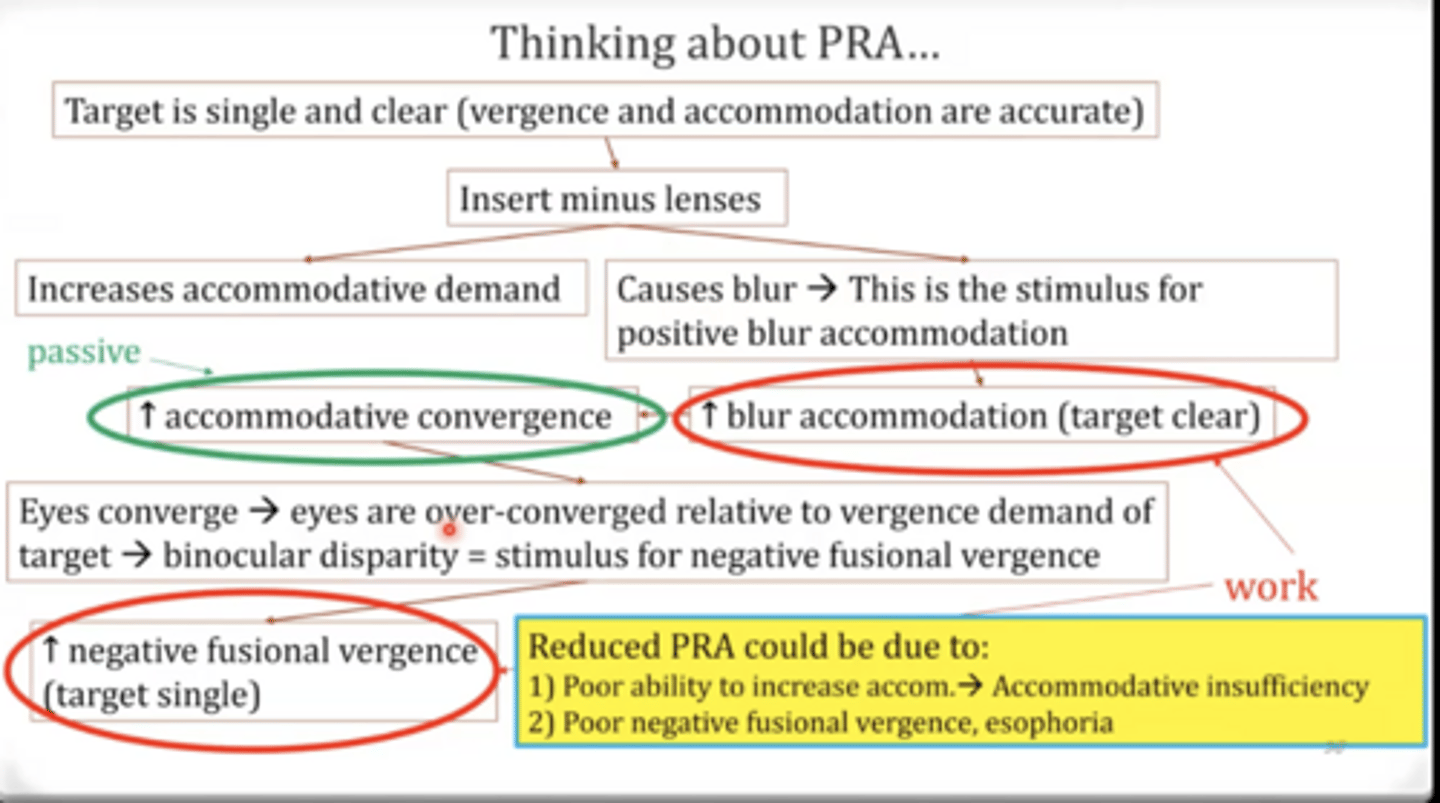
PRA Flowchart
What kind of lenses will be inserted?
Minus lenses
PRA Flowchart
What happens when minus lenses are inserted in front of a patient?
-increases accommodative demand
-causes blur
PRA Flowchart
After blur is caused by minus lenses, what increases?
positive blur accommodation
PRA Flowchart
What increases as a result of an increase to blur accommodation?
accommodative convergence
PRA Flowchart
As a result of increasing accommodative convergence, what happens?
Eyes converge
PRA Flowchart
When eyes are over-converged relative to the vergence demand of the target, what happens?
binocular disparity
PRA Flowchart
What is binocular disparity a stimulus for?
stimulus for negative fusional vergence
PRA Flowchart
When negative fusional vergence increases, what happens to the target?
Target becomes single
PRA Flowchart
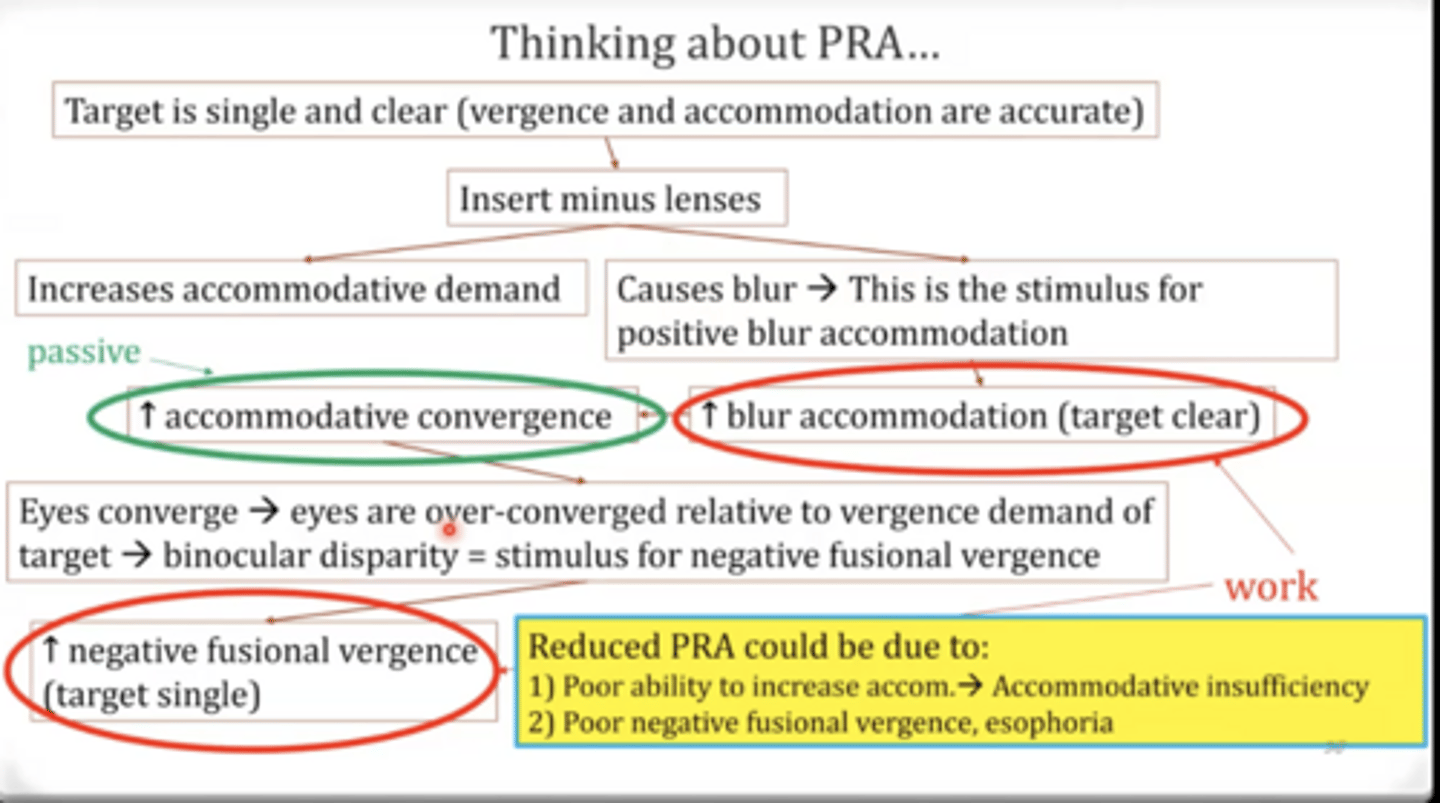
Reduced PRA could be d/t what?
-poor ability to increase accommodation (accommodative insufficiency)
-poor negative fusional vergence (eso)
-Eso w High AC/A ratio (convergence excess)
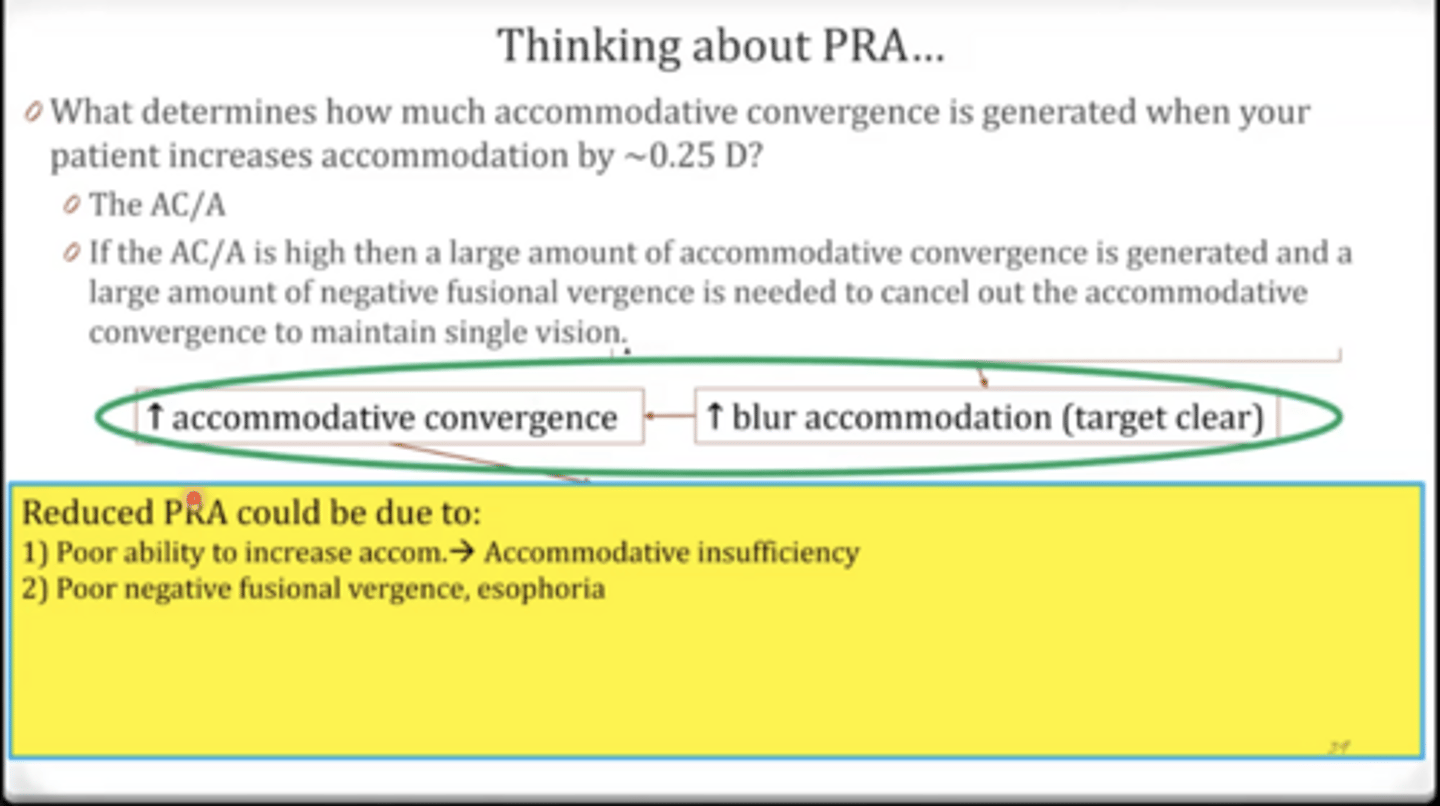
What determines how much accommodative convergence is generated when patient increases accommodation by 0.25D?
The AC/A ratio
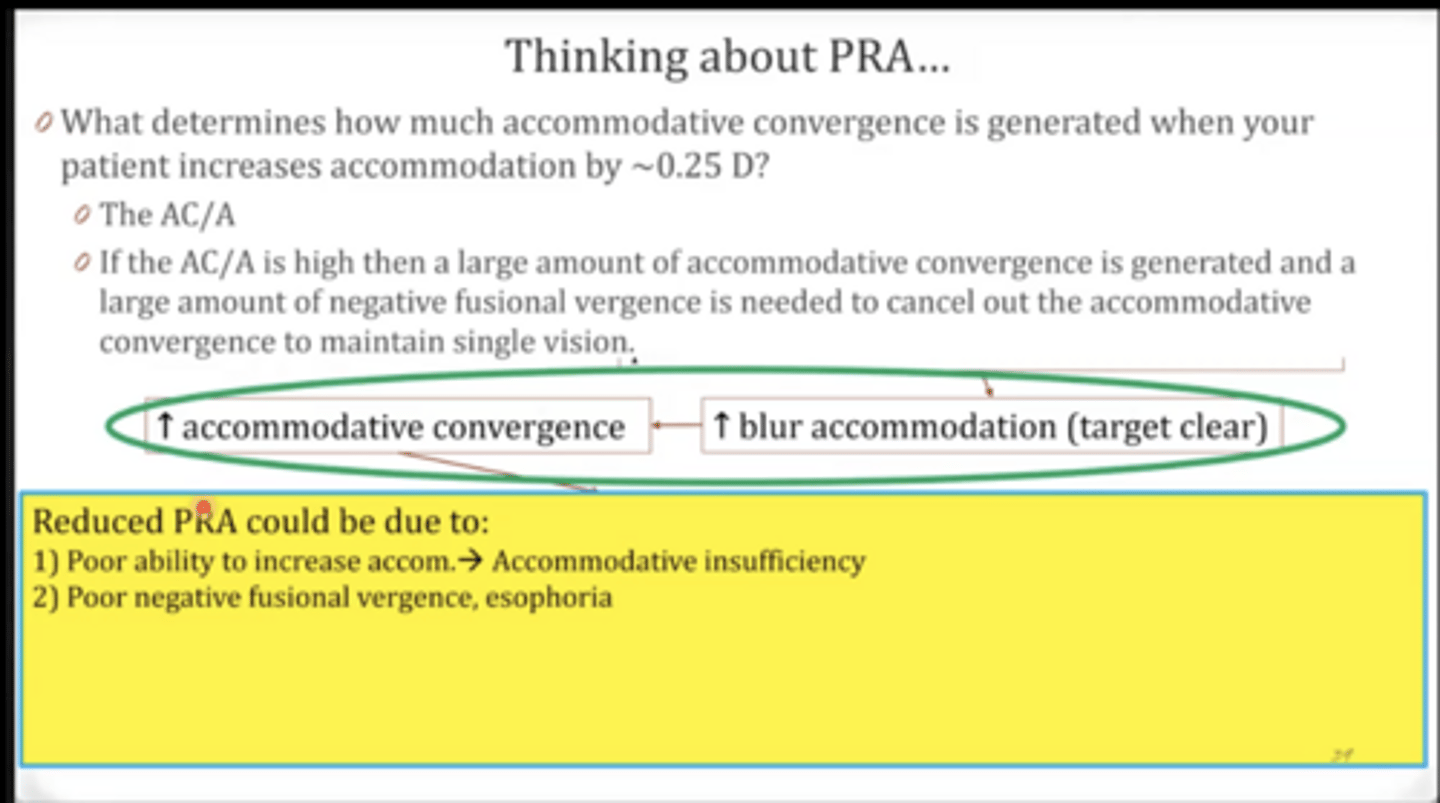
If the AC/A Ratio is HIGH, then a (small/large) amount of accommodative convergence is generated
large
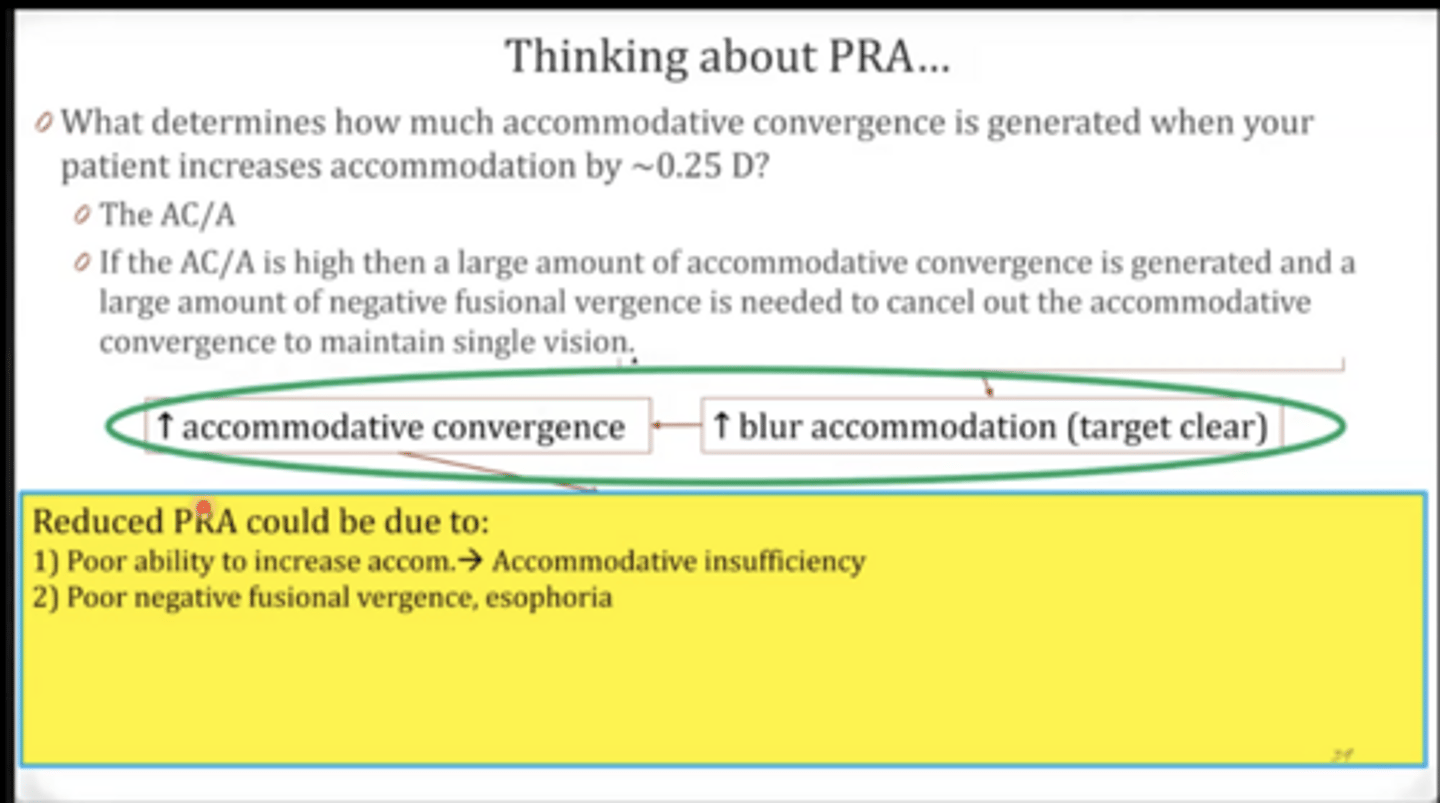
If the AC/A Ratio is high, a (small/large) amount of negative fusional vergence is needed to cancel out the accommodative convergence to maintain single vision
large
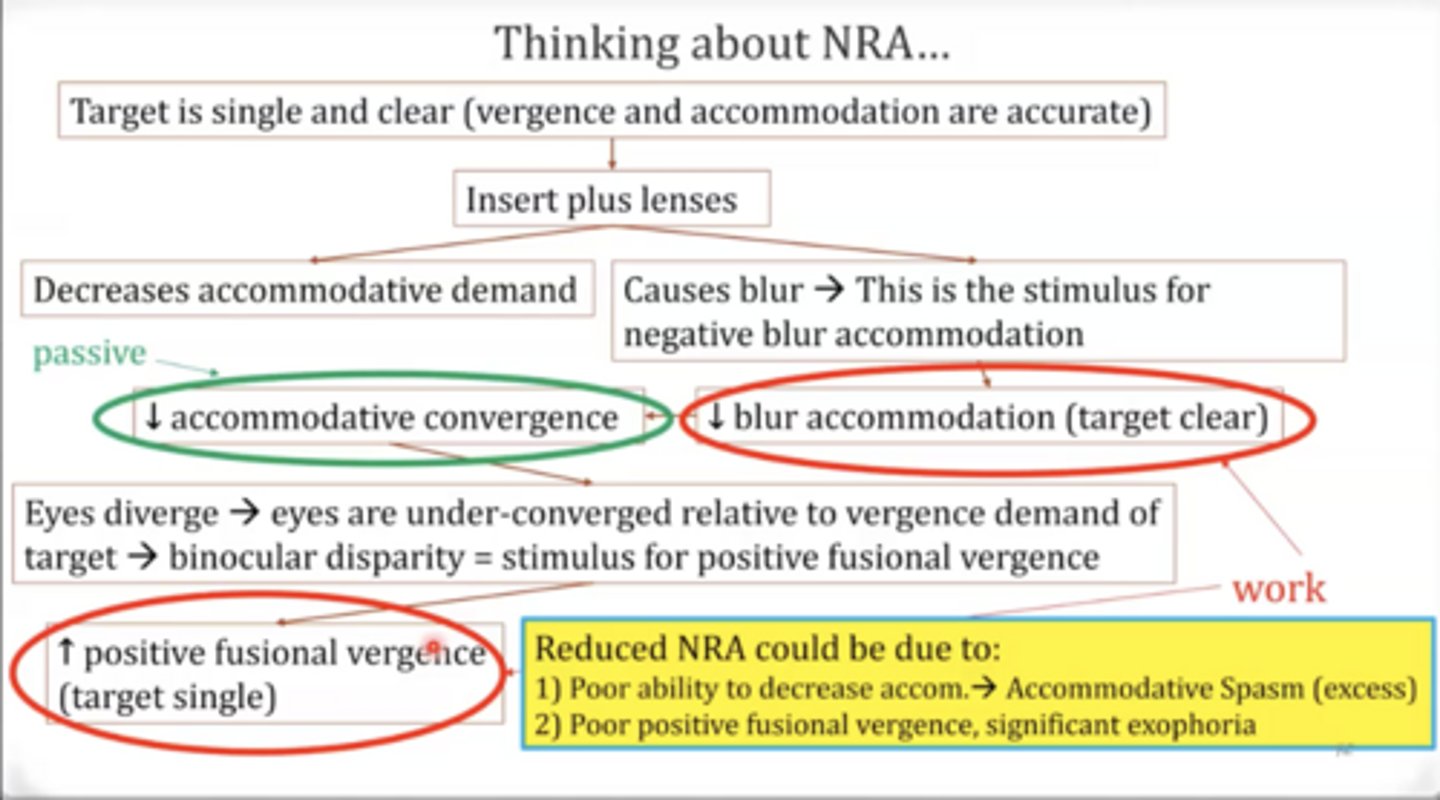
NRA Flowchart
What is the first step in this flowchart to start?
Target is single and clear (vergence and accommodation are accurate)
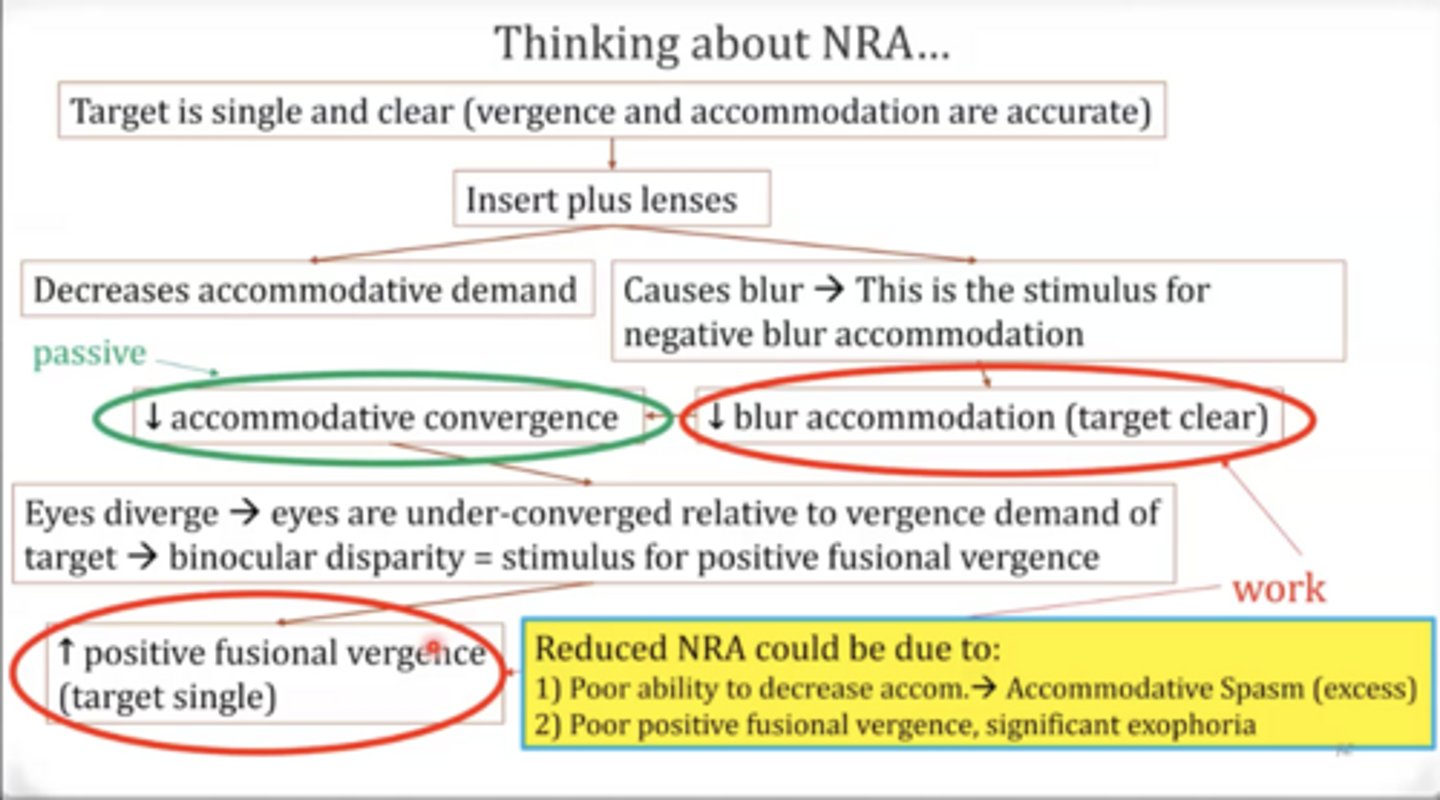
NRA Flowchart
What kind of lenses will be inserted?
plus lenses
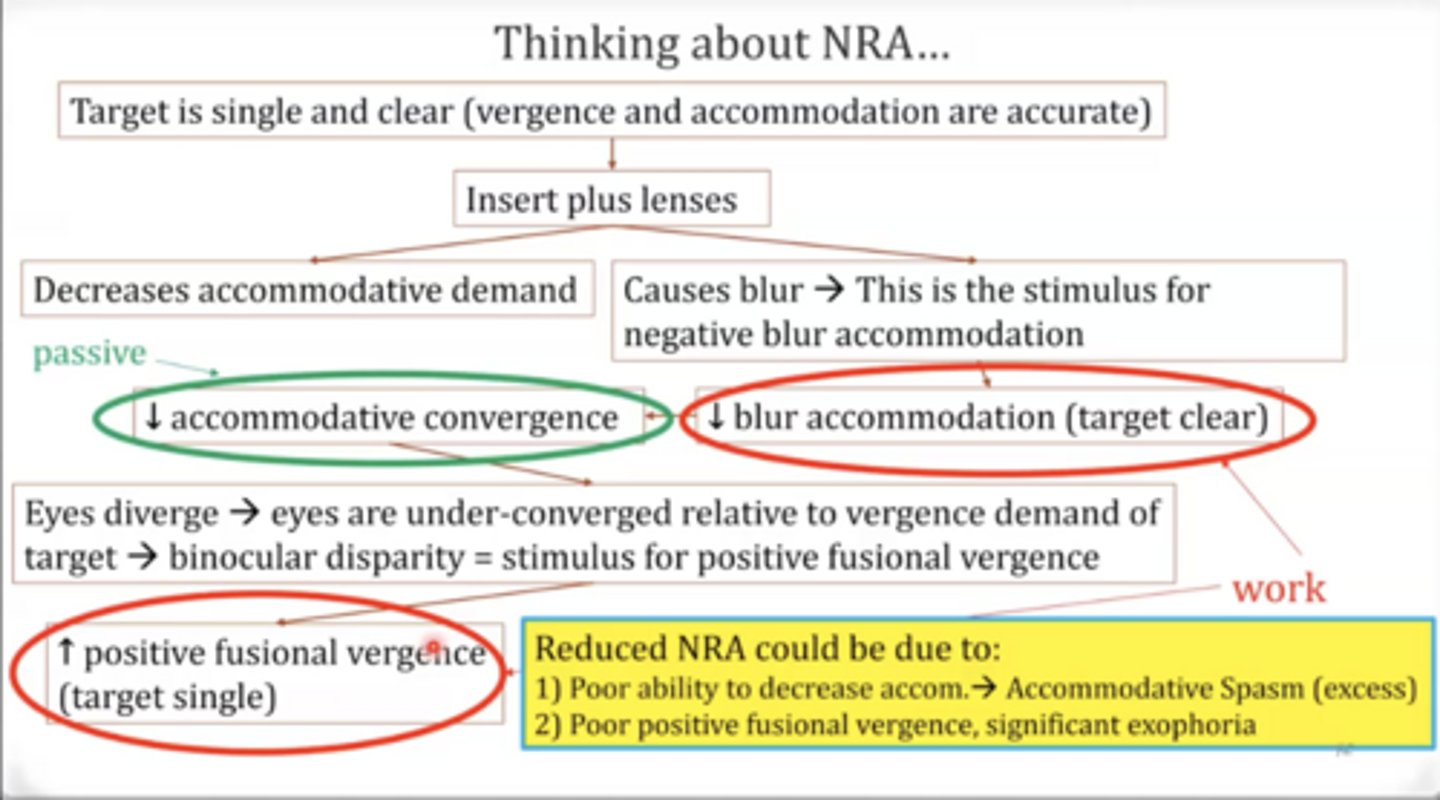
NRA Flowchart
What happens when plus lenses are inserted in front of a patient?
-decreases accommodation demand
-causes blur
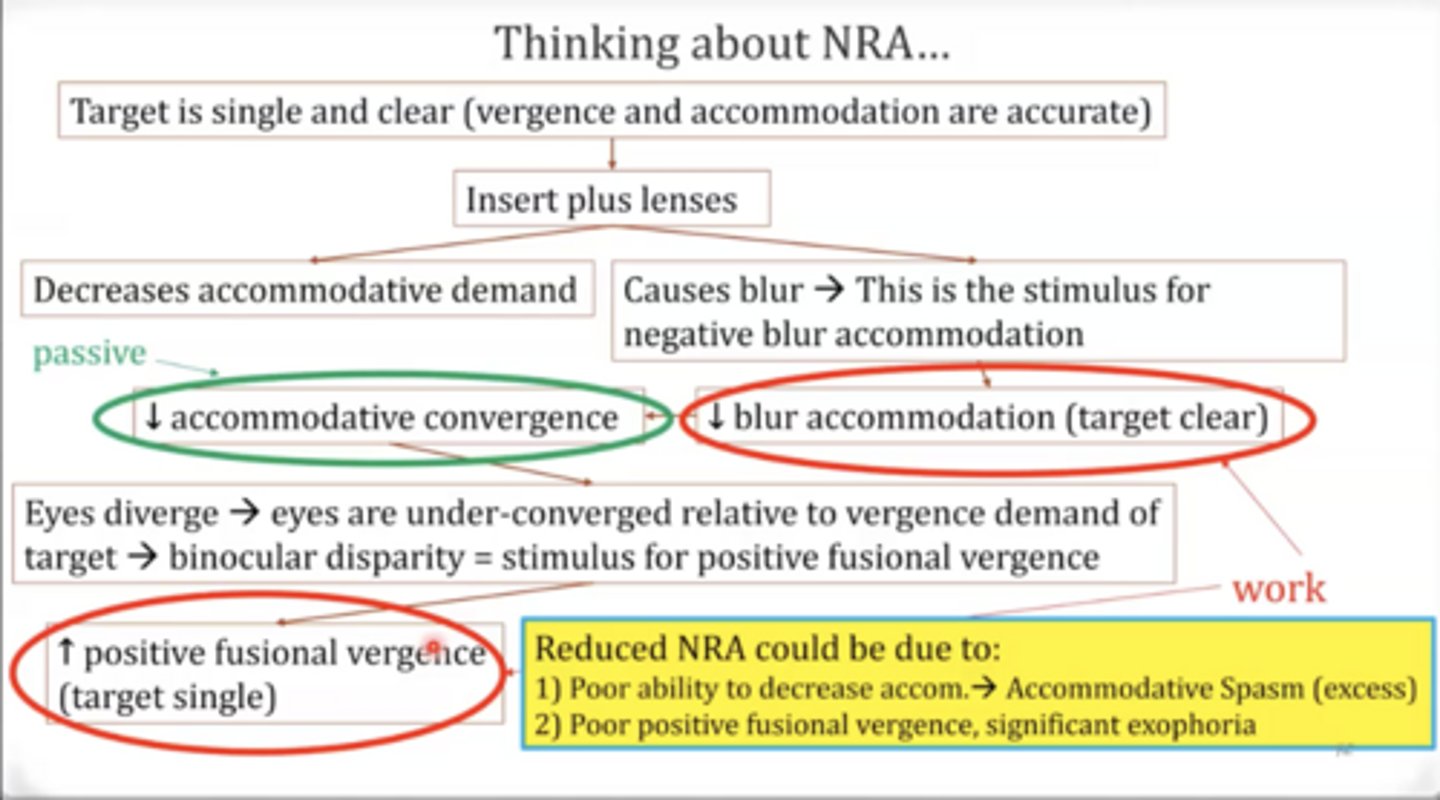
NRA Flowchart
After blur is caused by plus lenses, what increases?
negative blur accommodation
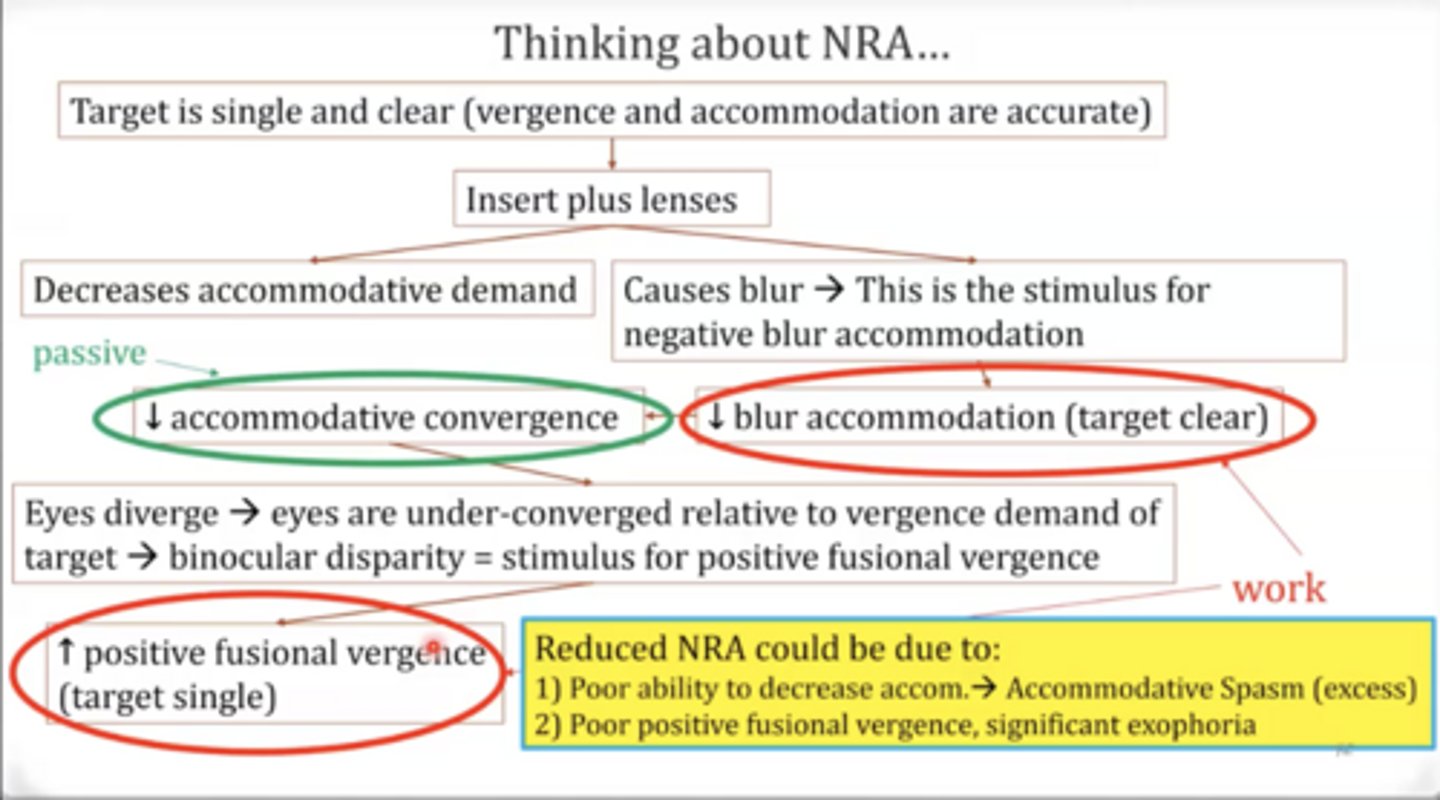
NRA Flowchart
What decreases as a result of an decrease to blur accommodation?
decrease accommodative convergence
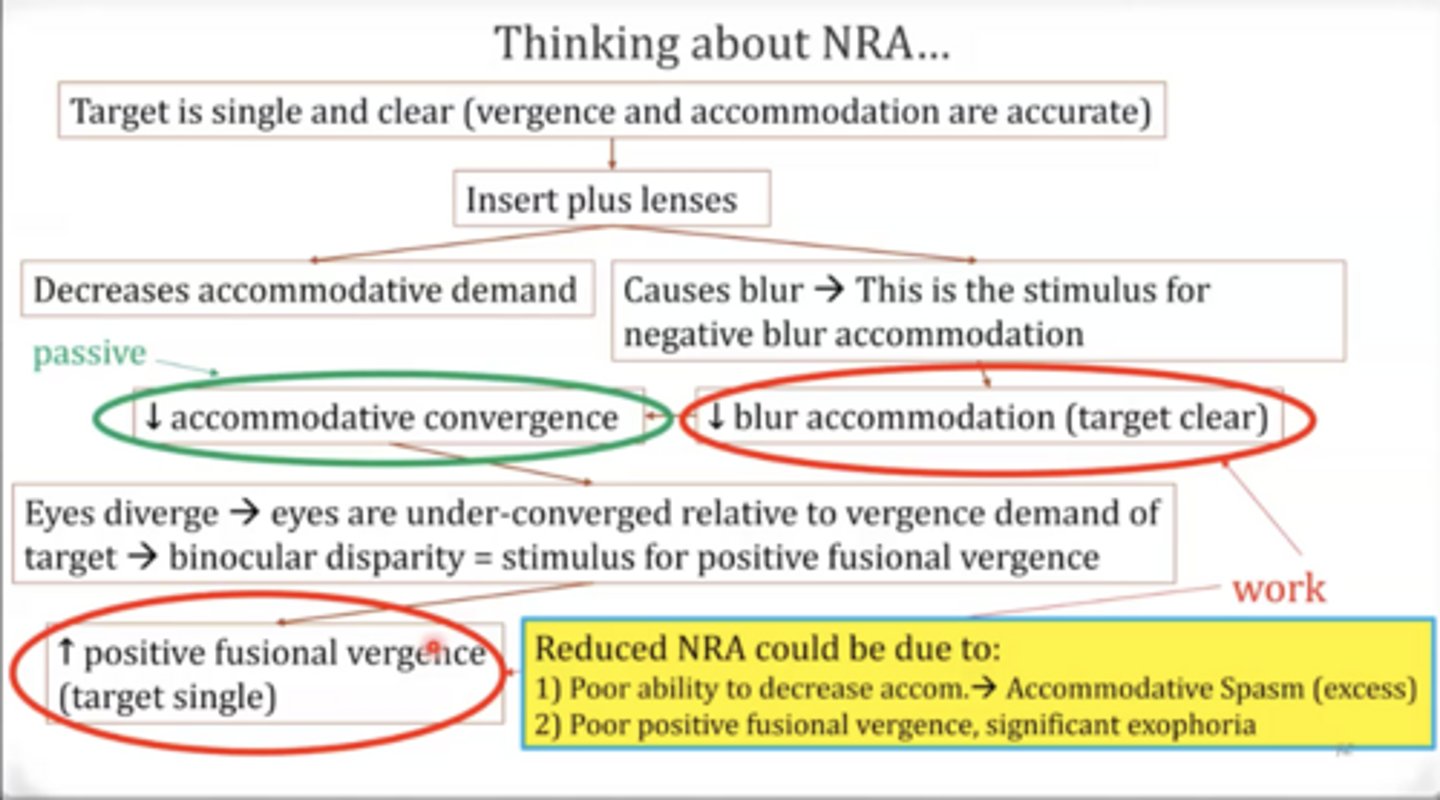
NRA Flowchart
As a result of decreasing accommodative convergence, what happens?
eyes diverge
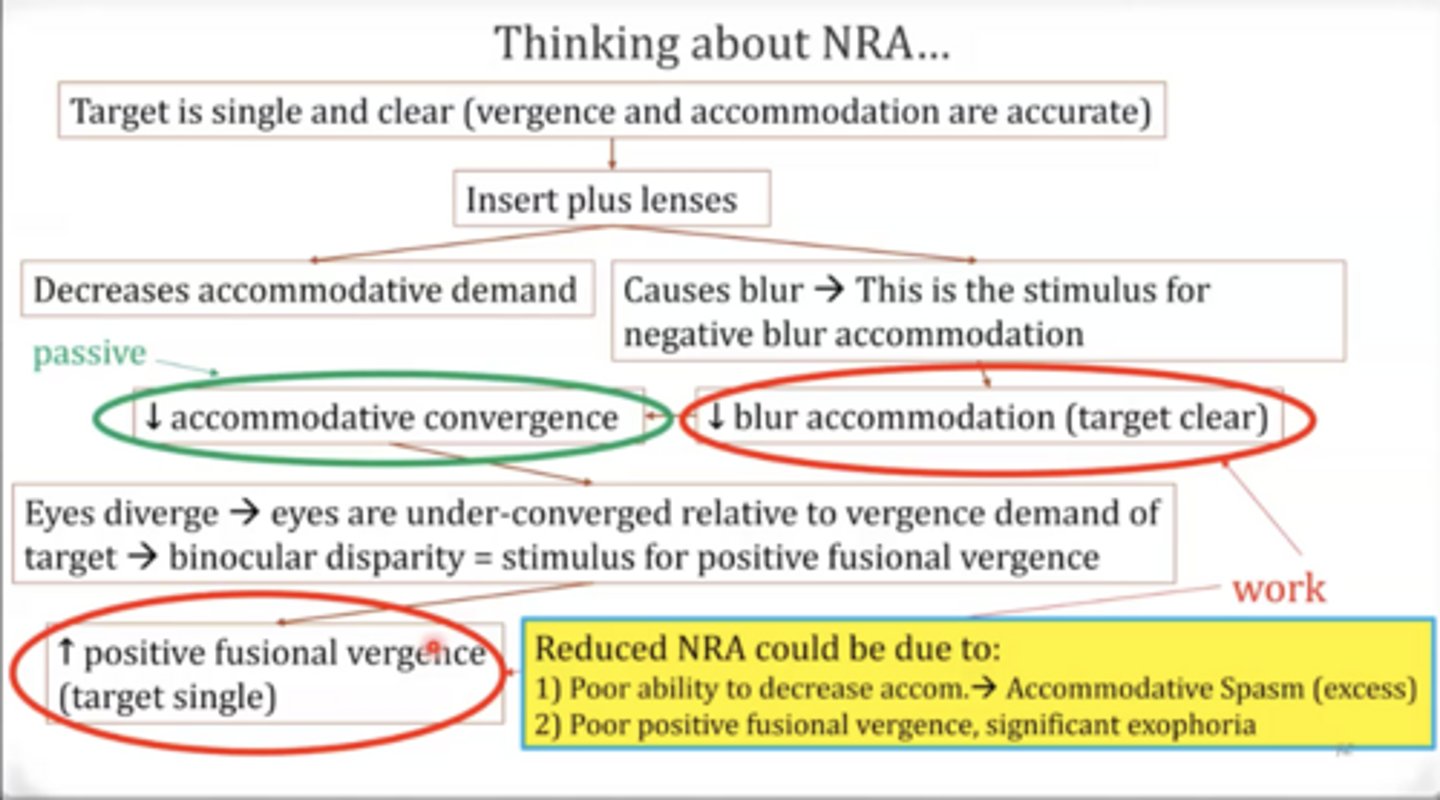
NRA Flowchart
When eyes are under-converged relative to the vergence demand of the target, what happens?
binocular disparity
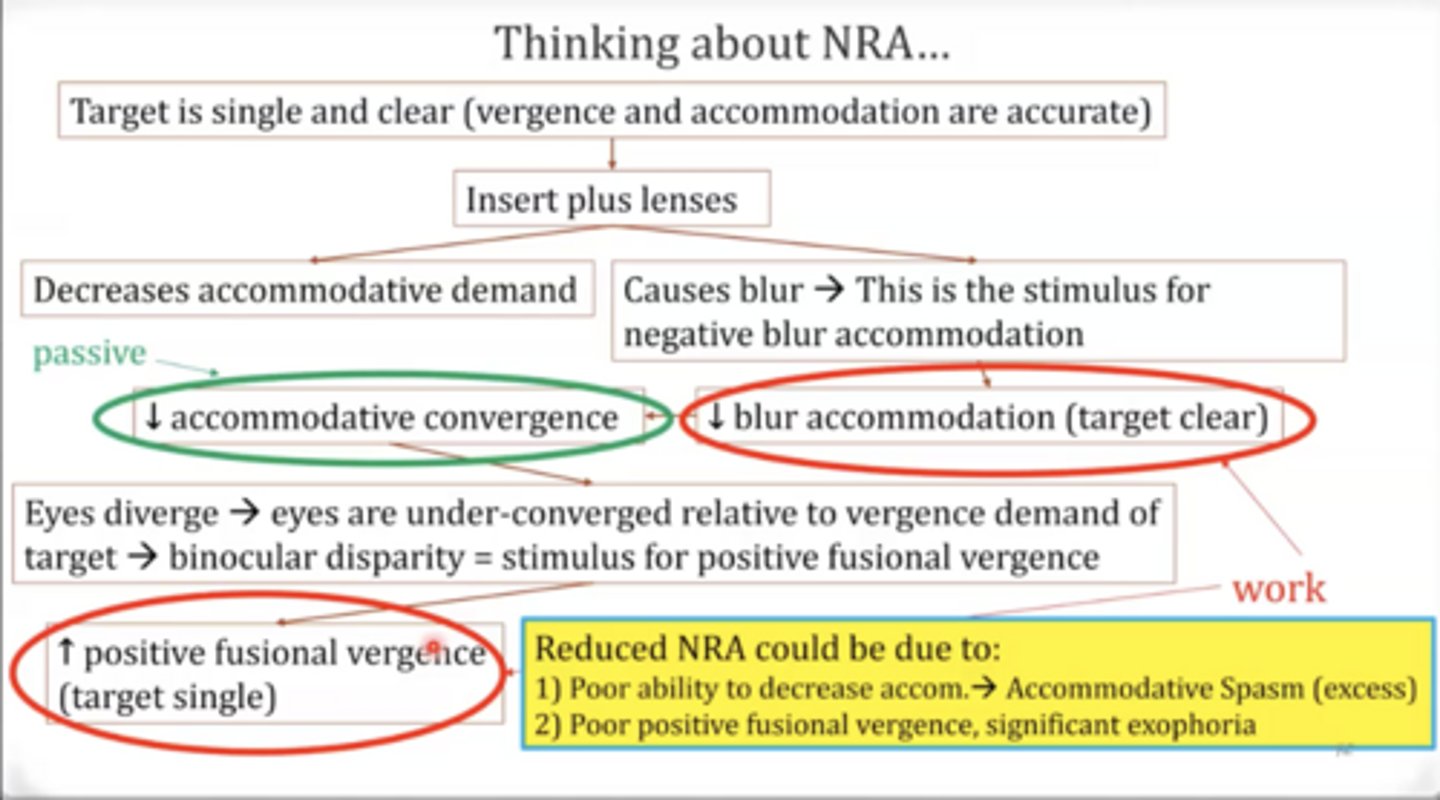
NRA Flowchart
What is binocular disparity a stimulus for?
positive fusional vergence
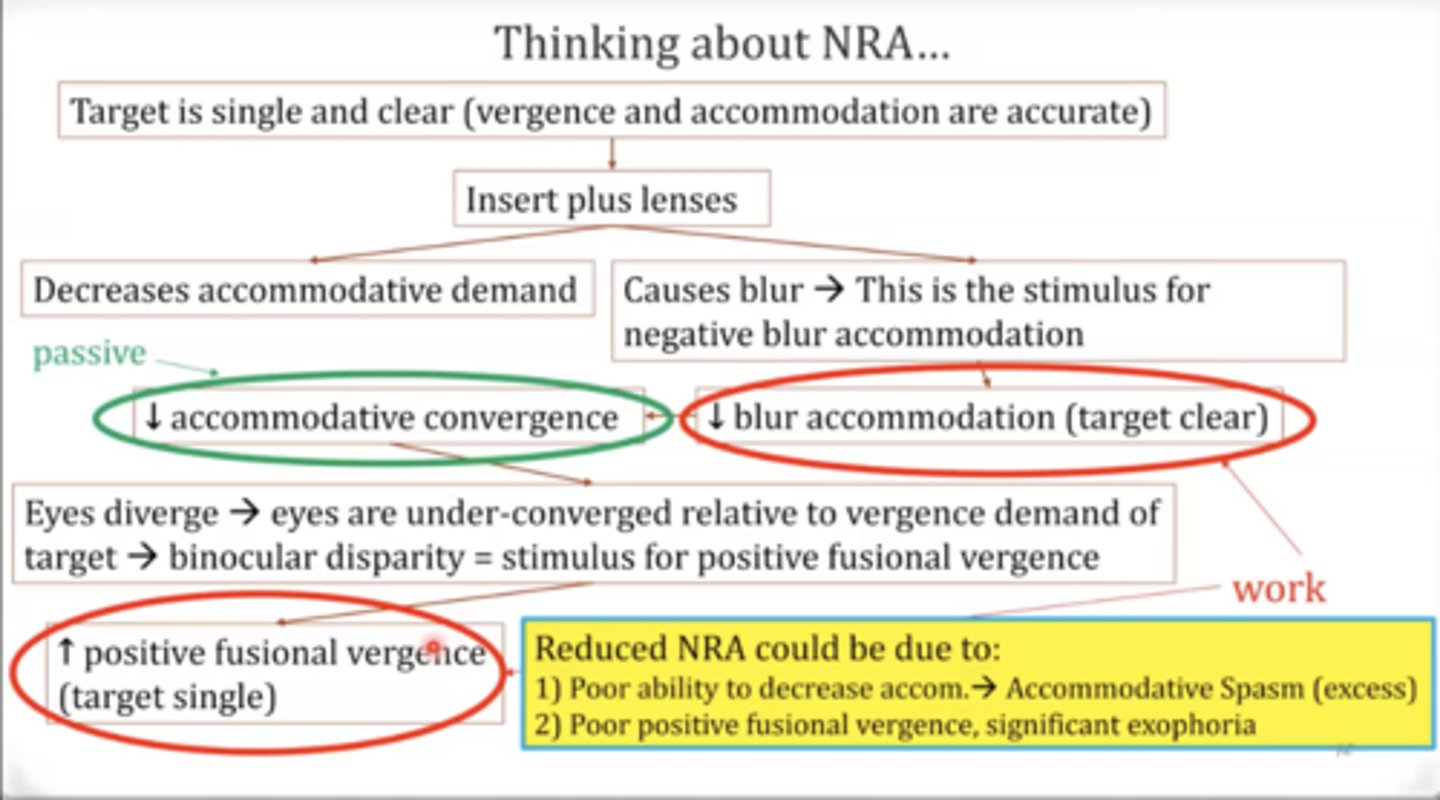
NRA Flowchart
When positive fusional vergence increases, what happens to the target?
Target becomes single
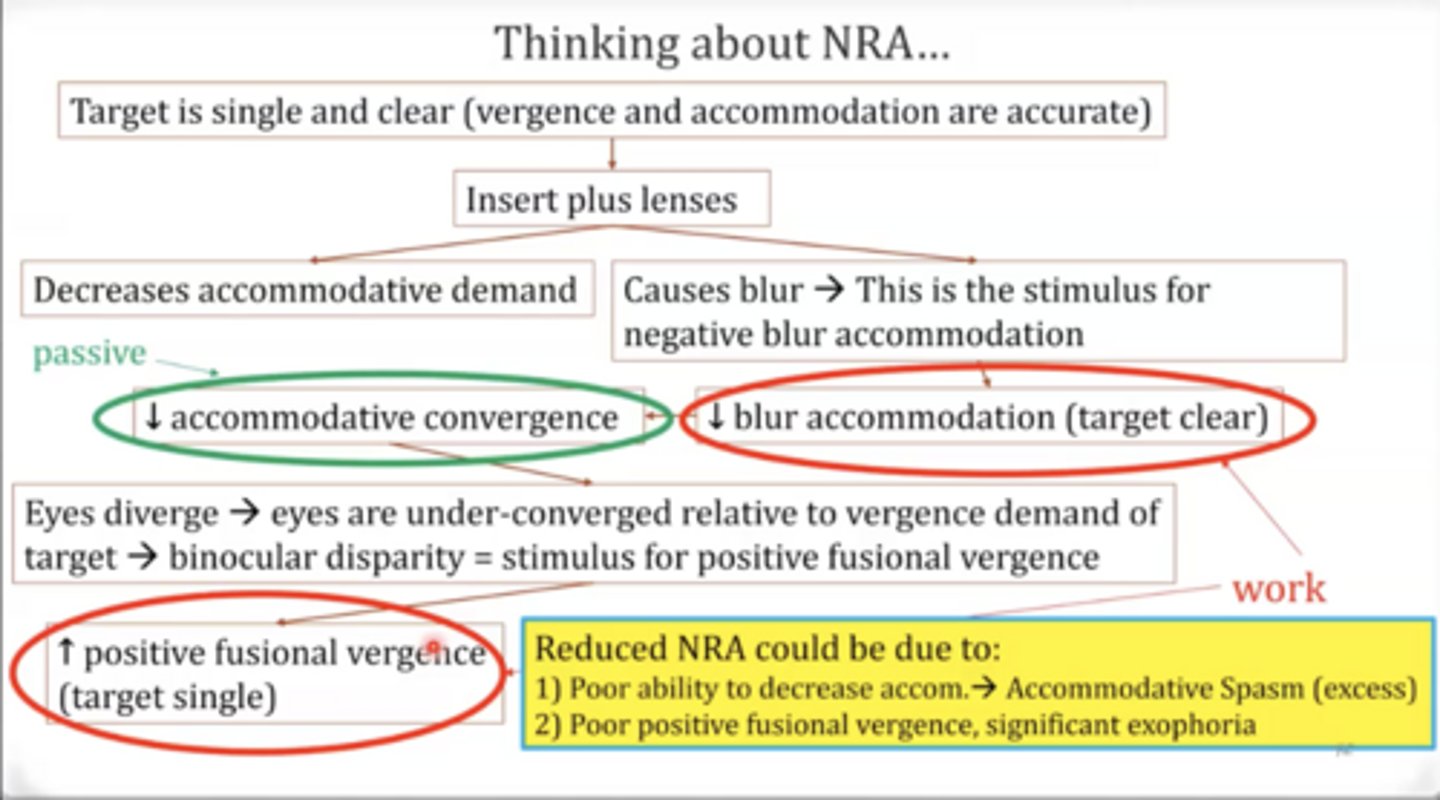
NRA Flowchart
Reduced NRA could be d/t what?
-poor ability to decrease accommodation (accommodative excess/spasm)
-poor positive fusional vergence (Exo)
To measure the AC/A, what do we look at?
the amount that accommodative convergence changes with a change in accommodation
How to we determine the change in accommodative convergence?
by looking at the amount the phoria changes
We will assume that the accommodation changes by the amount that we change the _______
accommodative demand