Economies & Diseconomies of Scale (3)
 Call Kai
 Learn
Learn Practice Test
 Spaced Repetition
 Match
Match Flashcards
 Knowt Play
1/8

There's no tags or description
Looks like no tags are added yet.
Name | Mastery | Learn | Test | Matching | Spaced | Call with Kai |
|---|
No analytics yet
Send a link to your students to track their progress
9 Terms
What happens as a firm increases its scale of output in the long - run ?
As a firm increases its scale of output in the long-run, its long-run average total costs (LRATC) will initially decrease due to the benefits it receives
These benefits are called economies of scale
During this period the firm is enjoying increasing returns to scale (Occurs when an increase in inputs leads to a larger than proportional increase in output)
What happens as a firm continues increasing its scale of output in the long - run ?
As a firm continues increasing its scale of output in the long-run, its LRATC will start to increase at some point
The reasons for the increase in the LRATC are called diseconomies of scale
During this period the firm is facing decreasing returns to scale (Occurs when an increase in the quantity of inputs leads to a less than proportional increase in the quantity of output)
Types of Economies of Scale
Financial Economies
Large firms often receive lower interest rates on loans than smaller firms as they are perceived as less risky. A cheaper loan lowers the AC
Managerial Economies
Occurs when large firms can employ specialist managers who are more efficient at certain tasks and this efficiency lowers the AC. Managers in small firms often have to fulfil multiple roles and are less specialised
Marketing Economies
Large firms spread the cost of advertising over a large number of sales and this reduces the AC. They can also reuse marketing materials in different geographic regions which further lowers the AC
Purchasing Economies
Occur when large firms buy raw materials in greater volumes and receive a bulk purchase discount which lowers the AC
Technical Economies
Occur as a firm is able to use its machinery at a higher level of capacity due to the increased output thereby spreading the cost of the machinery over more units & lowering the AC
Risk - Bearing Economies
Occur when a firm is able to spread the risk of failure by increasing its numbers of products i.e greater product diversification - less failure lowers AC
Types of Diseconomies of Scale
Management Diseconomies
Occur when managers work more in their self interest than in the interest of the firm e.g managers become territorial & obstructive thus reducing efficiency and increasing the AC
Communication Diseconomies
Occur when a firm with multiple layers of management & perhaps in multiple geographic locations, struggle to communicate quickly & efficiently leading to slow responses & increased AC
Geographical Diseconomies
Occur when a firm has widespread bases of operations & this leads to logistical & communication challenges which can raise the AC
Cultural Diseconomies
Occur when a firm expands into foreign markets in which workers have very different cultural work/productivity norms which can raise the AC
What is the minimum efficient scale ?
The minimum efficient scale is the lowest cost point on a long-run average total cost (LRATC) curve
It represents the lowest possible cost per unit that a firm in the industry can achieve in the long run.
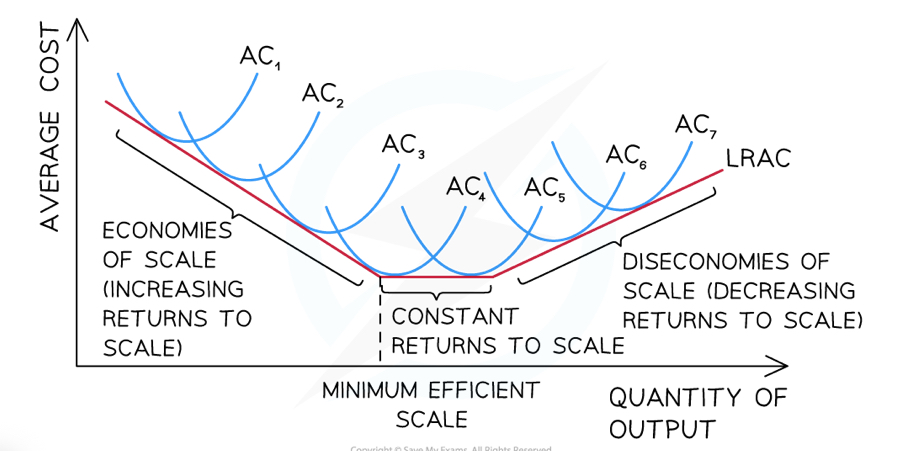
As a firm grows, economies of scale help a firm to reach its minimum efficient scale before diseconomies raise the cost/unit again - Diagram analysis
Each subsequent short-run average cost (SRAC) curve represents growth and an increase in size
Output increases with each period of growth
Initially firms experience increasing returns to scale as a result of the economies of scale
At a certain level of output, the firm will reach the minimum efficient scale where it experiences constant returns to scale (Occur when an increase in inputs leads to a proportional increase in output)
If it continues to grow beyond that level of output the firm will experience decreasing returns to scale as diseconomies of scale occur
What are all of the ECONOMIES of scale explained above an example of ?
Internal economies of scale (Occur as a result of the growth in the scale of production within the firm)
What are external economies of scale ?
External economies of scale occur when there is an increase in the size of the industry in which the firm operates
The firm is able to benefit from lower LRATC generated by factors outside of the firm
Sources of External Economies of Scale
Source | Explanation |
|---|---|
Geographic Cluster | As an industry grows, ancillary firms move closer to major manufacturers to cut costs and generate more business. This lowers the LRATC e.g. Car manufacturers in Sunderland rely on the service of over 2,500 ancillary firms. Silicon Valley, California: A large pool of highly skilled technology workers creates a network that benefits firms by attracting talent and sharing ideas |
Transport Links | Improved transport links develop around growing industries in order to help get people to work and to improve the transport logistics. This lowers the LRATC e.g. transport links around the M4 Corridor Tech Areabetween Reading and Bracknell in the UK have experienced significant improvement |
Skilled Labour | An increase in skilled labour can lower the cost of skilled labour, thereby decreasing the LRATC. The larger the geographic cluster, the larger the pool of skilled labour |
Favourable Legislation | This often generates significant reductions in LRATC as governments support certain industries in order to achieve their wider objectives, e.g the animation cluster in Bristol and Bath is growing due to the tax incentives offered to the industry by the Government |