Waves
 Call Kai
 Learn
Learn Practice Test
 Spaced Repetition
 Match
Match Flashcards
 Knowt Play
1/125

There's no tags or description
Looks like no tags are added yet.
Name | Mastery | Learn | Test | Matching | Spaced | Call with Kai |
|---|
No analytics yet
Send a link to your students to track their progress
126 Terms
Wave
An oscillation that transfers energy WITHOUT transferring any matter by making particles of the substance oscillate.
Transverse Wave
Waves with oscillations that are perpendicular to the direction of travel/energy transfer.
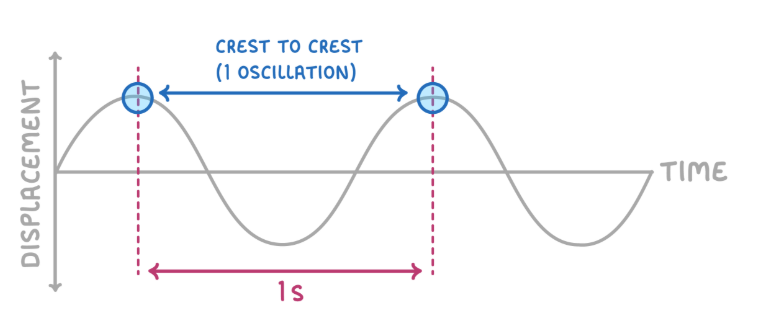
Frequency of a wave is number of time it oscillates in one second
1Hz - 1 oscillation per second
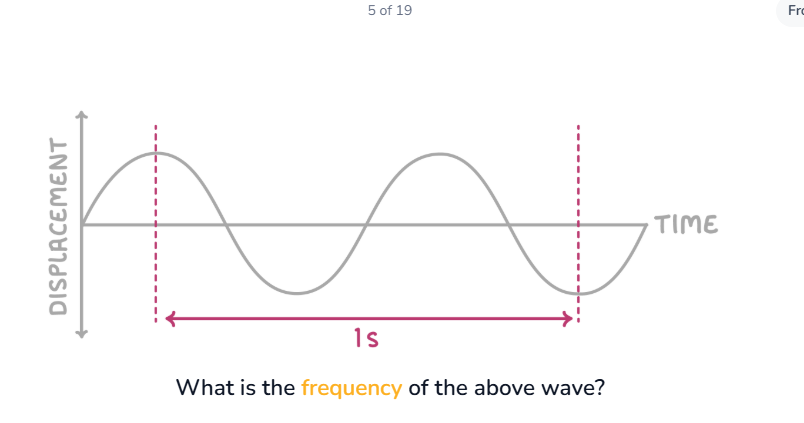
fREQUENCY = 1.5hZ
Oscillates 1.5 times in 1 second
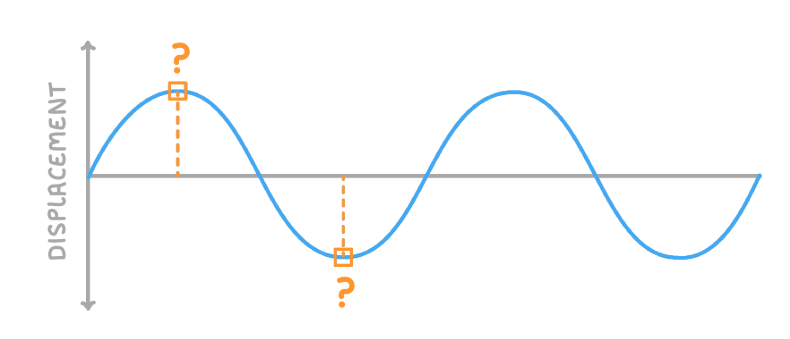
Amplitude
Maximum displacement from equilibrium position
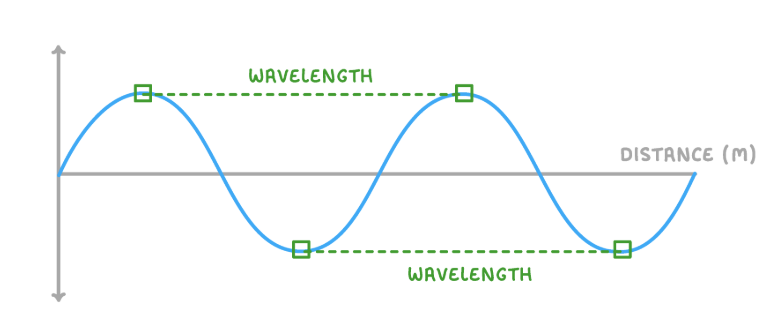
Wavelength is the length of one oscillation
measured in meters
distance from a point on one wave to the equivalent point on the adjacent wave
Crests
high points on a wave (peak)
Throughs
low points on a wave
Rest Position
The position where the wave is at rest, half way between the crest and trough.
frequency
The number of waves passing a given point in a second.
Period of a wave
The amount of time taken for a full cycle of a wave to be comepleted./ entire oscillation of wave
Time , Period Formula
P=1/frequency(hz) or 1/T (s)
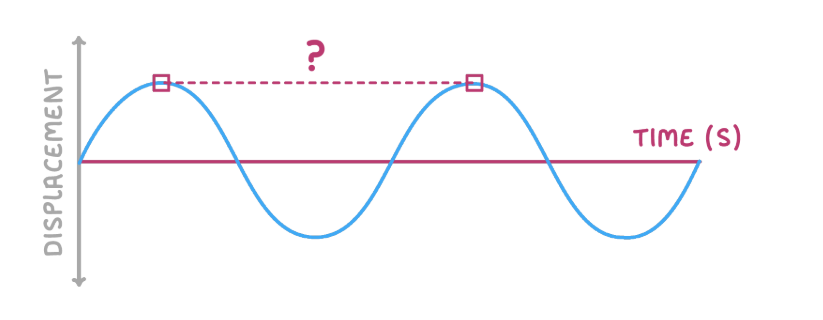
Time period
Wave Speed
v=fλ velocity(m/s)=wavelength(m)*frequency(hz)
Example of transverse waves
EM Waves
Water Waves
Waves on a string
Seismic S-Waves
Longitudinal Wave
Waves with oscillations that are parallel to the direction of travel/energy transfer.
The show areas of compression and refraction
Examples of Longitudinal Waves
Sound Waves
Seismic P Waves
What are the two types of waves?
Longitudinal Waves
Transverse Waves
Differences between longitudinal/transverse
Property | Transverse waves | Longitudinal waves |
|---|---|---|
Structure | Peaks and troughs | Compressions and rarefactions |
Vibration | Right angles to the direction of energy transfer | Parallel to the direction of energy transfer |
Vacuum | Can travel in a vacuum (electromagnetic waves only) | Cannot travel in a vacuum |
Material | Can move in solids and on the surface of liquids | Can move in solids, liquids, and gases |
Density | Density is constant | Density is not constant |
Pressure | Pressure is constant | Pressure is not constant |
Speed of wave | Depends on the material it is travelling through (fastest in a vacuum) | Depends on the material it is travelling through (fastest in a solid) |
Wavefront Description
Both transverse and longitudinal waves can be represented as wavefronts
This is where the waves are viewed from above
For a transverse wave:
One line represents either a peak or a trough
For a longitudinal wave:
One line represents either a compression or a rarefaction
The arrow shows the direction the wave is moving and is sometimes called a ray
The space between the lines represents the wavelength
When the lines are close together, this is a wave with a short wavelength
When the lines are far apart, this is a wave with a long wavelength
Explain why the water doesnt travel but the water in ripples?
Ripples on water surface cause floating objects
To bob up and down
They don’t move object across the water to the edge
This means that the wave travels but no water (no movement of matter)
Describe evidence that waves transfer energy, not the medium.
Particles in the medium vibrate/oscillate about a fixed position
No net movement of the medium
Wave transfers energy, not matter
Example: cork on water moves up and down, not along
Example: air particles vibrate back and forth in sound waves
Shows wave travels through medium, medium stays in place
What is wave speed?
speed at which the energy is transferred (or the wave moves) through the medium
How to measure the speed of sound in air?
need to find out the
frequency and wavelength of sound wave
you can do this by generating a sound wave with specific frequency
by attaching a signal generator to a speaker
sound wave then detected by microphones
which convert it to a trace on an oscilloscope
Methods to measure speed of sound on air
set up both microphones next to the speaker
detected wave at each microscope seen as separate wave on oscilloscope
move one microphone away from speaker
wave will shift sideways on oscilloscope
keep moving it until the two waves on the oscilloscope are aligned once more
at this point microphones will be exactly one wavelength apart so measure distance between them
you can then use wave speed formula to find speed
typically speed out sound is 330m/s
Waves at a boundary (between two different materials) can
- Absorption (by material)
- Reflection
- Transmission (travel through material while undergoing refraction)
How to draw ray diagram for reflection
1. Draw normal perpendicular to the boundary at the point of incidence.
2.Measure angle of incidence and repeat on the other side
3.Then draw reflected ray on other side
Angle of incidence
Angle between incoming wave and normal
Angle of reflection
Angle between reflected wave and normal
Law of reflection
angle of incidence = angle of reflection
What are two types of reflection?
specular reflection
diffuse reflection
Specular Reflection (Smooth boundary)
when waves are reflected in a single direction by a smooth surface (gives clear reflection)
Diffuse Reflection (Bumpy Boundary)
When waves are reflected by rough surfaces and so are scattered in different directions as the normal for each bump are different.
creates an unclear image/no image at all
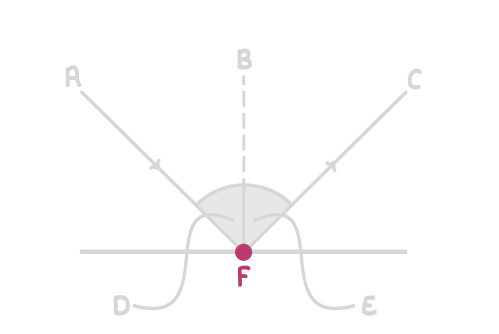
A - Incident Ray
B - Normal
C - Reflected Ray
D - Angle of Incidence
E - Angle of reflection
F - Point of Incidence
Reflection
A wave hits a boundary between two media and does not pass through, but instead stays in the original medium
Transmisson
A wave passes through a substance
Describe the effects of reflection, transmission and absorption at material interfaces.
Reflection: wave bounces off boundary
Transmission: wave passes through material
Absorption: wave energy taken in by material
Reflected waves change direction
Transmitted waves may change speed/wavelength
Absorbed energy often converted to heat
Depends on properties of the materials at the boundary
How to draw a ray diagram
1. Draw the boundary between the materials and the normal at the point of incidence (perpendicular to boundary)
2. Draw incident ray that meets the normal at the point
3. Draw refracted ray, if the second material is denser than the first then the refracted ray will bend towards the normal
4. If the material is less dense that the ray will bend away from the normal.
Absorption
Energy is transferred from the wave into the particles of a substance
waves can be partially or completely absorbed
Light will be absorbed if the frequency of light matches the energy levels of the electrons
Refraction through medians
Wave travels faster in some materials than other speed of wave can change as it crosses a boundary
If waves slow down at boundary it bends towards normal
If wave speed up at boundary it bends away from normal
If wave enter more optically dense material waves move more slowly bends towards normal angle of refraction smaller than angle of incidence
If wave enter less optically dense material waves speed up so it bends towards away from the normal angle of refraction greater than angle of incidence
What is optical density of a material?
how quickly light travels through it
higher optical density - slower light travels
Refraction
refers to change in direction of a wave
as it passes from one medium to another
due to change in speed/density of medium it is passes through changes
What happens to light as it passes through a denser median?
wavespeed of light will decrease (more slowly)
it will bend towards the normal
frequency of light will stay the same
wavelength of light will decrease
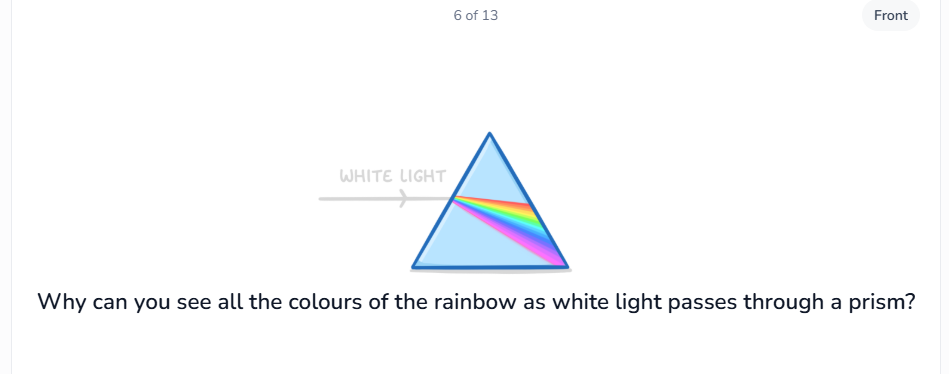
white light contains all the different wavelengths of visible light (ROYGBIV)
as light passes through prism → waves of different wavelength slow down and get refract to different degrees
which causes them to effectively spread out
allowing you to see the different colours
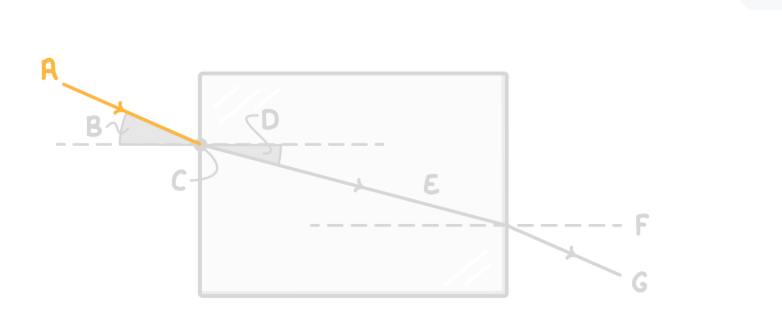
A - Incidence Ray
B - Angle of Incidence
C - Point of Incidence
D - Angle of Refraction
E - Refracted Ray
F - Normal
G - Emergent Ray
EM Spectrum Order
radio waves - Long Wavelength/Short Frequency
micro waves
IR
Visible Light
Ultraviolet Rays
X Rays
Gamma Rays - Short Wavelength/Long Frequency
EM Spectrum
transverse waves that transfer energy from the source of the waves to an absorber
continuous spectrum of all types of electromagnetic wave travel at the same velocity through a vacuum (space) or air.
EM Waves Speed
Travel at same speed in a vaccum (3*10^8) and same speed in air (slower than vaccumn)
Transfer energy from a source to absorber
What EM waves can our eyes detect?
our eyes can only detect visible light
so they can only detect a limited range of electromagnetic waves
Examples of how EM WAVES TRANSFER ENERGY
microwaves → water molecules absorb certain wavelengths of microwave radiation
microwave oven transfers energy by radiation to the thermal store of food placed inside it
infared → energy is transferred by radiation to thermal store of object/surroundings
sun
visible light
IR waves heat up earth
UV waves cause suntans
via radiation
Diffract
Diffraction is the spreading out of waves as they pass through an aperture or around objects
Dispersion
Dispersion is defined as the spreading of white light into its full spectrum of wavelengths.
Properties of electromagnetic waves when they meet a boundary
refract/reflect electromagnetic waves in ways that vary with wavelength
some example are due to difference in velocity of waves in different substances
How are radiowaves produced?
produced by oscillation in electrical circuits/magnetic fields
when radio waves are absorbed they create a alternating current → with the same frequency as radio wave itself
so radio waves can induce oscillation in an electrical circuit themselves
How to produce radiowaves part 2?
you can produce radio waves using ac current in an electrical circuit
object which charges electron to oscillate to create radio waves is called a transmitter
when transmitted radiowaves reach a reciever the radiowaves are abosrbed
energy carried by waves is transfered to electrons of material in reciever
energy causes electrons to oscillate → complete electrical circiut (then ac current generated)
current has same frequency as the radio wave that generated it
Radio waves Applications
Long wavelength radio - 1-10km diffract bend around curved surface of the earth
so signals can be received even if it isn’t in line of transmitter
Short wavelengfth radio - 10m-100m reflected between ionosphere (electrically charged layer) to get to places
can be recieved long distances from transmitter
Medium wave - reflect off ionsphere depnding on atmospheric conditons
TV signals Fm radio - short wavelengths 10cm-10m must be in direct sight of trasmitter → doesnt bend or travel far through buildings
Bluetooth → Short wavelength radio devices used to send data over short distances without wires
Microwaves
Satellites - certain wavelengths of microwave can easily pass atmosphere and reach satellites (without being reflect,refracted,diffracted or absorbed)
transmitter - satellite - satellite dish
however there is a slight time delay due to long distance being travelled
Cooking - microwaves abosorbed by food molecules,transferring energy to water molecules in food causing it to heat up → which quickly cooks food
Infared Radiation
Emitted from all object that have thermal energy
Hotter it is more infared radiation
IR radiotin applications
Cooking Food → causes objects to get hotter - means food can be cooked using IR radiation (as temp increases when it absorbs IR radiation)
Infrared Cameras → heat loss can be detected through different parts of the camera/ night vision equipment (hotter object is brighter it appears)
Electrical Heating → contain long piece of wire that heat up when current flows through it → lots of IR radiation is emitted and absorbed by objects in the room
which increases thermal store of object causing temp to increase
Visible light applications
em radiation that can be seen with naked eye
so used in CAMERAS
fibre optic communications →
optical fibres are thin glass /plastic fibres that carry data
over long distance due to pulses of visible light
reflection (so they are bounced back and forth)
visible light is used as it is not easily absorbed or scattered as it travels along a fibre
UV radiation
Ionise atoms inside our cells leading to sunburn — cancer sometimes
Flourescent light,tanning beds,security ink,destroying microorganisms
Flourescent - ultraviolet light absorbed and emitted as visible light (due to layers of phosphorus → makes them energy efficient)
UV radiation applications
Energy efficent lamps → flourescent light generate uv radiation abosrbed then remitted as visible light
due to layer of phosphorus inside bulb
energy efficient so good to use over long periods of time
Sun Tanning → UV lamps are used to give them artifical sunlight - overexposure to UV raadiation is dangerous (but floursecent emit low uv so its fine)
X ray process
X rays are fired at patient
Absorbed by material that are very dense like bones
Trasmitted through materials that are not very dense like flesh
X rays that pass through are dected by detector plate forming an xray image
Gamma Rays
Changes in atoms and the nuclei of atoms can result in
electromagnetic waves being generated or absorbed over a wide frequency range.
Gamma rays originate from changes in the nucleus of an atom.
gamma xyra medical treatment
radiographers use x rays to treat people with cancer (radiotherapy)
high doses of these rays kill living cells so they are directed towards cancer cells
precaution must be taken to avoid killing healthy cells
Uses:
sterilise equipment/medical imaging (tracers) /treat cancer
Oscilloscope
Device used to display wavelength amplitude and frequency of voltage and current
Why cant microwaves in satellite communcation be abosrbed by water molecules?
If they were absorbed by water molecules they would not be able to pass through the atmopshere
Dangers of EM radiation
High frequnecy waves have lots of damage eg.
Ultraviolet waves
can cause skin to age prematurely and increase the risk of skin cancer
. X-rays and gamma rays
are ionising radiation that
can cause the mutation of genes and cancer.
radiowaves
don’t have much energy so pass through soft tissue without being absorbed
Sieverts
radiation does depends on exposure and type of radiation
measured is sieverts
1000 milli sieverts = 1 sievert
Convex Lens
lens that buldges outwards
parallel rays of light are brough to a focus at the principal focus
distance from lens to principal focus is called focal length
Convex/Converging Lense
Concave/Diverging Lense
Lens
forms an image by refracting light and changing its direction
What is distance from the CENTRE lens to the principle focus called?
focal length
Three rules for convex lenses
incident ray travelling parallel to the axis refract through the lens and passes through the principal focus onto other side
incident ray pass through centre carries on in the same direction
incident ray passing through principal focus before meeting lens refracts through lens and travels parallel to axis
Concave lenses
caves inwards - parallel rays of light diverge out
image produced is always virtual
principal focus of concave lens is point where rays hitting lens parallel to axis appear to all come from (you can trace them back until they appear to meet up at a point behind the lens)
Three important rules for concave lenses
incident ray travelling parallel to the axis refracts through the lens and travels in line with near sided principal focus (so appear to have come from principal focus)
incident ray passing through centre of lens carries on in the same direction
incident ray passing through lens towards far sides principal focus refracts through the lens and travels parallel to axis
How to draw ray diagrams concave
1. Lens with arrows facing outwards
2. Draw line going from the top of object through middle and touching top of lense.
3. Draw a virtual line from the top of the lense meeting point to the focal point and continue that line on the other side with a solid line.
4. Point where they meet is where image is reflect.
How to draw ray diagrams convex
1. Lens with arrows facing inwards.
2. Draw line going from the top of object through middle and touching top of lense.
3. Draw a real line through the focal on the other side draw until two lines meet.
4. Point where they meet is where image is reflect.
(Sometimes when it is too small to meet go backwards and draw a virtual image)
How to describe image
- Virtual or Real
- Inverted or Upright
- Smaller or Larger
magnification produced by a lens can be calculated
convex lenses virtual image - object magnified must be closed to the lens than focal length
image height/object height
magnification is a ratio and has no units
Image height and object height should both be measured in either mm or cm.
Qualities of high power lenses
more curved
material that refracts light more strongly
What does each colour in the visible light spectrum have?
has its own narrow band of wavelength
and frequency
eg. violent at 400nm and red at 700nm
Visible Light
waves cover a very large spectrum
however we can only see a tiny part of the spectrum
What happens when you mix colours?
colour can be mixed together to form other colours
only colours that you can make are primary colours red/green/blue
White light
contains wavelengths of all colours
some object appear white as they reflect all wavelengths EQUALLY
Black
absence of light’
some object appear black as all wavelengths are absorbed
How do colour filters work?
absorbing certain wavelengths (and colour)
and transmitting other wavelengths (and colour).
Colour of opaque objects
determine by which wavelengths of light are more strongly reflected
opaque objects do not transmit light
they absorb wavelengths of light and reflect others
eg. apple reflect red
For opaque object that are not a primary colour:
they may be reflecting either the wavelengths of light corresponding to that colour
or wavelengths of primary colours that can mix to make that colour
eg. banana looks yellow as it reflects red and green light
Transparent objects
transmits light in straight lines (all light through)
so you can see image clearly
eg. glass
Translucent objects
transmit light but all scatter it
What does colour of trannsparent/translucent object depend on?
wavelengths of light transmitted and reflect by it
some wavelengths of light still abosrbed/reflected
Colour Filters
only transmits certain wavelengths of light
and absorbs all other wavelengths
eg. look at blue object through blue colour filter object is blue (light reflect and transmitted by filter)
eg. if object was red the object will appear black if viewed through blue colour filter (as all light reflect by object is absorbed by filter)
eg. transmits that colour eg. white light is shone at blue colour filter → only blue light will be let through rest is abosrbed
Non - Primary colour filter
let both wavelengths of light for that colour
and the wavelengths of the primary colours that can be ADDED TO MAKE THAT COLOUR
Black body radiation
perfect black body is an object that absorbs all of the radiation falling upon it
it does not reflect or transmit any radiation
it is the best possible emitter of radiation
Radiation emitted by objects?
some object emit radiation due to their thermal energy stores
dont just emit infared radiation → emit a range of wavelengths and frequencies across EM spectrum
intensity and distribution of radiation emitted depends on objects temperature
Intensity of wavelengths emitted
power per unit area
intesity of radiation depends on temerpature
As temperature of object increases the intensity of every emitted wavelength increases
What do all bodies do?
that all bodies (objects) emit radiation
that the intensity and wavelength distribution of any emission depends on the temperature of the body.
What happens to a body temp icnreases?
body absorbs radiation faster than it emits radiation