Animal Phys Exam 4 Review
 Call Kai
 Learn
Learn Practice Test
 Spaced Repetition
 Match
Match Flashcards
 Knowt Play
1/45

There's no tags or description
Looks like no tags are added yet.
Name | Mastery | Learn | Test | Matching | Spaced | Call with Kai |
|---|
No analytics yet
Send a link to your students to track their progress
46 Terms
following fertilization, a zygote has
46 chromosomes
segregation of sister chromatids at
anaphase of meiosis II
meiosis makes
four non identical haploid cells
gametogenesis
gonads produce sex cells called gametes and secrete sex hormones
erythropoiesis
red blood cell formation
growth of pubic hair and axillary hair for a female are by
androgens secreted by adrenal cortex and ovary
mature sperm are stored in the
epididymis
estrogen in females promote
development of secondary sex characteristics
an ovulated egg enters
the fallopian tube
if an egg is fertilized,
zygote divides
after several divisions, a zygote becomes
blastocyst
blastocyst implants in the
endometrium of the uterus
inhibin
peptide hormone, inhibits FSH more than it inhibits LH
the peak of LH is necessary for
the release of the egg (ovulation)
estrogens rise during the follicular phase to
thicken the uterine lining and trigger the LH surge
progesterone is produced by the
corpus luteum after ovulation
progesterone maintains the
uterine lining for a potential pregnancy
oxytocin (OT)
surge of hormone released during sexual arousal and orgams
four main layers of the digestive tract
mucosa, submucosa, muscularis externa, serosa
accessory digestive organs
pancreas, liver (bile)
amylase is released by the pancreas into small intestine to
break down carbohydrates
peptidases, trypsin - from pancreas to small intestine to
breaks down proteins
lipases from pancreas to small intestine to
break down fat
gastrointestinal tract wall - muscularis is composed of
smooth muscle
inner circular layer of tract wall contraction constricts
the tube lumen
outer longitudinal layer of tract wall contraction
shortens tube
myenteric nerve plexus
axons and ganglia between layers control contractions
mixing
backward and forward motion that lacks directional movement to blend ingested materials with secretions
propulsion
directional movement of materials through GI tract
propulsion occurs by
peristalsis
peristalsis
sequential contraction of muscularis, GI tract wall moves like a wave
inner circular layer of GI track thickened at locations to form a
sphincter, closes off lumen and controls passage of contents to next section of GI tract
increased rate of peristalsis (propulsion) =
decreased time for absorption in GI
salivary glands
lubricate mouth and throat
salivary amylase
helps break down starches/ carbohydrates in food
mastication
chewing
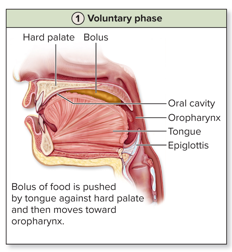
voluntary phase of swallowing
bolus of food is pushed by tongue against hard palate and then moves toward oropharynx
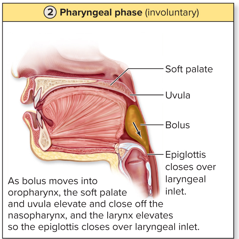
pharyngeal phase (involuntary)
as bolus moves into oropharynx, the soft palate and uvula elevate and close off the nasopharynx, and the larynx elevates so the epiglottis closes over laryngeal inlet
the stomach delivers
chyme to the small intestine
the stomach enzymatically digests proteins with
pepsin
the stomach secretes intrinsic factor required for
absorption of vitamin B12
what do epithelial goblet cells secrete
mucus to protect epithelial cell that line the GI
HCL is secreted by
parietal cells
HCL
denatures proteins and destroys pathogens
what enzymes are specific for disaccharides
maltase, sucrase, lactase