Specific terms and examples of things---Biology
 Call Kai
 Learn
Learn Practice Test
 Spaced Repetition
 Match
Match Flashcards
 Knowt Play
1/147

There's no tags or description
Looks like no tags are added yet.
Name | Mastery | Learn | Test | Matching | Spaced | Call with Kai |
|---|
No analytics yet
Send a link to your students to track their progress
148 Terms
enzyme that works in low pH
pepsin: works at pH of 2
non-conjugated protein
collagen triple helix
only polypeptides
conjugated protein
hemoglobin (and its haem groups)
polypeptides + non-protein groups
Fibrous protein
collagen, keratin
elongated, structural, insoluble
Globular protien
enzymes, insulin, hemoglobin
compact, functional, soluble
Microscopy stains
iodine (plants)
methylene blue (animals)
Atypical eukaryotic cells
Red blood cells: no nucleii
phloem sieve tube elements: no nuclei
skeletal muscle fibers: many nuclei
Aseptate hyphae: many nuclei
hybrid species
horse x donkey = mule (sterile)
Places with aquaporins
kidney, root hairs
totipotent stem cells
zygote
pluripotent stem cells
embryonic stem cells
multipotent stem cells
bone stem cells
examples of cell size as specialization
sperm: long and thin for mobility
egg: large, nutrient reserves
RBCs: concave, small volume, lots of surface area
Neurons: long axons for transmission
Muscle fibers: long and multinucleated: strong contraction
Adaptations to increase surface area to volume ratio
RBCs
kidney proximal tubule cells have microvilli and infoldings
positive feedback loops for climate change
ocean outgassing: warmer water holds less CO2, so it warms the atmosphere.
Ice & albedo: melting ice lowers reflectivity, meaning more absorption and more warming.
Permafrost/peat: warming = CO2 and CH4 (methane) release
Drough/fire: carbon and soot emissions = warming
Ocean upwelling
warmer ocean surface = more stratification (layer seperation).
less mixing = less nutrients go to euphotic zone.
Primary production decreases, impacting species
coral reefs
acidification = less carbonate ions, and weaker calcification
warming = bleaching (zooxanthellae loss)
phenology
biological timing, + climate cues
flowering, migration, nesting.
depends on photoperiod, and temp
mesocosm
controlled mini-ecosystem to test variable effects on stability
stability within ecosystem depends on
energy supply being reliable
nutrient recycling with minimal leakages
genetic diversity within species
climate within tolerance (temp and rainfall reasonable)
eutrophication
excess nitrogen and phosphate runoff = algae blooms
biomagnification
stuff that accumulates in organisms
top predators have highest concentrations
DDT, methylmercury
arrested succession
when the cycle of succession in an envionment is lowk stopped
grazing, drainage that dries wetlands, etc.
Example of modelling natural and sexual selection
Endler’s guppies:
manipulated predators to track trait changes
no predators = sexual selection dominates
weak predators = natural and sexual selection
strong predators = natural selection dominates
Hardy-Weinberg equation
p² + 2pq + q² = 1
p + q = 1
USED WHEN
no mutation
large population
random mating
no migration
no natural selection
endosymbiotic
the thing where chloroplast and mitochondria were taken into cell
Criteria for life
MR H GREN
metabolism, response, homeostasis, growth, reproduction, excretion, nutrition
how to tell trans fat
Hydrogen atoms are on opposite sides of the double bond
trans fat also has one or more double bonds
wtf is sucrose made of
glucose and fructose joined by glycosidic bond
what are covalent bonds
sharing of one or more pairs of electrons
what does increasing substrate do to rate of reaction
increases it
does not increase rate of reaction when there is non-competitive inhibitor
where are photosystem arrays
in thylakoid membrane in chloroplasts
what molecule is reduced by photosystem 1 during photosynthesis
NADP+
chemiosmosis
diffusion of protons (hydrogen ions) across concentration gradient, back into matrix through ATP synthase to generate ATP
H+ pumped into intermembrane space, or thylakoid space
pennicilin mechanism of action
it acts as a mechanism-based inhibitor on transpeptidase enzymes
action spectra vs absorption spectra
action spectra shows wavelenths that activate photosynthesis
absorption spectra shows the wavelengths absorbed by a pigment
what does NAD do in respiration
it accepts hydrogen from a substrate, becoming NADH.
it then carries the hydrogen to the ETC
Decarboxylation of pyruvate in the link reaction
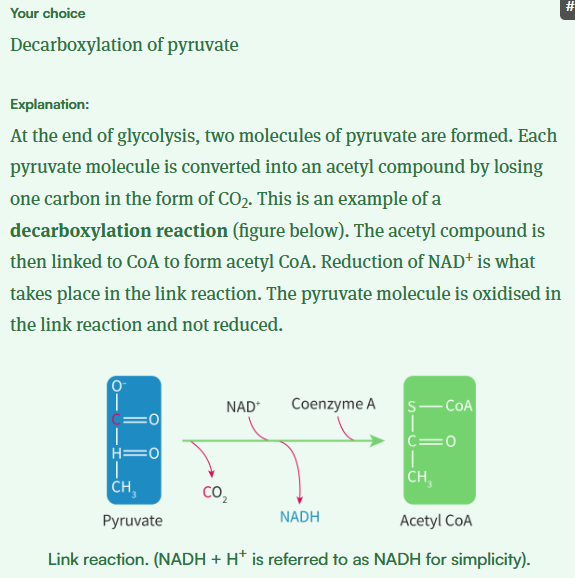
where does light-dependent reactions take place
on molecules embedded in bilayer of thylakoids
plasmodesmata
small channels between cells, like phloem seive tubes and their companion cells
systole vs diastole
systole = contract
diastole = relaxation
blood pressure is systolic/dystolic
external and internal intercostal muscles
external: contract, expanding ribs, inhalation
internaL: contract, ribs move inward, exhalation
coral
depend on sunlight for zooxanthellae photosynthesis
salinity 32-43 ppt
pH greater than 7.8 for calcium carbonate depositon
shallow waters
23-29 degrees C
obligate aerobes / anaerobes
cannot function without O2, and cannot function with O2
faculative anaerobes
switch between aerobic and anaerobic
does archaea do photosynthesis
NEVER
holozoic nutrition
animals ingest solid food and digest internally
saprotrophic nutrition
secrete enzymes onto dead matter and absorb products
decomposers
chemotrophic
oxidize inorganic compounds such as iron ions
fundamental vs realized niche
fundamental: full range a species could occupy without competition
realized: actual occupied range with competition
metabolism
network of enzymaatic reactions
the sum of all chemical reactions that occur within every cell of a living organism to sustain life
induced fit binding
the active site of enzyme chances slightly to better fit the substrate
what does denaturation do
disrupts weak bonds within enzyme, destroying shape of active site
examples of extracellular enzymes
amylase, trypsin, fungal cellulases
cyclical vs. linear metabolic pathway
cyclical: regenerates a starting molecule (Kreb’s cycle regenerates oxaloacetate)
linear: substrate flows to a diff end product (glycolysis to pyruvate)
feedback inhibition, and example
end product of a process binds allosterically to the first enzyme, slowing the pathway.
negative feedback loop
example: isoleucine inhibits threonine deaminase
mechanism based inhibition, and examples
inhibitor is processed by the enzyme into a reactive form, that irreversibly inactivates the active site
EX: penicillin and bacterial transpeptidase, aspirin acetylates COX enzymes
oxidation vs reduction
OIL RIG: Oxidation is loss, reduction is gain (of electrons)
link reaction
follow glycolysis
transports pyruvate into mitochondrial matrix
pyruvate loses a carbon, forming CO2 (3C turns into 2C)
forms an acetyl group when it loses a hydrogen atom
acetyl compound binds w coenzyme A to make acetyl CoA
why does fermentation occur
no O2 = ETC stops
fermentation regenerates NAD from NADH, to keep glycolysis going
makes lactic acid in muscles, ethanol in yeast and plants
Cell repiration product release stats
glycolysis (cytoplasm)—-uses glucose, ATP, NAD —→ 2 pyruvate, 2 NADH, 2 net ATP
link (mitochondrial matrix)—-uses 2 pyruvate, 2 NAD —→ 2 acetyle CoA, 2 CO2, 2 NADH, 0 ATP
Kreb’s (matrix)—-uses 2 acetyl CoA, 6 NAD, 2 FAD —→ 4 CO2, 6 NADH, 2 FADH, 2 ATP
ETC (inner membrane)—-uses FADH and NADH, and O2 —→ makes H2O, NAD, FAD, and 28-32 ATP
glycolysis steps and stuff
energy investment: 2 ATP made into 2 ADP. Glucose becomes frictose 1, 6 biphosphate. ADP made back into ATP, and fructose 1 6 biphosphate becomes 2 pyruvate. NAD made into NADH too.
pyruvate to lactate
lactate dehydrogenase is the enzyme that does pyruvate + NADH —→ lactate + NAD
yeast fermentation
pyruvate —→ ethanal + CO2 (decarboxylation)
then ethanal —→ ethanol
Kreb’s cycle
Acetyl CoA + oxaloacetate = citrate
the cycle replenishes oxaloacetate
for each acetyl CoA, 3 NADh, 1 FADH2, 1 ATP, 2 CO2.
Goes twice per glucose (2 acetyl CoA’s from link reaction)
what does light dependent reaction make
ATP and NADPH, in the thylakoid membrane
what does Calvin cycle do
uses ATP and NADPH to fix CO2 into triose phosphate in stroma
where does oxygen come from in light dependent reaction
from the H2O, not the CO2.
released from photolysis in PSII
chlorophyll a
the reaction center. all others are antenna pigments
Free-air carbon dioxide enrichment
lots of CO2 in controlled environment, increases photosynthesis
photolysis
light splits water
2 H2O —> 4 H + 4 e + O2
IN PHOTOSYSTEM 2 (mainly in grana)
the H+ ions are used for chemiosmosis
wtf does photosystem 1 do
reduces NADP to NADPH (for use in calvin cycle)
in stroma lamellae
wtf is Rubisco and carbon fixation
most common enzyme on planet
adds CO2 to a 5-carbon sugar, RuBP (ribulose 1 5 biphosphate)
this makes an unstable 6 carbon sugar, which breaks into 3-PGA (3-phosphoglycerate)
takes place in stroma, first step of Calvin cycle
Calvin Cycle
3 molecules CO2 plus Rubisco —→ carbon fixation
6 ATP to 6 ADP
6 NADPH to 6 NADP + H
regeneration of RuBP
3 ATP to 3 ADP
plasmolysis
happens to plant cells in hypertonic solutions. The cell becomes shriveled
crenation
happens to animal cells in hypertonic solution (cell shrinks)
water potential
potential energy of water per unit volume
more solute = lower water potential
more pressure = higher water potential
uses the lil trident symbol
water moves from high water pot. to low water pot.
sum of (pot. solute) and (pot. pressure).
quorum sensing
bacteria
cells secrete autoinducers at low constant rates
alter gene expression when threshold is reached
it is COMMUNITY signalling
signalling categories in animals
hormones: endocrine glands
neurotransmitters: released at synapses
cytokines: small proteins from many cell types
calcium ions: universal intracellular second messenger (for muscle and neurons)
hormone amines
melatonin, thyroxin, epinephrine
hormone peptides
insulin, glucagon, ADH
hormone steroids
oestadiol, progesterone, testosterone
neurotransmitter amines
dopamine, norepinephrine
neurotransmitter amino acids
glutamate, glycine
transmembrane vs intracellular receptors
transmembrane binds hydrophilic ligands outside
intracellular binds lipi-soluble ligands inside cytoplasm/nucleus
GPCRs
GPCR binds ligand, and the receptor changes shape.
the GDP leaves the alpha subunit, and GTP binds to it.
the alpha/GTP thing dissociates from beta-gamma complex, and they trigger other things
RESET: the GTPase on alpha subunit hydrolyses GTP, resetting it to GDP and starting everything over.
epinephrine and cAMP
epinephrine binds beta adrenergic GPCR —→ activates adenylyl cyclase, which produces cAMP (cyclic AMP)
cAMP activates PKA (Protein kinase A) which phosphorylates different enzymes
EX: activates glycogen phosphorylase, inhibiting glycogen synthase
Receptor tyrosine kinase
ligand binding (like insulin) leads to receptor dimerization, and autophosphorylation on tyrosines
recruits signalling proteins, increasing glucose uptake
receptor-ligand vs enzyme substrate binding
receptor-ligand doesn’t change the ligand.
oestradiol
acts in ovary, uterus, and brain to modulate GnRH release.
Stimulating GnRH increases LH and FSH
Action potential
resting is around -70 mV
threshold is about -55 mV
depolarization: Na channels open, and Na comes inside to about +30 mV
repolarization: Na channels close, K goes out.
hyperpolarization: overshoot resting, go to -80 mV
refractory period: prevents backflow
saltatory conduction
jumping thing between nodes of myelinated axon
what does action potential even do
action potential opens calcium channels
vesicles release neurotransmitter by exocytosis
diffusion across cleft
binding to postysynaptic receptors
how does a signal move along axon
local Na diffusion depolarizes the next section of the axon
refractory period prevents backward movement (neuron can’t immediately fire another signal)
summation
spatial summation: many inputs at once
temporal summation: one input firing rapidly
axon hillock: little triangle thingy connecting body of neuron to axon. This is the site of integration of signals.
nociceptor
pain receptor
Spinal cord
integration center for unconscious processes
white matter = signals
grey matter = synapses
coordinates reflexes and unconscious actions faster than brain
baroreceptors
blood pressure
chemoreceptors
CO2 and pH
efferent vs afferent
afferent = going to brain
efferent = away from brain