Biology Topic 4: Genetic information, variation and relationships between organisms
 Call Kai
 Learn
Learn Practice Test
 Spaced Repetition
 Match
Match Flashcards
 Knowt Play
1/87

There's no tags or description
Looks like no tags are added yet.
Name | Mastery | Learn | Test | Matching | Spaced | Call with Kai |
|---|
No analytics yet
Send a link to your students to track their progress
88 Terms
define genetic diveristy
the number of different alleles of genes in a population
how does genetic diversity affect natural selection?
genetic diversity is a factor that enables natural selection to occur
what is natural selection?
the process where organisms with advantageous traits for their environment are more likely to survive and reproduce, passing on those traits to their offspring
this results in species that are better adapted to their environment. These adaptations may be anatomical, physiological or behavioural
what is evolution?
The gradual change in a population's characteristics over time due to natural selection acting on genetic variations.
outline the process of natural selection
random mutation results in new alleles of a gene
in certain environments, this allele is advantageous to the possessor, so the individual has increased reproductive success
individuals without the allele are selected against by the selection pressure, so are outcompeted by mutated individuals
mutated individuals pass the advantageous allele onto their offspring
as a result, over many generations, the new allele increases in frequency in the population
what is directional selection?
when the environment favours a particular extreme of a trait
over time, the mean of the popular shifts in favour of that extreme
e.g. when a population is bacteria is exposed to an antibiotic, bacteria that mutate and gain the allele for antibiotic resistance will reproduce and survive
this leads to a gradual increase in the antibiotic resistance of the population
what is stabilising selection?
when an environment favours the intermediate phenotype, and selects against the extremes.
this typically occurs in a stable environment
e.g. babies with low birth weights are prone to infection and have thermoregulation issues, whilst babies with high birth weights have issues during delivery.
thus, babies with intermediate birth weights are selected for
what are anatomical adaptations?
physical features of an organism that improve survival
e.g. giraffes having long necks
what are physiological adaptations?
changes in internal biochemical processes
e.g. snakes producing venom
what are behavioural adaptations?
patterns of behaviour that increase the chance of survival
e.g. mating calls, migratory behaviour
how do we know if two organisms belong to the same species?
if they are able to interbreed and produce fertile offspring
what is courtship behaviour?
sequence of actions carried out by an organisms to attract a mate of the same species and opposite sex
necessary precursor to successful mating
why is courtship behaviour important?
helps organisms to identify potential mates of the same species
allows animals to assess the health of a prospective mate
can lead to the formation of a bond pair
helps synchronise mating behaviours (release of egg and sperm at the same time, increasing chances of fertilisation)
indicates sexual maturity
what is a phylogenic classification system?
arranges species into groups based on their evolutionary origins and relationships
uses a hierarchy in which smaller groups are placed within larger groups, with no overlap. these groups are taxa (taxon: singular)
what is a taxon composed of?
domain > kingdom > phylum > class > order > family > genus > species
what is a binomial?
genus, species
what is species richness?
measure of the number of different species in a community
what is a diversity index?
the relationship between the number of species in a community and the number of individuals in each species
formula for diversity index
N(N-1) / Σn(n-1)
where N is the total number of organisms in all species
when n is the total number of individuals in a particular species
how do farming techniques reduce biodiversity?
deforestation: remove trees and habitats, decreasing the number of species able to be hosted by the environment
monoculture farming: only one crop species is grown, reducing the number of habitats for insects, and decreasing the food supply for other organisms
pesticides: decrease the population of pests, decreasing the population of organisms that feed on pests
herbicides: decrease the population of plants, decreasing the population of organisms that feed on those plants
how can conservation and farming be balanced?
maintaining hedgerows: provides habitats and wildlife corridors for birds and insects
planting wildflower strips: supports pollinators and natural predators of pests
crop rotation: reduces soil depletion and increases biodiversity
protecting areas: national reserves, protecting areas with high biodiversity
how can genetic diversity be measured?
measuring the frequency of observable characteristics
studying the base sequence of DNA/RNA and comparing overlapping sequences
comparing the amino acid sequence of the proteins encoded by DNA and mRNA
if two organisms have similar DNA and protein sequences, what can be inferred?
the organisms likely share a more recent common ancestor
how have advanced in gene technology aided studies of genetic diversity?
by allowing for direct comparison of DNA base sequences, which is more accurate than measuring observable characteristics
how can you use quantitative data to investigate diversity?
collecting data from random samples
sampling must be random
sample sizes must be large
calculating mean and standard deviation
plot continuous variation on a distribution graph
calculate the mean
the standard deviation is how spread out the data is around the mean
describe DNA in prokaryotic cells
DNA molecules are short, circular and not associated with proteins (no histones)
describe DNA in eukaryotic cells
DNA molecules are very long, linear and associated with proteins (histones)
describe DNA in the mitochondria and chloroplasts of eukaryotic cells
short, circular and not associated with proteins
what is a gene?
base sequence of DNA that codes for the amino acid sequence of a polypeptide or a functional RNA (mRNA, tRNA)
where is a gene located?
a gene occupies a locus on a chromosome/DNA molecule
what is a codon/triplet?
sequence of 3 DNA bases
why is the genetic code universal?
the same four bases (A, T, G, C) are used in the DNA of every organism
the same codons encode the same amino acids in every organism
codons in DNA are transcribed into mRNA and translated into amino acids in every organism
why is the genetic code non-overlapping?
there is no overlap between triplet codes - each nucleotide is part of only one codon
[i.e. the codons ATC and CGA are represented like this “ATCCGA” and not “ATCGA” - each nucleotide is only read once]
why is the genetic code degenerate?
multiple codons can code for the same amino acid
[e.g. tyrosine is coded for by TAC and TAT]
does all of the nuclear DNA code for polypeptides?
no - the majority of it doesn’t
there are multiple non-coding bases (introns) between genes
what are the coding regions of DNA called?
exons
what are the non-coding regions of DNA called?
introns
what is a genome?
the complete set of genes in a cell
what is a proteome?
the full range of proteins a cell is able to produce at a given time
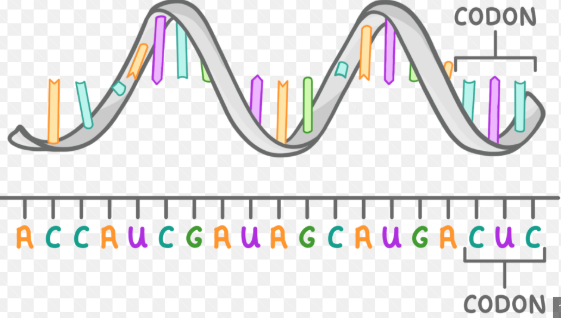
describe the structure of mRNA
single stranded, linear polynucleotide chain
composed of nucleotides (ribose sugar, phosphate group and nitrogenous base)
contains nucleotides adenine, uracil, cytosine and guanine
nucleotide bases are arranged into codons, which specify an amino acid or stop/start signal
nucleotides are linked by phosphodiester bonds
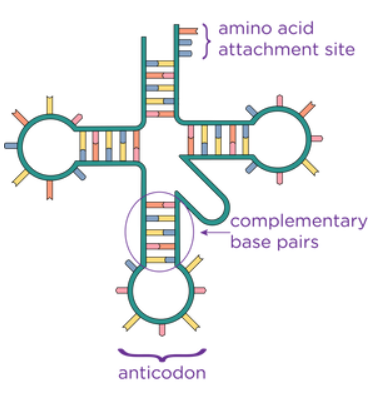
describe the structure of tRNA
single strand folded into a clover shape due to hydrogen bonds between complementary base pairs
one end is attached to an anticodon which corresponds to an mRNA codon, and the other has a binding site for the corresponding amino acid (to the mRNA codon)
what is transcription?
in prokaryotes - production of mRNA from DNA
in eukaryotes - production of pre-mRNA from DNA (this is then spliced to form DNA)
describe the process of transcription (prokaryotes)
RNA polymerase binds to the promoter region of the target gene. it then breaks the hydrogen bonds between complementary base pairs, unwinding the strands. this exposes the nucleotides.
exposed nucleotides on the template strand pair with free RNA nucleotides via complementary base pairing. H bonds are formed between base pairs, and Adenine (DNA) binds with Uracil (RNA)
RNA polymerase binds adjacent nucleotides together via phosphodiester bonds. this forms the mRNA strand. the mRNA strand is a copy of the target gene.
when RNA polymerase reaches a stop codon on the template strand transcription ends and it separates the mRNA strand from the template. the two DNA strands rejoin behind the enzyme. the mRNA strand exits the nucleus via the nuclear pores.
describe the process of transcription (eukaryotes)
RNA polymerase binds to the promoter region of the target gene. it then breaks the hydrogen bonds between complementary base pairs, unwinding the strands. this exposes the nucleotides.
exposed nucleotides on the template strand pair with free RNA nucleotides via complementary base pairing. H bonds are formed between base pairs.
RNA polymerase binds adjacent nucleotides together via phosphodiester bonds. this forms the pre-mRNA strand. the pre-mRNA strand is a copy of the target gene.
when RNA polymerase reaches a stop codon on the template strand transcription ends and it separates the pre-mRNA strand from the template. the two DNA strands rejoin behind the enzyme.
[splicing]
pre-mRNA contains introns and exons
spliceosomes bind to the intronic regions and cut them out of the strand
they then rejoin the exons together, forming an mRNA strand. this then leaves the nucleus via the nuclear pores.
is mRNA complementary to the target gene?
no - the template (non-coding strand) is complementary to the coding strand. as mRNA is complementary to the template strand, it is a copy of the coding strand.
thus it is identical to the target gene
what is translation?
the production of polypeptides from the sequence of codons carried by mRNA
describe the process of translation
mRNA binds to a ribosome in the cytoplasm. 2 codons enter the ribosome at a time.
tRNA binds to the first codon in the ribosome.
tRNA anticodons bind to complementary mRNA codons. on the other side of the molecules, tRNA carries a specific amino acid which correlates to a codon on the mRNA strand.
the amino acid on the tRNA forms a peptide bond with adjacent amino acids on other tRNA molecules. the formation of a peptide bond requires ATP
after the amino acid is joined to the polypeptide, tRNA is released. the ribosome moves along the mRNA strand to the next codons to form the polypeptide chain
what role does the ribosome play in translation?
site of protein synthesis
small subunit binds to the mRNA, large subunit bind binds to the tRNA molecules
what do gene mutations involve?
change in the base sequence of chromosomes
what are the 2 main types of gene/point mutations?
base deletion/insertion (indel) - a nucleotide base is inserted or deleted from the DNA sequence. this results in a frame shift.
base substituition - one nucleotide base in the DNA sequence is replaced by another
what is a frame shift?
where a nucleotide base is inserted/deleted, causing the order of the DNA sequence to shift one base forward or backwards
do all base substitutions produce a different amino acid in the polypeptide chain?
no - the DNA code is degenerate, so multiple codons can code for the same amino acid.
this means that not all mutations cause a significant change
what is a mutagenic agent?
a factor (chemical, biological, or physical agent) that increases the rate of gene mutations in the DNA
what are the two main chromosome mutations?
polyploidy - mutation where an individual has more than 2 sets of chromosomes
non-disjunction - mutation where the chromosomes fail to separate during meiosis, resulting in an individual with one more or fewer chromosomes
what does meiosis produce?
4 genetically different haploid daughter cells
process of meiosis
meiosis I:
prophase I: the chromosomes condense and homologus pairs form bivalents. crossing over occurs between non-sister chromatids.
metaphase I: homologus pairs line up at the centre of the cell. independent assortment occurs, causing genetically different daughter cells.
anaphase I: homologus chromosomes are separated, and chromosomes move to opposite ends of the cell
telophase I: chromosomes reach the poles and nuclear envelopes form. in cytokinesis, the cytoplasm divides. this forms 2 genetically different haploid daughter cells
meiosis II:
prophase II: nuclear envelopes break down
metaphase II: chromosomes line up at the equators of the cells
anaphase II: sister chromatids are separated and move to opposite poles
telophase II: chromosomes reach the poles and nuclear envelopes reform.
cytokinesis occurs, dividing the cytoplasm. this results in 4 genetically different haploid daughter cells.
how does independent assortment result in increased genetic variation?
during metaphase I, homologus chromosomes line up at the equator.
the arrangement of these pairs is random, meaning that the chromosomes which end up in each cell after division is random
how does crossing over result in increased genetic variation?
during prophase I, when the homologus chromosomes form bivalents non-sister chromatids exchange genetic material at the chiasmata
this causes recombination, increasing genetic variation
how can you calculate the number of different combinations of chromosomes after meiosis (wo crossing over)?
using the formula:
no. of combinations = 2n
where n = no. of homologus pairs
how can you calculate the number of different combinations of chromosomes after fertilisation?
(2n)2
what happens to the number of chromosomes during meiosis?
overall, the number of chromosomes halves
meiosis I: 2 haploid cells containing 2 sister chromatids
meiosis II: 4 haploid cells containing a single chromosome copy
how are the outcomes of mitosis and meiosis different?
mitosis produces 2 genetically identical offspring, whilst meiosis produces 4 genetically different offspring
mitosis produces diploid offspring, whilst meiosis produces haploid offspring
how does random fertilisation increase genetic variation?
random fertilisation is the fact that any singular sperm in the multitude can fertilise the egg
this increases genetic variation by producing new allele combinations
define genetic diveristy
the number of different alleles of genes in a population
how does genetic diversity affect natural selection?
genetic diversity is a factor that enables natural selection to occur
what is natural selection?
the process where organisms with advantageous traits for their environment are more likely to survive and reproduce, passing on those traits to their offspring
this results in species that are better adapted to their environment. These adaptations may be anatomical, physiological or behavioural
what is evolution?
The gradual change in a population's characteristics over time due to natural selection acting on genetic variations.
outline the process of natural selection
random mutation results in new alleles of a gene
in certain environments, this allele is advantageous to the possessor, so the individual has increased reproductive success
individuals without the allele are selected against by the selection pressure, so are outcompeted by mutated individuals
mutated individuals pass the advantageous allele onto their offspring
as a result, over many generations, the new allele increases in frequency in the population
what is directional selection?
when the environment favours a particular extreme of a trait
over time, the mean of the popular shifts in favour of that extreme
e.g. when a population is bacteria is exposed to an antibiotic, bacteria that mutate and gain the allele for antibiotic resistance will reproduce and survive
this leads to a gradual increase in the antibiotic resistance of the population
what is stabilising selection?
when an environment favours the intermediate phenotype, and selects against the extremes.
this typically occurs in a stable environment
e.g. babies with low birth weights are prone to infection and have thermoregulation issues, whilst babies with high birth weights have issues during delivery.
thus, babies with intermediate birth weights are selected for
what are anatomical adaptations?
physical features of an organism that improve survival
e.g. giraffes having long necks
what are physiological adaptations?
changes in internal biochemical processes
e.g. snakes producing venom
what are behavioural adaptations?
patterns of behaviour that increase the chance of survival
e.g. mating calls, migratory behaviour
how do we know if two organisms belong to the same species?
if they are able to interbreed and produce fertile offspring
what is courtship behaviour?
sequence of actions carried out by an organisms to attract a mate of the same species and opposite sex
necessary precursor to successful mating
why is courtship behaviour important?
helps organisms to identify potential mates of the same species
allows animals to assess the health of a prospective mate
can lead to the formation of a bond pair
helps synchronise mating behaviours (release of egg and sperm at the same time, increasing chances of fertilisation)
indicates sexual maturity
what is a phylogenic classification system?
arranges species into groups based on their evolutionary origins and relationships
uses a hierarchy in which smaller groups are placed within larger groups, with no overlap. these groups are taxa (taxon: singular)
what is a taxon composed of?
domain > kingdom > phylum > class > order > family > genus > species
what is a binomial?
genus, species
what is species richness?
measure of the number of different species in a community
what is a diversity index?
the relationship between the number of species in a community and the number of individuals in each species
formula for diversity index
N(N-1) / Σn(n-1)
where N is the total number of organisms in all species
when n is the total number of individuals in a particular species
how do farming techniques reduce biodiversity?
deforestation: remove trees and habitats, decreasing the number of species able to be hosted by the environment
monoculture farming: only one crop species is grown, reducing the number of habitats for insects, and decreasing the food supply for other organisms
pesticides: decrease the population of pests, decreasing the population of organisms that feed on pests
herbicides: decrease the population of plants, decreasing the population of organisms that feed on those plants
how can conservation and farming be balanced?
maintaining hedgerows: provides habitats and wildlife corridors for birds and insects
planting wildflower strips: supports pollinators and natural predators of pests
crop rotation: reduces soil depletion and increases biodiversity
protecting areas: national reserves, protecting areas with high biodiversity
how can genetic diversity be measured?
measuring the frequency of observable characteristics
studying the base sequence of DNA/RNA and comparing overlapping sequences
comparing the amino acid sequence of the proteins encoded by DNA and mRNA
if two organisms have similar DNA and protein sequences, what can be inferred?
the organisms likely share a more recent common ancestor
how have advanced in gene technology aided studies of genetic diversity?
by allowing for direct comparison of DNA base sequences, which is more accurate than measuring observable characteristics
how can you use quantitative data to investigate diversity?
collecting data from random samples
sampling must be random
sample sizes must be large
calculating mean and standard deviation
plot continuous variation on a distribution graph
calculate the mean
the standard deviation is how spread out the data is around the mean