quiz 2: chapter 6 - adolescent development
 Call Kai
 Learn
Learn Practice Test
 Spaced Repetition
 Match
Match Flashcards
 Knowt Play
1/23

There's no tags or description
Looks like no tags are added yet.
Name | Mastery | Learn | Test | Matching | Spaced | Call with Kai |
|---|
No analytics yet
Send a link to your students to track their progress
24 Terms
Culture and the Self
In discussing cultural differences in conceptions of the self, scholars typically distinguish between:
↪ Independent/Interdependent self - promoted by individualistic cultural values
↪ Independent/Interdependent self- promoted by collectivistic cultural values
Cultures that emphasize an independent, individualistic self promote and encourage ? about the __.
↪ In such cultures, it is seen as a good/bad thing to think about yourself, to consider who you are as an independent person, and to think highly of yourself (within certain limits, of course—no culture values selfishness or egocentrism).
Independent.
Interdependent.
reflection. self.
good.
Culture and the Self
Cultures characterized by collectivistic/individualistic values promote an interdependent conception of the self.
↪ In such cultures, the interests of the group—the family, the ethnic group, the nation, the religious institution—are supposed to come first, before the needs of the __.
↪ T/F: This means that it is not necessarily a good thing to think highly of yourself.
↪ People who think highly of themselves threaten the harmony of the __ because they may be inclined to pursue their personal interests regardless of the interests of the groups to which they belong.
↪ Children and adolescents in these cultures are socialized to learn to consider the interests and needs of __ to be at least as important as the interests and needs of themselves.
↪ By adolescence, this means that the “self” is thought of not so much as a __, independent being, essentially apart from others, but as defined by relationships with others, to a large extent.
collectivistic.
individual.
TRUE.
group.
others.
separate.
Types of Selves in Adolescence
T/F: Adolescents think about themselves differently than younger children do, in a variety of respects.
The changes in __ that occur in adolescence have their foundation in the more general changes in cognitive functioning.
Adolescent self-conceptions, like adolescent cognitive development overall, become more ? and more complex/simple.
TRUE.
self-understanding.
abstract. complex.
Types of Selves in Adolescence – More Abstract
To say that something is abstract means that it is a concept, an idea, something that cannot be experienced directly through the __.
↪ For adolescents, the __ becomes this kind of concept, as they reflect on their personal characteristics in new ways.
With increasing age, children describe themselves less in concrete terms and more in terms of their __.
↪ Childhood/Adolescence: “I have a dog named Buster and a sister named Maria”
↪ Childhood/Adolescence: “I’m pretty smart, but I’m kind of shy”
For adolescents, self-conceptions become more ?-focused, and the traits become more __, as they describe themselves in terms of intangible personality characteristics.
senses.
self.
traits.
Childhood.
Adolescence.
trait. abstract.
Types of Selves in Adolescence – More Abstract
One aspect of the capacity for abstraction in adolescents’ self-conceptions is that they can distinguish between an ? and ?.
↪ Actual self/Possible selves is your self-conception [how you currently see yourself].
↪ Actual self/Possible selves are the persons you imagine you could become in the future depending on your choices and experiences.
actual self and possible selves.
Actual Self.
Possible selves.
Types of Selves in Adolescence – More Abstract
Two kinds of possible selves/actual selves:
→ __ self: the person the adolescent would like to be.
↪ For example, an adolescent may have an ideal of becoming popular with peers or highly successful in athletics or music.
→ __ self: the person the adolescent imagines it is possible to become but dreads becoming.
↪ For example, an adolescent might fear becoming an alcoholic, or fear becoming like a disgraced relative or friend.
→ Both kinds of possible selves require adolescents to think __ - possible selves exist only as abstractions, as ideas in the adolescent’s mind.
possible selves.
Ideal.
Feared.
abstractly.
Types of Selves in Adolescence – More Abstract
The capacity for thinking about an actual, a possible, an ideal, and a feared self may be troubling in some respects.
↪ If you can imagine an ideal self, you can also become aware of the discrepancy between your actual self and your __ self (between what you are and what you wish you were)
↪ If the discrepancy is large enough, it can result in feelings of ?, inadequacy, and depression.
↪ T/F: Studies have found that the size of the discrepancy between the actual self and the ideal self is not related to depressed mood in both adolescents and emerging adults.
ideal.
failure.
FALSE! Studies have found that the size of the discrepancy between the actual self and the ideal self is related to depressed mood in both adolescents and emerging adults.
Types of Selves in Adolescence – More Abstract
However, awareness of actual and possible selves provides some adolescents with a motivation to strive toward their ideal self and avoid becoming the __ self.
↪ A longitudinal study found that 8th-grade students whose possible selves became more focused on academics over the course of a school year ended up receiving better grades at the end of the academic year.
feared.
Types of Selves in Adolescence – More Complex
Based on a more general cognitive attainment, the __ ability to perceive multiple aspects of a situation or idea [According to Jean Piaget, adolescents enter the formal operational stage, where they can think more abstractly and consider multiple aspects of a situation at the same time].
Adolescents’ self-conceptions become more complex, especially from early adolescence to middle adolescence.
↪ Research has shown that the extent to which adolescents described themselves in contradictory ways, such as both shy and fun-loving, increased sharply from 7th to 9th grade and then increased/declined slightly in 11th grade.
formal operational.
declined.
Types of Selves in Adolescence – More Complex
Recognizing these contradictions in their personalities and behavior can be confusing to adolescents.
↪ They try to sort out “the real me” from the different aspects of __ that appear in different situations.
These contradictions indicate that adolescents, more than younger children, recognize that their feelings and their behavior can __ from day to day and from situation to situation.
↪ “I’m shy when I’m around people I don’t really know, but when I’m around my friends I can be kind of wild and crazy.”
themselves.
vary.
Types of Selves in Adolescence – More Complex
Adolescents become aware of times when they are exhibiting a __ self: a self that they present to others while realizing that it does not represent what they are actually thinking and feeling.
↪ Research showed that adolescents indicate that they sometimes dislike putting on a false self, but many also say that some degree of false self behavior is acceptable and even desirable, to impress someone or to conceal aspects of the self they do not want others to see.
↪ Adolescents are most likely to put on their false selves with __, and least likely with their ?.
false.
dating partners. close friends.
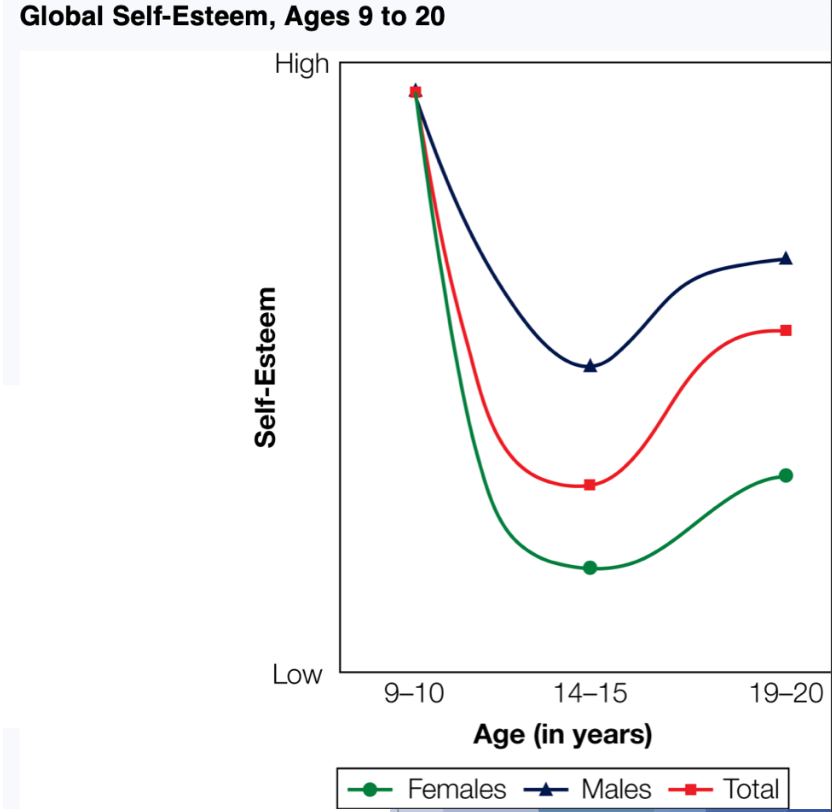
Self-Esteem from Preadolescence Through Adolescence
__: a person’s overall sense of worth and well-being.
↪ Self-image, self-concept, and self-perception are closely related terms, referring to the way people view and ? themselves.
Longitudinal studies have followed samples from preadolescence through adolescence or from adolescence through emerging adulthood.
↪ These studies find that self-esteem declines/rises in early adolescence, then declines/rises through late adolescence and emerging adulthood.
Self-esteem.
evaluate.
declines. rises.
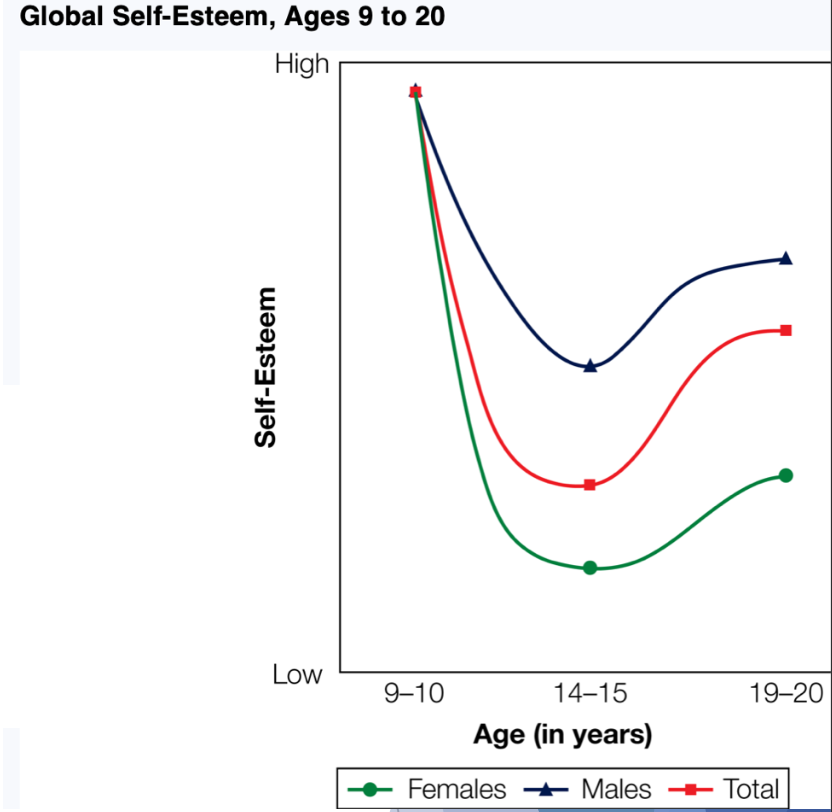
Self-Esteem from Preadolescence Through Adolescence
The __ can make adolescents self-conscious in a way that decreases their self-esteem when they first experience it in early adolescence.
↪ As adolescents develop the capacity to imagine that others are especially conscious of how they look and what they say and how they act, they may suspect or fear that others are __ them harshly.
Adolescents in Eastern/Western cultures tend to be strongly peer-oriented and to value the opinion of their peers highly, especially on day-to-day issues such as how they are dressed and what they say in social situations.
↪ Their peers have developed new cognitive capacities for sarcasm and ridicule, which tend to be dispensed freely toward any peer who seems odd or awkward or uncool.
The combination of greater peer-orientation, greater self-consciousness, and peers’ potentially harsh evaluations contributes to declines in __ in early adolescence.
imaginary audience.
judging.
Western.
self-esteem.
Self-Esteem from Preadolescence Through Adolescence
Most studies on self-esteem in adolescence assume that high self-esteem is good and low self-esteem is a problem that needs to be fixed. But views of self-esteem vary widely among __!
__ value high self-esteem to a greater extent than people in other countries, even compared to people in other Western countries.
↪ Example: in traditional Asian culture, __ is a virtue [a strength] and high ? is a character problem.
↪ The American concern with self-esteem is part of American individualism/collectivism.
cultures.
Americans.
self-criticism. self-esteem.
individualism.
Self-Esteem from Preadolescence Through Adolescence
Morris Rosenberg developed the widely used Rosenberg Self-Esteem Scale, and distinguished between ? and ?.
Barometric self-esteem/Baseline self-esteem: a person’s stable, enduring sense of worth and well-being.
↪ People with high baseline self-esteem might have an occasional bad day when they feel self-critical, but they still have high baseline self-esteem because most days they evaluate themselves __.
↪ In contrast, people with low baseline self-esteem might continue to have a good/poor opinion of themselves even though they have some days when things go well and they have positive feelings about themselves.
Barometric self-esteem/Baseline self-esteem: the fluctuating sense of worth and well-being people have as they respond to different thoughts, experiences, and interactions in the course of a day.
↪ An adolescent might have a disagreement with a parent over breakfast and feel miserable, then go to school and have some fun with friends before class and feel good, then get back a test in biology with a poor grade and feel miserable again, then get a smile from a potential love interest and feel great—all in just a few hours.
baseline self-esteem and barometric self-esteem.
Baseline self-esteem.
positively.
poor.
Barometric self-esteem.
Causes of Self-Esteem
Feeling ? and ? by others, especially parents and peers, is the influence identified by theorists and researchers as the most important. Approval from adults outside the family, especially teachers, contributes to __ as well.
School success has been found to be related to __ in adolescence, especially for Asian American adolescents.
It is also possible for self-esteem to be too high.
T/F: Adolescents who have inflated self-esteem—that is, they rate themselves more favorably than parents, teachers, and peers rate them—tend to have greater conduct problems in the classroom compared with their peers.
accepted. approved. self-esteem.
self-esteem.
TRUE.
The Self, Alone
Studies of daily time use show that over the course of adolescence, time spent alone increases/decreases.
By the late teens, adolescents spend more time __ every day than they spend with other people, including family members.
↪ When adolescents are alone, they spend the time on a variety of __.
↪ One study showed the most common activities were homework, watching something on TV or the internet, listening to music, thinking and daydreaming, actively engaging with social media, working on hobbies, and doing routine activities such as grooming (Hipson et al., 2021).
increases.
alone.
activities.
The Self, Alone
T/F: It is not problematic when adolescents are alone too much of the time.
Studies have found that adolescents who spend an unusually high proportion of their time alone tend to have higher rates of school __, depression, and other psychological difficulties.
T/F: However, these studies have also found that adolescents who are rarely alone also have higher rates of school problems and depression.
A moderate amount of time alone can be bad/healthy for adolescents.
FALSE! It is problematic when adolescents are alone too much of the time.
problems.
TRUE.
healthy
The Self, Alone
Social loneliness/Emotional loneliness: occurs when people feel that they lack a sufficient number of social contacts and relationships.
↪ Reflects a deficit in the quantity of social contacts and __.
Social loneliness/Emotional loneliness: occurs when people feel that the relationships they have lack sufficient closeness and intimacy.
↪ Reflects a deficit in the emotional __ of a person’s relationships.
Social loneliness.
relationships.
Emotional loneliness.
quality.
The Self, Alone
Emerging adults spend even more time alone, somewhere between 4 to 5 __ per day.
In many Eastern/Western countries, most emerging adults move out of the home by age 18 or 19, to go to college or to live independently.
↪ This move may have many advantages, such as giving emerging adults more __ and requiring them to take on more responsibility for their daily lives.
↪ It also means that they are no longer wrapped in the relative security of the __ environment.
↪ They may be glad to be on their own in many ways, but nevertheless they may find themselves to be __ more often than when they had lived at home.
Most young people in developed/developing countries do not enter marriage—and the emotional support and companionship that usually go along with it—until their late 20s or early 30s
hours.
Western.
independence.
family.
lonely.
developed.
The Self, Alone
In the college environment, emerging adults experience social/emotional loneliness less often, but social/emotional loneliness is common.
The first/last year of college has been found to be an especially lonely period for emerging adults.
A first-year college student living in a dormitory may have people around virtually every moment of the day—while sleeping, eating, studying, working, and going to class—but still feel lonely if those social contacts are not __ rewarding.
social loneliness. emotional loneliness.
first.
emotionally.
Erikson’s Theory
One of the most distinctive features of adolescence is that it is a time of thinking about ? you are, ? your life is going, what you ? in, and how your life fits into the ? around you - these are all issues of __.
During adolescence and continuing through emerging adulthood, explorations are made into various aspects of __, culminating in ? that set the foundation for adult life.
In Erikson’s theory of __, each period of life is characterized by a distinctive developmental issue or “?.”
Each of these ? holds the potential for a healthy path of development and an unhealthy path.
In adolescence, the crisis is ? versus ?.
who. where. believe. world. identity.
identity. commitments.
human development. crisis.
crises.
identity versus identity confusion.
Erikson’s Theory
The healthy path in adolescence involves establishing a clear and definite sense of ? you are and how you fit into the __ around you.
The unhealthy path is __, which is a failure to form a stable and secure identity.
Identity formation involves __ on what your traits, abilities, and interests are, and then sifting through the range of life choices available in your culture, trying out various possibilities, and ultimately making ?.
The key areas in which identity is formed are ?,?,? (? and ?).
In Erikson’s view, a failure to establish commitments in these areas by the end of adolescence reflects __.
who. world.
identity confusion.
reflecting. commitments.
love, work, and ideology (beliefs and values).
identity confusion.
Erikson’s Theory
T/F: Erikson did not assert that adolescence is the only time when identity issues arise and that once adolescence is over identity issues have been resolved, never to return.
↪ He saw adolescence as the time when __ issues are most prominent and most crucial to development.
Identity issues exist early/later in life, from the time children first realize they have an existence separate from others.
These issues continue far beyond adolescence as adults continue to ask themselves questions about who they are and how they fit into the world around them.
As Erikson observed, “A sense of __ is never gained nor maintained once and for all. . . . It is constantly lost and regained” (Erikson, 1959).
TRUE.
identity.
early.
identity.