(10.0) General Info
 Call Kai
 Learn
Learn Practice Test
 Spaced Repetition
 Match
Match Flashcards
 Knowt Play
1/14

There's no tags or description
Looks like no tags are added yet.
Name | Mastery | Learn | Test | Matching | Spaced | Call with Kai |
|---|
No analytics yet
Send a link to your students to track their progress
15 Terms
What are Airborne Precautions? What diseases are involved with airborne precautions? What materials would you need to protect yourself and the patient?
Airborne precautions are PRECAUTIONS TO PROTECT AGAINST INFECTIOUS DROPLETS SMALLER THAN 5MCG
Diseases it’s involved
TUBERCULOSIS
MEASLES
VARICELLA (chicken pox)
COVID 19
Materials to protect self
N95 or HEPA RESPIRATOR
Materials to protect patient
PRIVATE, NEGATIVE AIR PRESSURE ROOM
What’s the difference between a positive and negative pressure room?
NEGATIVE PRESSURE rooms KEEP AIR INSIDE (and not let it escape outside) so that other people do not get the infectious disease
This helps prevent the spread of diseases
POSITIVE PRESSURE room KEEPS AIR OUTSIDE, PREVENTING AIR FROM GOING IN
You want to use a positive-pressure room for someone who is immunocompromised because you don’t want them to get anything that may be harmful to their respiration
What is Droplet Precautions? What diseases are involved with droplet precautions? What materials would you need to protect yourself and the patient?
Droplet precautions are precautions used for anything that is "“liquidy”
e.g, cough/sneeze particles, etc
Diseases involved:
Influenza
Pertussis (whooping cough)
Mumps
Rubella
Pneumonia
Meningitis
Influenza
Scarlet fever
Respiratory syncytial virus (RSV)
(Anything RESPIRATORY)
Precautions to protect SELF
Wear a MASK and GLOVES
Not necessarily the N95 masks
You don’t need to wear gowns unless dealing with blood or body fluids (or contaminated surfaces)
Also do hand hygiene
Precautions to protect the patient
PROVIDE PRIVATE ROOM
WEAR MASK DURING TRANSPORT
Minimize movement
Don’t have the patient go outside often
⭐ What are Contact Precautions? What diseases are involved with contact precautions? What materials would you need to protect yourself and the patient?
Contact precautions are precautions to take when you are going to have direct physical contact with a patient or indirect contact with the contaminated reservoir
Diseases involved:
MRSA/VRE
C DIFF
SHIGELLA
RSV
Skin and wound infections
e.g, scabies, impetigo
Precautions to protect yourself
Wear gloves and a gown when handling a patient with contact precautions
Always do hand hygiene
Use disposable equipment
If an item has to be reused, then make sure you thoroughly clean it
Precautions to protect patients
Make sure that the patient is in a private room or they are roomed with A patient who has the same condition
Make sure that infected wound areas are covered
They don't necessarily have to wear masks
⭐ What are antibiotics used for? What are some of the RISKS of antibiotic usage? What are some surgical considerations? When do you NOT use the antibiotics?
These are USED TO TREAT BACTERIA; it’s NOT EFFECTIVE AGAINST VIRUSES
Risks of antibiotic usage: ANTIBIOTIC RESISTANCE
This is a risk because it causes bacteria to evolve and survive, rendering treatments ineffective
Surgical considerations: “mycin” antibacterial meds could cause respiratory paralysis if it’s combined with certain muscle relaxants
DON’T USE when: there’s a VIRAL INFECTION, NO ACTIVE INFECTION
⭐What’s the purpose of collecting urine before antibiotics? Why is it CRUCIAL to collect it? What is the ROLE of the nurse for urine collection?
The purpose of collecting urine before antibiotics is to identify what kind of bacteria is causing an infection of some sort
It's important to collect the urine to make sure that the patient is getting the right antibiotic for whatever kind of infection they are going through, in case the medication is wrong
The role of the nurse is to make sure that appropriate specimens are collected
What are the s/s of infection? What are the ATYPICAL SYMPTOMS for older adults? What are some nursing intervention to help decrease infection?
Normal s/s of infection
fever, chills, diaphoresis (abnormal sweating), malaise (general feeling of discomfort), and increased pulse and respiratory rates
Atypical s/s for older adults
agitation, confusion, incontinence, any changes in mental status
Nursing interventions
Practice HAND HYGIENE
Make sure STANDARD PRECAUTIONS ARE USED (e.g, gloves, gown, mask)
ASEPTIC TECHNIQUE (procedure to prevent spread of microbes)
Describe the stages of pressure injuries
Stage 1: INTACT SKIN, NON-BLANCHABLE REDNESS
Stage 2: PART-THICKNESS LOSS, LOSS OF EPIDERMIS
Stage 3: FULL-THICKNESS LOSS, FAT VISIBLE
Stage 4: FULL-THICKNESS LOSS, FAT AND BONES VISIBLE
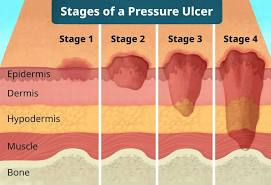
What are the causes of pressure injuries? What nursing interventions can be done to prevent it from getting worse?
Causes
External pressure
Friction or
Temperature and moisture of the skin
Interventions
Make sure the patient is shifted every two hours (changing their position)
Keep the skin dry
Elevate the feet
Provide some support In Bony prominences
What are the different WOUND COMPLICATIONS? What interventions can be done to prevent it?
Different wound complications
Desiccation: DEHYDRATION OF TISSUE
Maceration: Skin breakdown due to too much moisture of the skin
Edema: Swelling
Interventions
Make sure that the skin is dry and clean
Give antibiotics
Address dressing changes
(Anything where you FOCUS ON CLEANING, INFECTION CONTROL, AND PROTECTING THE WOUND)
Explain the common HAIs (Health care associated infections) CAUTI, SSI, CLABSI, MRSA, CDI. What are the most effective prevention strategies for it?
CAUTI: Catheter-associated UTI
SSI: Surgical Site infection
CLABSI: Central line associated bloodstream infection
MRSA: Methicillin-resistant staphylococcus aureus
This is a type of bacteria that is resistant to several common antibiotics and can cause infection
CDI: C. Diff Infections
Anything that a patient contracts in the hospital is considered a healthcare-associated infection
So if was put on a ventilator because of an infection that they accumulated while staying in the hospital that would be considered a health care associated infection
What is the chain of infection? What does the cycle consist of? What do we do to break each chain of infection?
Chain of infection DESCRIBES THE SPREADING PROCESS OF AN INFECTIOUS AGENT FROM ONE PERSON/PLACE TO ANOTHER
The cycle:
Infectious agent: this is the BACTERIA, VIRUS, ETC (the PATHOGEN)
Reservoir: this is WHERE THE AGENT LIVES
Portal of Exit: HOW THE AGENT LEAVES THEIR HOME
Common portals
Respiratory tract (e.g, sneezing)
GI tract
GU tract (e.g, poop)
Blood
Breaks in the skin
Mode of Transmission: how the AGENT TRAVELS FROM ONE PLACE TO ANOTHER
e.g, direct/indirect contact, droplets, airborne
Portal of Entry: How the agents ENTER their host
Common portals
Respiratory tract (e.g, sneezing)
GI tract
GU tract (e.g, poop)
Blood
Breaks in the skin
Susceptible Host
What do we do to break each chain of infection?
To break the infectious agent link: HAND HYGIENE and STERILIZATION
To break the reservoir link: FOLLOW TRANSMISSION-BASED PRECAUTIONS and USE DISPOSABLE SUPPLIES
To break the portal of entry/exit link: KEEP WOUNDS COVERED, WEAR GLOVES and PPE, practice respiratory hygiene/cough etiquette
To break the means of transmission: REFRIGERATE THE FOOD, HAND HYGIENE
To break susceptible host link: MAINTAIN IMMUNIZATION, have good nutrition and hydration to support immune system
Explain the stages of infection (incubation, prodromal, full stage of illness, and convalescent period).
Incubation: Time from when the pathogen enters to when general symptoms start to show up
You don't really see a lot of symptoms happening in the stage because this is when the pathogen just first enters the body
Prodromal stage: Time from when the pathogen has caused general symptoms to show up to when the symptoms start to intensify
This is the stage when general symptoms start showing up like chills or runny nose or fatigue occurred
The person is most infectious at this time because the pathogens continue to multiply
Full stage of illness: Stage one specific illness starts to show up
For example, illnesses like sore throat, extreme nausea, or anything where some symptom has intensified would be when the full stage of illness has occurred
Convalescent period: This is the stage when the illness starts to disappear and the body starts to feel better
The Body returns to baseline