Carnivorous Plants
 Call Kai
 Learn
Learn Practice Test
 Spaced Repetition
 Match
Match Flashcards
 Knowt Play
1/8

Earn XP
Description and Tags
Exam 3
Name | Mastery | Learn | Test | Matching | Spaced | Call with Kai |
|---|
No analytics yet
Send a link to your students to track their progress
9 Terms
Are all Carnivorous plants monophyletic?
No. Modern molecular data shows multiple origins of carnivorous plants, not just one.
Which order contains the most CP species?
Mostly Lamiales, because Lentibulariaceae includes Utricularia (~250 sp), Pinguicula (~80 sp), and Genlisea (21 sp).
>95% of carnivorous plant species belong to Lamiales or Caryophyalles
Givnish’s 1984 cost-benefit model
Carnivory evolves when the nutrient/photosynthetic benefits of capturing prey exceed the cost of making traps, It is favored in sunny, wet, nutrient-poor habitats.
Why high sunlight, low nutrients and wet habitat
Low nutrients make prey valuable; high sunlight provides enough carbon gain to “pay for” costly traps; wet conditions reduce the drought cost of modified leaves/traps. In shade or dry sites, the photosynthetic / water cost can outweigh benefits.
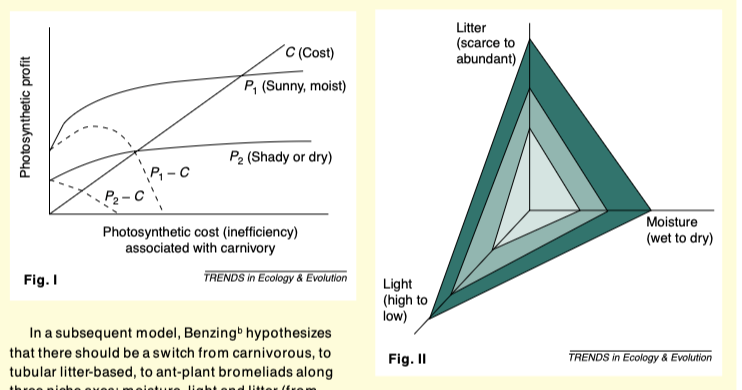
How does Benzing’s model differ from Givnish’s model?
Benzing adds litter-derived nutrients as a third axis, along with light and moisture. Instead of carnivore being mainly restricted to sunny, wet, nutrient-poor sites, his model allows tradeoffs among light moisture, and litter availability, especially for bromeliads.
Ellison and Gotelli 2009: two models
Energetics hypothesis: complex traps evolved through changes in regulatory/metabolic genes that helped meet the high energy demands of active traps.
Predictable prey capture hypothesis: complex traps evolved because they capture prey more frequently and predictably.
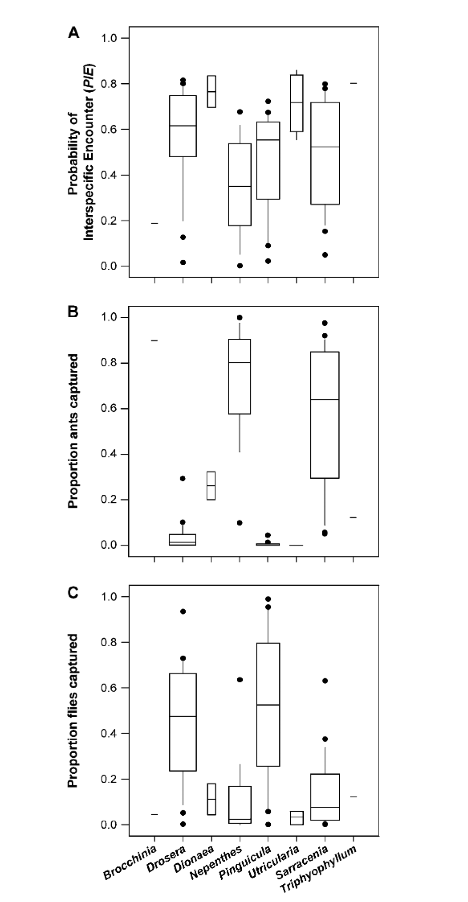
What does Figure 4 indicate?
Shows that carnivorous plant genera differ in prey specialization.
Low PIE = more specialized
High PIE = more generalized
Pitcher plants, such as Brocchinia, Nepenthes, and Sarracenia, were more specialized and captured many more ants, while Utricularia was more generalized
What is Cox1 and why is it significant?
Cox1 is a mitochondrial gene encoding subunit 1 of cytochrome C oxidase.
Its significant because changes in this gene may relate to energy metabolism, especially the energetic demands of active traps such as Utricularia bladders.
Which model fits best (Energetics or Predicatble Prey)?
The energetics hypothesis is better because the data does not match the predictable prey hypothesis.