MLS 320 Final
 Call Kai
 Learn
Learn Practice Test
 Spaced Repetition
 Match
Match Flashcards
 Knowt Play
1/56

There's no tags or description
Looks like no tags are added yet.
Name | Mastery | Learn | Test | Matching | Spaced | Call with Kai |
|---|
No analytics yet
Send a link to your students to track their progress
57 Terms
Prolonged exposure of a preserved urine specimen to light will cause
Decreased bilirubin
Which of the following would be least affected in a specimen that remained unpreserved at room temp for more than 2hrs?
a. Urobilinogen
b. Ketones
c. Protein
d. Nitrite
c. Protein
Affect of decreased production of ADH on volume:
Higher volume
In which metabolic disease will urine turn dark brown to black upon standing?
Alkaptonuria
A patient with uncontrolled diabetes mellitus will most likely have:
Pale urine with high SG
Urine specific gravity is an index of the ability of the kidney to:
Concentrate the urine
The fluid leaving the glomerulus normally has a specific gravity of:
1.010
Clearance tests used to determine the glomerular filtration rate must measure substance that are:
Neither reabsorbed nor secreted by tubules
A 17-year-old goes on a starvation diet. After 1 week of this, what substance would most likely be found in her urine?
Ketones
Patients that take high doses of vitamin C (ascorbic acid) may have false-negative result for which reagent?
Bilirubin
An eosinophil count may be requested on urine from a patient with suspected:
Acute interstitial nephritis
Which cast is most indicative of end stage renal disease?
Waxy
The urine microscopic constituents that best differentiate between cystitis and pyelonephritis are:
WBC casts
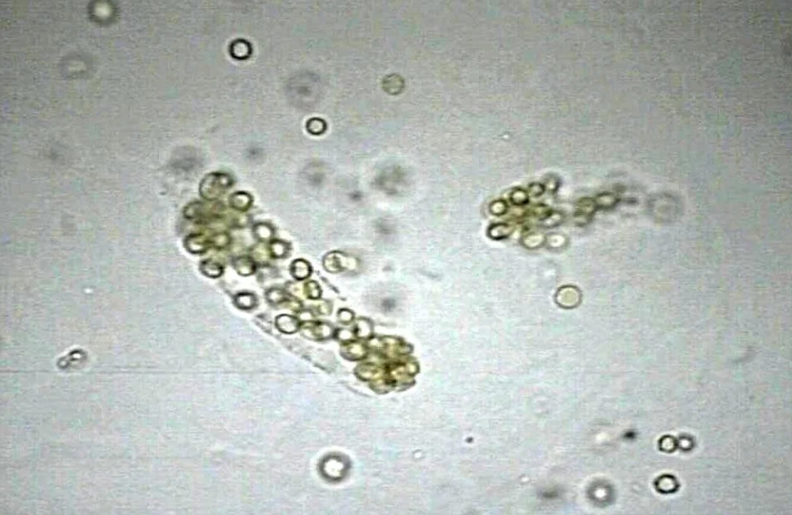
What is the most likely diagnosis given this microscopic finding?
RBC cast → Glomerulonephritis
A white precipitate in a urine of a specimen with a pH of 7.5 would most likely be caused by:
Amorphous phosphates
Which crystal is seen in amber urine with a positive bilirubin?
Tyrosine
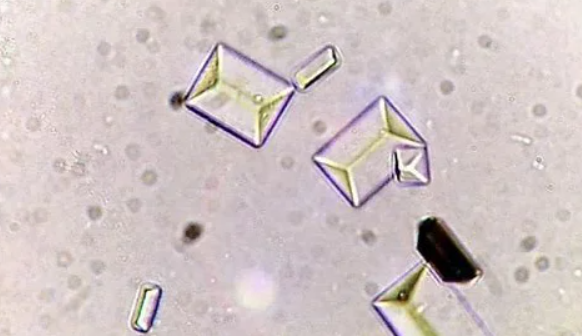
These crystals are found in what kind of urine? Are they pathogenic?
Alkaline pH and nonpathogenic
Glycosuria may be due to
Renal tubular dysfunction
Oval fat bodies are
RTEs containing lipids
The normal glomerular filtration rate is:
120 mL/min
What cell is associated with bacterial vaginosis?
Clue cells
The finding of a large amount of uric acid crystals in a urine specimen from a 6-month old baby may indicate:
Increased purine metabolism
Ketonuria is associated with increased metabolism of
Lipids
A random urine sample with an increased microalbumin concentration is predictive of:
Diabetes insipidus
A patient with hyperlipidemia and 3+ protein in urine shows numerous casts and oval fat bodies microscopically indicates
Nephrotic syndrome
A CSF shows decreasing RBC counts from tube 1 to tube 3. No xanthochromia is present. What is the most likely cause?
Traumatic tap
Decreased CSF protein can be found in:
CSF leakage
What BEST explains the presence of xanthochromia in CSF?
Breakdown of RBCs into bilirubin products
Increased CSF lactate is found in
Bacterial meningitis
A CSF sample has low glucose relative to plasma and neutrophilia. What is the most likely diagnosis?
Bacterial meningitis
A patient with a blood glucose of 120mg/dL would have a normal CSF glucose of:
80 mg/dL
The finding of oligoclonal bands in the CSF and not in the serum is seen with:
Multiple sclerosis
A positive India ink preparation indicates the presence of:
Cryptococcus neoformans
An increase in the amount of serous fluid is called a/an:
Effusion
Which mechanism is MOST responsible for transudate formation?
Increased hydrostatic pressure
Which mechanism is MOST responsible for exudate formation?
Increased capillary permeability
pH determinations are clinically relevant for which of the following?
Pleural fluid
An additional test performed on pleural fluid to classify the fluid as a transudate or exudate is the:
Fluid-Cholesterol ratio
Results from a milky peritoneal fluid has elevated triglycerides and chylomicrons. This indicates the fluid is:
Chylous
Increased synovial fluid protein is MOST associated with:
Inflammatory or hemorrhagic disorders
Milky synovial fluid is MOST associated with:
Crystal-induced arthritis
Before testing, very viscous synovial fluid should be treated with
Hyaluronidase
The chemical test most frequently performed on synovial fluid is:
Glucose
Which crystal is MOST associated with gout?
Monosodium urate (MSU)
Clue cells are BEST described as:
Squamous epithelial cells coated with coccobacilli bacteria
Which feature is required to report Trichomonas vaginalis?
Observation of directional or jerky motility across the field
What is the PRIMARY purpose of adding KOH to a vaginal specimen?
Lyse epithelial cells to better visualize yeast
A positive amine (“whiff”) test suggests:
Bacterial vaginosis
Which organism is MOST commonly associated with bacterial vaginosis?
Gardnerella vaginalis
A stool specimen that appears black and tarlike should be tested for the presence of:
Occult blood
What compound is used as a chromogen in fecal occult blood tests?
Guaiac
Presence of fecal neutrophils indicates:
Invasive bacterial infection of intestinal mucosa
A positive fecal lactoferrin test indicates:
Presence of neutrophils
Steatorrhea is MOST commonly caused by
Fat malabsorption or maldigestion
What is the macroscopic appearance of steatorrhea?
Pale, bulky, greasy stool
Mucus in stool is MOST associated with:
Intestinal irritation or inflammation
Measurement of which enzyme can be used to confirm a fluid is seminal fluid?
Acid phosphotase