Week 2: Elicited (Involuntary) Behavior
 Call Kai
 Learn
Learn Practice Test
 Spaced Repetition
 Match
Match Flashcards
 Knowt Play
1/32

Earn XP
Description and Tags
look at elicited behaviors and non-associative learning
Name | Mastery | Learn | Test | Matching | Spaced | Call with Kai |
|---|
No analytics yet
Send a link to your students to track their progress
33 Terms
What happens in the Feline “Righting Response”?
The cat gets back into the correct orientation (on it’s feet after it falls)
The cat shows the response early in development and does so without practice
What are the three characteristics of “righting response” that considers the behavior as “not learning”?
Innate, Reflex, Development
Innate: The response comes from species ancestry
Reflex: Occurs from specific arrangement of motor neurons
Development: Circuit to perform process is wired from birth
Despite similarities of elicited behaviors to learning, why is it not considered a form of learning?
Elicited behaviors (Relatively-Automatic Behaviors) do not require any learning of associations to be carried out
Generated in response to environmental stimuli
What are reflexes and why aren’t they a form of learning?
Reflexes are simple, involuntary fast responses elicited by particular stimuli
The system is built into the nervous system and doesn’t require learning but can involve learning when modulated
What are examples of reflexes commonly seen?
Patellar Reflex
Pupillary response to light
Sneezing
Withdrawal
What are the three steps involved in the reflex cicuit?
Sensory Receptor → Interneuron → Motor Effector
Due to the fulfillment of a reflex action, how would we categorize this type of behavior?
Considered a hard-wired response with top down input since we can consciously alter the perception of sensory information but will occur without any thought!
Definition of Reflex Modulation
The reflex happening at a time where the reflex wasn’t expected to occur
ex. Closing your eye when a tone is played
What are two ways reflexes can affect our ability to learn?
Orienting Reflex
Learning-Performance Distinction
How does the orienting reflex affect our ability to learn?
Impacts ability to express and measure a pavlovian conditioned response as the reflex makes you turn your attention to an intense and unexpected stimulus
What is the learning-performance distinction and how does it affect our ability to learn?
Impacts learning as it considers behaviors that affect learning such as motivation, fatigue, attention, and distraction which must be considered when measuring learning
What are Modal Action Patterns, how are they different to simple reflexes?
Instinctive species-specific sequences of behaviors that are triggered by a sign stimulus
Different to simple reflexes since MAPS are higher in complexity are a sequence of multiple reflexes
Why are MAPs not an example of learning and are considered to a Relatively Automatic Behavior?
MAPs don’t involve learning to fulfill the series of steps for the sequence of movements
Action is built into nervous system and can be done correctly the first time
What are the four main characteristics for a behavior to be a MAP?
Action must be present in every member of the species
Action is highly similar across individual animals
No learning or practice is required for the action to be required
Actions is carried out completely without interruptions
What is a physiology difference between a MAP and reflex?
MAPs involve brain processing and reflexes generate responses through the periphery and spinal cord
What is the purpose of a deprivation experiment?
Allows researchers to understand whether an action is learning or if its a modal action pattern
Deprives subjects of learning opportunities and observing whether a certain behavior emerges anyway
What are possible outcomes of a deprivation experiment?
If the behavior requires learning : a change in behavior should depend on the exposure and experience of the species, we won’t see a behavior happen
If the behavior is a modal action pattern: Subject displays the action regardless
What are the two evolutionary factors that should be considered when looking at sophisticated learning processes?
Natural Selection: Control behaviors of species uniquely to match niche
Common Selective Pressure to drive General Adaptation : Creates generic factors that provide learning relationships to apply what we know about animals to humans
What are the three types of examples of Non-Associative Learning?
Pseudo Conditioning
Habituation
Sensitization
Definition of Non-Associative Learning
Relatively permanent changes in behavior resulting from repeated presentation of stimulis without the formation of specific associations
How do we know when habituation to a stimulus has occurred?
After repeated exposure to a stimulus we expect a response decrease
Subject learns that there is nothing meaningful happening
How does frequency effect habituation?
When stimuli are presented quickly in repetition and are intense, habituation occurs faster
Subject has more evidence that nothing meaningful is happening and it can preserve its attention
Is habituation specific to stimuli?
Yes! Habitation only occurs for presented stimulus
Low Generalization to stimuli as subject is still attentive to its environment
Definition of Dishabituation
The process of introducing an intervening new stimulus that recovers or restores the behavioral response to a previously habituated stimulus
We can see a response similar to the response prior to habituation
Why does dishabituation occur if a participant was already habituated to the stimulus?
When a novel stimulus is introduced in dishabituation the participant expects something of significance to occur and is attentive
What is the main difference between dishabituation and spontaneous recovery?
Different in terms of why they occur
Both will involve an increase in the previously habituated response
Spontaneous Recovery: Relies on time passing from the end to start of a session
Dishabituation: Relies on the introduction of a novel stimulus
What is the outcome response to Sensitization?
Through repetition of a stimulus there is an increase in the participant’s response
Subject wants to protect itself from harmful stimuli
Why do the opposite outcomes occur between sensitization and dishabituation if same process of presentation happens?
Difference in stimuli
Sensitization: Strong and Noxious Stimuli (intense and unpleasant)
Participants want to be alert to avoid stimulus
Habituation: Weak and innocuous stimulus (weak and neutral)
Participants want to save their attention
Does generalization occur in sensitization?
Yes, in sensitization participants generalize their response as they are alert of any potential threatening stimuli in their environment
Definition of Pseudo-Condition
Form of non-associative learning with a sensitization-like form of learning by which the exposure to the US alone causes an increased response to previously innocuous stimulus
Is often confused with Pavlovian Conditioning
How is the response in pseudo-conditioning similar to sensitization and Pavlovian Conditioning?
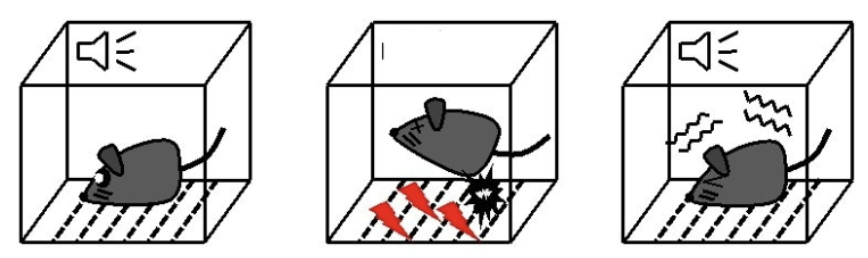
Like sensitization we see that there is an increased response by the participant which will generate the response
The end response (the rat freezing to the tone) is the same result we would expect to see if we would’ve conducted a Pavlovian Conditioing Test
How can we tell the difference between sensitization and Pseudo-Conditioning?
The responses are different when stimuli are presented
We would expect subject to have the same jumping response to every stimuli in sensitization
In Pseudo-Conditioning we see a jumping response to a shock and a freezing response to a tone
What is the purpose of parsing the contribution of associative and non-associative factors?
Considers the additive effect to test how much a behavior is driven by non-associative and associative factors