L1: Pharmaceutical biotechnology & biologics
 Call Kai
 Learn
Learn Practice Test
 Spaced Repetition
 Match
Match Flashcards
 Knowt Play
1/71

There's no tags or description
Looks like no tags are added yet.
Name | Mastery | Learn | Test | Matching | Spaced | Call with Kai |
|---|
No analytics yet
Send a link to your students to track their progress
72 Terms
Obj. 1
What is Small Molecule and Large Molecule in drug delivery.
🔹Q: What are SMALL MOLECULES in drug delivery?
Drugs synthesized by classical chemical rxns between organic and/or inorganic compounds.
They typically have:
⬇Low MW
Simple, well-defined structures
✅Good stability @ room temp
💊Oral ROA capability
Obj. 1
What is Small Molecule and Large Molecule in drug delivery.
🔹Q: What is one example of Small molecule?
Aspirin (MW ≈ 180 Da)
Obj. 1
What is Small Molecule and Large Molecule in drug delivery.
🔹Q: What are LARGE MOLECULES (Biologics) in drug delivery?
Large molecules = Biologics/Macromolecules
These are drugs based on:
Proteins
Peptides
mAbs (Monoclonal Ab)
Vaccines
Hormones
Ab
Obj. 1
What is Small Molecule and Large Molecule in drug delivery.
🔹Q: How are Large Molecules produced?
They are produced using Living Cells or Biotechnology and may reach MW up to 150,000 Da (150 kDa).
Obj. 1
What is Small Molecule and Large Molecule in drug delivery.
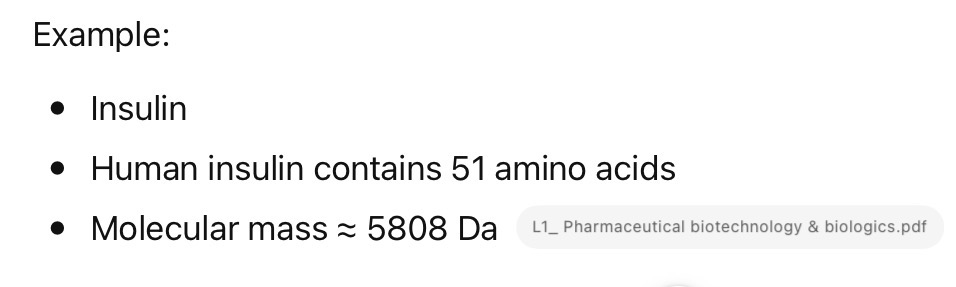
🔹Q: What is one example of Large Molecule?
Insulin (Human insulin)
Obj. 1
What is Small Molecule and Large Molecule in drug delivery.
🔹Q: What are the major difference between SMALL vs. LARGE molecules?
Small Molecules | Large Molecules (Biologics) |
⬇Low molecular weight | ⬆High molecular weight |
STABLE at room temperature | UNSTABLE at room temperature |
Usually oral (PO) | Usually parenteral |
Chemically synthesized | Produced from living cells/biotechnology |
⬇Rare immunogenicity | ⬆Higher risk of immunogenicity |
Obj. 1
What is Small Molecule and Large Molecule in drug delivery.
🔹Q: Why are most biologics not given orally?
Most biotech drug products CANNOT be administered Orally b/c they are UNSTABLE in the acidic environment of the stomach.
Obj. 1
What is Small Molecule and Large Molecule in drug delivery.
🔹Q: What are common Delivery Routes for BIOTECH drug products?
Nasal
Inhalation
Buccal/Sublingual
Parenteral
Transdermal
Obj. 1
What is Small Molecule and Large Molecule in drug delivery.
🔹Q: What is Biotechnology in pharmaceuticals?
Biotech involves using LIVING ORGANISMS, CELLS, or GENETIC ENGINEERING techniques to produce beneficial pharmaceutical products such as:
Recombinant proteins
Vaccines
Hormones
mAbs (monoclonal Ab)
Obj. 1
What is Small Molecule and Large Molecule in drug delivery.
🔹Q: What is an IMPORTANT exam point abt BIOLOGICS vs. SMALL Molecules?
➡SMALL molecules = chemically synthesized
➡LARGE molecules / BIOLOGICS = produced from LIVING systems through Biotech
👉BIOLOGICS = larger, ⬇less stable, & ⬆More immunogenic THAN Small molecules.
Obj. 2
Differentiate between small Vs large molecule therapeutics.
🔹Q: What is the main difference between small molecule and large molecule therapeutics?
Small Molecules | Large Molecules |
Chemically synthesized | Produces by biotechnology |
⬇Low MW | ⬆High MW |
STABLE | UNSTABLE |
Usually ORAL | Usually PARENTERAL |
⬇Rare immunogenicity | ⬆Higher immunogenicity |
Obj. 2
Differentiate between small Vs large molecule therapeutics.
🔹Q: Which has a ⬇LOW MW? Which has a ⬆HIGH MW?
⬇Low MW = Small molecules
⬆High MW = Large molecules / Biologics
Obj. 2
Differentiate between small Vs large molecule therapeutics.
🔹Q: Which is STABLE @ room temp? Which is UNSTABLE @ room temp?
✅STABLE = SMALL molcules
❌UNSTABLE = LARGE molecules / BIOLOGICS → 🥶Refrigerate/cold storage
Obj. 2
Differentiate between small Vs large molecule therapeutics.
🔹Q: Which has PO administration? Which has PARENTERAL administration?
💊PO = SMALL molecules
💉PARENTERAL = LARGE molecules / BIOLOGICS → b/c they’re unstable in the stomach’s acidic environment
Obj. 2
Differentiate between small Vs large molecule therapeutics.
🔹Q: How are SMALL Molecules produced?
They’re synthesized through Chemical rxns between organic and/or inorganic compounds.
Obj. 2
Differentiate between small Vs large molecule therapeutics.
🔹Q: How are LARGE Molecules / BIOLOGICS produced?
They’re made from LIVING CELLS/ORGANISMS using biotech & recombinant DNA tech.
Obj. 2
Differentiate between small Vs large molecule therapeutics.
🔹Q: Which has Rare Immunogenicity? Which has Higher risk of Immunogenicity?
⬇Rare immunogenicity = SMALL molecules
⬆Higher risk of immunogenicity = LARGE molecules / BIOLOGICS
Obj. 2
Differentiate between small Vs large molecule therapeutics.
🔹Q: Examples of SMALL molecules?
Aspirin (MW ≈ 180 Da)
Metformin
Obj. 2
Differentiate between small Vs large molecule therapeutics.
🔹Q: Examples of LARGE molecules?
Insulin
mAbs (monoclonal Abs)
EPO (erythropoietin)
Human Growth HORMONE (HGH)
Vaccines
Exenatide (Byetta) → mimics GLP-1 (for T2DM)
Obj. 3
Discuss pharmaceutical application of biotechnology.
🔹Q: What is pharmaceutical BIOTECH?
Involves using LIVING organism, cells, genetic engineering, or molecular components to produce beneficial pharmaceutical products.
Obj. 3
Discuss pharmaceutical application of biotechnology.
🔹Q: What are some applications of BIOTECH in pharmaceuticals?
Recombinant proteins
Modified proteins
Vaccines
Genetic engineering
Biologics: hormones, Ab, peptides
Obj. 4
Enlist the routes of delivery of biotechnological products.
🔹Q: Why are many biotechnology drug products not given orally?
Most BIOTECH drug products CANNOT be administered Orally b/c they are UNSTABLE in the strong acidic environment of the stomach.
Obj. 4
Enlist the routes of delivery of biotechnological products.
🔹What are the major ROUTES of Delivery for Biotechnology drug products?
Nasal
Inhalation
Buccal/Sublingual
Parenteral - IV, IM, SC
Transdermal
Obj. 5
Types of biotechnology-derived products/Biologics.
Peptides and Proteins - Erythropoietin, Tissue plasminogen activator.
🔹Q: What is Erythropoietin (EPO)?
Glycoprotein that stimulates the production of RBC (erythrocytes) in the Bone marrow.
Obj. 5
🔹Q: What is the source of Erythropoietin (EPO)?
Glycoprotein naturally produced by the Peritubular cells of the KIDNEYS in response to Hypoxia.
Obj. 5
🔹Q: What condition is Erythropoietin (EPO) used to treat?
Anemia
Kidney Dialysis patients
Obj. 5
🔹Q: Where is Erythropoietin (EPO) naturally produced?
Naturally produced by the KIDNEYS (Peritubular cells) in response to HYPOXIA (⬇Low oxygen).
Obj. 5
🔹Q: What does tissue plasminogen activator (tPA) do?
tPA ⬇breaks down Blood Clots (thrombi) & 🔨restores blood flow.
Obj. 5
🔹Q: What is the source of tissue plasminogen activator (tPA)?
Natural human PROTEASE that binds Fibrin & breaks down Blood Clots.
Obj. 5
🔹Q: Why is tPA called a “clot buster”?
B/c it DISSOLVES BLOOD CLOTS, esp. during acute stroke or MI (myocardial infarction).
Obj. 5
Types of biotechnology-derived products/Biologics.
Hormones – Leuprolide, exenatide (Byetta).
🔹Q: What does Leuprolide do in men and women?
⬇Testosterone in 🧔♂MEN
⬇Estrogen in 👱♀WOMEN
Obj. 5
🔹Q: What is the source of Leuprolide?
Man-made protein / synthetic hormone that acts like a natural hormone in the body.
Obj. 5
🔹Q: What conditions is Leuprolide used to treat?
Prostate cancer
Endometriosis
Uterine fibrosis
Other FEMALE Hormone-related conditions
Obj. 5
🔹Q: What does Exenatide (Byetta) MIMIC?
GLP-1
Obj. 5
🔹Q: What condition is Exenatide (Byetta) used to treat?
T2DM
Glycemic control
Obj. 5
🔹Q: What is the source of Exenatide (Byetta)?
Synthetic version of extending-4, a hormone found in the SALIVA of the 🦎VENOMOUS LIZARD GILA MONSTER.
Obj. 5
Types of biotechnology-derived products/Biologics.
Vaccines.
🔹Q: What is the source of vaccines?
Vaccines are biological preparations made from:
Attenuated (weakened) pathogens
Inactivated pathogens
Toxins
Surface proteins
Antigens (pieces of microorganisms)
Obj. 5
🔹Q: What disease conditions are Vaccines used for?
Vaccines provide ACTIVE ACQUIRED IMMUNITY against infectious disease such as:
MMR (Measles, Mumps, Rubella)
Hep. A & B
Rabies
Polio
Typhoid
Cholera
Obj. 5
🔹Q: What the source (and disease) of Attenuated Vaccines?
Weakened (attenuated) viruses
Disease: MMR
Obj. 5
🔹Q: What the source (and disease) of Inactivated Vaccines?
Chemically or radiation-inactivated viruses/bacteris
Disease: Hep. A, Rabies, Polio
Obj. 5
🔹Q: What the source (and disease) of Protein/Toxoid Vaccines?
Purified proteins/toxins from pathogens
Disease: Typhoid, Cholera, Hep. B
Obj. 5
Types of biotechnology-derived products/Biologics.
Nucleic acid – Aptamer, (Pegaptanib sodium; Macugen).
🔹Q: What is an Aptamer?
Aptamers are:
Short synthetic Single-stranded DNA or RNA molecules
Specially designed to BIND biological targets such as proteins w/ ⬆HIGH specificity & Affinity.
💭Think: Aptamer = “DNA/RNA antibody-like grabber.”
Obj. 5
🔹Q: What is the source (and disease condition) of Pegaptanib sodium; Macugen?
RNA Aptamer / Single-stranded Nucleic acid (anti-VeGF Aptamer)
Disease condition:
Macular degeneration
Neovascular AMD (age-related macular degeneration)
Vision loss associated w/ abnormal blood vessel growth
🔹Q: MOA of Pegaptanib sodium; Macugen?
🔑Macugen is an aptamer that acts like a “protein blocker.”
👉It specifically grabs onto VEGF, the protein causing abnormal blood vessel growth in the eye in macular degeneration.
Obj. 6
What is recombinant DNA products (Insulin, Human Growth Hormone).
🔹Q: What is Recombinant DNA (rDNA)?
Genetically engineered DNA created by recombining fragments of DNA from different organisms.
Obj. 6
🔹Q: What are Recombinant DNA (rDNA) products?
Products made using recombinant DNA tech:
Recombinant Drugs
Recombinant Vaccines
Recombinant Enzymes
Obj. 6
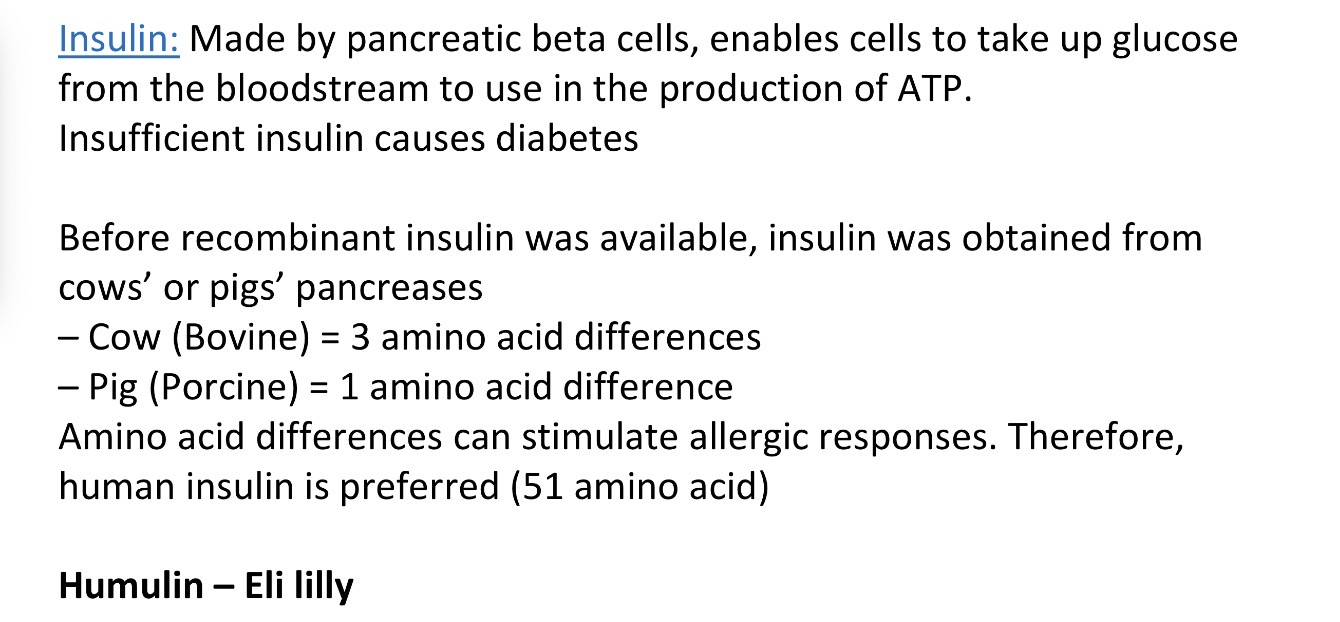
🔹Q: What is Insulin?
A hormone made by pancreatic β-cells that allow cells to take up Glucose form the bloodstream for ATP production.
Obj. 6
🔹Q: Before Recombinant Insulin was available, how was insulin obtained?
Cows’ (Bovine) or Pigs’ (Porcine) pancreases.
Obj. 6
🔹Q: Why is Human Insulin preferred?
AA difference can stimulate ALLERGIC responses.
Obj. 6
🔹Q: What is one example of Recombinant Insulin?
Humulin (Eli Lilly)
Obj. 6
🔹Q: What is HGH (Human Growth Hormone)?
A hormone that promotes overall body growth.
Obj. 6
🔹Q: What disease condition is associated with HGH deficiency?
Dwarfism
caused by insufficient production of HGH by the pituitary gland.
Obj. 6
🔹Q: What was the old source of HGH before Recombinant tech?
HGH was purified from Cadaver pituitary glands.
Obj. 6
🔹Q: What is the NEW source (of Recombinant HGH)?
Human HGH gene is isolated
Gene inserted into E.coli Bacteria
Bacteria produce HGH
HGH is extracted & purified
Obj. 6
🔹Q: What are example of Recombinant HGH products?
Protropin (Genentech)
Humatrope (Eli Lilly)
Obj. 6
🔹Q: What is the Key concept of Recombinant DNA products?
Recombinant DNA tech inserts human genes into microorganisms (like bacteria) so they can produce human Therapeutic proteins.
Obj. 7
What is monoclonal antibody.
🔹Q: What are Abs?
Abs are proteins produced by the immune system to identify bacteria, viruses, & other foreign substances & help fight them off.
Obj. 7
🔹Q: What are mAbs (monoclonal Abs)?
Abs made by IDENTICAL immune cells that are all CLONES of 1 unique parent cell.
Obj. 7
🔹Q: What is a key characteristic of mAbs (monoclonal antibodies)?
Monovalent affinity = binds to the SAME epitope on an antigen
Obj. 7
🔹Q: What is an Epitope?
Specific part of an ANTIGEN recognized & bound by an antibody.
Obj. 7
🔹Q: What does monovalent affinity mean in monoclonal antibodies?
It means mAbs bind ONE specific epitope/target.
Obj. 7
🔹Q: Why are mAbs useful Therapeutically?
B/c they are ⬆HIGHLY SPECIFIC & Target ONE specific Antigen/epitope.
Obj. 7
🔹Q: Are mAbs considered Biologics?
Yes.
mAbs = LARGE-molecule biologics produced using biotech.
Obj. 7
🔹Q: mAbs are:
CLONES from ONE parent cell
Bind the SAME Epitope
Have MONOVALENT Affinity
Obj. 8
🔹Q: What is hybridoma technology?
A method used to produce mAbs.
Obj. 8
🔹Q: What cells are used in hybridoma technology?
Ab-producing B lymphocytes (from immunized mice)
Immortal Myeloma cells
⭐️These 2 types of cells FUSE TOGETHER → forms HYBRIDOMA cells.
Obj. 8
🔹Q: What is a Hybridoma cell?
A fused cell made from:
B Lymphocyte + Myeloma cell = Hybridoma cell
⭐️It can continuously produce mAbs.
Obj. 8
🔹Q: What is the end product of hybridoma technology?
mAbs
Obj. 8
🔹Q: Why are Myeloma cells used in hybridoma technology?
Myeloma cells are IMMORTAL → allowing continuous growth & Ab production
Obj. 8
🔹Q: Why are B lymphocytes used in hybridoma technology?
B/c they produce Ab against a specific Ag.
Obj. 8
🔹Q: Why is hybridoma technology preferred for monoclonal antibody production?
B/c the mAbs produced are:
⬆High purity
⬆Highly sensitive
⬆Highly specific
Obj. 8
🔹Q: Hybridoma “formula”:
B cell + Myeloma cell = Hybridoma = mAbs