CM12006 Limits
 Call Kai
 Learn
Learn Practice Test
 Spaced Repetition
 Match
Match Flashcards
 Knowt Play
1/22

There's no tags or description
Looks like no tags are added yet.
Name | Mastery | Learn | Test | Matching | Spaced | Call with Kai |
|---|
No analytics yet
Send a link to your students to track their progress
23 Terms
What is ε? [1]
The distance |f(x) - L|
What is δ? [1]
The distance |x - c|
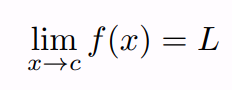
How is ‘the limit of f(x) as x approaches c is L’ written? [1]
What is the ε - δ definition of a limit? [3]
If for every number ε > 0, there is a number δ > 0 such that
If 0 < |x - c| < δ
Then |f(x) - L| < ε
What are the 2 steps for solving an ε - δ definition problem? [2]
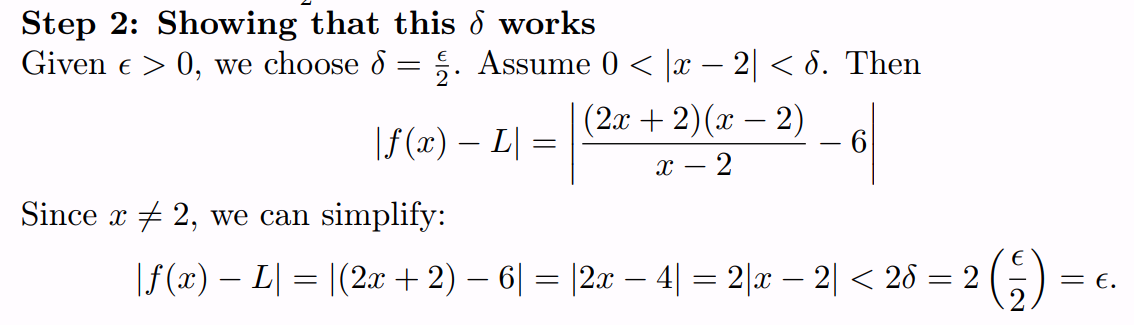
Guess a value for δ
Showing that this δ value works
How do you guess a value for δ? [2]
Rearrange |f(x) - L| into the form |x - c|
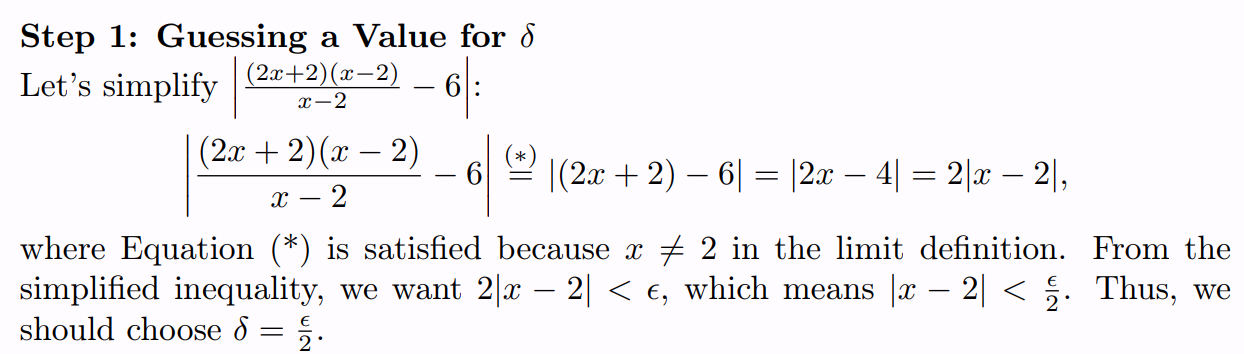
How do you show that this δ value works? [2]
Sub back into equation
What is the sum law? [1]

What is the difference law? [1]

What is the constant multiple law? [1]

What is the product law? [1]

What is the quotient law? [1]

What is the power law? [1]

What is the root law? [1]

How do you write a left-hand limit? [1]
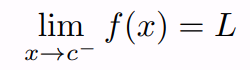
What is the definition of a left-hand limit? [3]
If for every number ε > 0 there is a number δ > 0
Such that c - δ < x < c then
|f(x) - L| < ε
How do you write a right-hand limit? [1]
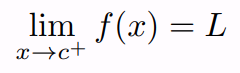
What is the definition of a right-hand limit? [3]
If for every number ε > 0 there is a number δ > 0
Such that c < x < c + δ then
|f(x) - L| < ε
What is the relationship between limits and one-sided limits? [2]

How do you write an ∞ limit? [1]
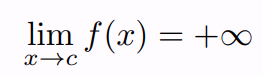
What is the definition of an ∞ limit? [3]
For every positive number M there is a positive number δ > 0 such that
If 0 < |x - c| < δ then f(x) > M
How do you write an -∞ limit? [1]
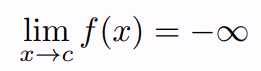
What is the definition of an -∞ limit? [3]
For every negative number N there is a positive number δ > 0 such that
If 0 < |x - c| < δ then f(x) < N