Chapter 9 Social Psychology
 Call Kai
 Learn
Learn Practice Test
 Spaced Repetition
 Match
Match Flashcards
 Knowt Play
1/60

There's no tags or description
Looks like no tags are added yet.
Name | Mastery | Learn | Test | Matching | Spaced | Call with Kai |
|---|
No analytics yet
Send a link to your students to track their progress
61 Terms
Leadership
Getting group members to achieve the group’s goals
Defining Leadership
Not just compliance or an exercise of power.
Are they effective? (i.e., set goals and achieve them) Primarily object.
Are they good? (e.g., character, ethics, and morality) Subjective.
Great Person Theory
Perspective on leadership that attributes effective leadership to innate or acquired individual characteristics
Big Five
The five major personality dimensions of extraversion, agreeableness, conscientiousness, emotional stability, and intellect/openness to experience
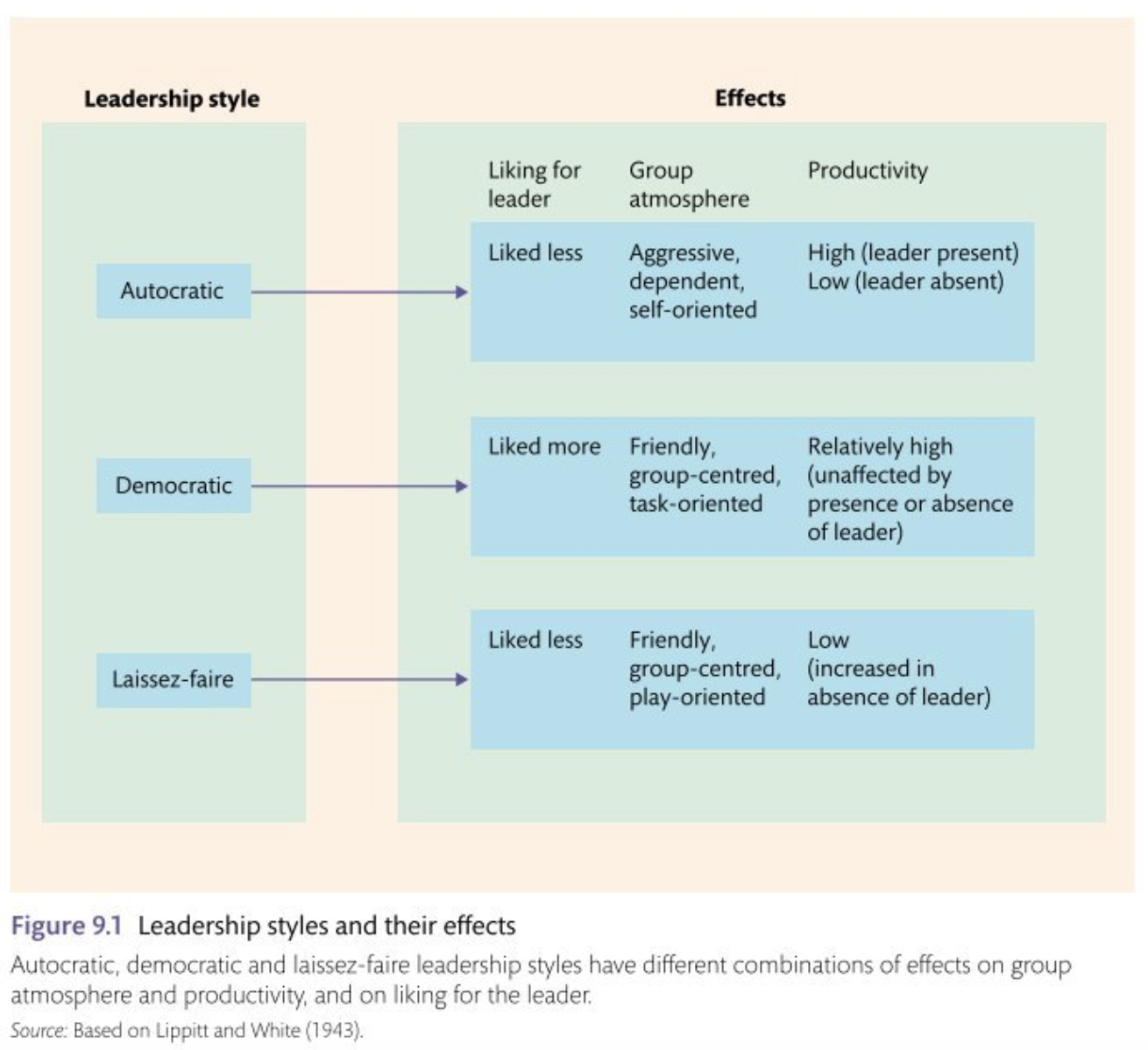
Autocratic Leaders
Leaders who use a style based on giving orders to followers
Democratic Leaders
Leaders who use a style based on consultation and obtaining agreement and consent from followers
Laissez-faire Leaders
Leaders who use a style based on disinterest in followers
Leadership Styles and Their Effects
Two key leadership roles:
Task specialist (concentrate on reaching solutions)
Socioemotional specialist (attentive to the feelings of group members)
Leader Behavior Description Questionnaire (LBDQ)
Scale devised by the Ohio State leadership researchers to measure leadership behavior and distinguish between “initiating structure” (task oriented) and “consideration” (welfare) dimensions. Generally agreed that the most effective leaders score high on both dimensions.
Contingency Theories
Theories of leadership that consider the leadership effectiveness of particular behaviors or behavioral styles to be contingent on the nature of the leadership situation
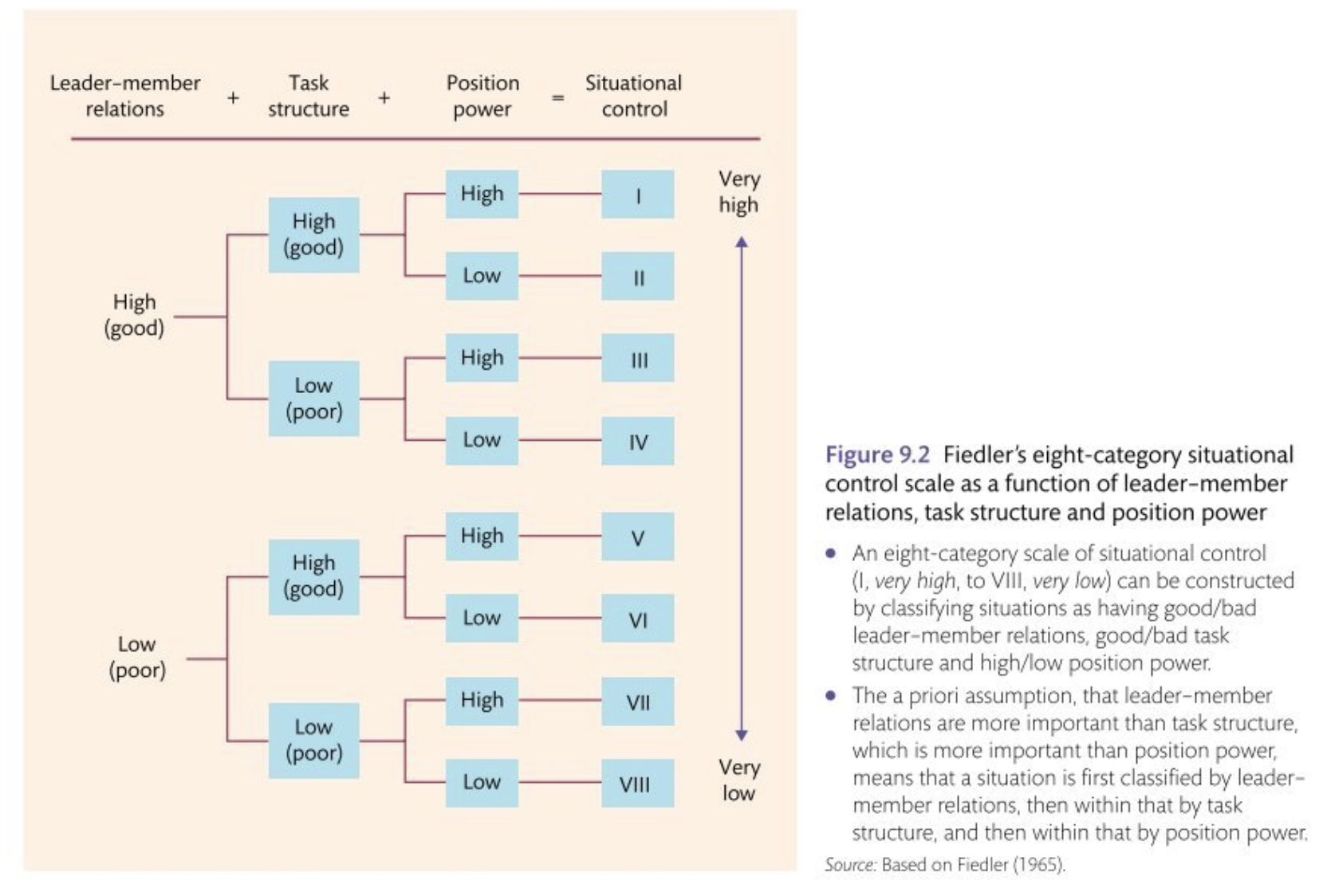
Least-preferred Coworker (LPC) Scale
Fielder’s scale for measuring leadership style in terms of favorability of attitude towards one’s least-preferred coworker. A high score indicates a relationship-oriented leadership style, and a low score indicates a task-oriented leadership style
Situational Control
Fielder’s classification of task characteristics in terms of how much control effective task performance requires. Task-oriented leaders are most effective when situational control is either high or low, while relationship-oriented leaders are most effective when situational control lies somewhere in the middle.
Normative Decision Theory (NDT)
A contingency theory of leadership that focuses on the effectiveness of different leadership styles in group decision-making contexts
Normative Decision Theory identifies three decision-making strategies among which leaders can choose:
Autocratic (subordinates input is not sought)
Consultative (subordinate input is sought, but leader makes final decision)
Group Decision-making (leader and subordinates are equal partners)
Path-goal Theory
A contingency theory of leadership that can also be classified as transactional theory—it focuses on how “structuring” and “consideration” behaviors motivate followers
Transactional Leadership
Approach to leadership that focuses on the transaction of resources between leader and followers. Also a style of leadership
Idiosyncrasy Credit
Hollander’s transactional theory, in which followers reward leaders for achieving group goals by allowing them to be relatively idiosyncratic
Behaviors that build idiosyncratic credit:
Initially conforming closely to group norms
Ensuring the group feels like the leader has been democratically elected
Seen to have competence to fulfill objectives
Seen to identify with the group, its ideals, and its aspirations
Leader-member Exchange Theory
Theory of leadership in which effective leadership rests on the ability of the leader to develop good-quality personalized exchange relationships with individual members
Vertical Dyad Linkage (VDL) Model
An early form of leadership-member exchange (LMX) theory in which a sharp distinction is drawn between dyadic leader-member relations: the subordinate is treated as either an ingroup member or an outgroup member
LMX Relationships
High LMX relationships lead to subordinates internalizing leader’s goals
Low LMX relationships lead to subordinates complying without internalization
Transformational Leadership
Approach to leadership that focuses on the way that leaders transform group goals and actions—mainly through the exercise of charisma. Also a style of leadership based on charisma
Three components of transformational leadership:
Individualized consideration (attention to followers’ needs)
Intellectual stimulation (challenging followers’ basic thinking)
Charismatic/inspiring leadership (provides energy)
Multifactor Leadership Questionnaire
The most popular and widely used scale for measuring transactional and transformational leadership
Charismatic leadership is a product of:
a) the leader’s personal charisma
b) followers’ reactions to the leader’s charisma in a particular situation
Leader Categorization Theory
We have a variety of schemas about how different types of leaders behave in different leadership situations. When a leader is categorized as a particular type of leader, the schema fills in details about how that leader will behave
Status Characteristics Theory
Theory of influence in groups that attributes greater influence to those who possess both task-relevant (specific status characteristics) and characteristics of a high-status group in society (diffuse status characteristics). Also called expectation states theory
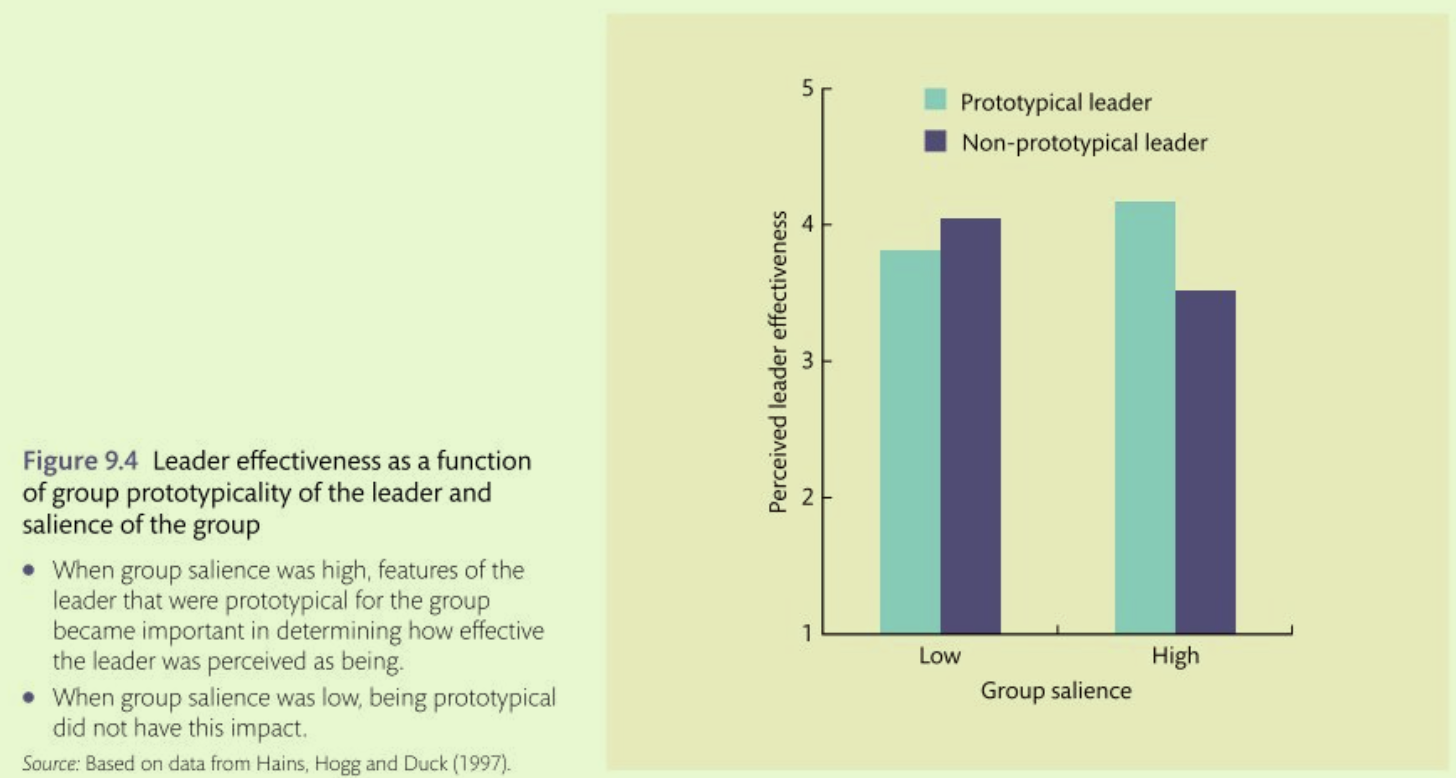
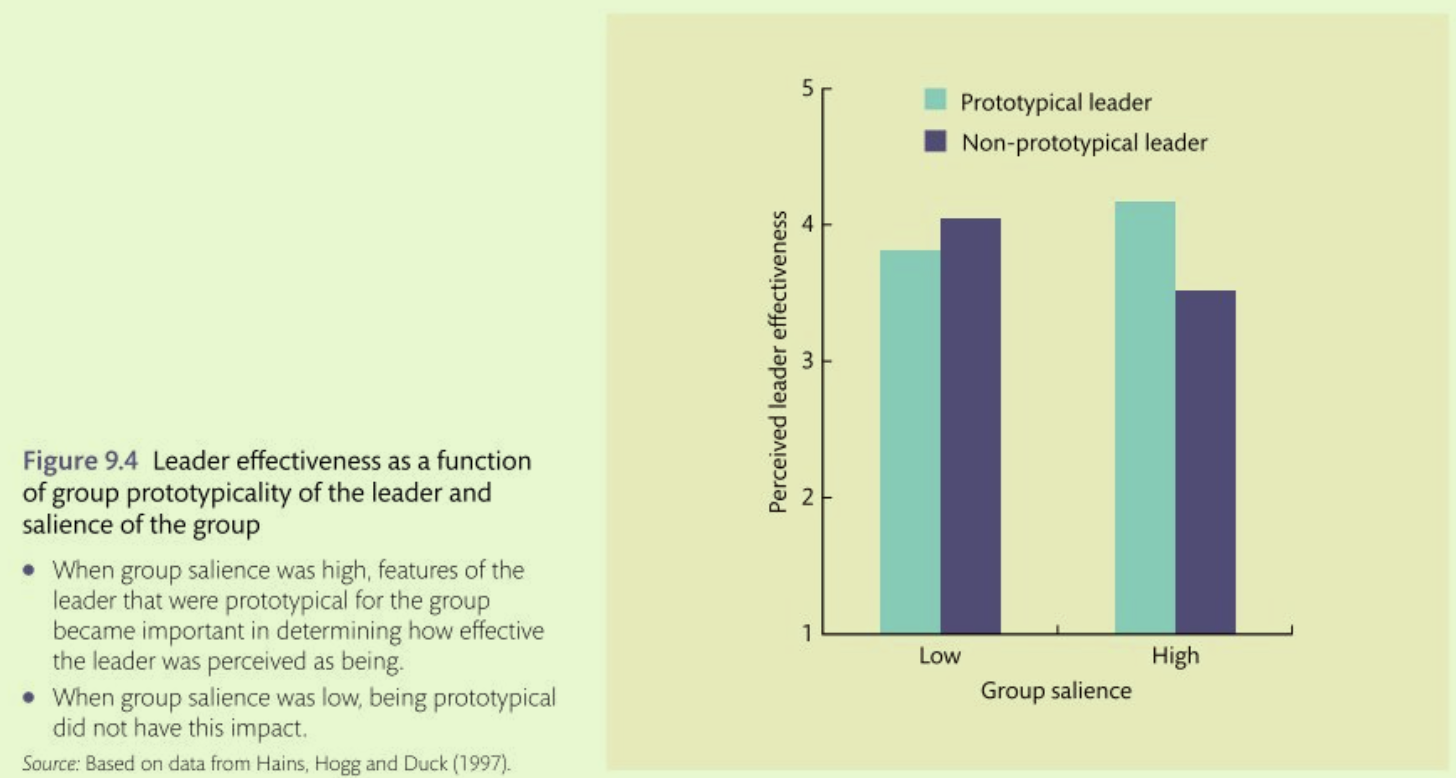
Social Identity Theory of Leadership
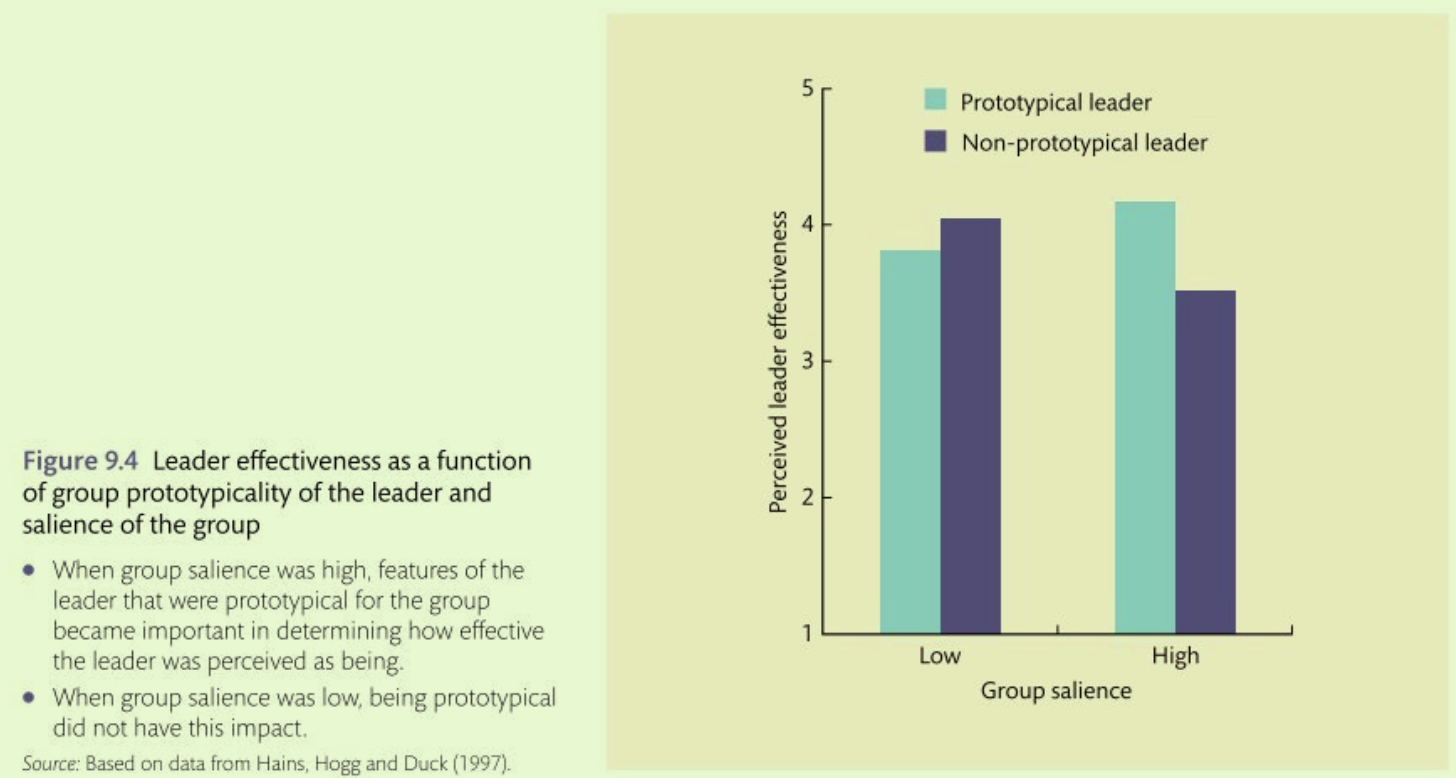
Development of social identity theory to explain leadership as an identity process whereby in salient groups prototypical leaders are more effective than less prototypical leaders
Correspondence Bias
A general attribution bias in which people have an inflated tendency to see behavior as reflecting (corresponding to) stable underlying personality attributes
Group Value Model
View that procedural justice within groups makes members feel valued, and thus leads to enhanced commitment to and identificaiton with the group
Relational Model of Authority in Groups
Tyler’s account of how effective authority in groups rests upon fairness- and justice-based relations between leader and followers
In judging fairness, followers evaluate a leader in terms of both:
Distributive justice and procedural justice
Distributive Justice
The fairness of the outcome of a decision
Procedural Justice
The fairness of the procedures used to make a decision
Social Dilemmas
Situations in which short-term personal gain is at odds with the long-term good of the group
Glass Ceiling
An invisible barrier that prevents women, and minorities in general, from attaining top leadership positions
Role Congruity Theory
Mainly applied to the gender gap in leadership—because social stereotypes of women are inconsistent with people’s schemas of effective leadership, women are evaluated as poor leaders
Stereotype Threat
Feeling that we will be judged and treated in terms of negative stereotypes of our group, and that we will inadvertently confirm these stereotypes through our behavior
Glass Cliff
A tendency for women rather than men to be appointed to precarious leadership positions associated with a high probability of failure and criticism
Intergroup Leadership
Often uses us verus them rhetoric.
Alternatively, it can be used to build a unified group identity.
Social Decisions Schemes
Explicit or implicit decision-making rules that relate individual opinions to a final group decision
Group Rules for Decisions
Intellective tasks (has a correct solution). Truth-wins rule.
Judgmental tasks (no correct solution). Majority-wins rule.
Strictness and distribution of power are also factors in decision-making.
Social Transition Scheme
Method for charting incremental changes in member opinions as a group moves towards a final decision. Can be intrusive.
Brainstorming
Uninhibited generation of as many ideas as possible in a group, in order to enhance group creativity
Do nominal groups or groups that interact generate more creative ideas when brainstorming?
Nominal groups
Why don’t brainstorming groups generate more creativity?
Evaluation apprehension
Social loafing and free riding
Production matching
Production blocking
Production Blocking
Reduction in individual creativity and productivity in brainstorming groups due to interruptions and turn taking
Illusion of Group Effectivity
Experience-based belief that we produce more and better ideas in groups than alone
Transactive Memory
Group members have a shared memory for who within the group remembers what and is the expert on what
Group Mind
McDougall’s idea that people develop a qualitatively different mode of thinking when in a group
Memory-assignment Systems
Groups can negotiate responsibility for different memory domains
Groups can assign memory domains on the basis of relative expertise
Groups can assign memory domains on the basis of access to information
Groupthink
A mode of thinking in highly cohesive groups in which the desire to reach unanimous agreement overrides the motivation to adopt proper rational decision-making procedures
Risky Shift
Tendency for group discussion to produce group decisions that are more risky than the mean of members’ pre-discussion opinions, but only if the pre-discussion mean already favored risk
Group Polarization
Tendency for group discussion to produce more extreme group decisions than the mean of members’ pre-discussion opinions, in the direction favored by the mean
Persuasive Arguments Theory
View that people in groups are persuaded by novel information that supports their initial position, and thus become more extreme in their endorsement of their initial position
Social Comparison Theory
Comparing our behaviors and opinions with those of others in order to establish the correct or socially approved way of thinking and behaving
Bandwagon effect
Pluralistic ignorance
Cultural Values Theory
The view that people in groups use members’ opinions about the position valued in the wider culture, and then adjust their views in that direction for social approval reasons
Social Identity Theory
Theory of group membership and intergroup relations based on self-categorization, social comparison, and the construction of a shared self-definition in terms of ingroup-defining properties
Self-categorization Theory
Turner and associates’ theory of how the process of categorizing oneself as a group member produces social identity and group and intergroup behaviors
Recency
An order of presentation effect in which later presented information has a disproportionate influence on social cognition