1.6 Classification of Goods and Services
 Call Kai
 Learn
Learn Practice Test
 Spaced Repetition
 Match
Match Flashcards
 Knowt Play
1/35

There's no tags or description
Looks like no tags are added yet.
Name | Mastery | Learn | Test | Matching | Spaced | Call with Kai |
|---|
No analytics yet
Send a link to your students to track their progress
36 Terms
How do economists classify goods and why does it matter
By excludability (can non‑payers be kept out?), rivalry (does one person’s use reduce what is left?), and by how markets under‑ or over‑provide them.
The classification explains market outcomes and when government intervention may be needed.
What is excludability
Where it is possible to stop someone from consuming a good or service.
What is rivalry
Where consumption by one person of a good or service reduces the availability of the good or service for others
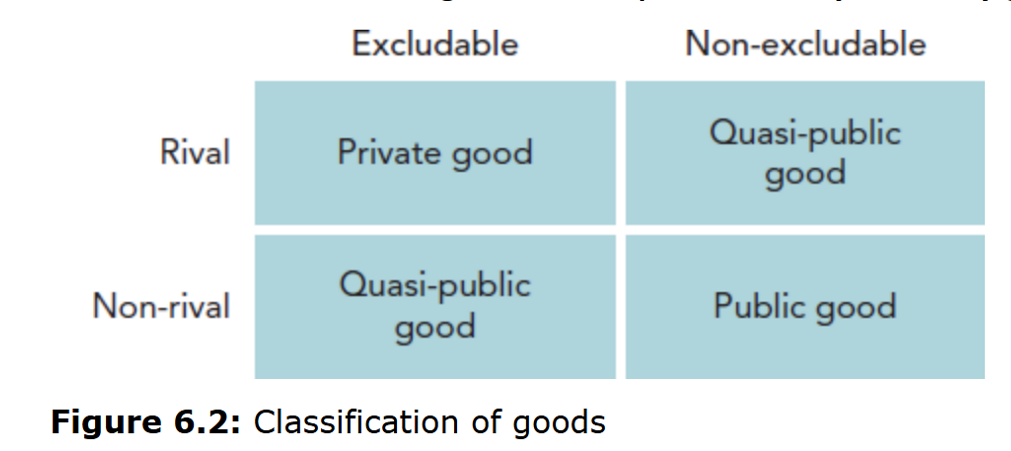
Draw the classification of goods table (excludability & rivalry grid).
• Excludable + rival → Private good
• Non‑excludable + non‑rival → Public good
• Excludable + non‑rival → Quasi‑public good (e.g., toll road at low traffic)
• Non‑excludable + rival → Quasi‑public good (e.g., busy public beach becoming congested)
What does excludable mean
Consumers who do not pay can be prevented from using the good (e.g., a smartphone or a ticketed service).
What does rival mean
If one person’s consumption reduces the amount available to others (e.g., a sandwich).
What does non‑rival mean (with an example)
One person’s use does not reduce others’ ability to consume (e.g., a lighthouse warning beam or street lighting).
What is a free good
A good with zero opportunity cost because consumption is not limited by scarcity. There is no price in principle and no factors are required to produce it.
Give examples of free goods.
In some contexts: rainfall, water in a local river, wild fruit/berries, and the air we breathe.
Why are true free goods rare in practice
Because most goods require scarce resources at some stage; few items are available without limit or processing.
What is a private (economic) good + examples
A scarce good with opportunity cost that is excludable and rival (e.g., food items, clothing, smartphones, petrol).
- Goods that are consumed by one person/firm for their own benefit and not available to anyone else
Why do private goods usually have prices
Because resources used are scarce, so a price is needed to ration demand and cover costs of production.
What is a public good
A good that is non‑excludable (users cannot be kept out) and non‑rival (one person’s use does not reduce others’ benefit).
Give public‑good examples (7).
National defence, police, fire protection, street lighting, traffic lights, flood‑control systems, lighthouses etc.
Why are public goods under‑provided by the market
Because of non‑excludability: firms cannot charge users easily, so there is no profit incentive to produce them.
What is the free‑rider problem
People enjoy the benefits of a public good without paying (e.g., using a non‑toll road funded by taxpayers). - This discourages private provision.
What role does government take with public goods
Typically funds/provides them (via taxation) to overcome free‑riding and avoid market failure.
What are quasi‑public goods
Goods that do not fully meet both public‑good characteristics; they are partly excludable and/or partly rival depending on conditions.
Give 2 quasi‑public examples and explain why.
• Toll road: excludable via tolls, non‑rival when uncongested.
• Public beach: seemingly non‑excludable, but can become rival when crowded; access can be limited by charges or capacity.
Why does the classification of some goods change over time or with use
Because congestion can turn a non‑rival good into a rival one; policy (e.g., pricing/barriers) can make an otherwise open access good excludable.
What is a merit good
A good judged desirable for consumers but under‑provided by the market because of information failure. - Consumers undervalue private benefits and society gains external benefits from wider use.
Give merit‑good examples.
Education, vaccinations, and wider preventative healthcare.
Why are merit goods under‑consumed (two core reasons)?
1. Information failure: consumers do not recognise full private/social benefits.
2. Low income: even if benefits are known, some cannot afford the quantity they would like.
How does government increase consumption of merit goods (4)
Subsidies, free or subsidised provision, compulsion (e.g., schooling), and information campaigns to correct misconceptions.
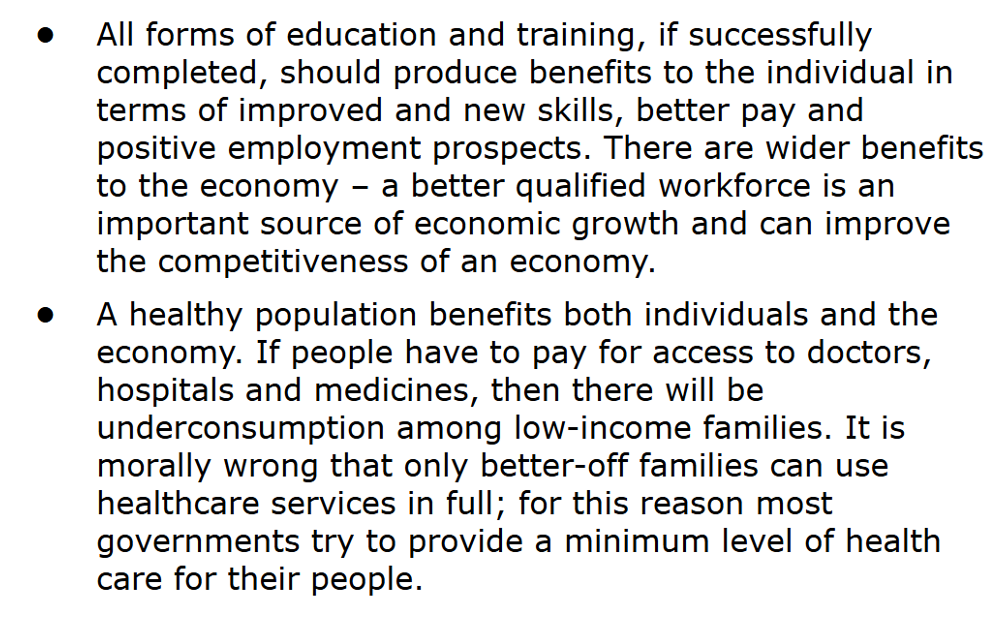
What broader benefits do merit goods create
Positive externalities: e.g., a more educated or healthier population raises productivity and growth.
How does low income contribute to merit‑good underconsumption
Even with awareness, inability to pay limits access (notably education and healthcare). Many governments therefore aim to provide a minimum level of such services.
What is a demerit good
A good judged undesirable for consumers and over‑provided in the market due to information failure -> it generates negative externalities.
Give demerit‑good examples (3).
Cigarettes (including passive smoking), junk foods high in sugar/fat, and some alcohol use.
Why are demerit goods over‑consumed (5)
Consumers may be unaware of harms, be influenced by persuasive advertising, rely on misleading packaging, or discount long‑term risks; these goods are often cheap and readily available.
How does government reduce consumption of demerit goods (4)
Indirect taxes, regulation/bans (e.g., smoking in public places), labelling and public‑health campaigns to correct information failures.
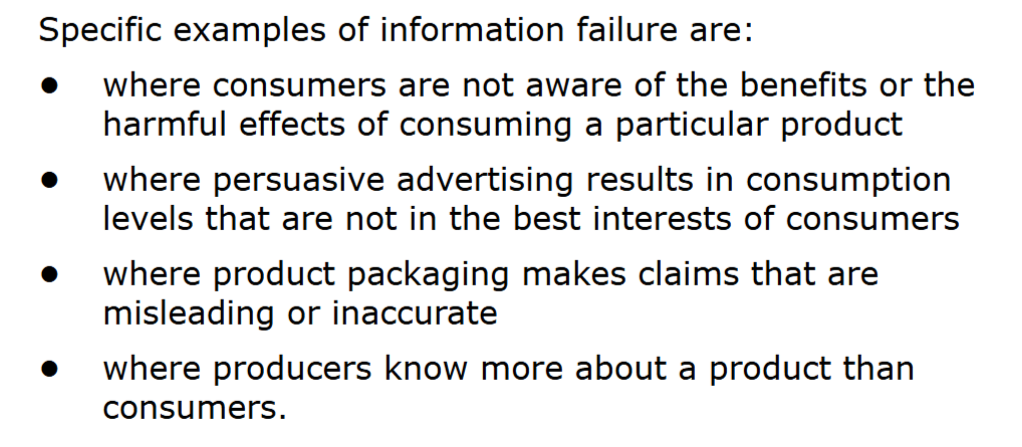
What is information failure in this topic and why does it matter
When consumers lack correct or complete information to judge a product’s benefits or harms and make appropriate decisions, markets may misallocate resources—under‑consuming merit goods and over‑consuming demerit goods.
Give specific sources of information failure (4).
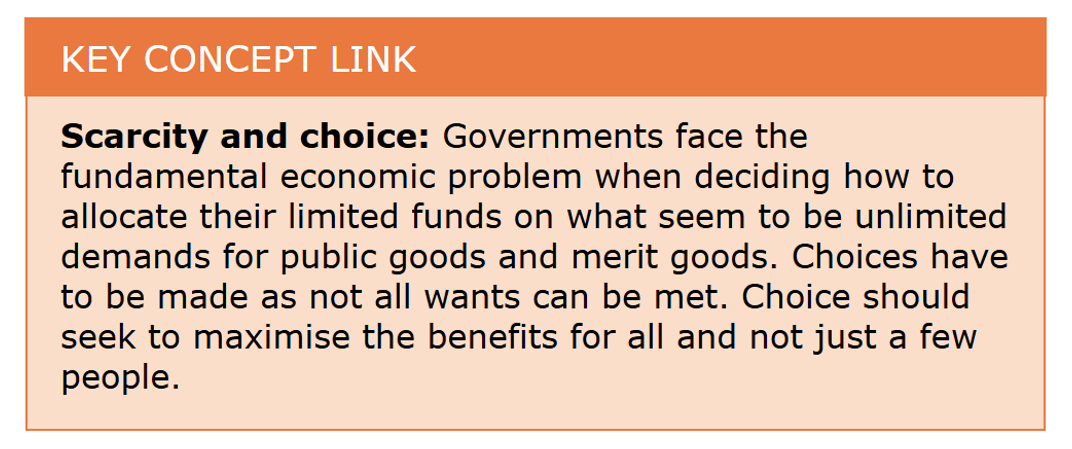
Key concept link
Why is the private vs public vs merit vs demerit distinction useful in policy
It guides where markets work well (private goods) and where intervention is justified (public goods, merit/demerit goods) to improve efficiency and equity.
Quick examples recap of all types of good
Free: rainfall/river water (context‑dependent), wild berries, air.
Private: food, trainers, smartphones, petrol.
Public: defence, street lighting, flood control, lighthouse.
Quasi‑public: toll road (excludable, non‑rival if empty), busy beach (non‑excludable, rival when congested).
Merit: education, vaccinations.
Demerit: cigarettes, high‑sugar fast food.
Exam tip – what to include for full marks
For public goods: state non‑excludable + non‑rival and explain the free‑rider problem and government provision.
For merit/demerit: define, link to information failure (and low income for merit), and give policy tools.
For quasi‑public: explain how/why excludability or rivalry depends on conditions (e.g., congestion or tolls).