4.3 Emerging + developing economies
 Call Kai
 Learn
Learn Practice Test
 Spaced Repetition
 Match
Match Flashcards
 Knowt Play
1/47

There's no tags or description
Looks like no tags are added yet.
Name | Mastery | Learn | Test | Matching | Spaced | Call with Kai |
|---|
No analytics yet
Send a link to your students to track their progress
48 Terms
Economic development
The sustainable increase in living standards for a country, typically characterised by increase in lifespan, education levels and income.
Human development index (HDI)
A combination of indicators with equal weighting:
Health: measured by life expectancy at birth e.g. in 2019, it was 81.2 in the UK
Education: measured by a combination of the mean schooling years that 25 year old’s have received, with the expected years of schooling for a pre-schooled child
Income: as measured by the real GNI per capita at PPP.
-scored between 0 and 1: the closer to 1, the higher the level of economic development + better standard of living. e.g. Switzerland- 0.967, Somalia-0.380
Advantages + disadvantages of HDI
+a composite indicator which provides a more accurate comparison metric than single indicators do- doesn’t only consider economic factors: incorporates 3 of the most important metrics for households
+widely used all over the world which provides an opportunity for meaningful comparisons
+analyses progress + provides a goal for governments to use when developing policies e.g. may help identify that education levels are holding back improvements to the HDI & government policy can target that
-doesn’t measure the inequality that exists as it uses the mean GNI/capita
-doesn’t measure the environmental quality, human rights, political freedom, crucial for social development.
-for many countries it doesn’t provide useful short-term information as gathering the data required for the calculation is difficult, so data often lags reality by several years
Other indicators of development
IHIDI: measures the level of human development when inequality is accounted for- will be equal to the HDI value when there is no inequality, but falls below the HDI value as inequality rises
+expressed as a percentage & represents the loss in potential human development due to inequality, in order to compare to other countries.
MPI(multidimensional poverty index): measures the complexities of poor people’s lives, individually & collectively, each year.
-tracks deprivation over 3 dimensions + 10 indicators: health, education + living standards
+used to identify most vulnerable populations within regions of a country, allowing for targeted policy implementation+resource allocation.
Factors influencing growth + development
Primary product dependency
Volatility of commodity (raw material) prices
Savings gap
The foreign currency gaps
Capital flight
Demographic factors
Debt
Access to credit + banking
Infrastructure
Education + skills
Absence of property rights
Primary product dependency
Primary products have a low income elasticity of demand (YED) so as world income rises, there is a less proportional increase in demand, so less proportional economic growth.
APP: avg commodity prices fell between 2013-17, causing economic slowdown in 64 dependent nations.
primary products have low added value (low profits) e.g. Sub-saharan Africa with minerals + agricultural products
exporting manufactured products raises added value + income
prices are volatile due to inelastic demand-decrease in price due to increase of supply decreases TR.
EVALUATION
If price for primary products increase, Qd increases by a larger %, increasing TR.
Attracts FDI- countries looking to access raw materials.
Don’t require costly investment + borrowing-less debt.
Volatility of commodity prices (how much prices can change easily + unpredictably)
Due to the inelastic nature of the demand + supply of commodities, even small changes in demand or supply can lead to large changes in price, and therefore export revenue.
susceptible to unpredictably supply shocks
in 2020, 25% of Bolivia’s GDP was generated by exports- 60% of exports were commodities.
When commodity prices rise, GDP rises.
EVAL: a more diversified range of exports prevent this.
Savings gap
Harrod - Domar model:
increase savings → increased investment → higher capital stock → higher economic growth → increased savings
-so any government/ foreign intervention to increase capital stock(FDI, foreign aid) will increase economic growth.
+circle can be broken by debt relief or foreign aid (uses savings of other countries to finance investment)
Criticisms:
Doesn’t account for other factors e.g. labour productivity, corruption, technological innovation.
Created based on data from wealthier industrialising nations as opposed to very poor undeveloped countries.
Focused only on physical investment & ignored other types such as investment in human capital (labour)

Foreign currency gap
When a country’s spending in foreign currency exceeds its earnings from exports. May develop as:
Trade imbalance: use foreign reserves to import more goods than exporting
Debt service: poor countries owe debt to foreign countries, so reserves need to be spent towards servicing debt.
-can’t afford essential imports e.g. fuel so cuts down on those imports- shortages, reduced development
-to address issue, country may devaluate currency, which can worsen inflation
APP: Asian countries have trade surpluses, S. America + Africa have deficits
+developing a diverse + strong export market prevents this.
+can be reduced by remittances +foreign aid/ debt relief
+attract FDI to increase supply of foreign currency
Capital flight
Occurs when money or assets rapidly leave a country.
-this may happen due to political upheaval, economic sanctions, war, or changes to government policy e.g. interest/ tax rates which reduce FDI, discourages investment+spending
APP: Sanctions applied to Russia in 2022 resulted in $75 billion of capital outflows.
Capital flight reduces supply of loanable funds, reducing money available for investment, reducing growth + development.
also depreciates currency (decrease in demand for currency), increasing inflation.
+changing interest/tax rates to prevent this
Demographic factors
If the dependency ratio (ratio of no. of dependents- children + pensioners to the working age pop.) is high, less people working, slower growth. Also, there is less money for savings + investment.
-many developing countries have high dependency ratios.
+improve healthcare so people can work for longer
+this is short-term: in long term, this can change e.g. India’s working age pop has grown larger since 2018
Debt
↑ demand for loanable funds by gov to finance debt→ causes interest rates to ↑ → higher costs for private sector to borrow → less borrowing+investment → crowding out (higher gov borrowing leads to lower private sector investment +spending) →lower growth
gov. may also ↑ tax rate to service debt via tax revenue
gov sells bonds to private sector to finance debt → less money for private sector to spend on investment + borrowing → crowding out
EVAL:
gov spending increases due to borrowing from private sector- injection in circular flow
debt relief can lessen debt
crowding out is unlikely in recession as more gov borrowing is making use of private sector savings(good thing)
Access to credit + banking
Financial institutions enable individuals & firms to borrow money which can be used for investment + therefore to generate output + growth. Also ↑ consumer spending, so ↑ AD.
Also, it promotes foreign trade → more employment opportunities → better standard of living.
+more financial institutions + mobile phone banking to replace physical networks prevents this from happening especially in poorer countries.
Infrastructure
Infrastructure reduces business costs & attracts foreign direct investment.
-some developing countries have such poor infrastructure that it makes it difficult to generate economic activity. This is one reason why China has invested so heavily in infrastructure projects in Asia & Africa as it unlocks economic potential.
Education + skills
Investing in this supply-side policy increases the potential output of the country (shifts the production possibility frontier outwards)
Higher education/skill levels → higher human capital → increased productivity → higher output → higher income.
Absence of property rights
A legal system that establishes + protects the rights of ownership of land, buildings and businesses- if it’s impossible to prove ownership, individuals and businesses may struggle to raise capital (as they have no collateral to use for loans), so less investment of capital, lower growth.
also, leads to more disputes over land, resulting in violence, and less development.
Dead capital: property which is not formally owned, so can’t be used to exchange for financial capital, and therefore have no collateral for loans.
Property is the main household asset which can be used to secure loans or generate income.
+allocating property rights can prevent this
Non-economic factors influencing growth + development
Corruption
Poor governance
Wars
Political instability
Geography
Corruption
Often money intended for investment is siphoned off by corrupt politicians resulting in a lower level of investment.
-also diverts funds to certain groups who bribed/ lobbied officials e.g. multinational firms resulting in projects that deliver a low level of growth + development
Poor governance
Leads to inefficient use of resources & poor decision-making.
-may also result in laws/regulation which directly inhibit growth & development
Wars
Conflict destroys infrastructure, disrupts supply chains & often reduces the post war supply of labour.
-shifts the production possibility curve inwards
Political instability
if governments keep changing, it results in constantly changing policies & priorities. It also reduces confidence in the economy & international investors are slower to invest as they are fearful of losing their investment
Geography
Harder for landlocked countries to generate economic growth. Often transportation & administration costs are higher than those with access to ports, which increases the costs of production & decreases international competitiveness.
-Natural terrain can also be a limiting factor e.g the arid, mountainous terrain of Pakistan
Market-oriented strategies influencing growth + development
Trade liberalisation
Promoting FDI
removal of government subsidies
floating exchange rate systems
microfinance schemes
privatisation
Pros+cons of trade liberalisation
Gov’s remove trade barriers, promoting exports + FDI.
PROS | CONS |
Lower prices for consumers- ↑ real incomes, higher CS Domestic markets more competitive: lower prices means AE- more competition so lower unit labour costs, firms benefit from specialisation + EoS | Lower government revenue due to lower import tariffs Infant industries suffer Removal of regulations means quality standards ↓ |
Pros+cons of FDI
PROS | CONS |
Allows the transfer of advanced technology- can be transferred to local businesses, fostering innovation new businesses bring investment + employee training→ more AD, more growth, more employment→ higher incomes, SoL | Exploitation of wages- poor working conditions, work environment e.g. China Environmental degradation Profits leak back to AC of the TNC’s |
Pros+cons of removing gov subsidies
Reducing/ eliminating financial assistance provided by the gov to certain industries, sectors, goods/ services.
+less distortion of prices, increases competition, efficiency, innovation
+government budget improves
-higher prices for necessity items- unaffordable
-domestic industries suffer
Pros+cons of microfinance
Small loans made available to unemployed or low income households who otherwise would not have had access to credit
e.g. Grameen Bank in Bangladesh
PROS | CONS |
Allows low income people to start/ expand businesses + increase income, reducing poverty Financially sustainable- don’t rely on grants/ subsidies to operate, + can provide services over long term | Over-indebtedness: there’s risk if multiple loans are taken out from different institutions, leading to more stress, bankruptcy + poverty Limited impact- larger scale interventions e.g. healthcare+education would be more effective |
Pros+cons of privatisation
+more competition- improved quality+lower prices
+increased investment- upgrading+expanding capacity of its enterprise, boosting growth
-income inequality: private investors may prioritise profit max over equitable resource allocation + social welfare- inefficiency
-job losses from cost-cutting, automation layoffs
Interventionist strategies influencing growth + development
development of human capital
protectionism
managed exchange rates
infrastructure development
promoting joint venture with global companies
buffer stock schemes
Pros+cons of human capital
Policies aimed at developing knowledge, skills + health, enabling them to become productive members of society.
+FDI: companies more likely to invest in a country with more skilled workforce- reduced training costs
+poverty+inequality reduction: enables individuals to secure higher wages
-financial barriers: low income groups unable to afford fees, transportation- leads to children dropping out of school
-risk of brain drain- may reduce the skilled workforce, decreasing productivity
-structural unemployment- more skilled workers may not match labour market needs.
-long run impact: time lag as benefits are not immediate- doesn’t affect LRAS in short run
Protectionism
Gov policies that restrict international trade in order to protect domestic industries e.g. tariffs
+protect domestic producers to be internationally competitive
-retaliation from other countries e.g. tariffs
-misallocation of resources as it limits those economies who have a comparative advantage
Managed exchange rates
+can prevent currency from being too strong(less price competitive)-macro-objective
+mitigates impact of an external shock- allows currency to adjust to external conditions e.g. change in global commodity prices- increases confidence
-not all countries have central banks with sufficient currency reserves to make intervention effective- expensive- opportunity cost
-may raise interest rates to manage exchange rate- reduce investment + growth
Pros+cons infrastructure development
Gov’s invest in infrastructure such as roads, ports, energy production to improve business environment.
+increases mobility of labour and FDI through transport development
+lowers supply costs
-environmental externalities
-opportunity cost
Joint ventures
A contractual agreement between 2 or more firms to combine their resources+expertise to achieve a particular goal. e.g. Sony+Honda- Sony’s expertise in electronics, Honda’s skill in mobility to produce electric cars
Pros+cons of promoting joint ventures
PROS | CONS |
help businesses to reduce risk of failure as joint venture partner shares the risks+rewards of the venture help access new markets +technologies they would not be able to develop on their own, if partner has expertise in a particular technology area | loss of control of business as partner gets a say in management- may lead to conflict of interest on goals+objectives termination: venture can be terminated by either party- can be costly + time-consuming |
Buffer stock scheme
When the government buys up supplies of agricultural products when harvests are plentiful, stores them- and then sells them when supplies are low
aims to stabilise market price of agricultural products
Pros+cons of buffer stock schemes
PROS | CONS |
price stability: ensures producers receive a fair price for products at a reasonable price- helps to reduce volatility + uncertainty in the market. food security: maintain a stockpile of food in case of crop failure or other emergencies- prevents food shortages + price spikes in times of scarcity/ external shocks | cost: require investment in storage, transport, management- cost can be passed onto consumers. some can’t be stored e.g. milk- results in waste distort markets: creating artificial demand + supply- leads to inefficient allocation of resources+ discourages private investment + innovation as they know they’ll always get paid a good price. |
Buffer stock scheme graph
equilibrium is initially at P1Q1
if price of rice drops below P2, the gov will purchase large quantities + store it (FG)
this will ↓ market supply, preventing the price from falling below the min price(P2)
if price rises above P3, gov releases it from storage (AB) + sells rice
this ↑ market supply + ensures that the price doesn’t rise above ceiling price
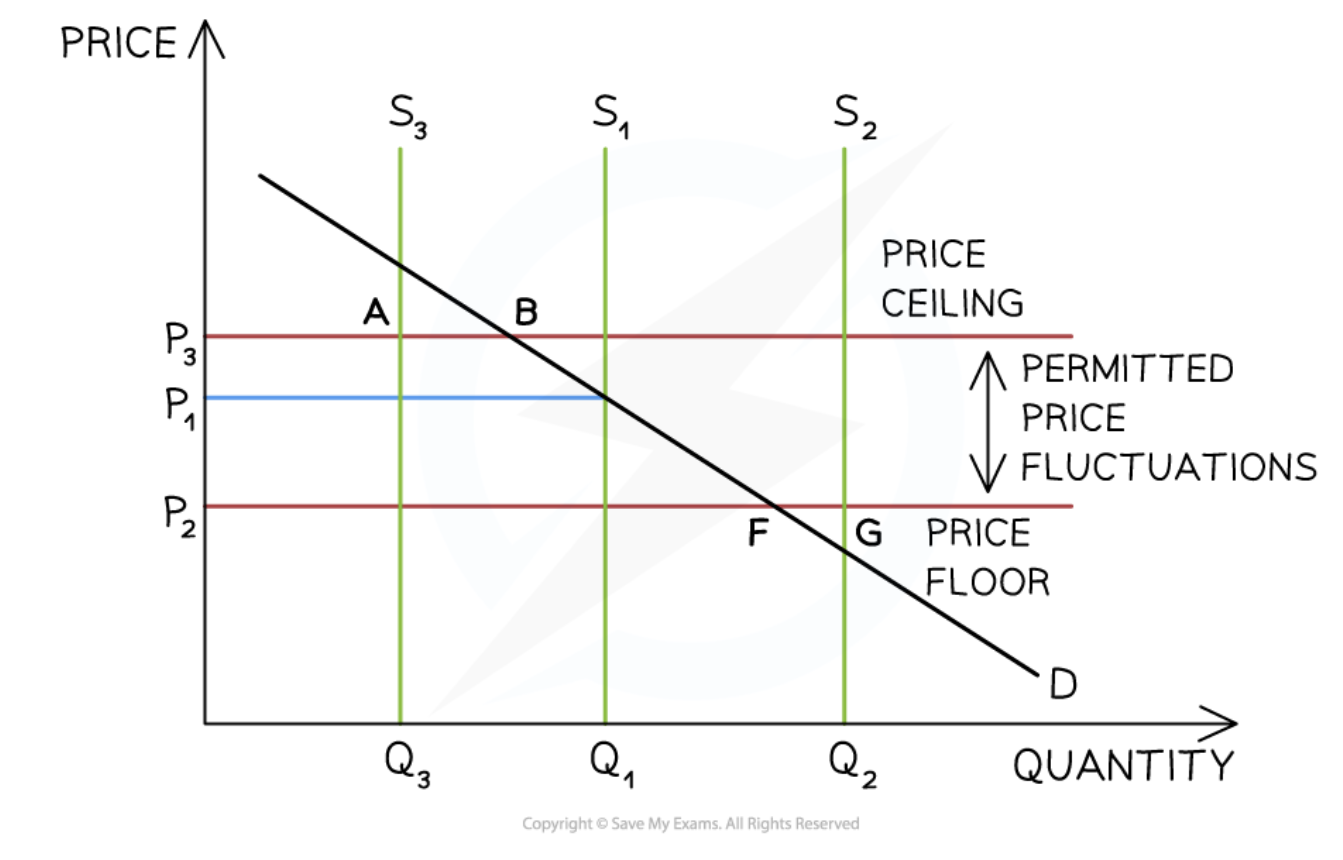
Buffer stock scheme alternatives
Crop insurance: help protect farmers against financial risk of crop failure/ other disasters. Provide income stability + reduce vulnerability to price fluctuation.
Contract farming: agreements between farmers + buyers- buyers commit to purchasing farmers products at predetermined price. provides income stability + encourage investment + quality improvements.
Other strategies influencing growth + development
Industrialisation: The Lewis Model
Tourism
Primary industries
Fairtrade schemes
Aid
Debt relief
Industrialisation
Lewis model describes economies as having 2 sectors: rural agricultural sector + urban industrial sector.
productivity + incomes higher in industrial sector so countries should transform their structure via rural-urban migration e.g. UK during industrial revolution
based on assumption that agriculture has surplus of unproductive labour
Evaluation for Industrialisation: Lewis model
-forced migration into urban areas creates poverty+overcrowding if its at a rapid pace
-migration will happen naturally if urban incomes are higher than rural
Tourism pros + cons
PROS | CONS |
Benefits from high YED due to rising global incomes- largest + fastest growing sectors in the world Employs large no. of low skilled workers- suited to LIDC’s e.g. 8% exports of LIDC’s come from tourism Shifts country away from primary product dependence + diversifies economy. Makes country attractive to FDI + developing their infrastructure. | Environmental degradation + creates NC externalities e.g. waste, noise, use of scarce resources like drinking water -rise in ecotourism Risky- income from tourism is unstable due to seasonal work + based off business cycle of developed countries |
Primary industries
Some countries have successfully developed due to GDP growth driven by primary industries e.g. Middle East with oil, due to their comparative advantage
+high export + tax revenue contributes to GDP growth e.g. Angola diamond industry made €1.2bn in 2021
+large + elastic supply of unskilled labour in rural areas- more employment
-volatile prices
-low YED (inelastic)
Fairtrade schemes
Promote equitable trading partnerships, connecting ethical buyers with farmers in developing countries.
+buyers pay high prices to support small farmers, help develop via value-added products
Pros + cons of aid
+help fill savings gap/ foreign currency gap
+use aid towards infrastructure development e.g. for water supply, healthcare
-aid may be misused, stolen by corrupt governments- leads to gov. failure due to info gaps (how to spend aid, what is more beneficial, etc)
-creates dependency culture
-tied aid- reduces freedom, increases cost for recipient country
Debt relief + evaluation
Forgiving/ restructuring debt of developing countries to reduce their financial burden.
financial resources are often diverted away from needs like infrastructure, education + healthcare
-create moral hazard: country may borrow recklessly again in the expectation of more debt relief,
-less likely to implement economic reforms to prevent debt again due to moral hazard
Role of WB, IMF, NGOs
World Bank | Provide loans to war countries+to aid infrastructure development Work with gov. to encourage economic reform+trade liberalisation |
IMF | Facilitate a stable global financial system via monitoring country’s policies, oversee exchange rates Provide members with currency to help deal with BOP issues |
NGOs | Voluntary, non-profit, community-based emphasis: encourage sustainability, remove need for aid, engage in small-scale projects, giving control to community stakeholders, draw on local skills |