IMM lec 7
 Call Kai
 Learn
Learn Practice Test
 Spaced Repetition
 Match
Match Flashcards
 Knowt Play
1/26

There's no tags or description
Looks like no tags are added yet.
Name | Mastery | Learn | Test | Matching | Spaced | Call with Kai |
|---|
No analytics yet
Send a link to your students to track their progress
27 Terms
What is microsegmentation in international marketing?
Segmentation carried out at the country or regional level when designing the international marketing programme (Stage IV), rather than using macro segmentation to choose which country to enter.
What are the three traditional segmentation bases identified by Gilooley et al. (2023)?
Demographic profiling (who consumers are), behavioural profiling (what consumers do), and psychographic profiling (why consumers behave as they do). Geographic segmentation (where) is also used.
in cultural branding, managers must identify the most appropriate myth market (Holt, 2004)
Why does Gilooley et al. (2023) favour psychographic over demographic segmentation?
Psychographic segmentation is argued to be more robust for high-involvement product categories (e.g. fashion and beauty) because personality is more predictive of behaviour than demographic variables.
Define the STP process.
Segmentation: identify distinct buyer groups. Targeting: select one or more segments to enter. Positioning: establish and communicate the distinctive benefit of the product offering for each target segment.
What are the five product levels according to Keller and Swaminathan (2020)?
Core benefit level, generic product level, expected product level, augmented product level, and potential product level. Most competition occurs at the augmented level.
brands vs products
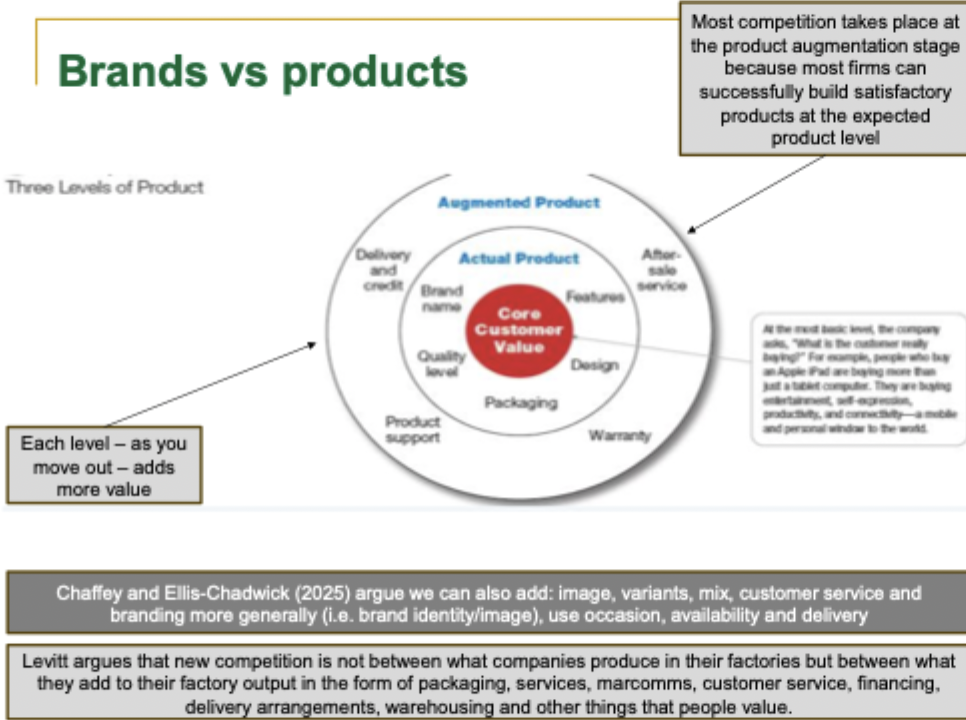
what do we mean by a brand ?
Aaker (2025) goes on to say that a brand is also a journey, an evolving relationship based on a customer perceptions and experiences whenever he or she connects to the brand
brands are powerful and aid communication
global brand: drivers, advantages and disadvantages
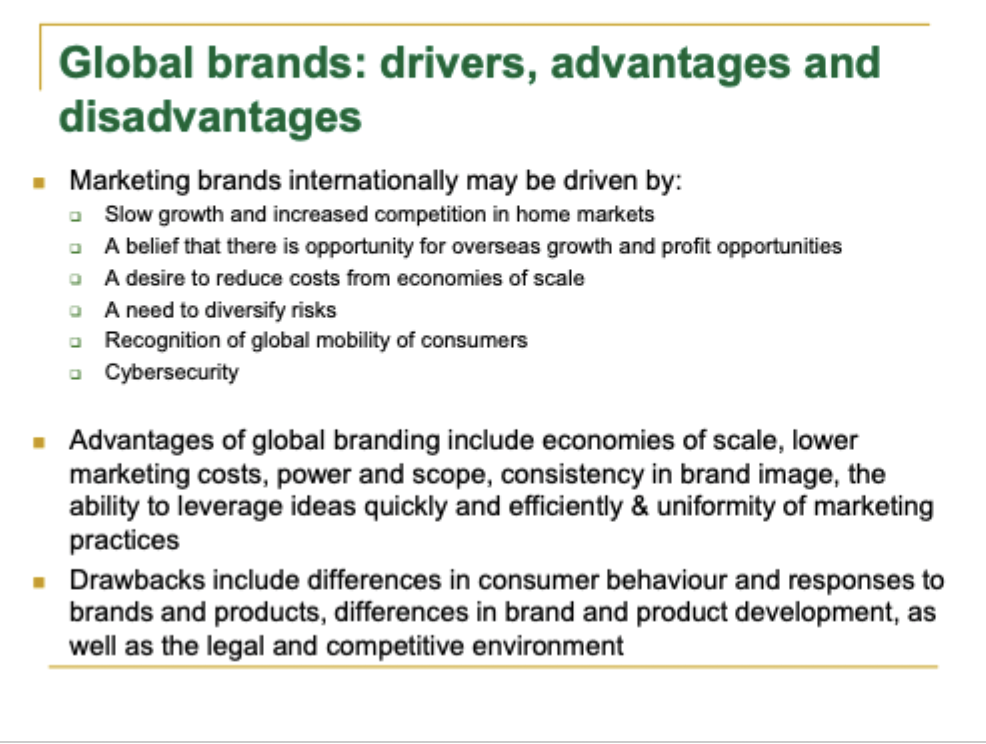
global and local brands
global brands - widely available across the international markets and enjoy high levels of recognition across the world
local brand - developed for and tailored to unique needs and desires of local markets
How does Levitt (1983) argue firms should compete globally?
By standardising products and marketing completely across all countries, exploiting economies of simplicity and scale. He argues a global market for uniform products had emerged.
What are the main criticisms of Levitt's standardisation argument?
It ignores branding, assumes market homogeneity, and does not account for differences in consumer preferences, regulations, culture, and competitive environments across countries.
Aaker 1999
Are we all the same globally?
Hence brand builders looking towards aspiration of building global brand
Global brands were perceived as better quality
Sony is an example of global brand at this time
Argues that the goal of standardisation is often unacheiveable, EOS may prove elusive, forming global teams can be difficult and that global brands cant be imposed on all markets
Arguees a nuanced approach is much better
Somehere along the spectrum of SA - depends on context which elements we standardise or adapt
levitt 1983
a global market for uniformed products and services had emerged, argue corps should grow by standardising all over the world, economics of simplicity
He does not mention branding, didn’t really exist
Managers of TNCs understood it as standardising product and packaging and communications across countries
Was about looking internally and saving cost
What is Aaker and Joachimsthaler's (1999) position on global standardisation?
A nuanced approach is better. Standardisation is often unachievable: economies of scale may be elusive, global teams are hard to form, and brand visions cannot simply be imposed on all markets.
What does Holt (2004) argue about global branding?
Most countries struggle to relate to generic standardised products. He advocates glocal and hybrid (cultural branding) strategies. Global brands are 'under siege' due to rising antiglobalism.
What are the 5 Bs of Aaker's (2025) brand equity framework?
Brand equity, brand relevance, brand image (including differentiation), brand loyalty, and brand portfolio. Each represents assets owned by the brand that affect consumer perceptions and decisions.
What does 'brand relevance' mean in Aaker's 2025 framework?
The brand must be visible AND credible for the context — high awareness alone is insufficient. Relevance requires cutting through clutter and being believable (credible) so there is no reason not to buy.
What is brand loyalty and why is it strategically important?
The ongoing asset value of repeat customers. It is at the heart of a brand's long-term value because retaining existing customers is far less costly than acquiring new ones.
What is the brand portfolio in Aaker's framework?
A strong brand is rarely alone; it leads a team that can include endorser brands, sub-brands, co-brands, and branded differentiators. An endorser brand is useful when entering a new market (e.g. Courtyard by Marriott).
brand vision model (Aaker, 2025)
Explain the Red Ocean vs Blue Ocean distinction (Kim & Mauborgne) in a branding context.
Red Ocean: highly competitive markets where brands constantly differentiate (e.g. Coca-Cola vs Pepsi). Blue Ocean: new sub-categories with no direct competitors, allowing pricing freedom (e.g. canned matcha latte in the UK).
What does Aaker (2025) say about the goal of having the same brand vision everywhere?
Having a shared brand vision offers coordination and clarity advantages, but the goal should be strong brands everywhere, not the same brand everywhere — adaptation is often necessary.
What elements typically need to be adapted when a brand enters different country silos?
Market share position, brand image (premium vs value), customer motivations, distribution channels, and local heritage/cultural differences affecting competitive positions.
What three strategies does Aaker (2025) suggest for adapting brand vision to local markets?
(1) Emphasise different core vision elements to suit the silo; (2) spin the brand story differently for local context; (3) augment with additional vision elements relevant to the local market without contradicting the global brand.
How does de Mooij (2023) link Hofstede's cultural dimensions to brand personality?
Brand traits like 'friendly' suit high uncertainty avoidance / low power distance cultures. 'Prestigious' works well in high power distance cultures. 'Trustworthy' is most attributed in high uncertainty avoidance cultures.
What are the advantages and disadvantages of a global branding strategy?
Advantages: economies of scale, lower marketing costs, consistent brand image, ability to leverage ideas efficiently. Disadvantages: differences in consumer behaviour, brand/product development, and legal/competitive environments.
What is Hollensen's tiered approach to country segmentation?
First, immediately knock out clearly unsuitable countries. Then conduct a top-level analysis on 10–15 candidates. Finally, carry out granular microsegmentation on the shortlisted markets.