Fish Culture Exam 3
 Call Kai
 Learn
Learn Practice Test
 Spaced Repetition
 Match
Match Flashcards
 Knowt Play
1/35

There's no tags or description
Looks like no tags are added yet.
Name | Mastery | Learn | Test | Matching | Spaced | Call with Kai |
|---|
No analytics yet
Send a link to your students to track their progress
36 Terms
Swim Bladder Stress Syndrome
Treatment: Driving off excess gas from the water by aeration or agitation.
Channel Catfish Virus (CCV)
- Viral
Treatment: No known cure.
Viral Hemorrhagic Septicemia
- Viral
Treatment: No known treatment for fish, but eggs can be treated.
Infectious Hemopoietic Necrosis (IPN)
- Viral
Treatment: No known cure for fish, but eggs can be treated.
Salmoid Herpes
- Viral
Treatment: No known cure.
Hemorrhagic Septicemia
- Bacterial
Treatment: Terramycin added to food or furacin added to water.
Columnaris
- Bacterial
Treatment: Furacin or diquat added to water.
Enteric Redmouth
- Bacterial
Treatment: Sulfurmerazine
Bacterial Kidney Disease
- Bacterial
Treatment: Erythromycin
Fungus (Most common = Saprolegnia)
- Fungal
Treatment: Eggs can be treated with malachite green and fish can be treated with formalin.
Ichthyopthirius multifilis (ICH)
- Parasitic
Treatment: Formalin and malachite green. Free swimming form is the only treatable stage in the life cycle of this parasite.
Trichodina
- Parasitic (Most common protozoan parasite of warmwater fishes.
Treatment: Salt (NaCl), acetic acid, or formalin.
Costia
- Parasitic
Treatment: Acetic acid or formalin dip treatments.
Myxosporidians
- Parasitic
Treatment: Spores are resistant to treatment. (“No treatment” for the sake of studying. Fumagillin for future reference.)
Digenetic Trematodes
- Parasitic
Treatment: By control of snail populations
Monogenetic Trematodes
- Parasitic:
Treatment: Formalin
Cestodes
- Parasitic
Treatment: food additive known as di-N-butyl tin oxide
Nematodes
- Parasitic: (Endoparasites) (Rarely a problem in fish culture facilities)
Treatment: antiparasitic medications
Copepods
- Parasitic (ectoparasites)
Treatment: Dylox
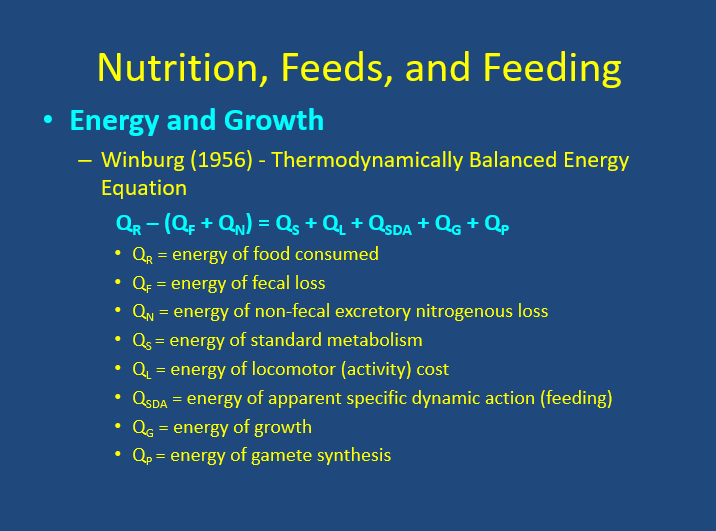
QR – (QF + QN) = QS + QL + QSDA + QG + QP
- Thermodynamically Balanced Energy Equation
Feed Conversion Ratio
- Dry weight of food : wet weight of fish
Feeding Methods:
- Hand Broadcasting
- Automated Feeder
- Demand Feeder
- Automatic Feeder
Most commonly used prepared diet:
- Oregon Moist Pellet
The three types of prepared diets:
- Practical diet
- Semi-purified diet
- Purified Diet
Practical Diet
Formulated from natural ingredients. Ex: Oregon Moist Pellet.
Semi-purified Diet
Often used in research. Contains some natural ingredients, but they are in a pure form. Used when looking at gross energy values.
Purified Diet
Ingredients are precisely known. Includes synthetic animo acids, fatty acids, and simple sugars. Used only in research.
Metabolism
The result of all chemical energy transformations that occur in a living organism.
Anabolism
- storage of energy for growth and deposition
Catabolism
- breakdown of storage products.
Kilocalories
amount of heat required to raise the temperature of 1 kg of water by 1° C
Hypervitaminosis
- Fish are fed too many fat-soluble vitamins
Hypovitaminosis
- Fish are fed too few fat-soluble vitamins
Ten amino acids that are considered essential to fish and cannot be synthesized by the animal:
–Phenylalanine
–Valine
–Threonine
–Tryptophan
–Isoleucine
–Methionine
–Histidine
–Arginine
–Leucine
—Lysine
Non-nutritional Variables:
- Flavor
- Odor
- Texture
- Water Stability
- Color
- Sinking or Floating