Calorimetry (3.1.4.2)
 Call Kai
 Learn
Learn Practice Test
 Spaced Repetition
 Match
Match Flashcards
 Knowt Play
1/3

There's no tags or description
Looks like no tags are added yet.
Name | Mastery | Learn | Test | Matching | Spaced | Call with Kai |
|---|
No analytics yet
Send a link to your students to track their progress
4 Terms
How can heat change in a reaction be calculated?
q = mcΔT
Where q is heat change (J)
Where m is mass of substance (g)
Where c is specific heat capacity (Jg-1K-1)
Where ΔT is change in temperature (K)
Where m is the mass of the substance that has a temperature change ∆T and a specific heat capacity c.
How do you calculate molar enthalpy change of a reaction?
ΔrH = q/n
Where ΔrH is the enthalpy change of reaction (kJmol-1)
Where q is heat change (J) - divide by 1000 to get to kJ
Where n is moles of reactant
How do you measure enthalpy change using calorimetry and what are the errors?
Method
1) Wash equipment with solution being used
2) Put a polystyrene cup in a beaker for insulation and support
3) Measure out desired volume(s) of solution(s) using volumetric pipettes and transfer to polystyrene cup
4) Place thermometer in cup and measure the initial temperature of the solution for 3 minutes
5) At minute 4 add desired mass (using balance (before and after weighing method)) of reagent to the cup
6) Stir mixture to ensure all the solution is at the same temperature
7) Record temperature of solution for several minutes after
Finding ΔT
1) Plot temperature against time using your results - skip minute 4
2) Draw two lines of best fit, one for the initial temperature, and the other following the cooling trend
3) Extrapolate both lines to the 4th minute
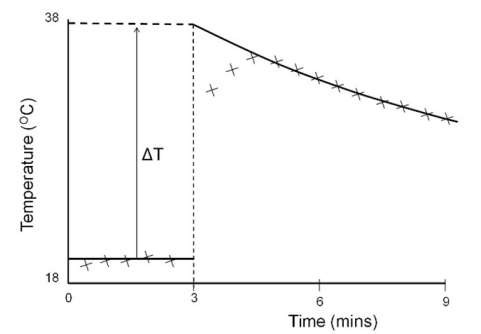
Finding ΔrH
1) Use q = mcΔT - where m is the mass of the solution used and c is the solution’s specific heat capacity
2) Use ΔrH = q/n - where n is the moles of the reagent added
Errors
1) Heat loss to the surroundings
2) Approximation in specific heat capacity of solution - assumes all solutions have the specific heat capacity of water
3) Reaction/dissolving may be incomplete/slow
4) Density of solution is taken to be the same as water
5) Some of the solution could’ve evaporated
6) If using fuel, incomplete combustion could’ve occured
1
1