Bonding in proteins.
 Call Kai
 Learn
Learn Practice Test
 Spaced Repetition
 Match
Match Flashcards
 Knowt Play
1/8

Earn XP
Description and Tags
https://www.youtube.com/watch?v=bjGsDpLyr2g
Name | Mastery | Learn | Test | Matching | Spaced | Call with Kai |
|---|
No analytics yet
Send a link to your students to track their progress
9 Terms
Where do the bonds in proteins form
Between the R groups of the amino acids on a polypeptide chain , type of bonding depends on the specific amino acids present in the polypeptide.
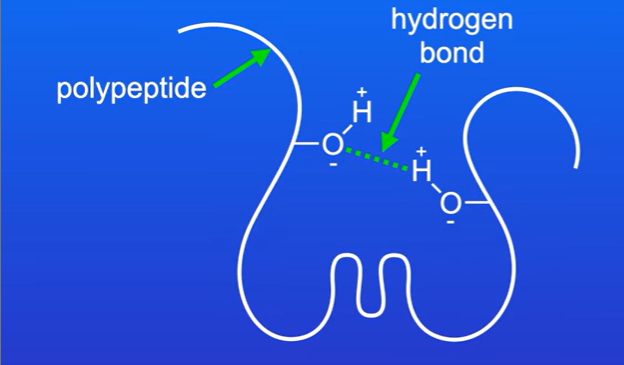
Where is hydrogen bonding found
R group containing hydroxyl, due to slight positive and negative charges present on hydroxyl, a hydrogen bond can form between these two R groups, this contributes to the 3d shape of a polypeptide chain
Hydrogen bonds are weak bonds, easily broken by high temp or pH changes.
What are hydrophobic interactions
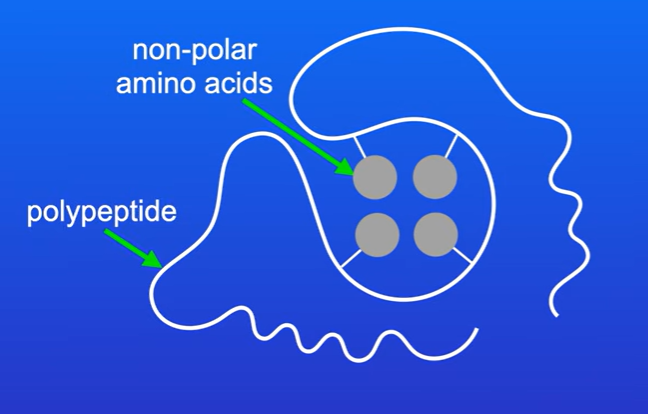
Several amino acids have uncharged R groups, they are called non polar amino acids, these amino acids are not attracted to water so they are hydrophobic
Amino acids with hydrophobic R groups tend to cluster together so they can exclude water molecules (hydrophobic interactions), which tend to be found in centre of proteins
What are hydrophillic interactions
Hydrophillic amino acids tend to be found on the surface of proteins, where they can interact with water molecules.
hydrophobicv and hydrophillic interactions have weak bonds
What are ionic bonds
These are found between amino acids with charged R groups
One amino acid has pos charge R group, one has neg charge R group
These opp charges attract each other and form an ionic bond, this bond holds together different parts of the polypeptide chain together.
Ionic bonds are broken by changes in pH
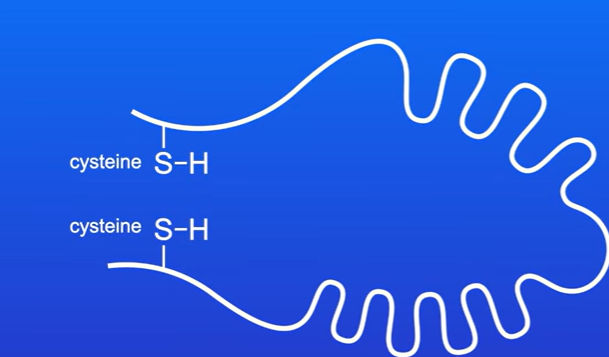
What does R group of cysteine have
Contains sulfur atom, sulfur atoms in the two cysteine molecules can form a covalent bond, this is called a disulfide bond
They are relatively strong bonds ,
What happens if these bonds form between amino acids on same polypeptide chain
Involved in tertiary structure
What happens if these bonds form between amino acids on different subunits
Theyre also involved in quat structure