Inheritance + Evolution
 Call Kai
 Learn
Learn Practice Test
 Spaced Repetition
 Match
Match Flashcards
 Knowt Play
1/66

There's no tags or description
Looks like no tags are added yet.
Name | Mastery | Learn | Test | Matching | Spaced | Call with Kai |
|---|
No analytics yet
Send a link to your students to track their progress
67 Terms
DNA Full Form
Deoxyribonucleic acid
DNA
Chemical that all the material in a cell is made up from
Determines Inherited Characteristics
Chromosomes
- Located in the nucleus
46 in each cell
- 23 Chromosome Pairs (one from father and mother)
- Coiled up DNA
What are chromosones?
A chromosome is a long DNA molecule with part of the genetic material of an organism
Structure of DNA
Tightly coiled and contained in chromosomes
DNA is a polymer (larger molecule built from smaller molecules)
Made up of two strands wrapped around each other to form a double helix
Sex Chromosomes
23rd pair of chromosomes
Determine whether individual is male or female
What Sex Chromosomes determine gender?
Female (XX)
Male (XY)
Gene
A gene is a small section of DNA found on a chromosome
Each gene codes for a particular sequence of amino acids
To make a specific protein
Controls our characteristics as they code for proteins that play an important role in what our cells do
DNA with Cells
Can determine the type of protein the cell produces
which can determine what type of cell it is.
Haemoglobin - Red blood cell
Number of amino acids?
only 20 AA
But there are multiple combinations that make thousand of different proteins
Genes simply tell what order to put the AA together
Genome
A genome is the entire set of genetic material in an organism
Human Genome Project Benefits
- Helps to understand and give effective treatments to inherited diseases/disorders
- Helps to search for genes linked to different types of diseases
- Use in tracing human migration patterns from the past
Nucleotide
The monomers of DNA consisting of a common sugar,
a phosphate group
and one of four chemical bases (A, T, C, G) attached to the sugar.
DNA in terms of polymers/monomers
DNA is a polymer
Made from four different nucleotides
Made from repeating nucleotide units
Nucleotide Structure
- Deoxyribose Sugar
- Nitrogenous Base
- Sugar and Phosphate form a backbone which is the strand
- Sugar and Phosphate groups Alternate
- The bases join together with hydrogen bonds if complementary
What are long strands of DNA made up of?
Consists of alternating sugar and phosphate sections
Four Types of Bases
Adenine (A),
Cytosine (C),
Thymine (T)
Guanine (G)
Complementary Base Pairing
The bases on each strand pair up with each other, holding the two strands of DNA in the double helix
The bases always pair up in the same way:
Adenine always pairs with Thymine (A-T)
Cytosine always pairs with Guanine (C-G)
How many bases code for a particular amino acid?
3 Bases
Codon/Triplet
Order of bases control the order in which amino acids are assembled to produce a particular protein
3 Uses of Protein
Enzymes - biological catalysts that speed up chemical reactions in the body
Hormones - used to carry messages around the body
Structural Proteins - provide structure and are physically strong
Non Coding DNA
DNA which does not code for a protein
Switches parts of genes on and off
controls gene expression.
Gene
A SMALL section of DNA that codes for a specific sequence of amino acids that join together to form different types of proteins.
(in exam say codes for a specific protein)
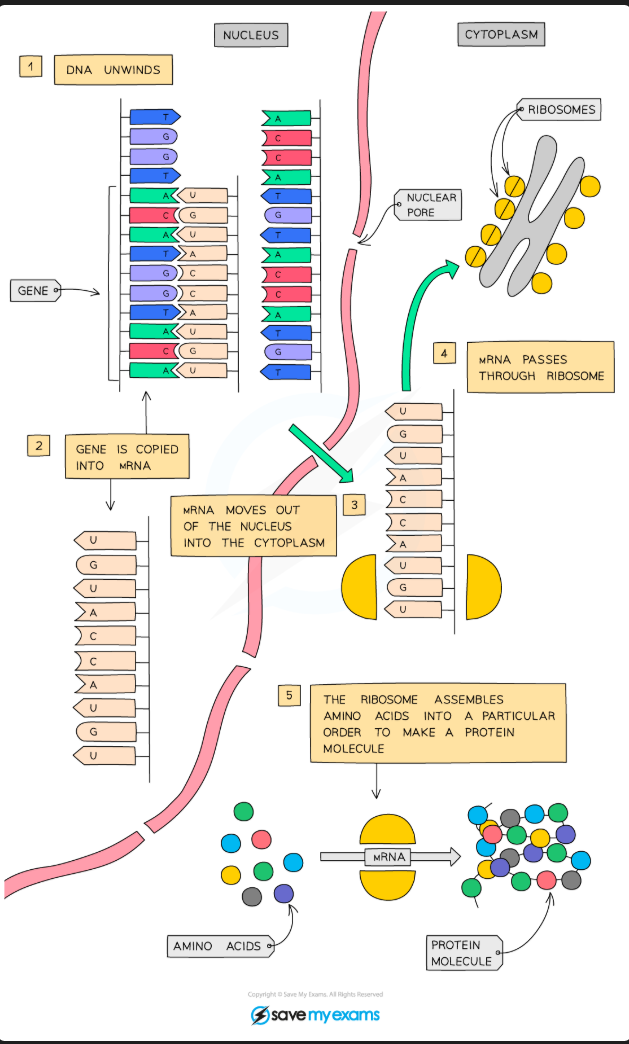
Transcription
Process of copying a single gene of DNA to mRNA
Takes place in the nucleus
mRNA vs DNA
mRNA is shorter than DNA
mRNA is single-stranded whereas DNA is double stranded
mRNA contains uracil (U) instead of DNA Thymine (T)
Where does mRNA go after transcription?
To ribosomes
Translation
Process by which a ribosome combines amino acids together to form a protein using instructions of mRNA
Ribosome function
To carry out protein synthesis
By assembling amino acids that fold up to form proteins
Polypeptide
Chain of amino acids
Transcription Steps (Protein Synthesis)
- RNA polymerase makes a complementary mRNA base in small parts at a time of the gene
- Gene closes and opens right after the RNA creates the base for it
-messenger RNA takes it to the ribosome
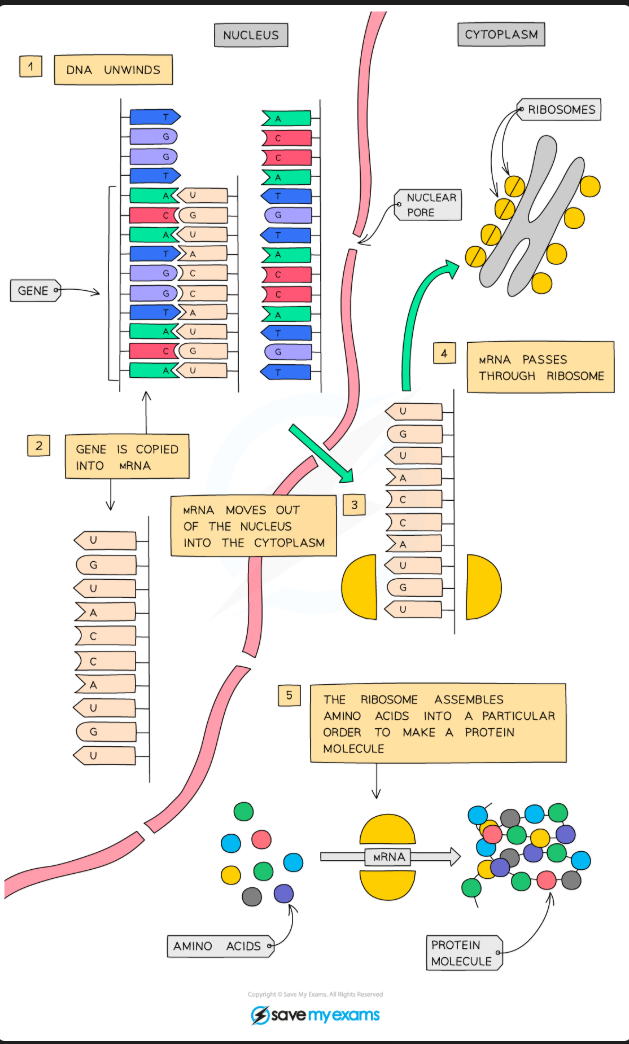
Translation Steps (Protein Synthesis)
- The ribosome 'reads' the code on the mRNA in groups of three
- Each triplet of bases codes for a specific amino acid
- tRNA bring specific amino acids to add to the growing protein chain in the correct order (due to its anti-codon being complementary)
- In this way, the ribosome translates the sequence of bases into a sequence of amino acids that make up a protein
- Once the amino acid chain has been assembled, it is released from the ribosome so it can fold and form the final structure of the protein
Coding for Amino Acids
Sequence of three bases (triplet/codon) code for a particular amino acid
Order of bases controls the order and different types of amino acids that are joined together’
AA sequence → particular type of protein
Order of bases in DNA eventually determine which proteins are produced
Double Helix Structure
phosphate and sugar section of the nucleotides form the ‘backbone’ of the DNA strand
base pairs connect to form the middle (complementary hydrogen bonds)
Sequence of bases holds code for formation of proteins
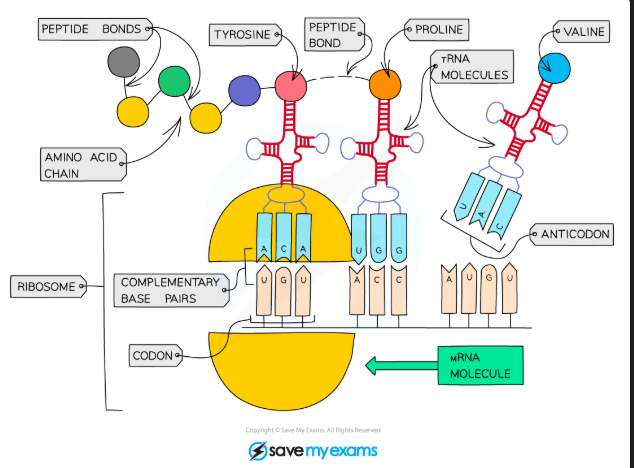
Function of Ribosomes
Ribosome reads the code on the mRNA in groups of three
Each triplet of bases codes for a specific AA
Carrier molecules bring specific AA to growing polypeptide chain in correct order (due to anti-codon being complementary)
Ribosome translates the sequence of bases into a sequence of AA that make up a protein
After AA chain has been assembled it is released from the ribosome so it can fold and form the final structure of a protein
Mutation
Change in the base sequence of DNA
(sometimes inherited)
When and where do mutations occur?
Mutations occur continuously
They can occur spontaneously eg. when a chromosome is replicated properly
Chance of mutation is increased by exposure to certain substances
What factors increase risk of mutations occuring?
Carcinogens → chemicals that cause cancer
Certain types of radiation (x ray and gamma rays)
These are risk factors that increase the CHANCE of mutations occurring
What is meant for a gene to be expressed?
Cell is actively producing proteins that the gene codes for
The gene is “switches on”
Non Coding DNA
DNA that does not code for proteins
Non-coding parts of DNA can switch genes on and off, so variations/mutations in these areas of DNA may affect how genes are expressed
Where are mutations most likely to occur?
Non - coding DNA
Mutations and affect?
change the sequence of DNA bases in a gene which produces a genetic variant
mutations can sometimes lead to a change in protein that is coded for
Most do not alter the protein, or only alter it slightly so that its appearance or function is not changed
Serious affect with mutations
few mutations code for an altered protein with a different shape
change in base sequence → change in sequence of amino acid → fold up to form a different protein with different shape
so can no longer carry out its function
Enzymes - enzyme may no longer fit the substrate binding site (active site changed)
structural protein like collagen may lose its strength
Insertion Mutation
- A new base is randomly inserted into the DNA sequence
-An insertion mutation changes the amino acid that would have been coded for by the codon
- An insertion mutation also has a knock-on effect by changing the groups of three bases further on in the DNA sequence
Substitution mutation
- A base in the DNA sequence is randomly swapped for a different base
- Unlike an insertion or deletion mutation, a substitution mutation will only change the amino acid for the group of three bases in which the mutation occurs (no knock on effect)
Deletion mutation
- A base is randomly deleted from the DNA sequence
- A deletion mutation changes the amino acid that would have been coded for by the codon
- A deletion mutation also has a knock-on effect by changing the groups of three bases further on in the DNA sequence
Mutation in Non Coding DNA
If a mutation occurs in a section of non-coding DNA the expression of these genes may be altered or in some cases the mutation may cause them not to be expressed at all
Effects of Mutations
- Most mutations do not alter the protein or only alter it slightly so that its appearance or function is not changed
- Some mutations code for a significantly altered protein with a different shape
- This may affect the ability of the protein to perform its function.
Enzyme EXAM STYLE Q (if altered what is the effect)
Change is base changes triplet/codon
Changes amino acid it codes for (so different poly peptide sequence)
This means the polypeptide will fold into a differently shaped protein/enzyme
The protein/enzyme may have a differently shaped active site
So it may no longer be complementary to the substrate
Which would mean it couldn't form an enzyme-substrate complex
So it couldn't catalyse the reaction as well / the rate would be lower
Sexual Reproduction
New offspring are produced by the fusion of male and female gametes (fertilisation)
Mixing of genetic information which leads to variety in the offspring
Genetically unique offspring (different from parents)
formation of gametes involves meiosis
Which two gametes fuse in animals?
During sexual intercourse
Sperm cell and Egg Cell
Which two gametes fuse in flowering plants?
Pollen
Egg Cell (Ovule)
Haploid
Half number of normal chromosomes (23)
eg. Sperm cell
Diploid
Full number of chromosomes 46
eg. Sperm + Egg cell fuse
Fertilisation
Fusion of male and female gametes
23 Sperm Cell + 23 Egg Cell
Fuse to form a zygote with full number of chromosomes
Offspring inherits features from both parents as it receives a mixture of chromosomes from mother and father
Asexual Reproduction
Type of reproduction where new offspring are produced by a single parent
No fusion of gametes
There is no mixing of genetic information → leads to genetically identical offspring (clones)
Genetically Identical Offspring
Only mitosis is involved
Different organisms (asexual/sexual reproduction?)
Animals - Sexual Reproduction
Fungi - Asexual Reproduction
Plants - Both
Bacteria - Asexual Reproduction (binary fission)
Meiosis vs Mitosis
Meiosis → non identical cells being formed
Mitosis → Identical cells being formed
3 Advantages of Sexual Reproduction
It produces variation in the offspring, so the species is less likely to be wiped out by extreme events.
If the environment changes, the variation will allow the species to adapt/evolve by natural selection.
Humans can speed up natural selection via selective breeding to gain certain benefits (e.g. selectively breeding certain crops to increase food production).
3 Disadvantages of Sexual Reproduction
It requires two parents.
It can require large amounts of time and energy to search for a mate.
Many species spend resources impressing their mates even though it doesn't aid survival.
3 Advantages of Asexual Reproduction
Only one parent is needed.
Takes less time as parents do not need to find a mate.
It is faster than sexual reproduction.
Genetically identical offspring → successful traits propagated
Many offspring produced
2 Disadvantages to Asexual Reproduction
Low genetic variation means that offspring are more susceptible to extreme events (like the spread of a new disease).
The population would have a smaller chance of adapting to new conditions.
3 Examples of Organisms to reproduces Asexually and Sexually
Malarial parasites reproduce asexually in the human host but sexually in the mosquito.
Many fungi reproduce asexually by spores but also reproduce sexually to give variation.
Many plants produce seeds sexually but also reproduce asexually – for example, by runners in strawberry plants or bulb division in daffodils.
Gamete
Sex Cell such as sperm or egg cell
23 Chromosomes
Where in the body does meiosis take place?
only in reproductive organs
testes in males
ovaries in females
produces 4 genetically unique cells
2 divisions occur
How does meiosis halve the number of chromosomes in gametes and how does fertilisation restore the full number?
Meiosis produces gametes (sperm and egg cells).
It halves the chromosome number from 46 to 23.
Each gamete contains 23 chromosomes.
During fertilisation, sperm and egg fuse together.
Their chromosomes combine (23 + 23).
The zygote restores the full number of 46 chromosomes.
What happens when a cell forms a gamete?
copies of the genetic information are made
the cell divides twice to form four gametes, each with a single set of chromosomes
all gametes are genetically different from each other
What happens after fertilisation during early development?
Gametes join at fertilisation, restoring the normal chromosome number.
The new cell (zygote) divides by mitosis.
The number of cells increases.
As the embryo develops, cells differentiate into specialised cells to make whole organism
Mitsios vs Meiosis
Mitosis produces gentically identical cells while meiosis produce geneticall unqiue/varied cells
Mitosis produces 2 daughter cells BUT meiosis produces 4 daughter cells
Mitosis has one cell divison while mitsosi has two cell divisons
mitosis produces diploid cells but meiosis produces haploid cells