Respiratory - Assessment of Oxygenation in CRITICALLY ILL
 Call Kai
 Learn
Learn Practice Test
 Spaced Repetition
 Match
Match Flashcards
 Knowt Play
1/24

There's no tags or description
Looks like no tags are added yet.
Name | Mastery | Learn | Test | Matching | Spaced | Call with Kai |
|---|
No analytics yet
Send a link to your students to track their progress
25 Terms
What things need to occur for tissue demands to be met by the delivery of O2?
adequate ventilation/perfusion
transfer of O2 across alveolar-capillary membrane
presence of hemoglobin to carry O2
adequate cardiac output to deliver O2 to the tissue bed
release of O2 from the hemoglobin molecule
ability of cells to utilize O2
why is oxygen at the cellular level SOOO important?
sufficient oxygen is needed for production of ATP (which is needed for cell energy/life)
without sufficient oxygen, lactic acid is produced (LACTIC ACIDOSIS), showing evidence of anaerobic metabolism, organ failure, and eventual death
why is NOT sufficient enough to look at only PaO2 and SaO2 in a septic patient?
a patient in septic shock may have a normal PaO2, SaO2, hemoglobin, clear lungs, and adequate ventilation/oxygen delivery, but have a lactate of 10, meaning lactic acidosis
OXYGEN UTILIZATION IS AFFECTED BY SEPSIS, RESULTING IN ANAEROBIC METABOLISM AT THE CELLULAR LEVEL
Indicators of oxygenation - PaO2 (normal range? relevance?)
normal range - 80-100mmHg on room air
clinical relevance - reflects how well oxygen is moving from the alveoli into the bloodstream, meaning conditions such as PNA, pulmonary edema, ARDS, or a PE can significantly drop PaO2
Indicators of oxygenation - SaO2 (normal range? relevance?)
normal range - 95-99% on room air
clinical relevance - measures the percentage of hemoglobin sites occupied by oxygen in arterial blood (REMEMBER - a drop in hgb does not always mean in a drop in SaO2)
Indicators of oxygenation - mixed venous oxygen saturation (SvO2) (normal range? relevance?)
normal range - 60-75%
clinical relevance - most sensitive indicator of oxygenation at the cellular level; REFLECTS THE BALANCE BETWEEN OXYGEN DELIVERY (DO2) and OXYGEN CONSUMPTION (VO2)
in low cardiac output states, less oxygenated blood reaches tissues, leading to tissues extracting more oxygen from blood, leading to a decreased SvO2
in SEPTIC SHOCK, our tissues’ ability to consume oxygen is impaired (VO2 is low), leading to a HIGH SvO2
Indicators of oxygenation - CaO2 (oxygen content) (normal range? clinical relevance?)
normal range - 15-20mL / 100 mL blood
clinical relevance - HELPS DETERMINE OXYGEN DELIVERY
conditions that affect CaO2:
severe anemia - example (hgb 5, SaO2 100%, PaO2 95 → normal oxygenation, markedly reduced CaO2; WHY? → there isn’t enough hemoglobin to carry oxygen)
hypoxemia - example (hgb 15, SaO2 80% → CaO2 decreases because less hgb is saturated)
Indicators of oxygenation - oxygen delivery (DO2) (normal range? clinical relevance?)
normal range - 900-1,100 mL/min
clinical relevance - the total amount of oxygen delivered to tissues each minute; relies on CO and CaO2 (oxygen content in blood); low CO, severe anemia, and hypoxemia result in reduced DO2
Indicators of oxygenation - oxygen consumption (VO2) (normal range? clinical relevance?)
normal range - 250-350 mL/min
clinical relevance - it is LOW with septic shock, due to the tissues’ inability to utilize oxygen even when delivery is adequate
Indicators of oxygenation - alveolar-arterial gradient (normal range? clinical relevance?)
normal range - < 10 mmHg
clinical relevance - calculates difference between alveolar oxygen and arterial oxygen; indicates whether gas transfer is normal or how bad the V/Q mismatch/shunt is
oxyhemoglobin dissociation curve - what is it?
describes the relationship between PaO2 (oxygen dissolved in arterial blood) and SaO2 (% of hemoglobin saturated with oxygen); it shows how READILY hemoglobin binds oxygen in the lungs and releases oxygen to the tissues
oxyhemoglobin dissociation curve - difference between LEFT shift and RIGHT shift?
Left shift - certain conditions make hemoglobin “HOLD ON” to oxygen molecules
such as alkalosis (low H+), low PaCO2, hypothermia, low 2,3-DPG; BAD FOR TISSUES, as SaO2 is high, but the O2 is stuck to the hgb
Right shift - certain conditions allow hemoglobin to “RELEASE” oxygen more easily to the tissues
such as acidosis (high H+), high PaCO2, fever, high 2,3-DPG; GOOD FOR TISSUES, as SaO2 is low but O2 is easily release to the tissues
2,3-diphosphoglycerate (2,3-DPG) - what is it?
an organic phosphate found in RBCs that has the ability to alter the affinity of hgb for oxygen
DECREASED? - results in hgb holding on to O2
INCREASED? - results in hgb more readily releasing O2
2,3-diphosphoglycerate (2,3-DPG) - conditions that result in DECREASED 2,3-DPG
multiple blood transfusions of banked blood
hypophosphatemia
hypothyroidism
RESULTING IN LESS O2 AVAILABLE TO TISSUES
2,3-diphosphoglycerate (2,3-DPG) - conditions that result in INCREASED 2,3-DPG
chronic hypoxemia (such as prolonged time spent at high altitudes or chronic HF)
anemia
hyperthyroidism
RESULTING IN MORE O2 AVAILABLE TO TISSUES
Carbon Monoxide Poisoning - why is it SOO dangerous?
carbon monoxide (CO) has a greater affinity for hemoglobin than oxygen (APPROXIMATELY 230 TIMES GREATER), meaning oxygen cannot be carried, leading to tissue hypoxia
Carbon Monoxide Poisoning - why can you NOT use a pulse oximeter to monitor for oxygenation status?
the pulse oximeter cannot differentiate between CO and O2, therefore an SpO2 of 95% in the presence of CO poising only means that the hemoglobin is saturated with a total of 95% molecules
if the CO level of the blood is 40%, the maximum O2 that can be carried by the hemoglobin is 60%
Carbon Monoxide Poisoning - carboxyhemoglobin (COHb) levels / associated clinical presentation
0-5% = NORMAL
6-15% = often in smokers, truck drivers
15-40% - headache, some confusion
40-60% - loss of consciousness, Cheyne stokes breathing
50-70% - MORTALITY
Carbon Monoxide Poisoning - treatment
100% FiO2 until symptoms resolve and carboxyhemoglobin level is <10%
hyperbaric oxygen chamber if available, generally within 30 minutes
Lung Compliance - general definition
the degree of elasticity of tissue in the lungs (THEREFORE, a decrease in compliance = INCREASED RESISTANCE/STIFFNESS)
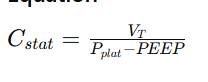
Lung Compliance - static compliance (what is it? equation?)
measurement of the elastic properties of the LUNGS
Equation: tidal volume / plateau pressure (minus PEEP)
NOTE: an increase in plateau pressure will DECREASE compliance
Lung Compliance - dynamic compliance (what is it? equation?)
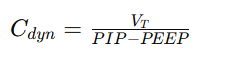
measurement of the elastic properties of the AIRWAYS
Equation: tidal volume / peak inspiratory pressure (PIP) (minus PEEP)
NOTE: an increase in peak inspiratory pressure will DECREASE compliance
Lung compliance - normal range for static/dynamic compliance?
BOTH is about 45-50 mL/cm H2O
Lung compliance - dynamic vs. static compliance
patients with pulmonary problems that mainly involve the airways (such as asthma) have a DECREASE in dynamic compliance, but their static compliance remains normal
patients with pulmonary problems that mainly involve the lungs (such as PNA, ARDS) have a DECREASE in static compliance, but their dynamic compliance may also decrease as the lung pressures may transmit up to the airways
Lung compliance - Status asthmaticus, ARDS
status asthmaticus
static compliance (lungs) would be normal
dynamic compliance (airways) would be LOW
ARDS
static compliance (lungs) would be LOW
dynamic compliance (airways) would be LOW, due to lung pressures transmitting up to the airways