3.2.4 More than Meets the Eye

0.0(0)
Studied by 0 people
call kaiCall Kai
learnLearn
examPractice Test
spaced repetitionSpaced Repetition
heart puzzleMatch
flashcardsFlashcards
GameKnowt Play
Card Sorting

1/48

encourage image

There's no tags or description

Looks like no tags are added yet.

Last updated 10:00 PM on 4/8/26
Name
Mastery
Learn
Test
Matching
Spaced
Call with Kai

No analytics yet

Send a link to your students to track their progress

49 Terms

1
New cards

What does immune privilege do?

Limits the body’s normal inflammatory response

2
New cards

What body structures have immune privilege?

The eye, brain, and testes

3
New cards

What does a limited inflammatory response in the eyes prevent?

Damage to the eye and vision impairment that might result from swelling and higher body temperatures

4
New cards
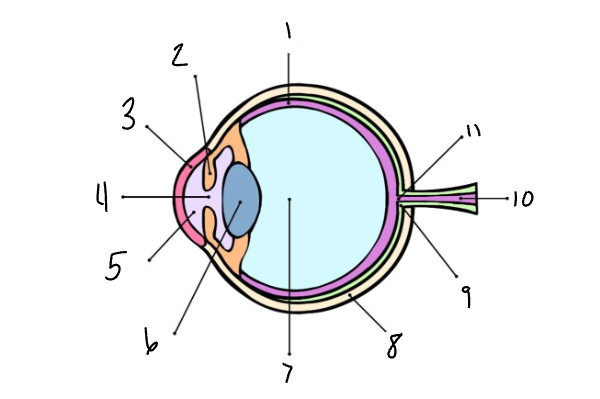
<p>Label the eye</p>

Label the eye

  1. Retina

  2. Iris

  3. Cornea

  4. Pupil

  5. Aqueous Humor

  6. Lens

  7. Vitreous Humor

  8. Sclera

  9. Tapetum

  10. Optic Nerve

  11. Blind Spot

5
New cards

Retina

The light-sensitive layers of nerve tissue lining the most posterior chamber of the vertebrate eye

6
New cards

What is the function of the retina?

It receives images and send them as electric signals through the optic nerve to the brain

7
New cards

What is the function of the iris?

Determines how much light to let in the eye

8
New cards

Cornea

The transparent part of the coat of the eyeball that covers the iris and pupil

9
New cards

What is the function of the cornea?

It admits light to the interior eye

10
New cards

What is the function of the pupil?

Admits light into the interior of the vertebrate

11
New cards

Aqueous Humor

The fluid that fills the space between the lens and the cornea

12
New cards

What is the function of the aqueous humor?

It maintains intraocular pressure, keeping the eye’s shape

13
New cards

What is the function of the lens?

Refracts light to be focused on the retina

14
New cards

Vitreous Humor

The clear, viscous substance that fills the eyeball behind the lens

15
New cards

What is the function of the vitreous humor?

It maintains the eyeball’s spherical shape, supports the retina, and acts as a shock absorber

16
New cards

Sclera

The white external layer of the eyeball

17
New cards

What is the function of the sclera?

Protects the inner eye from trauma, maintains the shape of the eye against external pressure, and provides an attachment point for the extraocular muscles

18
New cards

What is the function of the tapetum?

Enhances night vision by acting as a mirror

19
New cards

What is the function of the optic nerve?

The vital cable connecting the eye to the brain, transmitting visual information via electrical impulses

20
New cards

Blind Spot

The small circular area in the retina where the optic nerve enters the eye that is devoid of rods and cones and is insensitive to light

21
New cards

What is the function of the blind spot?

It provides necessary pathways for nerve fibers to carry visual information to the brain

22
New cards

Path of light within the eyes

Light rays enter the eye through the cornea and are filtered through the pupil to the lens. Once focused on the retina, the retina processes the image and converts it into nerve signals that can be received by the brain

23
New cards

What does the brain have to do due to the curves of the eyes?

The curves of the eye changes the direction of light entering it, so the image projected on the retina is upside down, so the brain has to invert it. The brain also has to layer the two images from your retinas to create the 3D image in your mind and give you depth perception

24
New cards

Who discovered the theory concerning the brain flipping the retina image?

French philosopher Rene Descartes by dissecting a bull’s eyeball and putting a viewing screen in place of the retina

25
New cards

What do muscles in the iris do?

Regulate its size

26
New cards

Why is the retina so important?

It is the sensory layer of the eyeball, which contains receptors for sight: rods and cones

27
New cards

Rods

Any of the long rod-shaped photosensitive receptors in the retina responsive to faint light

28
New cards

Cones

Any of the conical photosensitive receptor cells of the vertebrate retina that function in color vision

29
New cards
<p>Label the image</p>

Label the image

  1. Ciliary muscle

  2. Ciliary process

  3. Zonular fibers

  4. Cornea

  5. Pupil

  6. Lens

  7. Iris

  8. Sclera

  9. Choroid

  10. Retina

  11. Fovea

  12. Optic disc

  13. Central vein

  14. Central artery

  15. Optic nerve

30
New cards

Choroid

A spongy membrane full of vessels located underneath the sclera

31
New cards

Vitreous Body

A transparent gel-like substance that maintains eye shape, filling the space inside the globe of the eye

32
New cards

Fovea Centralis

A small area with a high density of cone photoreceptor cells, allowing for sharpness of vision

33
New cards

Subconjunctival Hemorrhage

A bright red patch appearing in the white of the eye (also known as red eye), when one or more of the small blood vessels break open and bleed near the surface of the white of the eye

34
New cards

Conjunctiva

Helps protect the eye and plays a role in tear production, with very small blood vessels within it

35
New cards

How can a subconjunctival hemorrhage happen?

It can happen without injury, as sudden increases in blood pressure, such as violent sneezing or coughing can cause it

36
New cards

Who is more likely to get a subconjunctival hemorrhage?

Babies, people with high blood pressure, or people who take blood thinners

37
New cards

Optician

  • Fits a patient for eyeglasses or contact lenses

  • Requires a high school diploma and completion of on-the-job training, a certificate program, or an Associate’s degree

38
New cards

Optometrist

  • Examines eyes, diagnoses, and treats eye conditions

  • Requires a Doctor of Optometry (OD) degree obtained through an undergraduate degree and 4 years in optometry school

39
New cards

Ophthalmologist

  • Examines eyes and diagnoses and treats eye conditions; can provide medical treatments and surgical procedures

  • Requires a Doctor of Medicine (MD) degree and residency in ophthalmology

40
New cards

Conjunctivitis

Inflammation of the clear membrane covering the white part of the eye, causing redness, itching, burning, and discharge

41
New cards

What eye structure(s) does conjunctivitis affect?

The eyelid margins, and in severe cases, the cornea

42
New cards

Loiasis

A parasitic infection caused by the filarial nematode Loa loa, transmitted through deerfly bites in the rainforests of West and Central Africa

43
New cards

What eye structure(s) does loiasis affect?

The subconjunctival space

44
New cards

Onchocerciasis

A tropical disease caused by a parasitic worm (Onchocerca volvulus) and is transmitted by Simulium blackflies breeding near fast-flowing rivers

45
New cards

What eye structure(s) does onchocerciasis affect?

The cornea, uvea, retina, and optic nerve

46
New cards

Trachoma

A highly contagious bacterial eye infection caused by Chlamydia trachomatis, leading to chronic conjunctivitis, scarring of the inner eyelid, and potential blindness

47
New cards

What eye structure(s) does trachoma affect?

The conjunctiva and cornea

48
New cards

Traumatic Iridodialysis

The separation of the iris root from the ciliary body caused by blunt or penetrating eye trauma

49
New cards

What eye structure(s) does traumatic iridodialysis affect?

The anterior chamber angle and the iris