ch3: employment income
 Call Kai
 Learn
Learn Practice Test
 Spaced Repetition
 Match
Match Flashcards
 Knowt Play
1/77

There's no tags or description
Looks like no tags are added yet.
Name | Mastery | Learn | Test | Matching | Spaced | Call with Kai |
|---|
No analytics yet
Send a link to your students to track their progress
78 Terms
employment income
Income received from holding an office or employment.
non-saving income
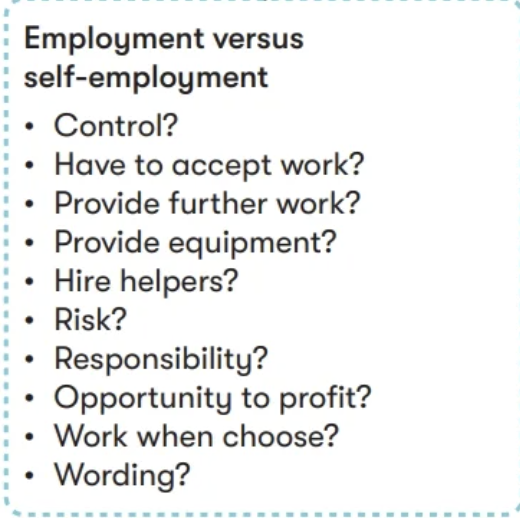
how to tell someone is employed, and not self-employed
have contract of service
relationship is ongoing
how to tell someone is self employed, and not employed
have a contract for services
task based
how to determine between self employed and employed
control = employed
who provides equipment? Employer → employment
who has the financial risk
can they hire their own helpers = self-employed
Main types of employment income?
Salary
Bonuses
commisions
non-cash Benefits (e.g. company car)
payments made on termination of income
Employment income taxed on what basis - normal tax rules
Earlier of received or entitled
What is PAYE?
Tax deducted at source from salary.
Employment income taxed on what basis for directors?
earliest of:
time payment made
entitled
amount credited in the company’s accounts
end of the company’s period of account
time the amount is determined
In exam questions, are salaries usually given gross or net?
gross
Main trap in bonus timing questions?
Confusing the accounting period the bonus relates to with the tax year in which it is taxed
tax year?
6 Apr 2025–5 Apr 2026
What are taxable benefits?
Perks provided by employers that are taxable on employees.
If no specific rule exists for a benefit, how is it valued?
Cost to the employer.
When is there NO taxable benefit?
When there is no private benefit to the employee.
What happens if a benefit is not available for the full tax year?
time apportion
If not available for full tax year OR unavailable for ≥30 days
What happens if the employee contributes towards the benefit?
Deduct the contribution.
exception of fuel benefit
When does a car give rise to a taxable benefit?
When provided by employer and available for private use.
Does commuting in the company car count as private use?
yes
(different for vans)
Exception to car benefit rule?
Pool car
(stays at the office)
Car benefit formula?
(List price – employee capital contribution [max £5,000]) × CO₂ %
What is included in list price?
Price when new
Optional extras (£100+)
Are discounts deducted from list price?
No (IGNORE discounts)
How does % increase above 55g/km?
+1% per 5g/km (rounded down)

pool cars
Used by more than one employee
Private use is incidental
Not kept overnight at employee’s home
Does partial employee contribution reduce fuel benefit?
no
When is fuel benefit NIL?
Only if employee pays for ALL private fuel
Does commuting count as private use for vans?
no
Van benefit for private use?
£4020
Van fuel benefit?
£769
Steps to calculate car benefit?
Find list price
Deduct employee capital contribution (max £5k)
Apply CO₂ %
Time apportion
Deduct employee usage contributions
Steps to calculate van fuel benefit?
Take £28,200
Apply same CO₂ %
Time apportion
DO NOT deduct contributions (unless full reimbursement)
Use of asset benefit formula?
Higher of:
20% × market value when first provided
Rent paid by employer
Gift of asset – if asset already used by employee?
Higher of:
Market value when given
Original value - benefits already taxed
Gift of NEW asset (not previously used)?
Cost to employer
gift of asset: Special rule for computers?
Always use market value
What happens to employee payments for asset?
Deduct from benefit
When does a beneficial loan arise?
Interest-free OR low-interest loan from employer
beneficial loan benefit calculation
Interest at official rate – interest actually paid
Official rate of interest (2025/26)?
3.75
Two methods for loan benefit calculation?
Average method
Strict (monthly) method
Average loan formula?
Interest = 3.75% × (Opening loan + Closing loan) ÷ 2
Strict method approach?
Calculate interest month-by-month on actual balances
When is NO loan benefit charged?
If total loans ≤ £10,000
If loan exceeds £10,000?
Entire loan taxed (not just excess)
What if loan is written off?
FULL amount is taxable
Final taxable benefit for loans?
LOWER of average vs strict method
When is accommodation NOT taxable and exempt?
When it is job-related
What counts as job-related accommodation?
Security reasons e.g. prime minister
Necessary for job e.g. caretaker
Customary for job
Basic accommodation benefit =
Greater of:
Annual value
Rent paid by employer - (if employer doesnt own property) doesn't
What happens to employee contributions to accomodation?
Deduct from benefit
accommodation: when does additional charges apply
employer owns the building
if property cost greater than £75,000
accommodation: Additional charge formula?
(Cost – 75,000) × official interest rate
accommodation: If property owned > 6 years before use?
Use market value at start, not cost
at the start of the financial year the employee moves in
If employer rents property, do we do additional charge?
❌ No (only basic charge)
If employer owns property?
✅ Basic + possible additional charge
When does a living expenses benefit arise?
When employer pays household costs
Job-related living expenses benefit =
Lower of:
Cost to employer
10% × net earnings
Non-job-related living expenses benefit =
Full cost to employer
Examples of living expenses?
Heating
Lighting
Cleaning
Maintenance
Furniture (follows use of asset rule - 20%)
is Workplace nursery exempt?
✅ Exempt (if employer-run)
What is an exempt benefit?
A benefit not taxable → NOT included in employment income
are Staff parties limit exempt?
£150 per head
❌ If exceeded → FULL amount taxable
When is an expense allowable?
Must be:
Wholly
Exclusively
Necessarily
for the job
specific allowable deductions
professional subscriptions
business travelling and other expenses incurred
Mixed (private + business) expense?
Only business portion allowed
When is commuting allowed?
Temporary workplace (< 24 months)
Approved mileage rates?
45p (first 10,000 miles)
25p (after)
Approved mileage rates
If employer pays MORE?
If employer pays LESS?
Excess = taxable
Employee claims deduction
EXEMPT = “CRAP MESS BUS” trick
Canteen
Removal (£8k)
Accommodation (job-related)
Parking
Mobile
Events (£150)
Sports
Subsidised buses
Bicycles
Under £6 home working
Service awards
contributing to a pension, max contribution tax relief
higher of
£3,600
earnings of the year
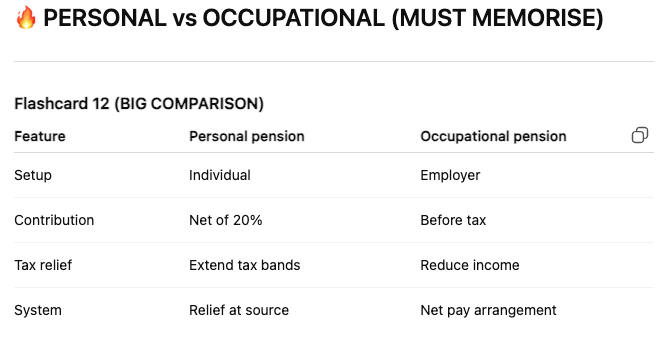
PERSONAL vs OCCUPATIONAL pension
How to spot which pension type in exam?
“Paid net of tax / relief at source” → Personal
“Deducted from salary before tax” → Occupational
How can an employee legally reduce taxable income?
Choose exempt benefits over taxable ones
Select benefits with lower cash equivalent
Contribute towards company car (not fuel)
Pay into a pension scheme
Use payroll giving (charity)
Claim all allowable deductions (e.g. business travel)
Keep income below £100,000 (avoid PA loss)
Prefer benefits over cash (no employee NIC)
EMPLOYMENT BASICS
Employment = salary + bonuses + benefits
Taxed at earlier of receipt or entitlement
Must distinguish employment vs self-employment
BENEFITS IN KIND
Most benefits = taxable
Car benefit = % × list price (based on CO₂)
Fuel benefit = additional charge
Van benefit = fixed (£4,020 + fuel £769)
Assets = 20% of value
Loans = interest saving
Accommodation = annual value + possible extra (>£75k)
EXEMPT BENEFITS
Job-related accommodation
Canteen, parking, childcare, pensions
Staff events (£150), home working (£6/week)
Mileage, bicycles, mobile phone
ALLOWABLE DEDUCTIONS
Must be wholly, exclusively, necessarily
Business travel ✔ | Commuting ❌
Temporary workplace (<24 months) ✔
Mileage: 45p / 25p
Reimbursed expenses → exempt
PENSIONS & CHARITY
Occupational pension → reduces income
Personal pension → extends tax bands
Employer contributions → exempt
Payroll giving → reduces taxable income