Week 2 (Myofiber (Structure-Function Relationships: Membranes, PLasmalemma, T-Tubules &SR)
0.0(0)
Studied by 1 person View linked note
 Call Kai
 Learn
Learn Practice Test
 Spaced Repetition
 Match
Match Flashcards
 Knowt Play
Card Sorting
1/12

There's no tags or description
Looks like no tags are added yet.
Last updated 5:46 PM on 2/26/25
Name | Mastery | Learn | Test | Matching | Spaced | Call with Kai |
|---|
No analytics yet
Send a link to your students to track their progress
13 Terms
1
New cards
Sarcolemma
Membrane that covers myofiber, differing from plasmalemma.
2
New cards
Basement membrane
Outer connective layer of sarcolemma that connects to endomysium and serves as scaffolding for muscle development.
3
New cards
Plasmalemma
Inner layer of the sarcolemma, also known as the plasma membrane, composed of phospholipids, proteins, and cholesterol.
4
New cards
Phospholipids
Primary components of plasmalemma that create a lipid bilayer.
5
New cards
Dystrophin
Protein complex that, when missing or mutated, causes muscle degeneration, weakness, and dysfunction.
6
New cards
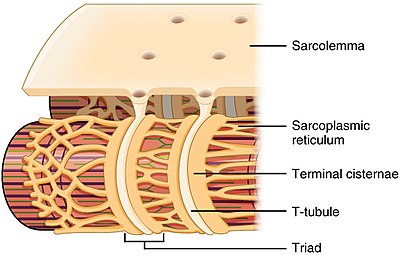
T-Tubules
Extensions of plasmalemma that conduct action potentials into the myofiber. Forms tube that acts like a membrane tunnel. 2 T-Tubules per sarcomere
7
New cards
Sarcoplasmic Reticulum (SR)
Membrane system that wraps around each myofibril and stores calcium for muscle activation.
Function: Stores, releases, & re-sequesters intracellular calcium (Ca2+) that is used to activate the force-generating proteins (actin & myosin)
8
New cards
Triad
Structure comprising one T-Tubule sandwiched between two opposing SR, critical for muscle activation.
9
New cards
Cytosol
Aqueous portion inside of a cell, also known as intracellular fluid.
10
New cards
Sarcoplasm
Cytoplasm of a myofiber, including fluid, enzymes, and organelles, excluding nuclei.
11
New cards
Troponin
Protein that binds calcium on the thin filament to help regulate force production.
12
New cards
Tropomyosin
Protein on the thin filament that blocks interaction necessary for force production.
13
New cards
Dihydropyridine receptor (DHPR)
Protein in the T-Tubule membrane that activates Ryanodine Receptor (RyR1) in SR upon receiving action potential.