The nervous system & the endocrine system
 Call Kai
 Learn
Learn Practice Test
 Spaced Repetition
 Match
Match Flashcards
 Knowt Play
1/21

There's no tags or description
Looks like no tags are added yet.
Name | Mastery | Learn | Test | Matching | Spaced | Call with Kai |
|---|
No analytics yet
Send a link to your students to track their progress
22 Terms
Nervous system
It is a specialised network of cells in the human body and is our primary internal communication system.
It relays messages from the brain to the body using chemical and electrical signals called neurons.
It is made up of the central and peripheral nervous system.
Functions of the nervous system
To collect, process and respond to information from our body and environment.
To co-ordinate the functioning of different organs and cells throughout the body.
The nervous system is divided up into…
The central nervous system (CNS)
The peripheral nervous system (PNS)
Central nervous system (CNS)
It consists of the brain and the spinal chord.
They are connected by the brain-stem.
It is responsible for processing and coordinating information received from the body and the environment.
It is also responsible for advanced cognitive functions such as think and decision-making.
Brain
It is the main organ of the CNS.
It is responsible for regulating all bodily functions, behaviours, emotions and though processes.
Spinal chord
It is a long structure of nerve tissue that connects the brain to the rest of the body.
It transmits messages between the brain and the body.
It controls simple reflex actions that do not involve the brain.
Reflex action
An involuntary and automatic response to a specific stimulus designed to protect us from harm.
Peripheral nervous system (PNS)
Sends information from the environment and the body to the CNS.
It also transmits messages from the CNS to muscles and glands throughout the body.
Peripheral nervous system is divided into…
Somatic nervous system (ANS)
Autonomic nervous system (SNS)
Somatic nervous system
It controls voluntary movement.
It is responsible for carrying sensory information to the CNS.
It is made up of sensory receptors that carry information to the spinal chord and brain and motor pathways that allow the brain to control movement.
It then sends commands using neurons from the CNS to the muscles.
Autonomic nervous system (ANS)
It is autonomic because it works without conscious control.
It controls functions such as breathing, heart rate, digestion, sexual arousal and stress responses.
It is further divided up into the sympathetic and parasympathetic nervous systems.
How to remember ANS and SNS
Autonomic nervous system → auto means ‘automatic’
Somatic nervous system → so you move
Autonomic nervous system is divided into…
Sympathetic nervous system
Parasympathetic nervous system
Sympathetic nervous system (SNS)
It is the body’s fight or flight system.
It mobilises energy so the body is ready for action.
Ways the SNS prepares the body for danger…
Increases heart rate
Increases breathing rate
Dilating pupils
Inhibiting digestion
Releasing adrenaline
→ It also suppresses less important actions such as salivation, digestion and the need to urinate.
Parasympathetic nervous system (PSNS)
This is referred to as the ‘rest and digest’ system.
It returns the body to its normal and relaxed state.
Ways the PSNS returns the body to a relaxed state…
Decreases heart rate
Decreases breathing rate
Constricts pupils
Stimulates digestion
Conserves energy
How to remember sympathetic and parasympathetic
Sympathetic → makes the body stressed because it sympathises with you
Parasympathetic → para sounds like ‘peace’ and it calms the body down
The SNS and PSNS are…
Antagonistic (they work in opposite ways)
SNS activates the body whilst the PSNS calms it down.
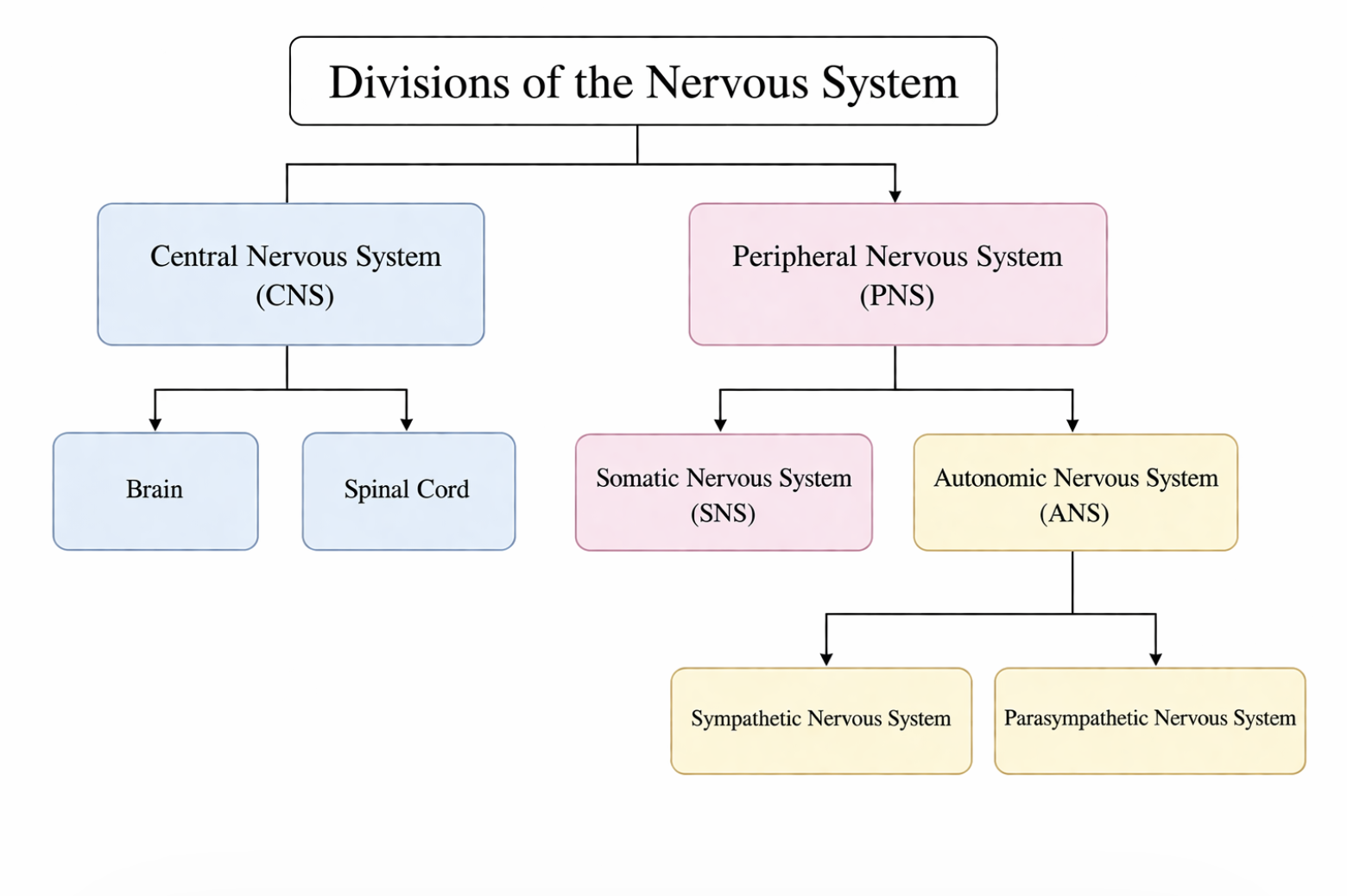
How is the nervous system divided?
Nervous system → central nervous system and peripheral nervous system.
Central nervous system → brain and spinal chord. Peripheral nervous system → somatic and autonomic nervous systems.
Autonomic nervous system → sympathetic and parasympathetic nervous systems.
Diagram
The endocrine system
Works alongside the nervous system.
Glands of the endocrine system produce hormones.
Hormones are secreted into the bloodstream and spread throughout the body.