the onset of reproductive activity
 Call Kai
 Learn
Learn Practice Test
 Spaced Repetition
 Match
Match Flashcards
 Knowt Play
1/20

There's no tags or description
Looks like no tags are added yet.
Name | Mastery | Learn | Test | Matching | Spaced | Call with Kai |
|---|
No analytics yet
Send a link to your students to track their progress
21 Terms
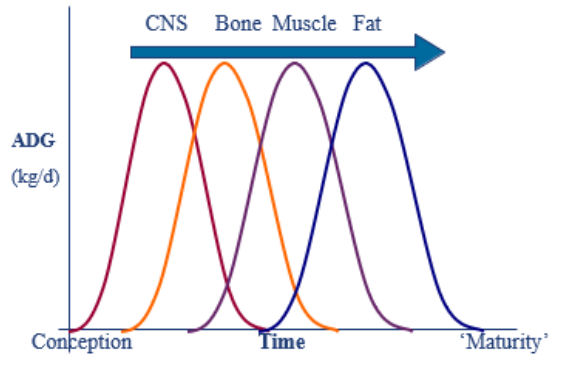
heterogenous growth and body ‘fatness’
Reproduction is a ‘luxury’.
Essential tissues prioritised.
Growth (increased mass) is accompanied by a relative decrease in metabolic rate.
More dietary energy ‘left over’ for ‘non- essential’ functions = fat deposition
to breed or not to breed - is there an option?
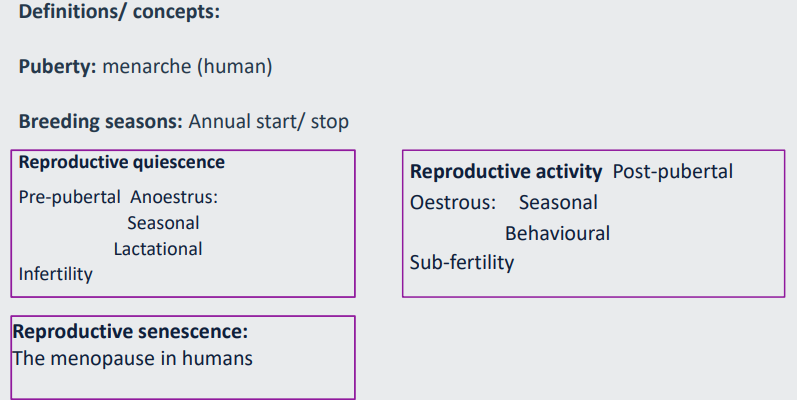
menarche - starts from first period - human - puberty
reproductive quiescence: pre-pubertal
Anoestrus: seasonal, lactational
infertility
reproductive activity: post-pubertal
Oestrus: seasonal, behavioural
Sub-fertility
reproductive senescence:
the menopause in humans
puberty definitions
Definitions: The ability to accomplish reproduction successfully
Male: Spermatozoa capable of fertilizing in the ejaculate
Female: Pregnancy supported without deleterious effects
A process which occurs over time, and is dependent on body growth and maturation.
Pre-pubertal: Hyperthalamic neurons and Hypothalamic-Pituitary-Gonadal axis established but quiescent
Peri-puberty: Acquire ability to receive information from pre-synaptic neurons to increase frequency and promote GnRH secretion
Puberty: Increased frequency and amplitude of GnRH secretion
hypothalamic-Pituitary-Gonadal axis
This is the hormonal axis that controls sexual development and reproduction. It consists of:
Hypothalamus → releases GnRH
Pituitary gland → releases LH and FSH in response to GnRH
Gonads (ovaries/testes) → produce sex hormones (estrogen, progesterone, testosterone) in response to LH/FSH
GnRH = Gonadotropin-Releasing Hormone
This is the hormone released by the hypothalamus that stimulates the pituitary gland to release gonadotropins (LH and FSH), which then act on the gonads.
gonad
a gonad is a reproductive organ that produces gametes (sex cells) and sex hormones.
There are two types:
In males:
Testes (testicles)
Produce sperm (male gametes)
Produce testosterone (primary male sex hormone)
In females:
Ovaries
Produce eggs/ova (female gametes)
Produce estrogen and progesterone (primary female sex hormones)
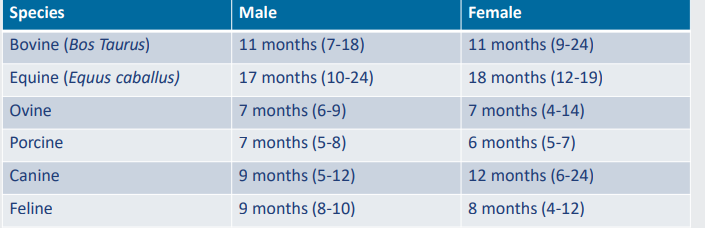
timing of puberty
Influenced by:
• Season and photoperiod
• Genetics (breed) e.g.:
Bitches: Border Collie, 9 months: Whippet, 18 months.
Heifers: Dairy, 7-9 months; Traditional Beef, 12-13 months
Bos indicus, 24 months
• Nutrition
• Social cues (presence / absence of opposite sex)
• Housing density (sows)
brain puberty
Independent of gonadal and anterior pituitary status.
• Can induce ovulation in pre-pubertal animals by exogenous GnRH administration
Dependent on ability of hypothalamus to secrete sufficient GnRH to stimulate pituitary gonadotrophin secretion.
for heifers- 2 months for LH pulse frequency is enough to drive gonadal function
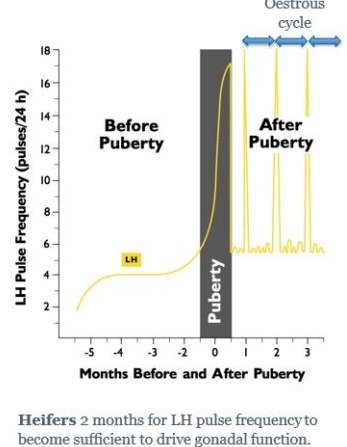
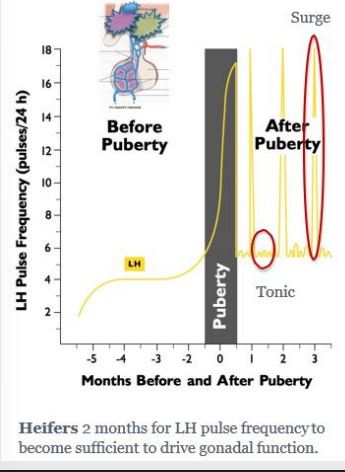
before and after brain puberty
Before puberty: Tonic (male) or Tonic and Surge (female) Centres release low frequency, low amplitude GnRH pulses.
Mature neural activity in the surge centre is essential for ovulation- need surge centre to develop:
Tonic GnRH neurones must fire more frequently and release large amounts of GnRH to stimulate the ovary to develop oocytes leading to oestradiol secretion.
Surge GnRH causing the Preovulatory LH surge is dependent on sufficient Tonic GnRH to drive ovarian activity and allow oestradiol (E2) secretion.
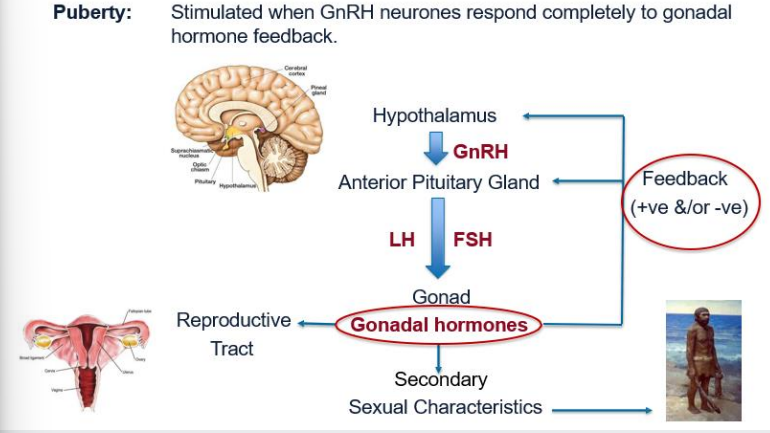
male brain pubery
before puberty, the brain is too sensitive to negative feedback, keeping testosterone levels low
puberty happens because brain loses this extreme sensitivity, allowing testosterone levels to surge and allow testicular development
🛑 Before Puberty
The brain is highly sensitive to negative feedback.
Even tiny amounts of testosterone/E2 shut down GnRH, LH, and FSH.
Result: Testosterone stays very low.
🚀 At Puberty
The brain becomes less sensitive to negative feedback.
It ignores low-level hormone signals and keeps pumping GnRH, LH, and FSH.
Result: Testicular development begins and testosterone surges.
🧠 The Role of E2 (Estradiol)
Testosterone enters the brain and converts to E2 via aromatase in brain, fat tissue, and testes.
This brain-made E2 provides the actual negative feedback signal.
Even though testosterone is the dominant sex hormone in males, estradiol still plays important roles in male physiology:
Bone health and closure of growth plates
Brain function
Libido
Feedback regulation of the HPG axis
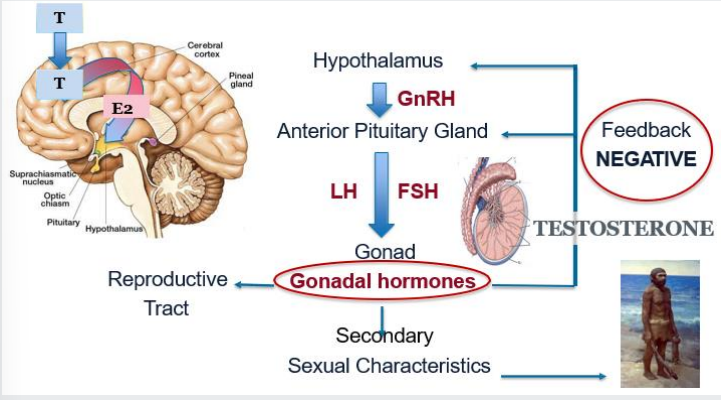
female brain puberty
More complex: Hypothalamic surge and tonic centres respond differently to oestradiol feedback
This diagram is explaining the female HPG axis and the menstrual cycle regulation.
Here's what it shows:
The HPG Axis (right side):
Hypothalamus releases GnRH
Anterior Pituitary Gland releases LH and FSH
Gonad (ovary) produces estradiol (E2) and other gonadal hormones
These hormones act on the reproductive tract and create secondary sexual characteristics
Key difference from the male diagram: The feedback is labeled as "+ve & -ve" (positive and negative), which is unique to females:
Negative feedback: Most of the time, estradiol inhibits GnRH/LH/FSH release (similar to males)
Positive feedback: At mid-cycle when estradiol levels peak, it actually stimulates a surge of LH and FSH, triggering ovulation
The brain diagram (top left): Shows the "surge centre" and "tonic centre" in the hypothalamus, illustrating how estradiol can have both positive (surge) and negative (tonic) feedback effects depending on timing and estradiol levels during the menstrual cycle.
![<p>More complex: Hypothalamic surge and tonic centres respond differently to oestradiol feedback</p><p></p><p>This diagram is explaining the f<span style="color: purple;">emale HPG axis and the menstrual cycle regulation.</span></p><p class="font-claude-response-body break-words whitespace-normal leading-[1.7]">Here's what it shows:</p><p class="font-claude-response-body break-words whitespace-normal leading-[1.7]"><span style="color: purple;">The HPG Axis (right side):</span></p><ul><li><p><span style="color: purple;">Hypothalamus releases GnRH</span></p></li><li><p><span style="color: purple;">Anterior Pituitary Gland releases LH and FSH</span></p></li><li><p><span style="color: purple;">Gonad (ovary) produces estradiol (E2) and other gonadal hormones</span></p></li><li><p><span style="color: purple;">These hormones act on the reproductive tract and create secondary sexual characteristics</span></p></li></ul><p></p><p>Key difference from the male diagram: The feedback is labeled as "+ve & -ve" (positive and negative), which is unique to females:</p><ul><li><p>Negative feedback: <span style="color: purple;">Most of the time, estradiol inhibits GnRH/LH/FSH </span>release (similar to males)</p></li><li><p>Positive feedback: At mid-cycle w<span style="color: purple;">hen estradiol levels peak, it actually <em>stimulates</em> a surge of LH and FSH, triggering ovulation</span></p></li></ul><p class="font-claude-response-body break-words whitespace-normal leading-[1.7]">The brain diagram (top left): Shows the "surge centre" and "tonic centre" in the hypothalamus, illustrating how estradiol can have both<span style="color: purple;"> positive (surge) and negative (tonic) feedback </span>effects depending on timing and estradiol levels during the menstrual cycle.</p>](https://knowt-user-attachments.s3.amazonaws.com/c91575c8-27f7-48a5-a1c7-83fafb752f0d.png)
brain puberty experiment proof
Female: Oestradiol (E2) feedback can be positive (Surge Centre) and negative (Tonic Centre)
Experiment:
• Ovariectomised (no endogenous E2)
• Subcutaneous E2 implant
Conclusion: Surge Centre is highly sensitive to positive E2 feedback from an early age
BUT: Pre-pubertal lambs don’t ovulate because their inactive ovaries fail to produce sufficient E2.
During puberty:
• Tonic centre becomes less sensitive to negative E2 feedback.
• At low [E2] (pre-pubertal), negative feedback is strong
• As negative feedback decreases, increased GnRH pulse frequency stimulates ovarian function
![<p>Female: Oestradiol (E2) feedback can be positive (Surge Centre) and negative (Tonic Centre)</p><p></p><p>Experiment:</p><p>• Ovariectomised (no endogenous E2)</p><p>• Subcutaneous E2 implant</p><p>Conclusion: <span style="color: purple;">Surge Centre is highly sensitive to positive E2 feedback from an early age</span></p><p>BUT:<span style="color: purple;"> Pre-pubertal lambs don’t ovulate because their inactive ovaries fail to produce sufficient E2.</span></p><p>During puberty:</p><p>• Tonic centre becomes less sensitive to negative E2 feedback.</p><p>• At low [E2] (pre-pubertal), negative feedback is strong</p><p>• As negative feedback decreases, increased GnRH pulse frequency stimulates ovarian function</p>](https://knowt-user-attachments.s3.amazonaws.com/c431d4ae-56ed-48a8-9298-072afaa92c2f.png)
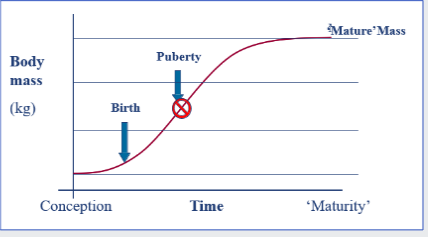
body condition and puberty
Puberty: dependant on body mass and fatness
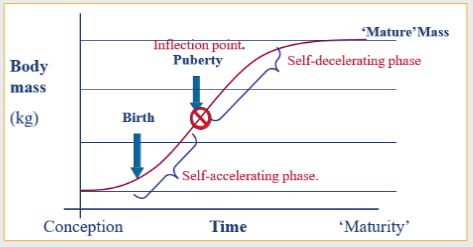
Puberty occurs exactly at the inflection point of the growth curve, meaning it is triggered when an animal reaches a specific milestone in body mass.
📈 Growth Phases & Puberty
Self-accelerating phase: Growth rate increases rapidly after birth.
Inflection point (Puberty): Growth rate reaches its absolute maximum speed.
Self-decelerating phase: Growth slows down toward mature weight.
🥩 Connection to Body Condition
Mass threshold: Puberty cannot start without reaching a critical body mass.
Fatness trigger: Adequate body fat stores signal the brain that energy is sufficient for reproduction.
Gating mechanism: The inflection point represents this ideal nutritional and physical readiness.
plane of nutrition and puberty
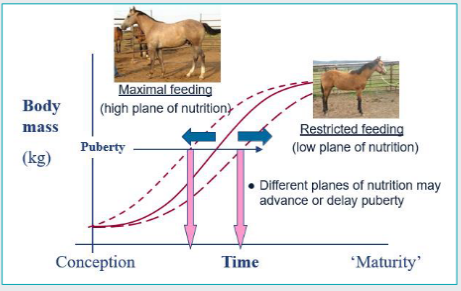
The plane of nutrition dictates the speed of growth, which directly determines the age at which an animal hits the required weight threshold for puberty.
📈 Nutrition Plane Effects
Maximal Feeding (High Plane): Accelerates growth rate, pushing the animal to hit the puberty mass threshold much earlier in time (advances puberty).
Restricted Feeding (Low Plane): Delays growth rate, taking the animal much longer to reach the necessary weight milestone (delays puberty).
Constant Mass Threshold: Note that the horizontal "Puberty" weight line stays at the exact same level; only the time axis shifts based on food availability.
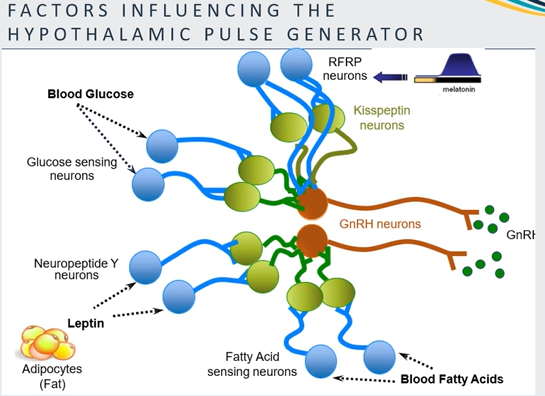
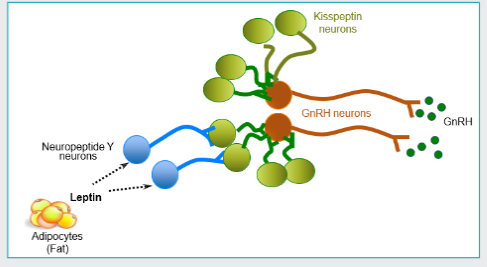
factors influencing the hypothalamic pulse generator
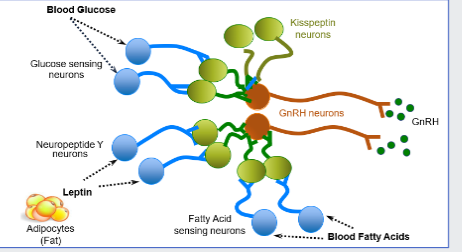
GnRH released into hypophyseal-portal system - neuroendocrine effect on the anterior pituitary - in response to kisspeptin neurons
when an animal has fat cells they have more adipocytes - so more of a hormone called leptin is formed in these adipocytes → triggers our neuropeptide Y neurones → triggers kisspeptin neurones which stimulate GnRH → production of LH and FSH in anterior pituitary
this is how fatness can help puberty process
if animal is skinnier so less of the effect
blood glucose and fatty acid concentrations
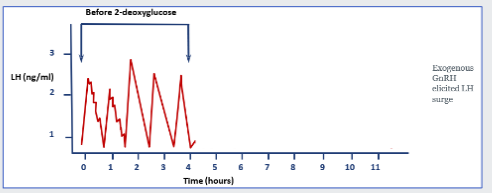
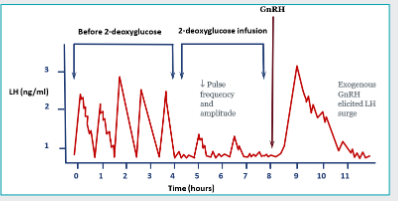
blood glucose and fatty acid concentrations can modify GnRH pulse frequency to alter reproductive status
The Experiment: Researchers use ovariectomized ewe lambs (ovaries removed) to isolate the brain. This lets them study exactly how the hypothalamus reacts to nutrition without ovarian hormones getting in the way.
Creating a Synthetic Energy Deficit: Giving them 2-deoxyglucose (2DG) stops the body from metabolizing glucose. This tricks the body into pretending it has zero sugar reserves, simulating an acute starvation situation.
Hypothalamus Response: The hypothalamus detects this low blood sugar phenomenon and drastically decreases both the frequency and amplitude of GnRH pulses.
The Downstream Effect: Because the brain's baseline pulses flatten out, the pituitary cannot release the massive preovulatory LH surge required to trigger ovulation.
Real-World Link: This explains why anorexic individuals or animals in a severe energy deficit stop cycling entirely—the brain actively puts the brakes on GnRH and LH to prevent reproduction during starvation.
flushing - feeding ewes higher plane of nutrition - more follicles recruited - so when ovulated more oocytes/follicles - twin/trippling pregnancy
factors influencing the hypothalamic pulse generator
just a summary so adipocytes(fat), glucose and fatty acids influence it
seasonality
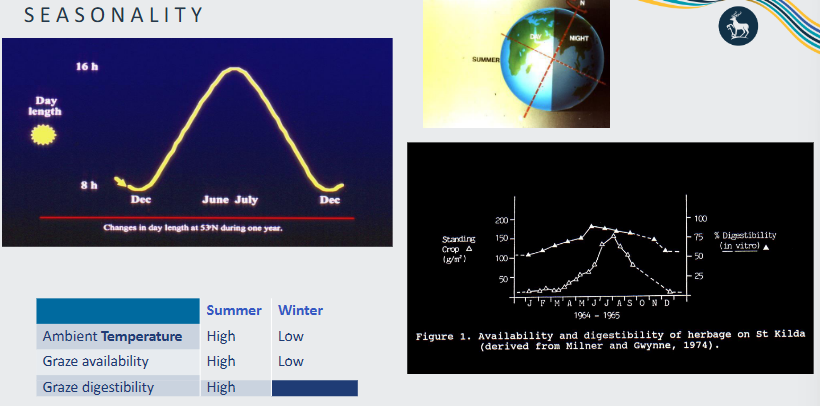
quality of food increases in spring and summer
better to have offspring in spring
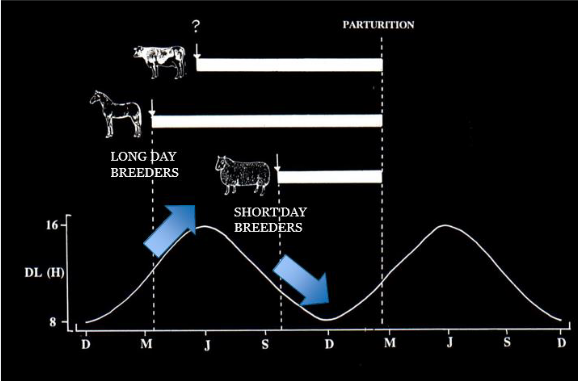
breeding seasons
horses-long day breeders
sheep-short day breeders
cows-non-seasonal
Y-axis: Day length (hours)
X-axis: Months of year, December (winter), March (spring), June (summer), September(autumn)
🐴 Horses: Long-Day Breeders
Breeding Season: Spring and summer (increasing day length).
Gestation: Lasts 11 months.
Timing: They conceive in the spring to give birth the following spring.
🐑 Sheep: Short-Day Breeders
Breeding Season: Autumn and winter (decreasing day length).
Gestation: Lasts 5 months.
Timing: They conceive in the autumn to give birth the following spring.
🐮 Cows: Non-Seasonal Breeders
Breeding Season: Year-round (not dependent on photoperiod).
Gestation: Lasts 9 months.
The Question Mark: They can breed at any time of year, but the graph shows a June conception purely to align with a spring birth.
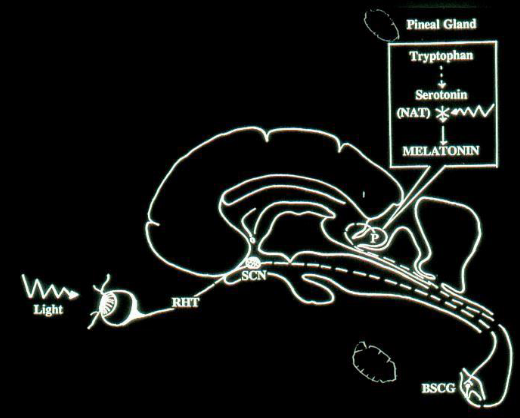
RHT: retino-hypothalamic tract.
SCN: Suprachiasmatic nucleus
P: Pineal gland
NAT: n-acetyl transferase
BSCG: Bilaterl superior cervical ganglia
light comes in through the eye and travels down the neurones
goes down the retinal hypothalamic tract
synapsis at the suprachiasmatic nucleus
synapses then down neck to bilateral superior cervical ganglions
then travels up again to brain to the pineal gland
conversion of tryptophan to serotonin
then seratonin to melatonin (catalysed by n-acetyl transferase) - if theres daylight this second step is inhibited, cos when light is present melatonin levels drop
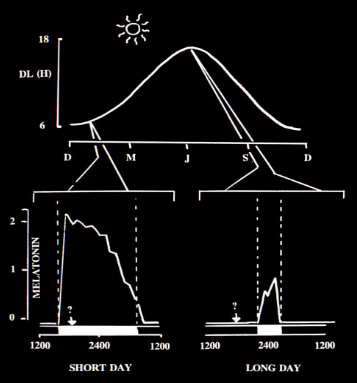
pineal melatonin secretion
• Daily pattern of melatonin secretion changes throughout the year
• Melatonin is only secreted during the hours of darkness.
• The hypothalamus is sensitive to melatonin during the late afternoon.
• Coincidence of hypothalamic sensitivity and melatonin indicate a short day
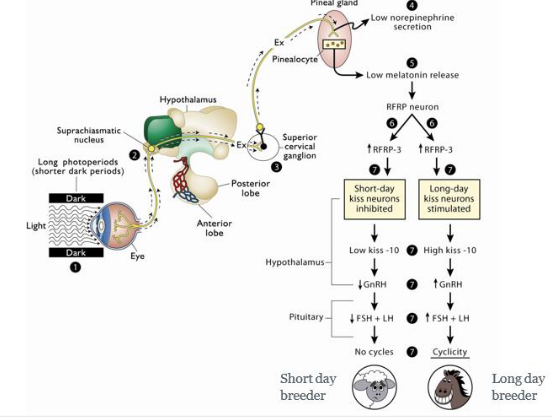
breeding seasons
summary pretty much
now on the right
got long and short daylight breeders
start with horse on right - low level of melatonin in summer- short nights and long days - u get stimulation of RFRP neurons - increase in RFRP 3
in horse and some cows species - we want to breed days are longer - increase in GnRH increase in cyclicity - kisspeptins are stimulated
sheep are short day breeder - low melatonin also stimulate RFRP 3 increase - kisspeptins are inhibited
RFRP neurons translate seasonal daylight changes to directly control reproductive cycles via kisspeptin.
In contrast, Neuropeptide Y (NPY) neurons primarily regulate metabolic appetite and energy balance during starvation.
summary