Carboxylic acid derivatives: reactions
 Call Kai
 Learn
Learn Practice Test
 Spaced Repetition
 Match
Match Flashcards
 Knowt Play
1/11

There's no tags or description
Looks like no tags are added yet.
Name | Mastery | Learn | Test | Matching | Spaced | Call with Kai |
|---|
No analytics yet
Send a link to your students to track their progress
12 Terms
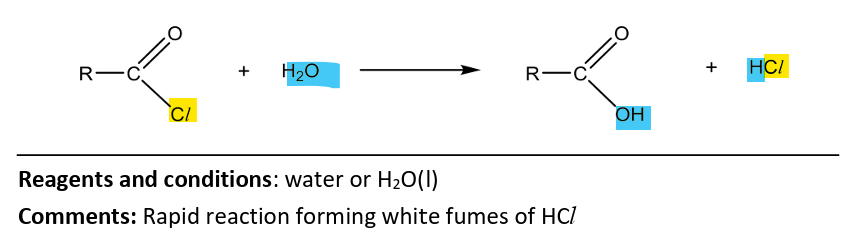
Hydrolysis of acyl chlorides to form carboxylic acids
RnCs: water
Observation: Rapid reaction forming whtie fumes of HCl
Hydrolysis of alkyl chloride(halogenoalkane)
RnCs: NaOH (aq), heat under reflux
OR KOH (aq), heat under reflux
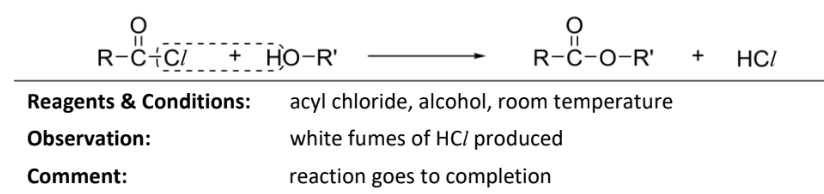
Condensation of acylchloride to form esters
RnCs: alcohol, room temperature OR phenol, room temperature
Observations: white fumes of HCl
Condensation of acylchloride to form amides
RnCs: primary amides in excess
Note:
in excess to ensure complete reaction as amine may react with HCl to form an ammonium salt via acid-base reaction
carboxylic acids cannot be used in place of acylchloride as they will react with amines in acid-base reaction instead
acyl chloride can also react with secondary amines or ammonia (but not tertiary amines as they lack H atom to be replaced with N atom)
rank the rate of hydrolysis in increasing order
acyl chlorides
aryl chlorides
alkyl chlorides
aryl chlorides(no reaction) < alkyl chlorides < acyl chlorides
Use electronic factor to explain why can’t aryl chlorides undero hydrolysis under normal lab conditions
lone pair of electron on Cl are delocalised into the benzene ring
imparting partial double bond character to the C-Cl bond
makiing it difficult to cleave the C-Cl bond
Carbon in C-Cl is least electron deficient and attracts nucleophile(OH-) minimally
Use steric factor to explain why can’t aryl chlorides undergo hydrolysis under normal lab conditions
large aromatic ring gives more steric hindrance to approaching nucleophilic attack
electron-rich benzene ring repels nucleophile
Use electornic reason to explain why is rate of hydrolysis for acyl chloride faster than alkyl chloride.
in acyl chloride,
carbon on C-Cl is attached directly to 2 electronegative atoms Cl and O
carbon is highly electron deficient and attracts nucleophile(OH-) strongly
In alkyl chloride,
carbon on C-Cl is attached directly to only 1 electronegative Cl atom
carbon is less electron deficient and attracts the nucleophile(OH-) less strongly
Use steric reason to explain why is rate of hydrolysis for acyl chloride faster than alkyl chloride.
In acyl chloride,
planar acyl carbon is less sterically hindered for apporaching nucleophile to attack
In alkyl chloride,
tetrahedral geometry around carbon is more sterically hindered for approaching nucleophile to attack
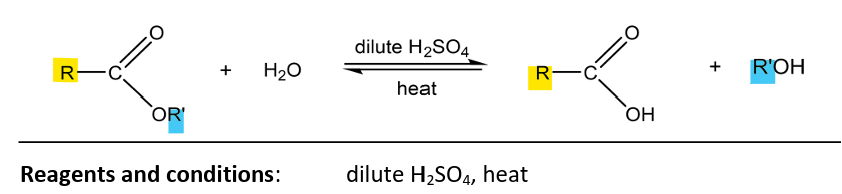
Acid hydrolysis of ester
RnCs: dilute H2SO4, heat
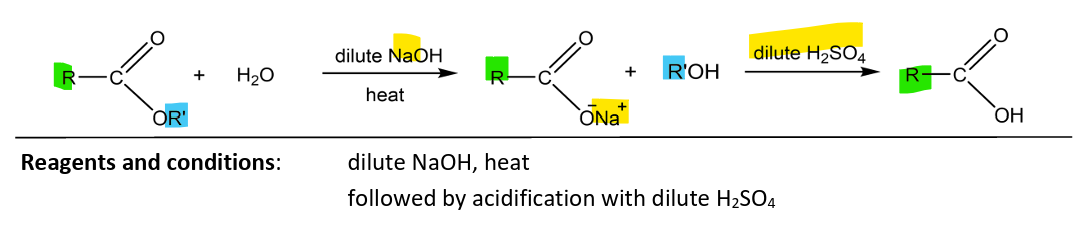
Base hydrolysis (Saponification) of esters
RnCs: dilute NaOH, heat
followed by acidification with diulte H2SO4