BSC2011L Midterm
 Call Kai
 Learn
Learn Practice Test
 Spaced Repetition
 Match
Match Flashcards
 Knowt Play
1/205

There's no tags or description
Looks like no tags are added yet.
Name | Mastery | Learn | Test | Matching | Spaced | Call with Kai |
|---|
No analytics yet
Send a link to your students to track their progress
206 Terms
What is plagiarism?
the practice of taking someone else's work or ideas and passing them off as one's own.
What is an internal citation?
An internal, in-text, or parenthetical citation giving credit to an author, singer, or speaker by citing their words/ideas within the text of your paper.
What is a works cited page?
A list of sources that were "cited" or used in a paper. Typically the "Works Cited" comes at the end of a paper.
What is "common knowledge"?
Information that is considered well-established fact verifiable in five or more sources; it needs no internal citation in a paper
What is a "unique phrase"
Coined by an author and used commonly by other authors in a specific genre or discipline, but is not necessarily a common fact or phrase used by everyone; does need an internal citation.
What are the steps of the scientific method?
purpose, research, hypothesis, experiment, analysis, conclusion
Define and create a hypothesis
A supposed or proposed explanation made on the basis of limited evidence as a starting point for further investigation.
How is a theory different from a hypothesis?
A theory is a principle that has been formed as an attempt to explain things that have already been sustained by data; considered to be truer than a hypothesis is. A hypothesis is an assumption, an idea that is proposed for the sake of argument so that it can be tested to see if it might be true; this is constructed before any applicable research has been done; usually tentative, made strictly for the objective of being tested.
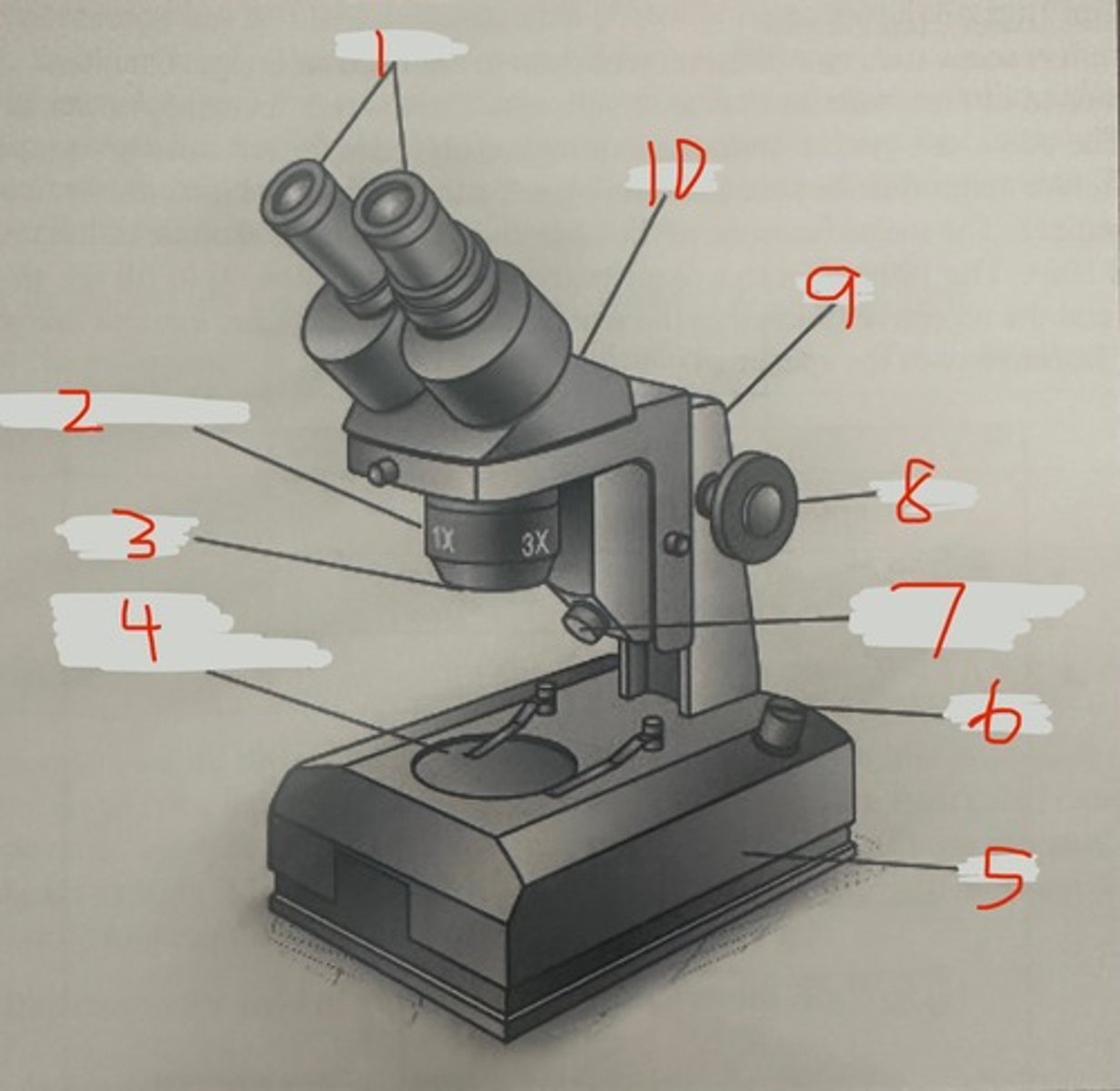
Dissecting Microscope
View objects in 3D at low magnificationC
Compound Microscope
View small objects at high magnification
Identify number 1 on the dissecting microscope
Oculars
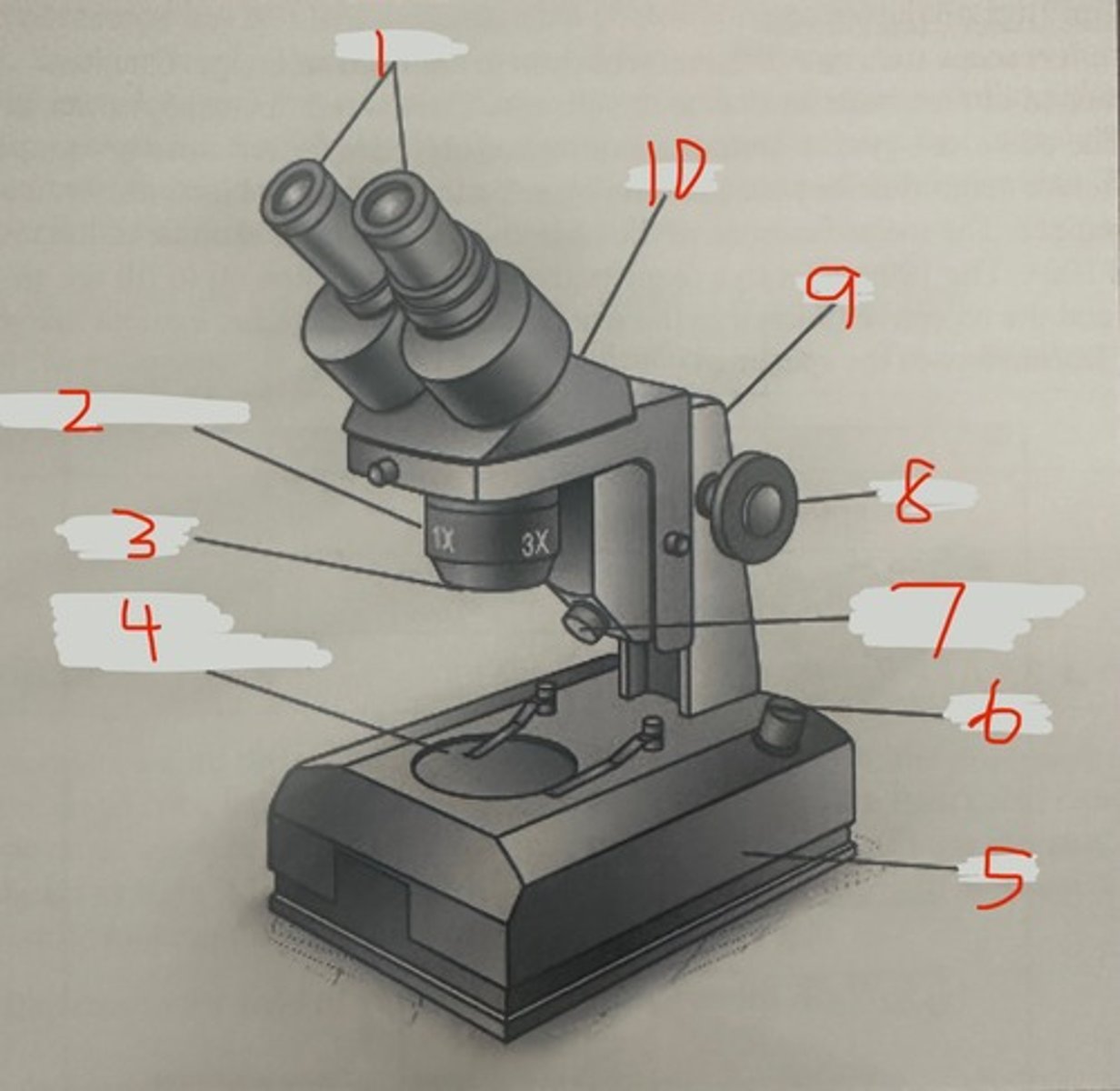
Identify number 2 on the dissecting microscope
Magnification control
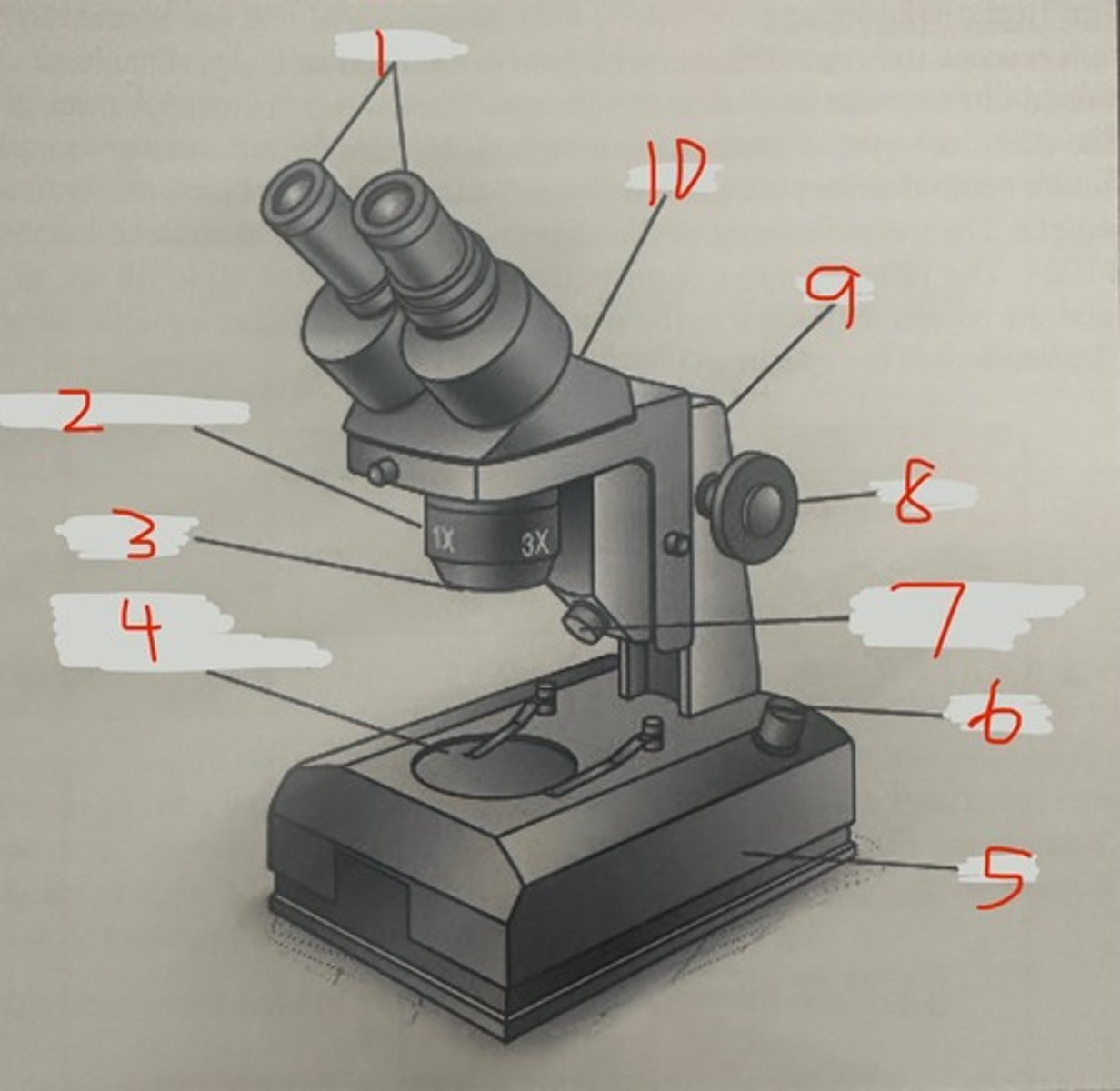
Identify number 3 on the dissecting microscope
Objectives
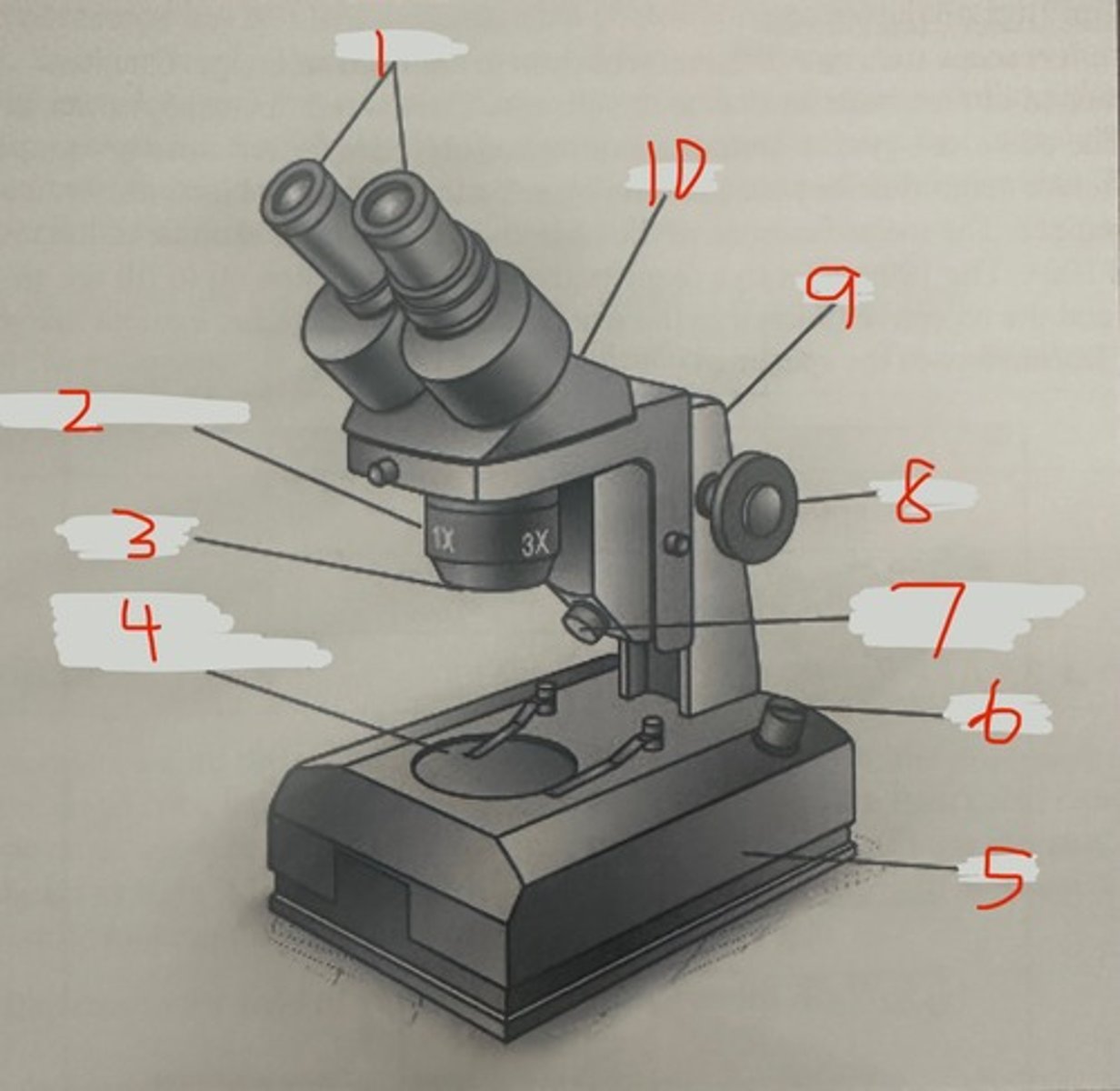
Identify number 4 on the dissecting microscope
Stage (with substage illumination)
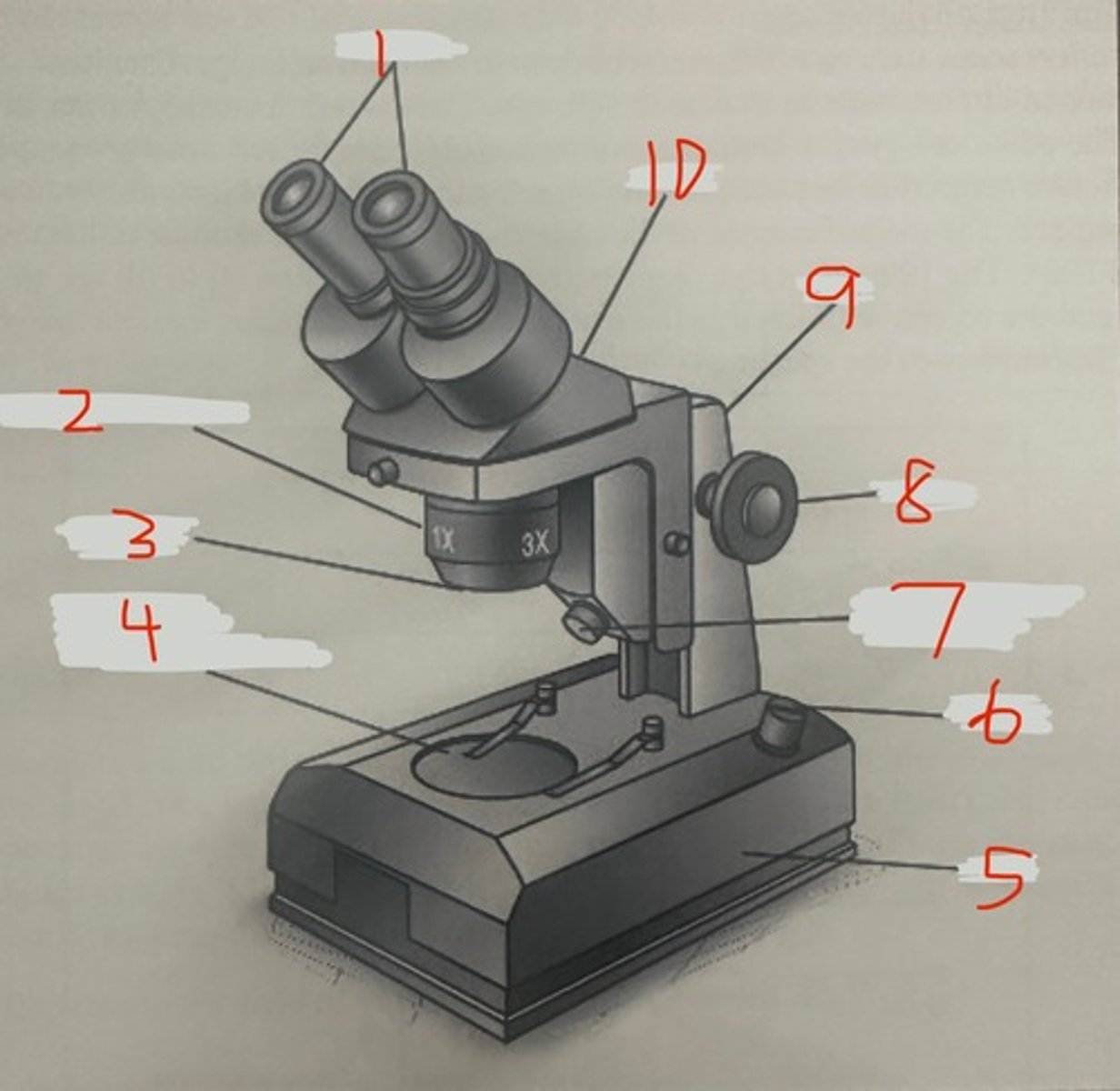
Identify number 5 on the dissecting microscope
Base
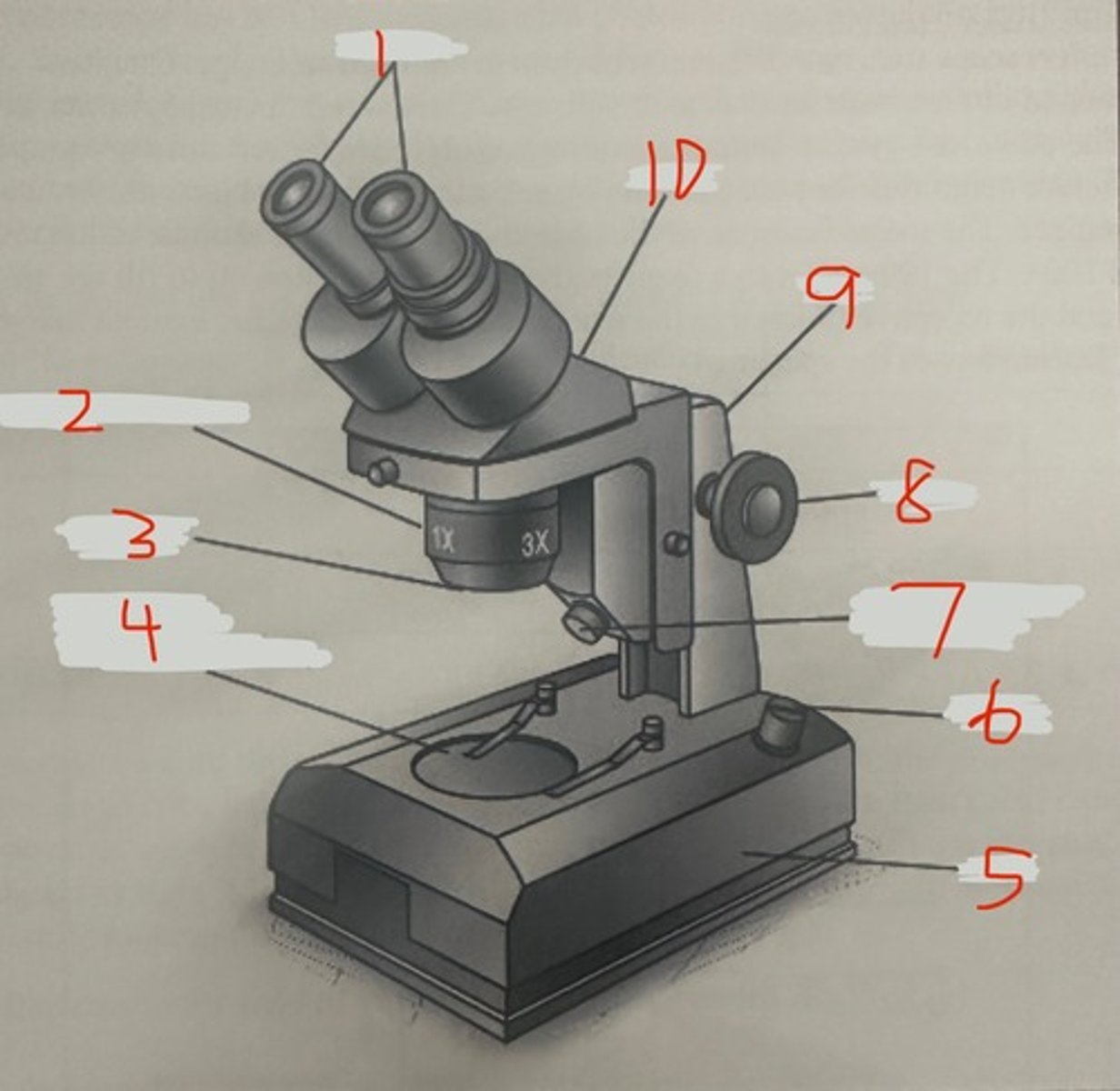
Identify number 6 on the dissecting microscope
Switch
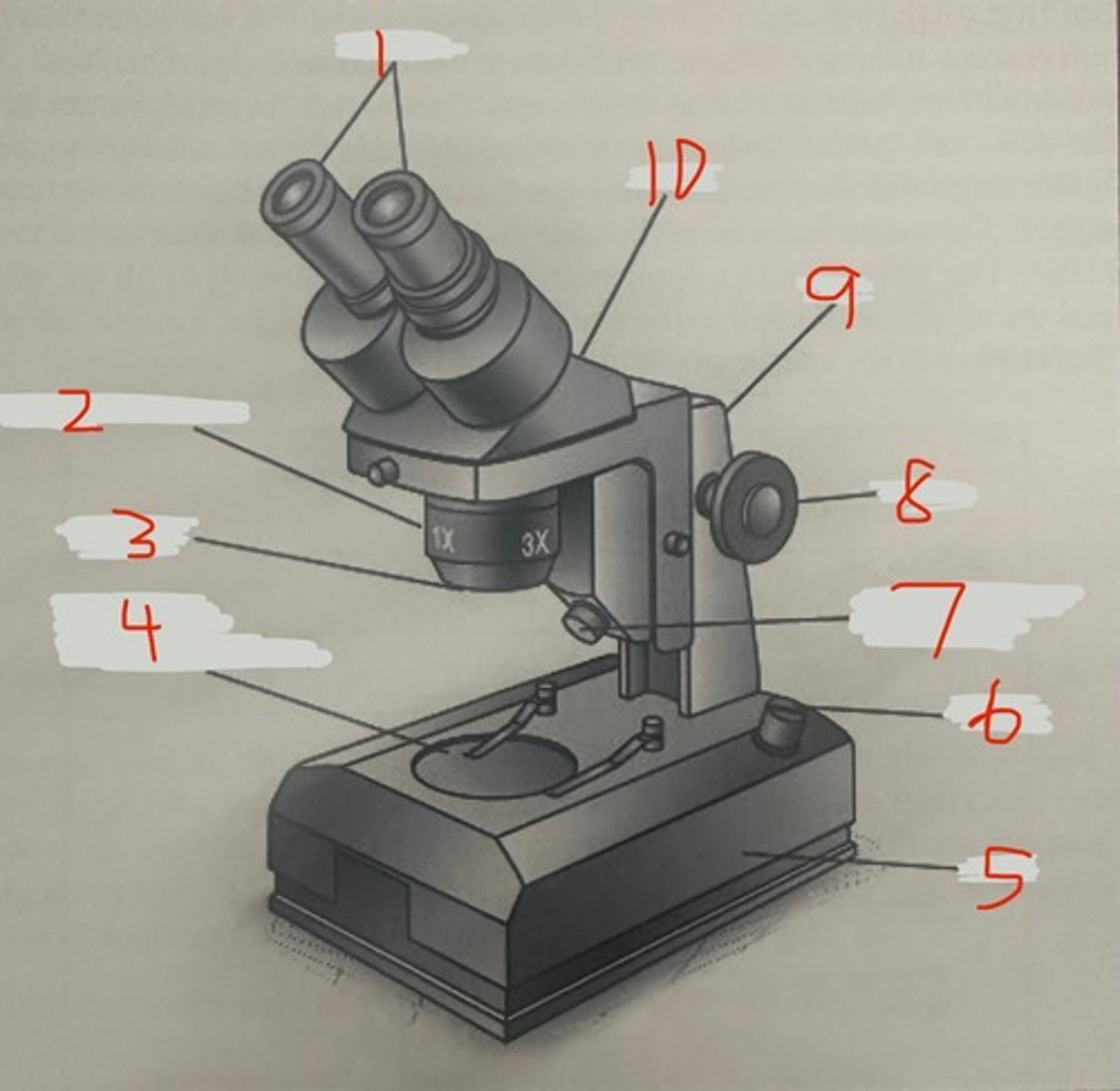
Identify number 7 on the dissecting microscope
Lamp for incident illumination
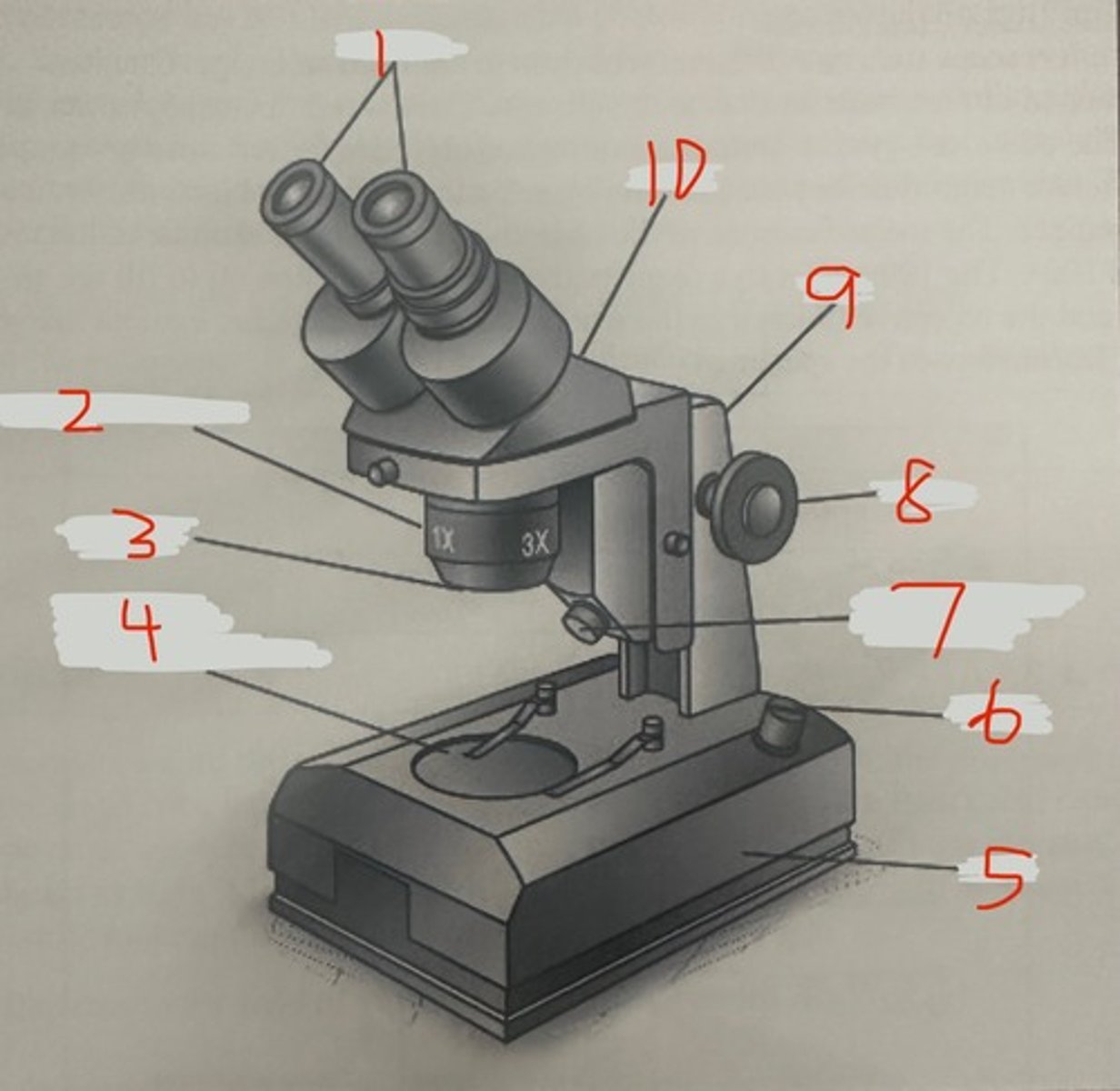
Identify number 8 on the dissecting microscope
Focus
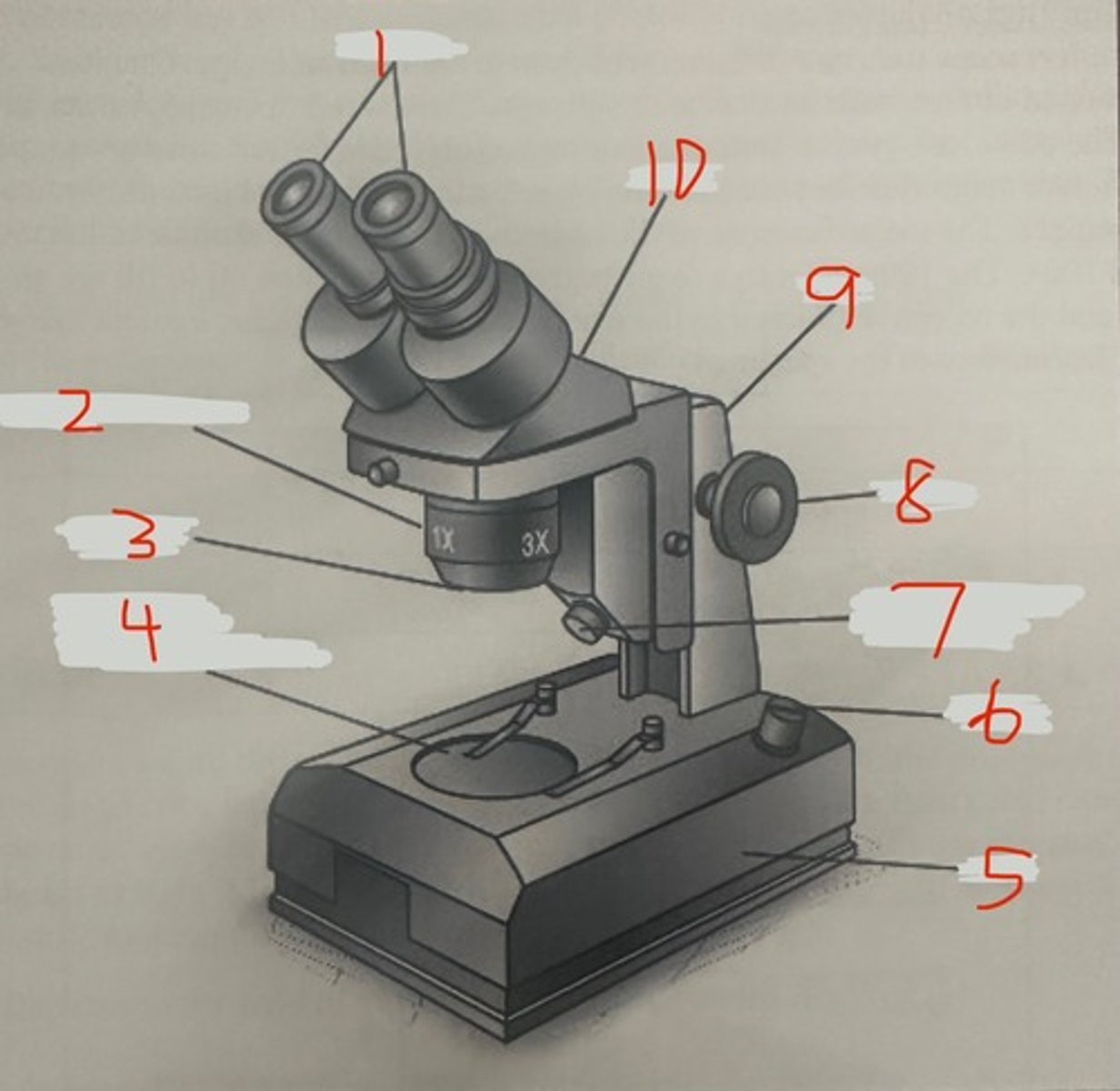
Identify number 9 on the dissecting microscope
Arm
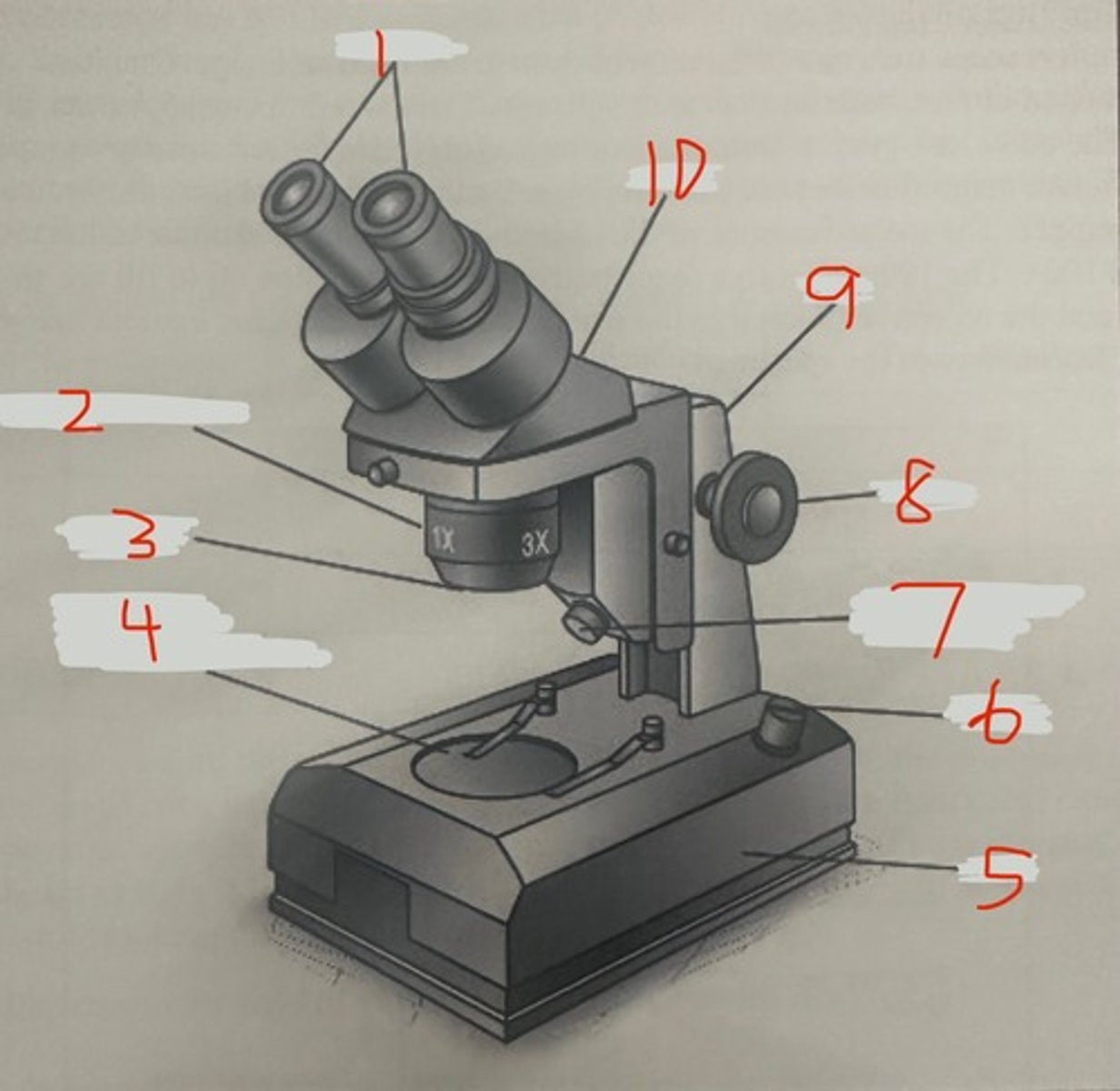
Identify number 10 on the dissecting microscope
Head
Identify number 1 on the compound microscope
Ocular lenses
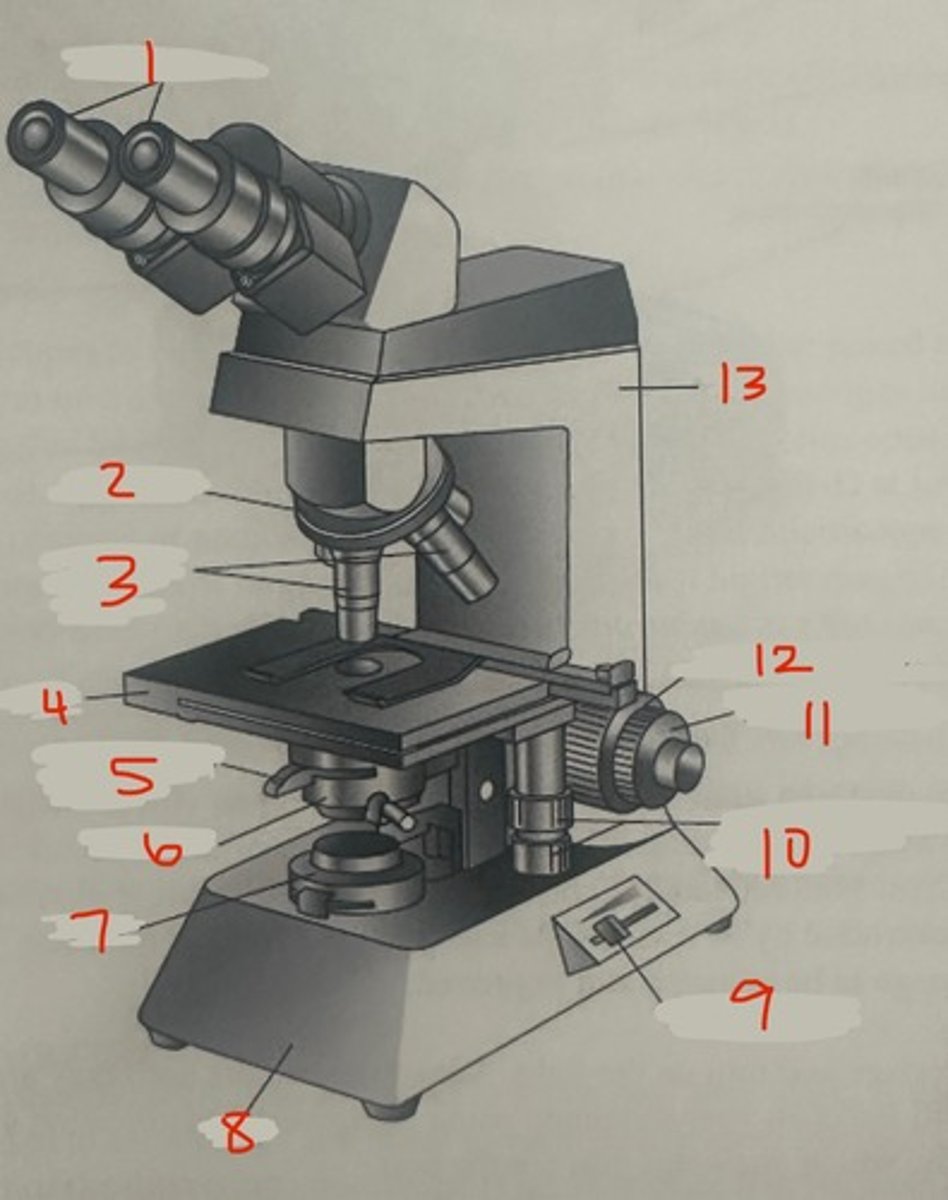
Identify number 2 on the compound microscope
Nosepiece
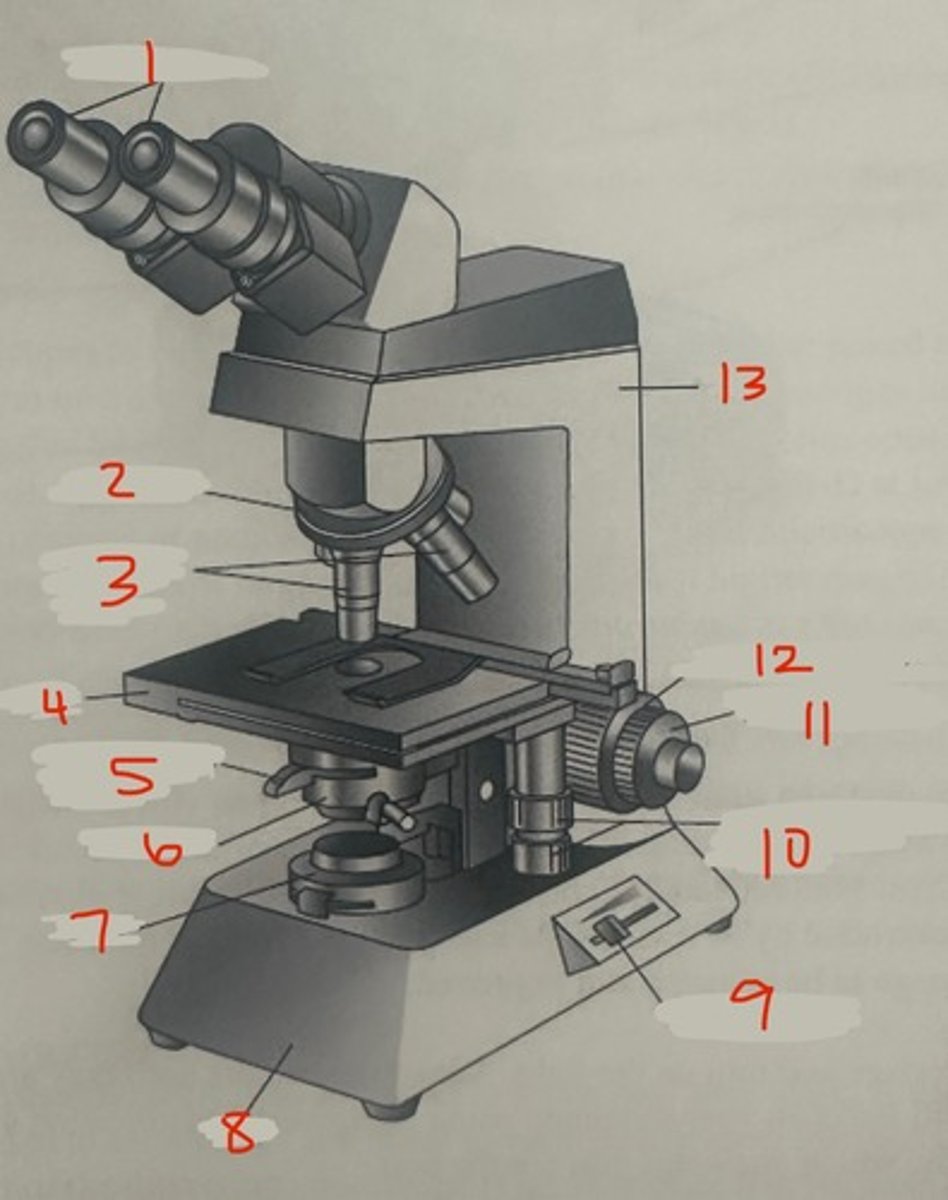
Identify number 3 on the compound microscope
Objective lens
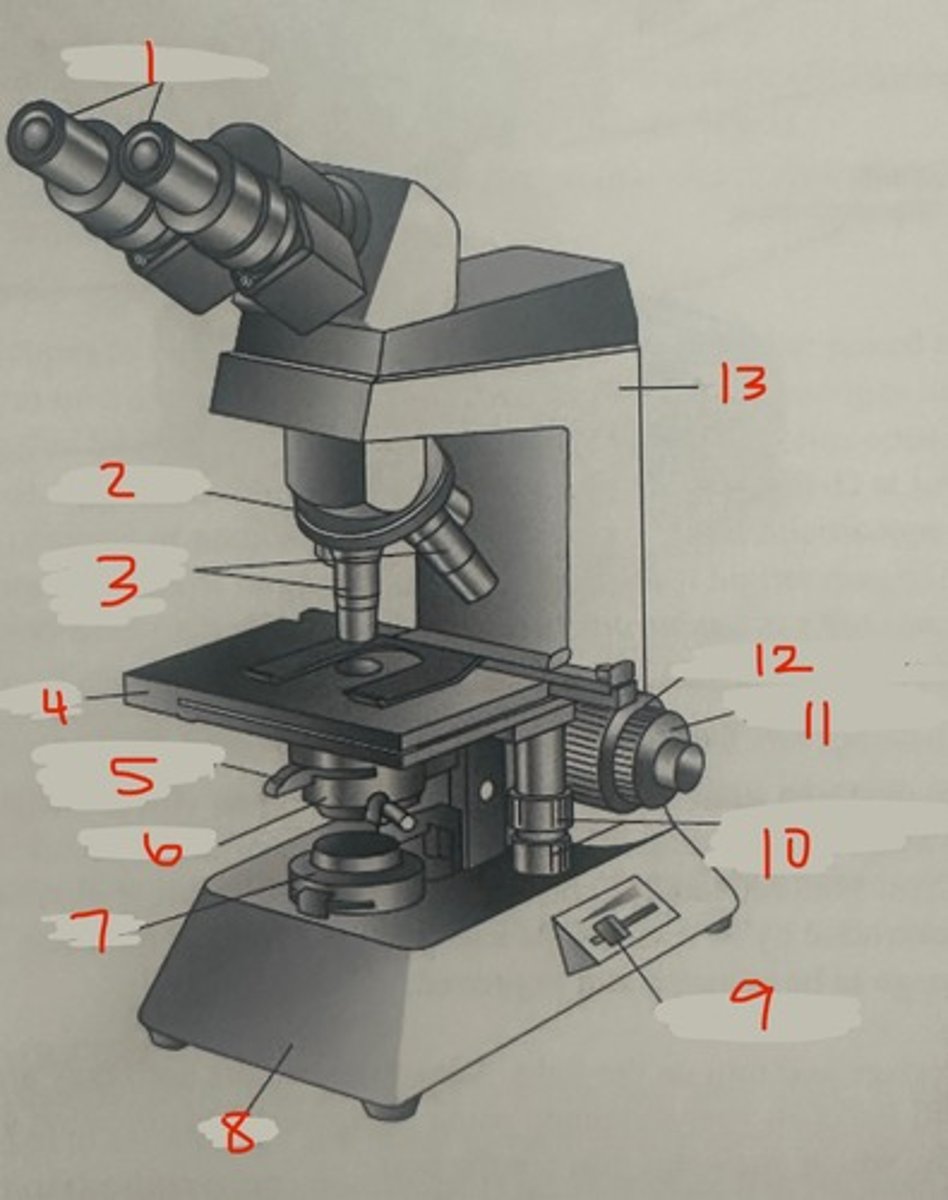
Identify number 4 on the compound microscope
Stage
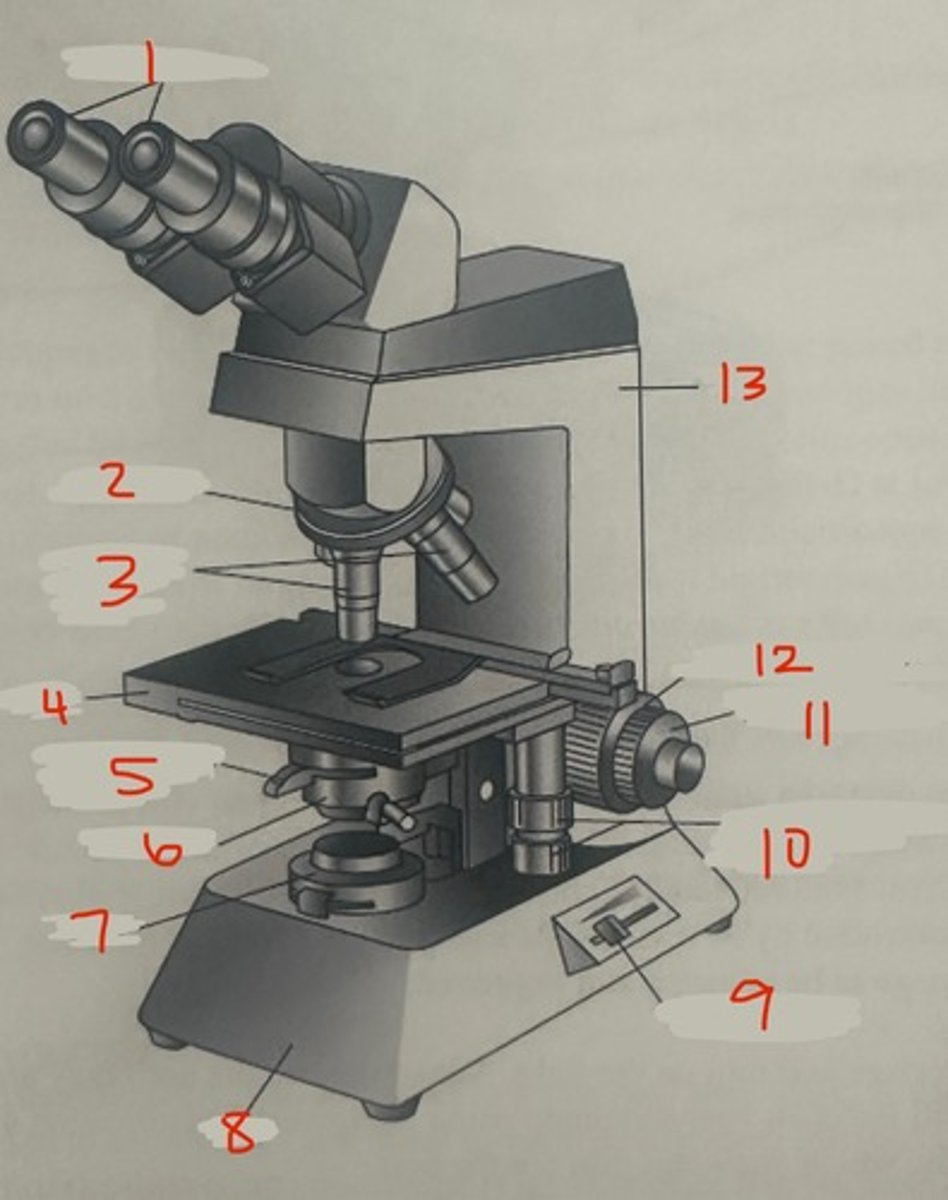
Identify number 5 on the compound microscope
Iris diaphragm switch
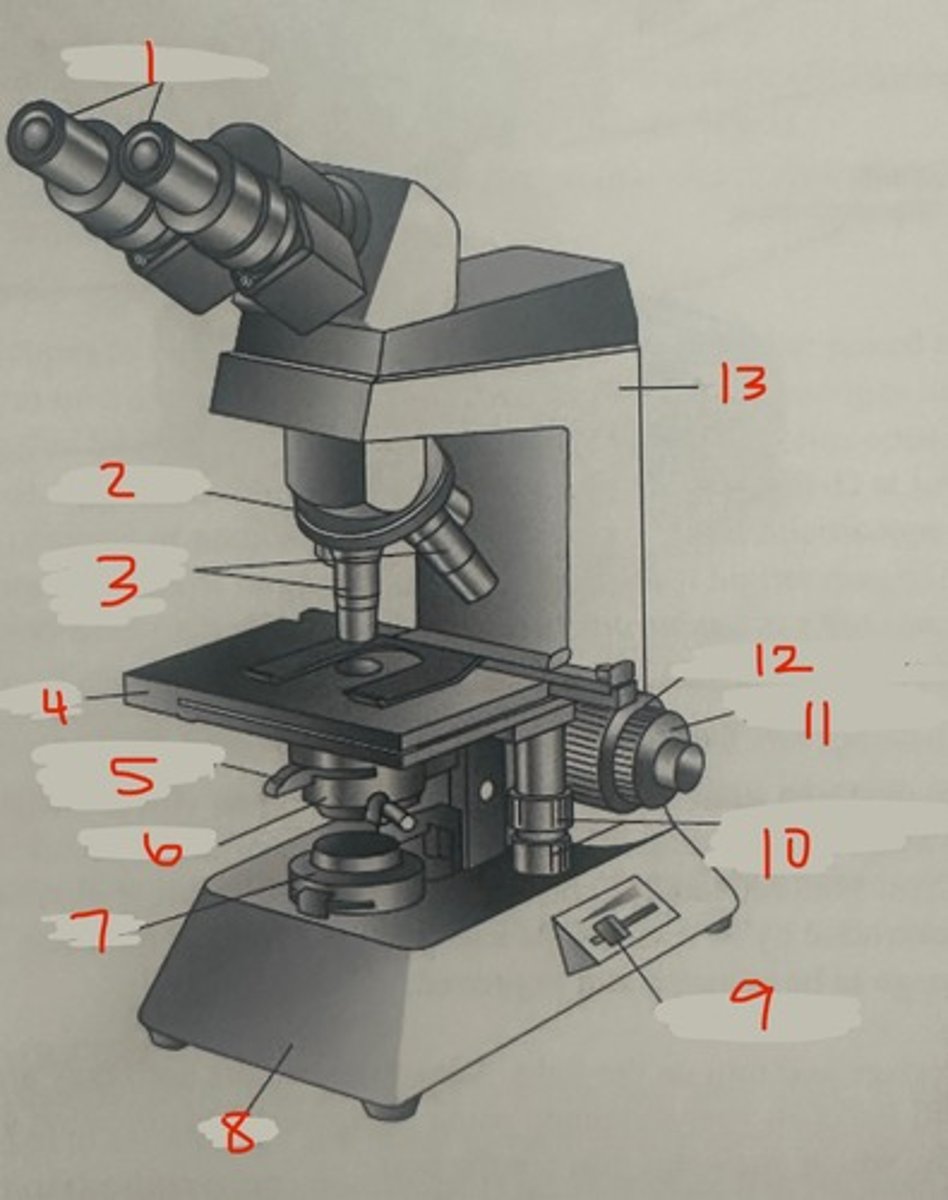
Identify number 6 on the compound microscope
Condenser
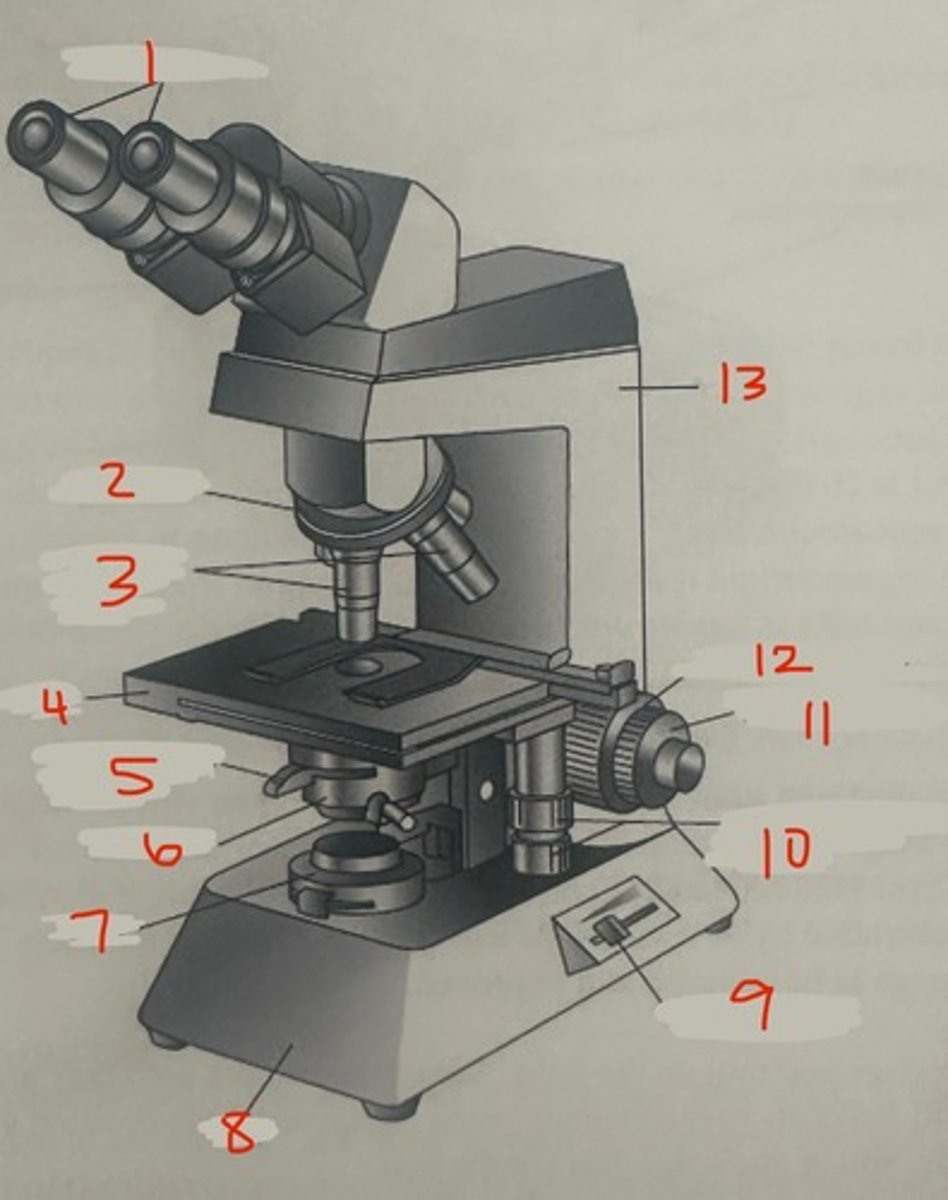
Identify number 7 on the compound microscope
Light
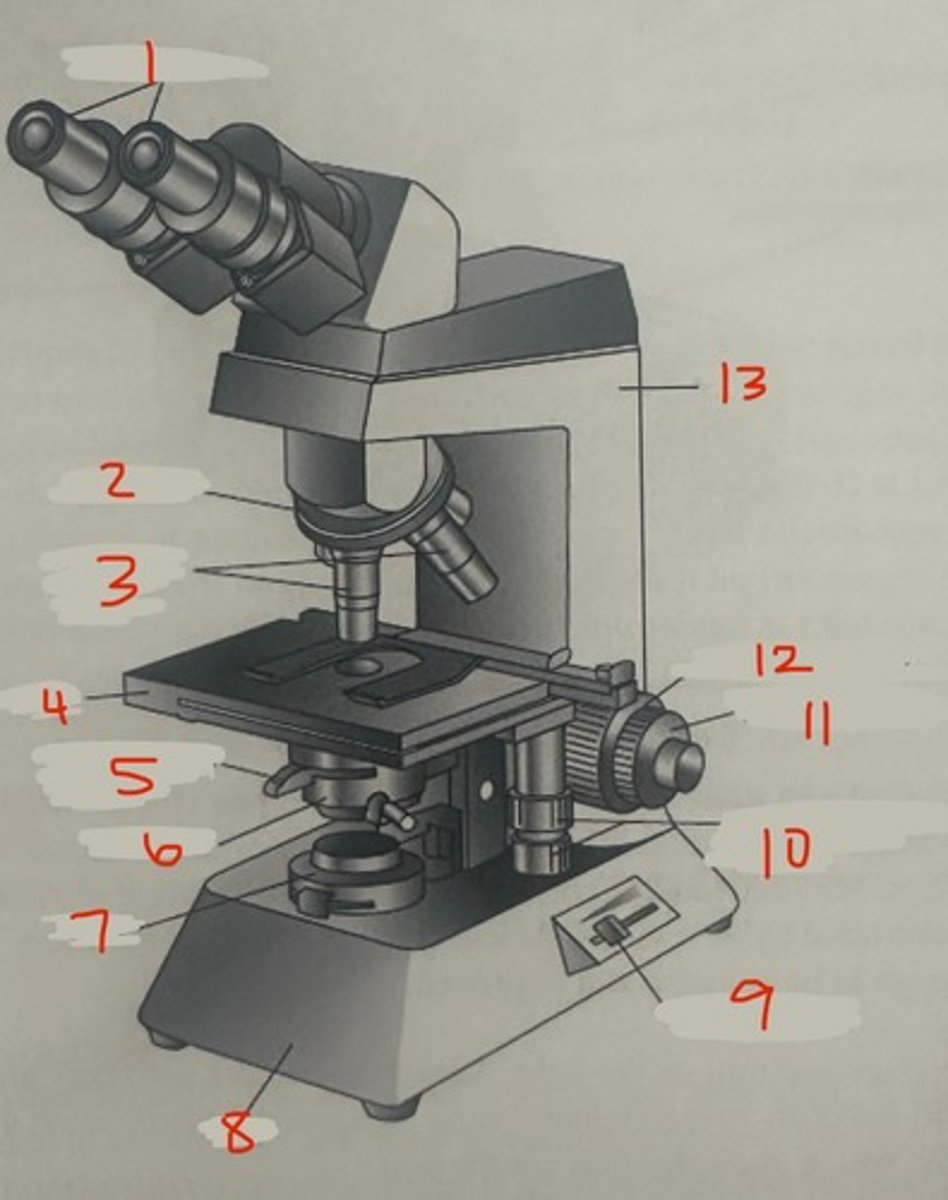
Identify number 8 on the compound microscope
Base
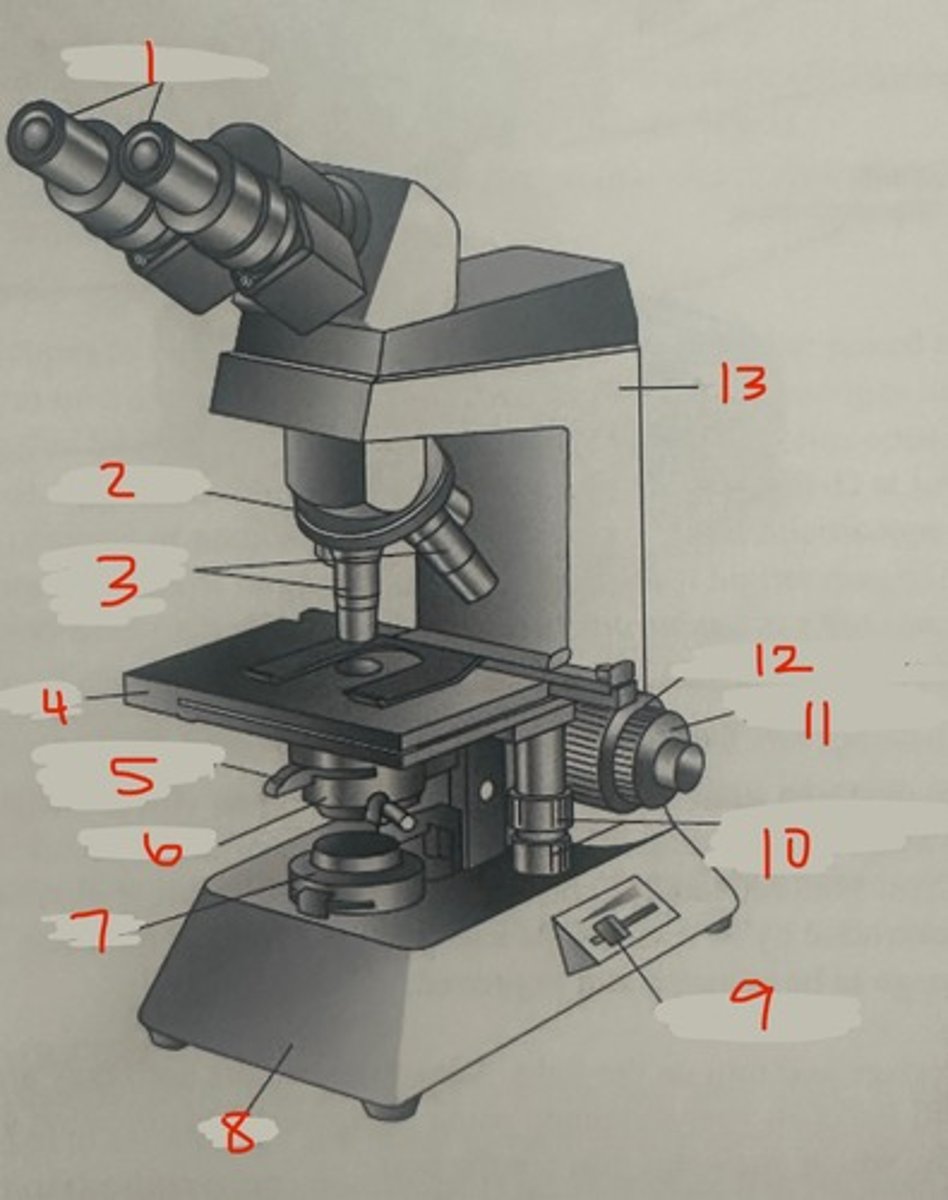
Identify number 9 on the compound microscope
Dimmer switch
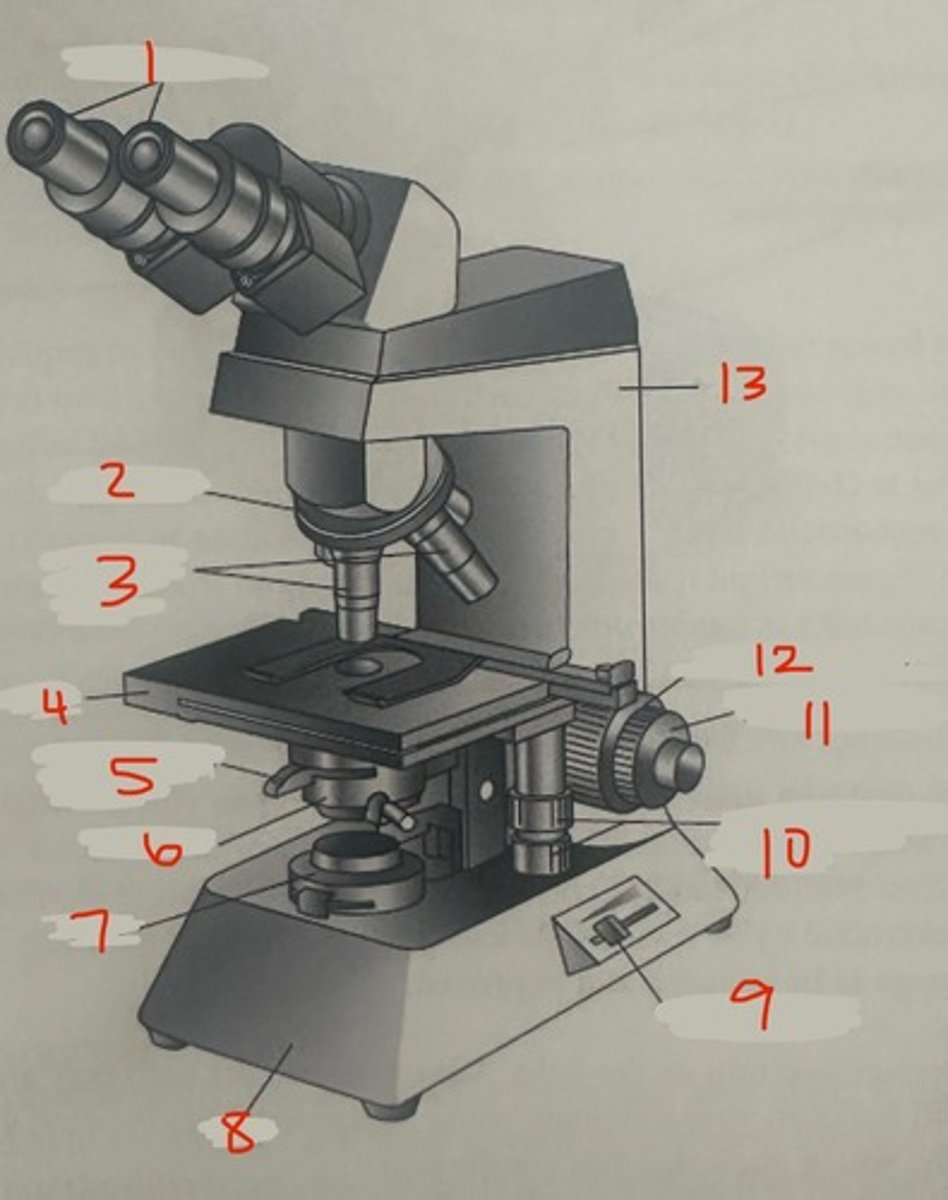
Identify number 10 on the compound microscope
Stage adjustment knobs
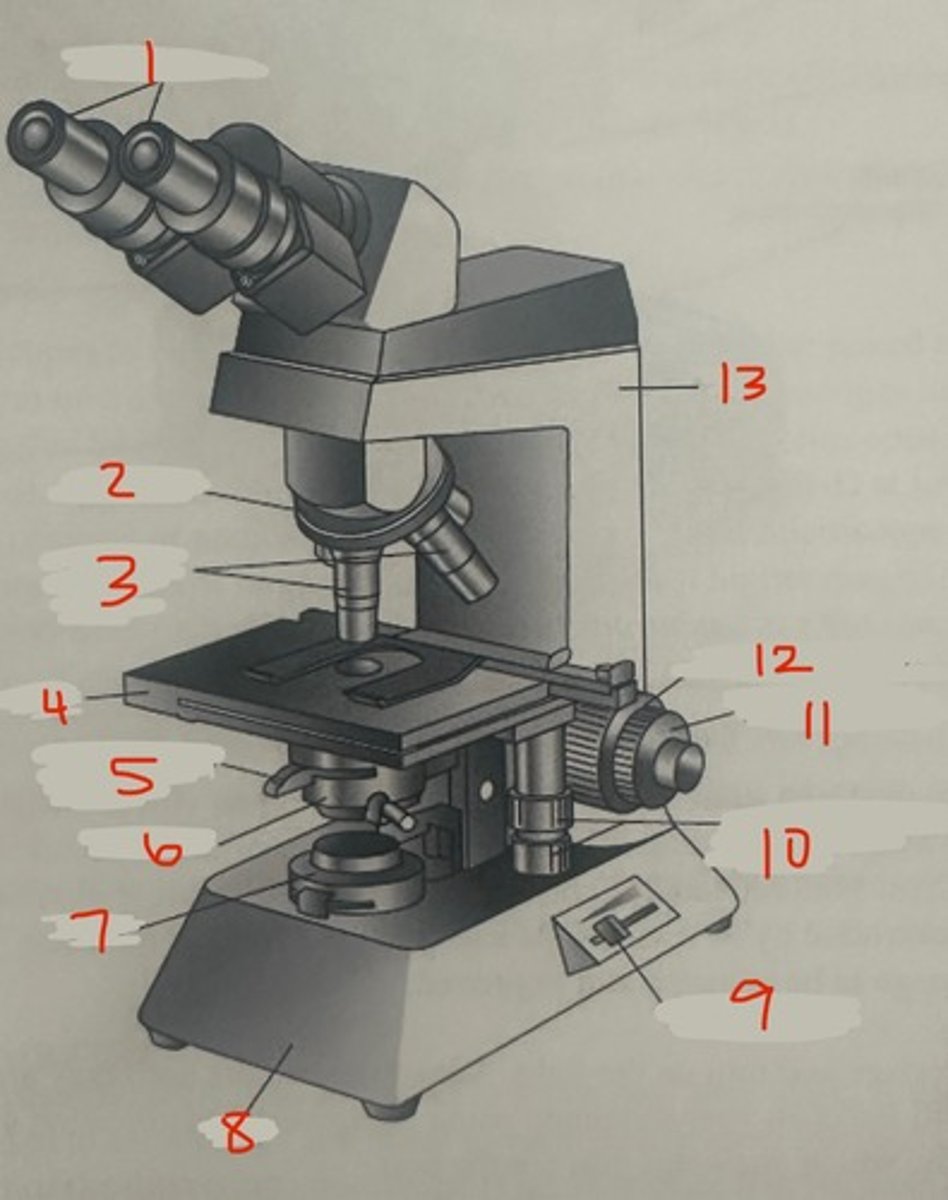
Identify number 11 on the compound microscope
Fine adjustment
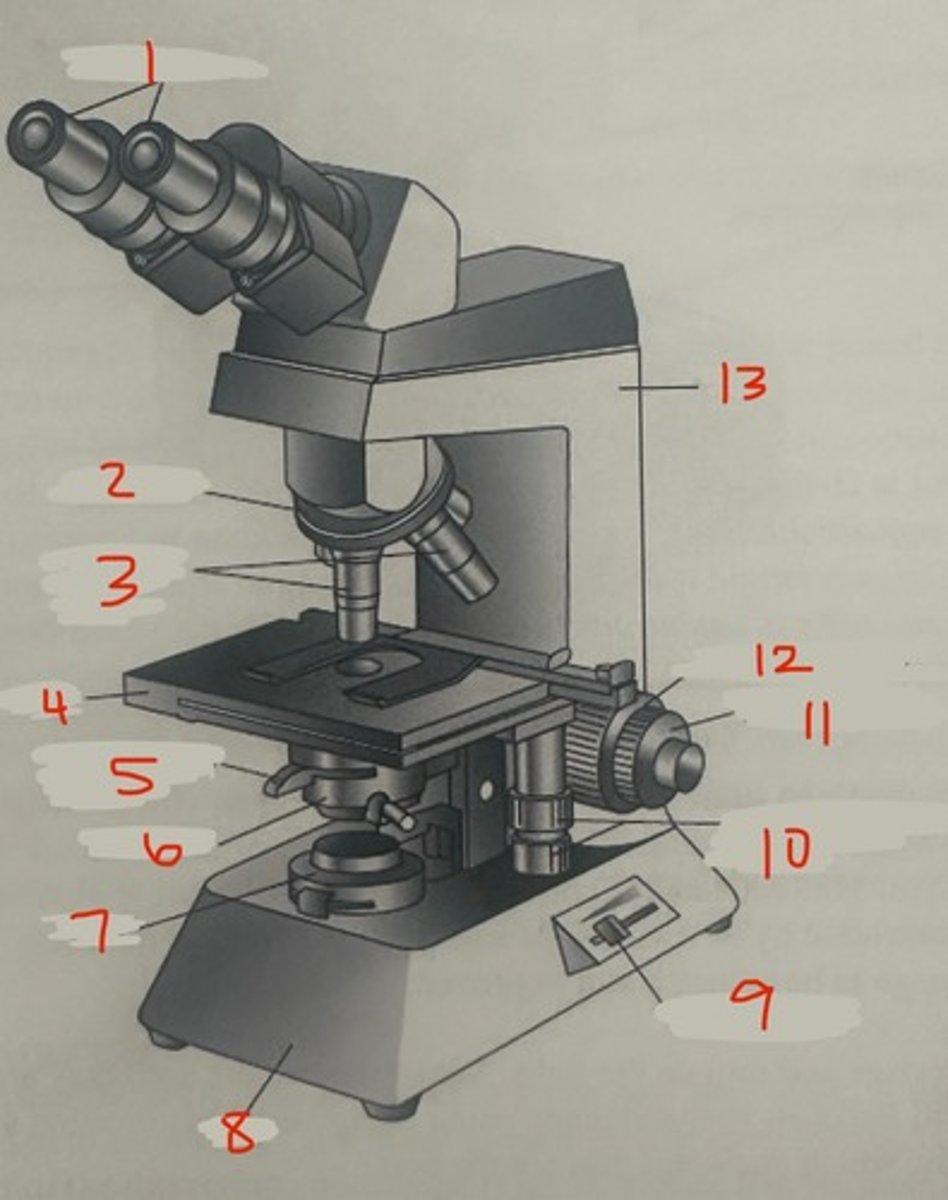
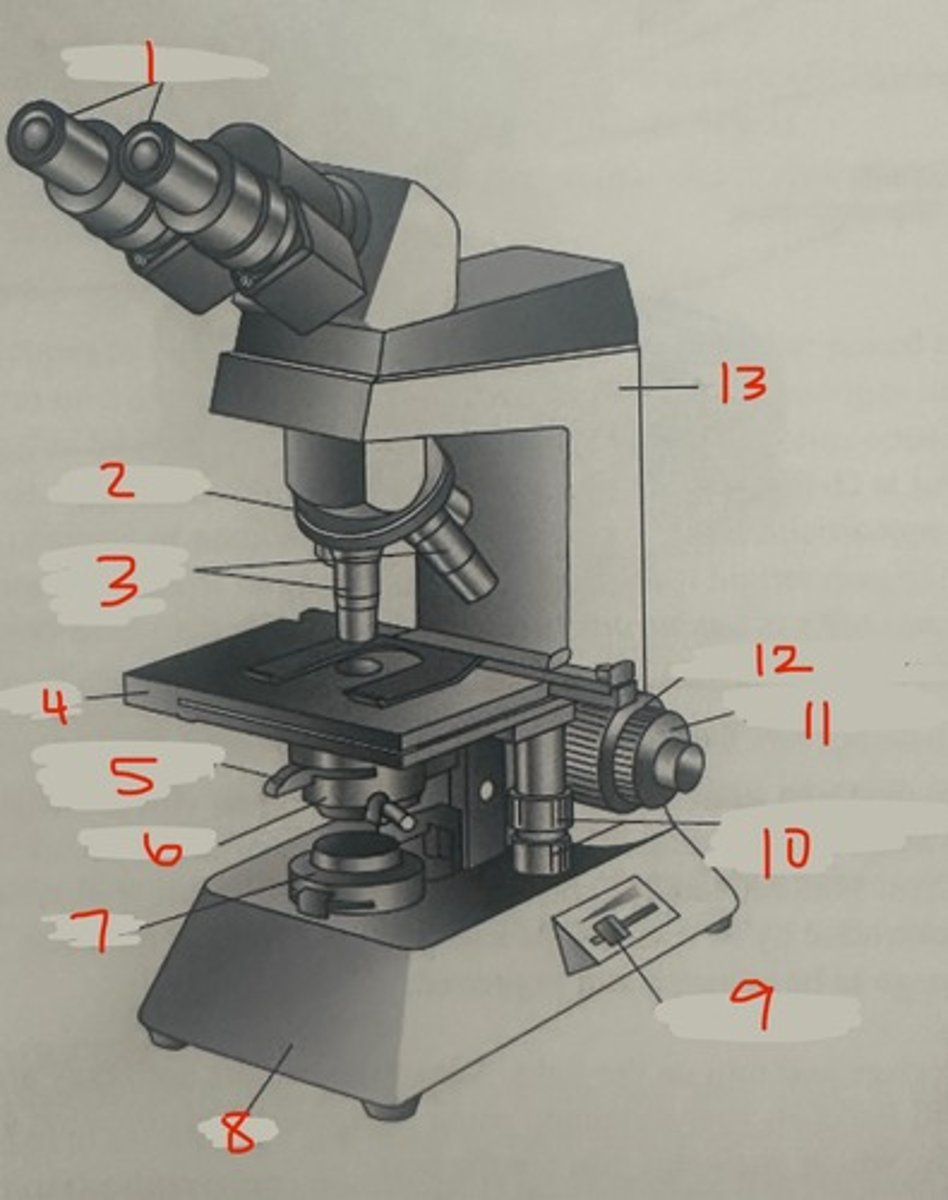
Identify number 12 on the compound microscope
Coarse adjustment knob
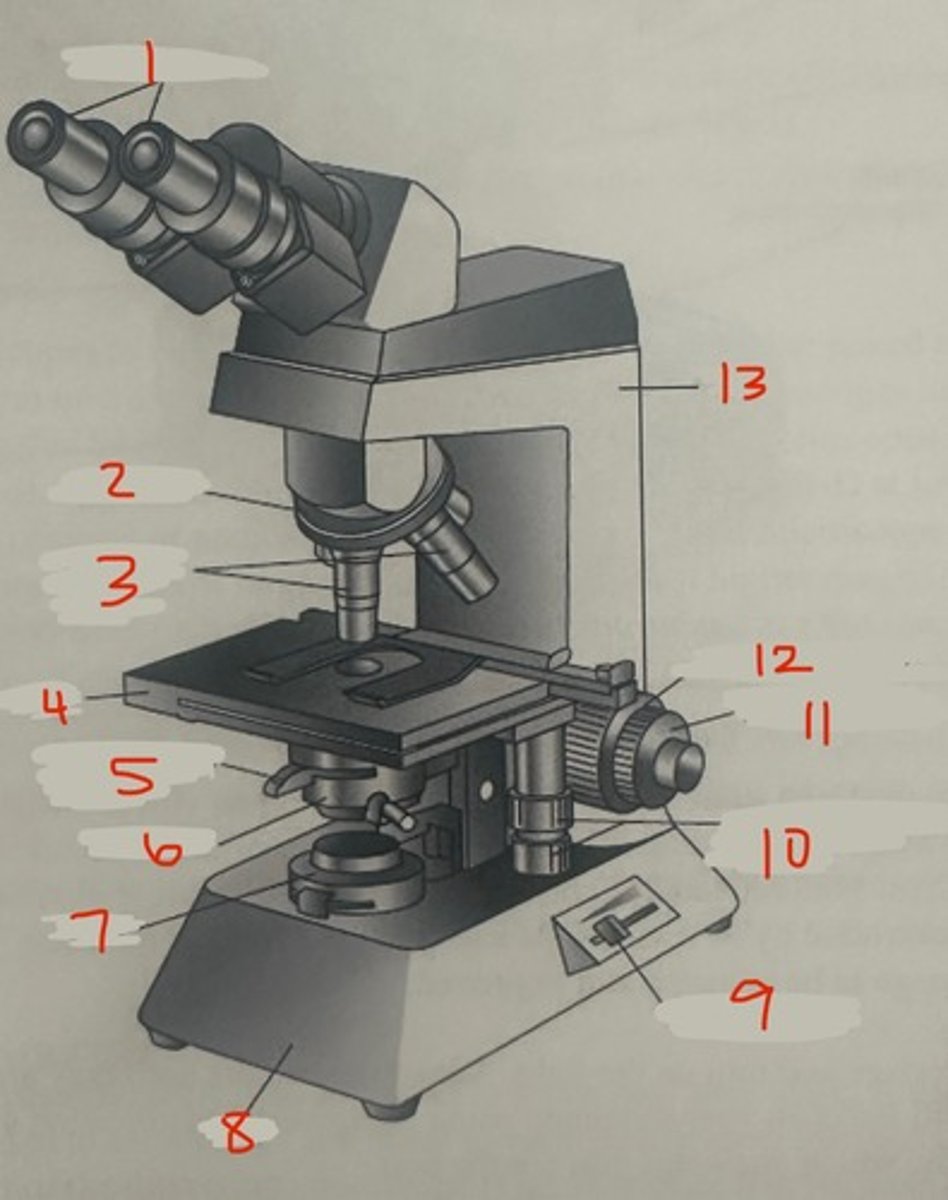
Identify number 13 on the compound microscope
Arm
Calculate magnification
Objective Lens x Ocular Lens = Total Magnification
4x 10x 40x
10x 10x 100x
40x 10x 400x
100x 10x 1000x
What is a phylogenetic tree?
A diagram that shows the hypothesized evolutionary relationship among species
Monophyletic group
A taxonomic grouping that includes an ancestral species and all of its descendants.
Paraphyletic group
Composed of a common ancestor and some descendants
Polyphyletic group
Composed of unrelated organisms descended from more than one ancestor
Natural Selection
Traits of organisms that are best at surviving AND reproducing will be most present in the next generation; created by Darwin; based on: 1) variation within a given species, 2) heritability, 3) differential reproductive rates
Genetic Drift
Changes in allele frequency due to random chance, not fitness; favors either loss or via action of an allele; faster in smaller populations; bottleneck and founder effect
Bottleneck Effect
Populations dramatically reduced, then rebuilds environmental event randomly eliminates members, surviving members may have allele frequencies G
Founder Effect
Small group separates from larger population; typically, less genetic variation than original population; allele frequencies in founding population may differ markedly from original population
Convergent Evolution (Analogies)
When a similar trait arises between species that do not share a recent common ancestor
Divergent Evolution (adaptive radiation)
The process of related species adapting differently to their environment and becoming more dissimilar. Involved species that share a recent common ancestor
Prokaryotes compose which two out of the three domains of life?
Archaea and Bacteria, not Eukarya
Cyanobacteria are ecologically important because they
Produce oxygen via photosynthesis, fix carbon dioxide and nitrogen out of the atmosphere, are a food source for invertebrates and cycle C and N up the food chain, and are indicators of water quality (high=toxic).
Cyanobacteria form symbiotic relationships with
Aquatic ferns
Anabaena (Cyanobacteria) forms _______ during periods of nitrogen limitation (used to pore from nitrogen fixation)
Heterocysts
Cyanobacteria are photosynthetic (autotrophs) meaning that they
Capture light energy and use it to convert water, CO2, and minerals into O2 and organic compounds
Cyanobacteria gave rise to
Plastids and mitochondria of eukaryotic algae and plants
Cyanobacteria are sometimes surrounded by a jellylike _____ ____
Mucilaginous sheath
What ecological role do nitrogen-fixing bacteria play in the environment?
They transform atmospheric nitrogen to a form that other organisms can use
Cell walls of bacteria are composed of
Peptidoglycan
Gram Staining is a differential stain which distinguishes______ based on cell wall composition
bacteria
Gram positive bacteria
Thick peptidoglycan layer traps Crystal violet. These cells are purple at the end of the stain
Gram negative bacteria
Thin peptidoglycan layer with outer membrane present. Cannot retain Crystal Violet after clean with alcohol . Counter stain with Safranin. These cells are pink by the end of the stain.
Gram staining process
fixation, crystal violet, iodine treatment, decolorization (w alcohol), counter stain, safranin
Eukaryotes
include all organisms except for bacteria, cyanobacteria, and archaebacteria. Have membrane bound organelles
Prokaryotes
Have a plasma membrane, DNA molecules, ribosomes, cytoplasm, and cell wall. They lack membrane bound organelles.
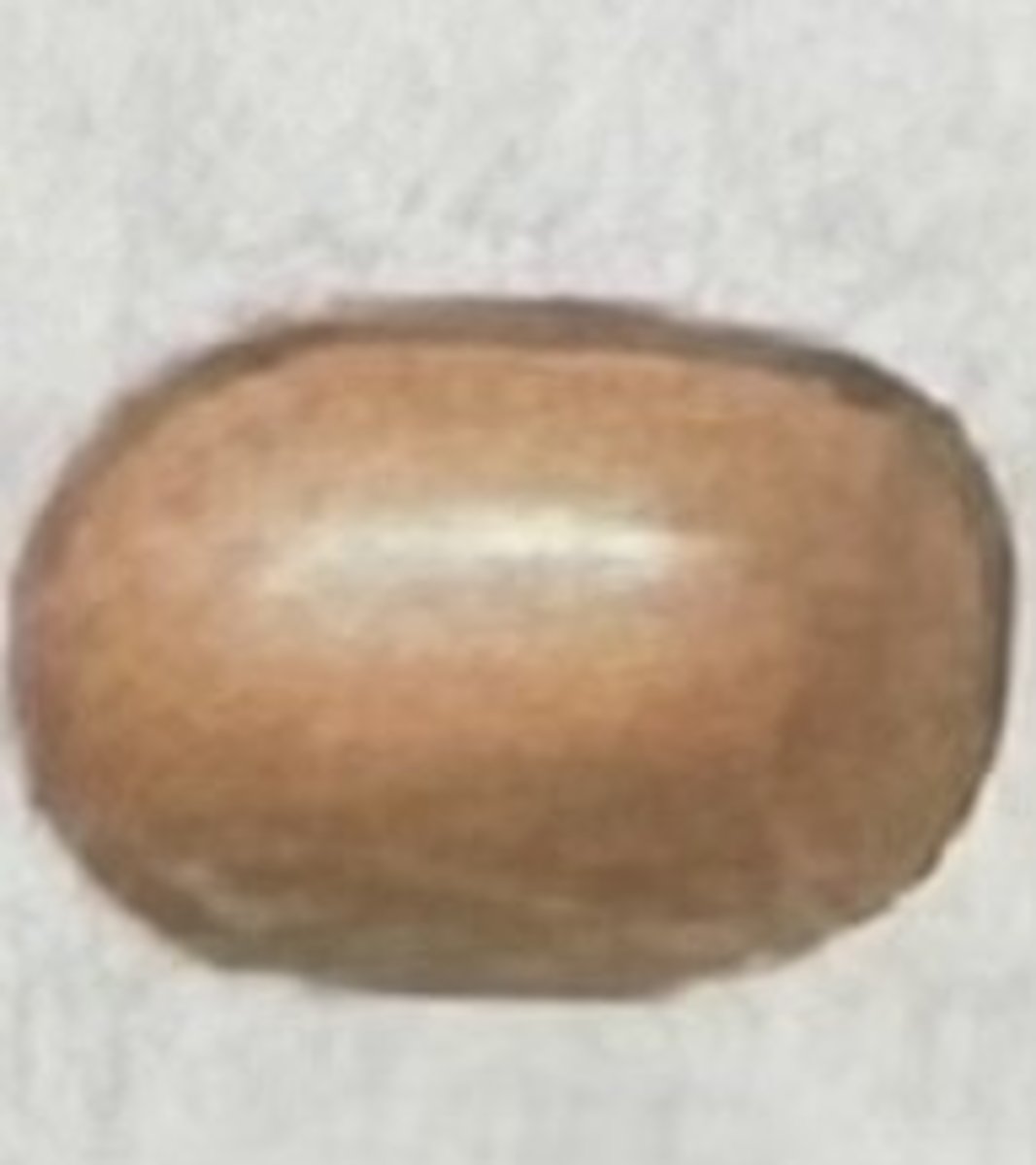
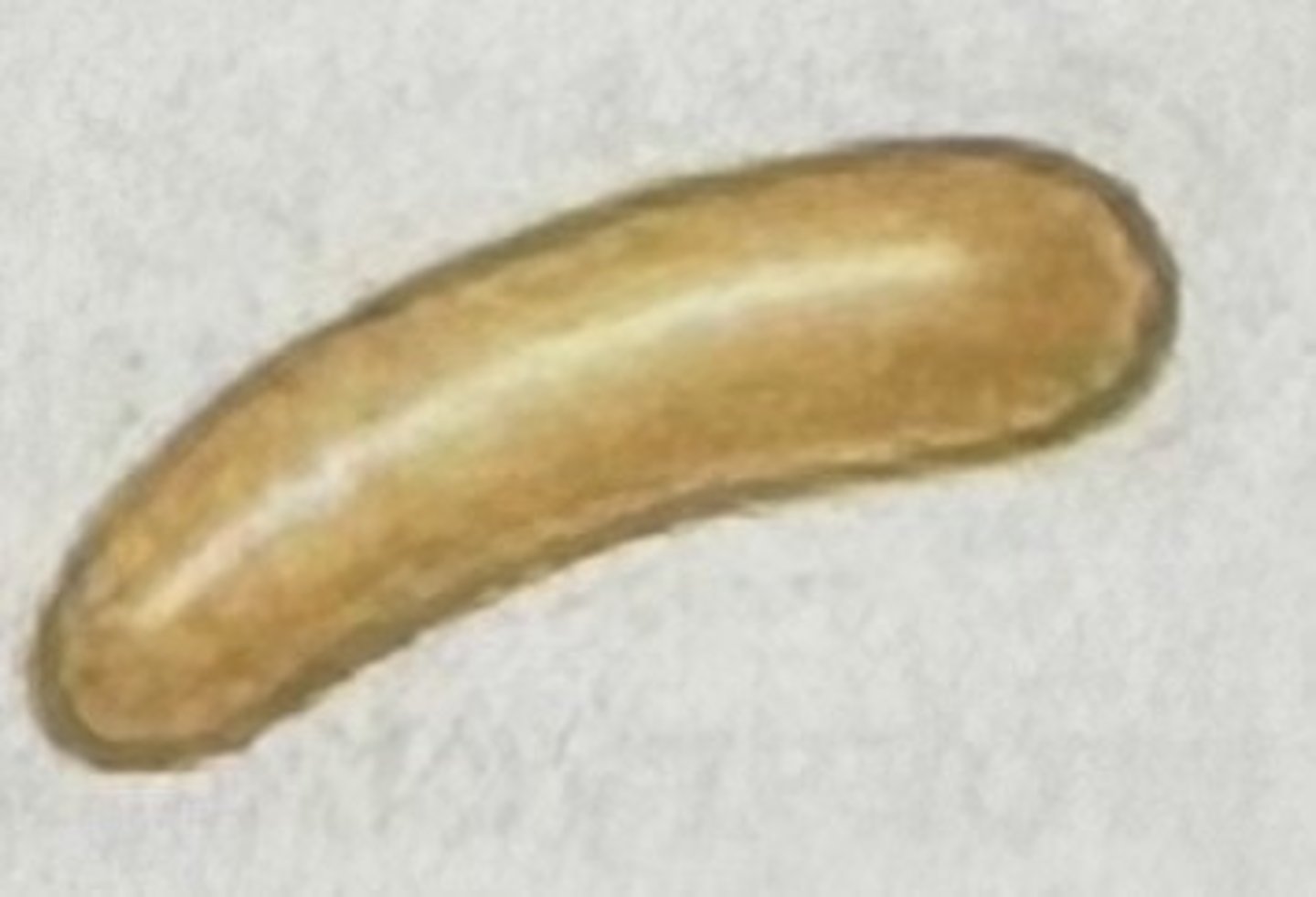
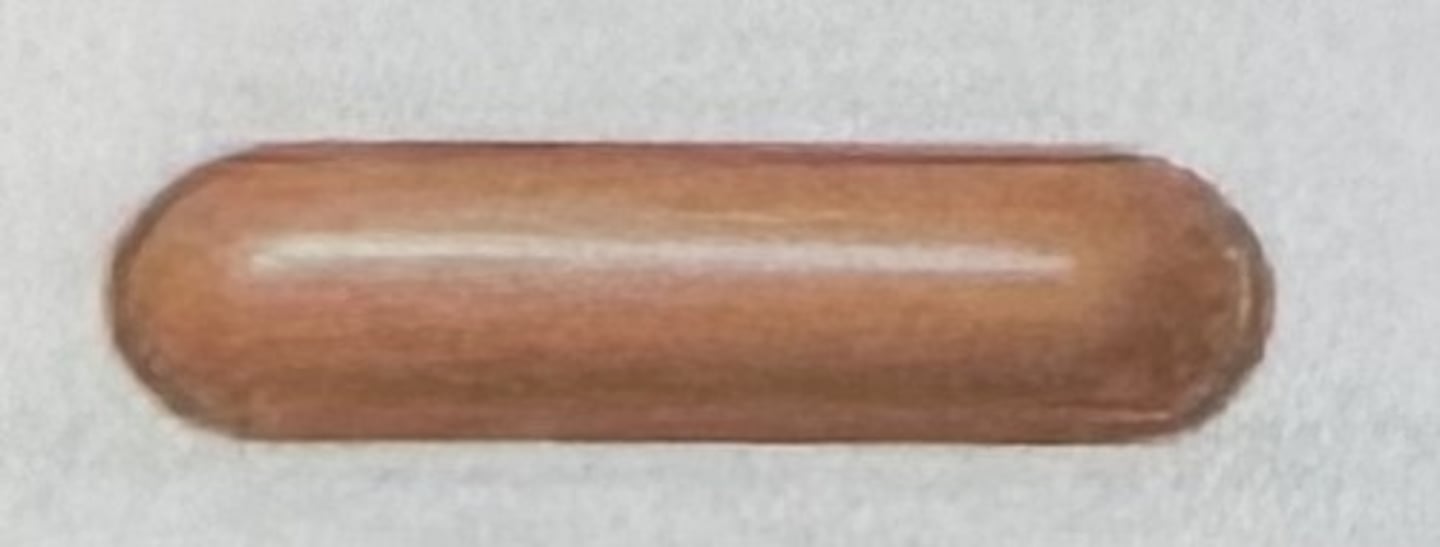
Bacterial groups are often based on the shape and arrangement of cells
Coccus, coccobacillus, vibrio, bacillus, spirillum, spirochete
Coccus
Which bacterial group is this?
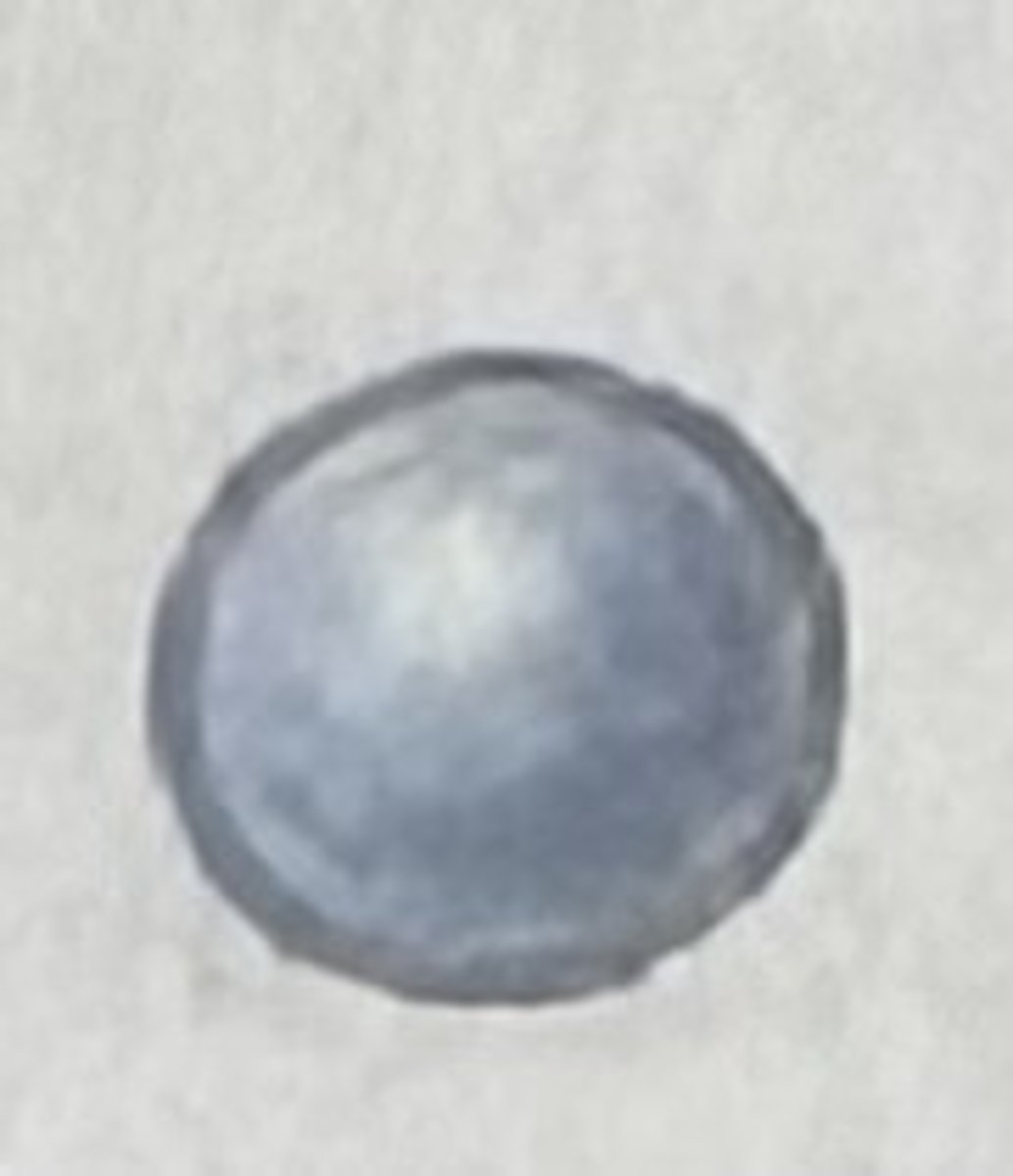
Coccobacillus
Which bacterial group is this?
Vibrio
Which bacterial group is this?
Bacillus
Which bacterial group is this?
Spirillium
Which bacterial group is this?
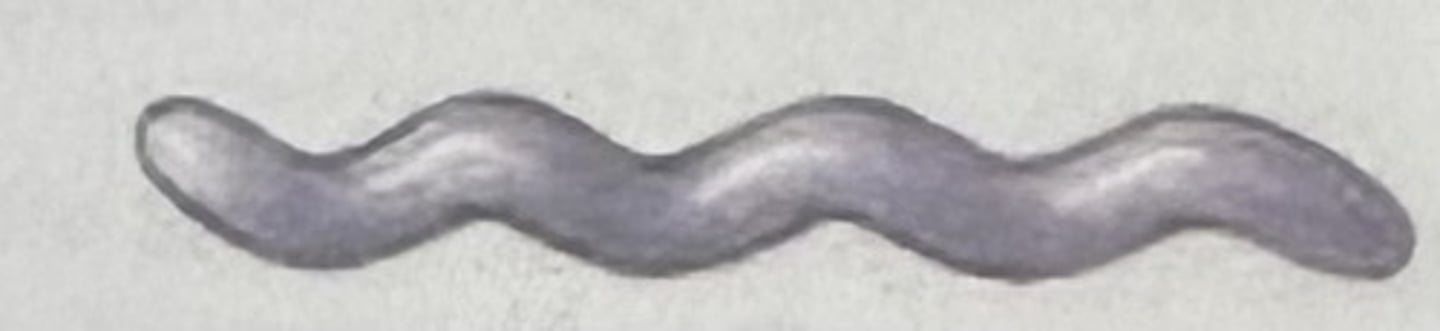
Spirochete
Which bacterial group is this?
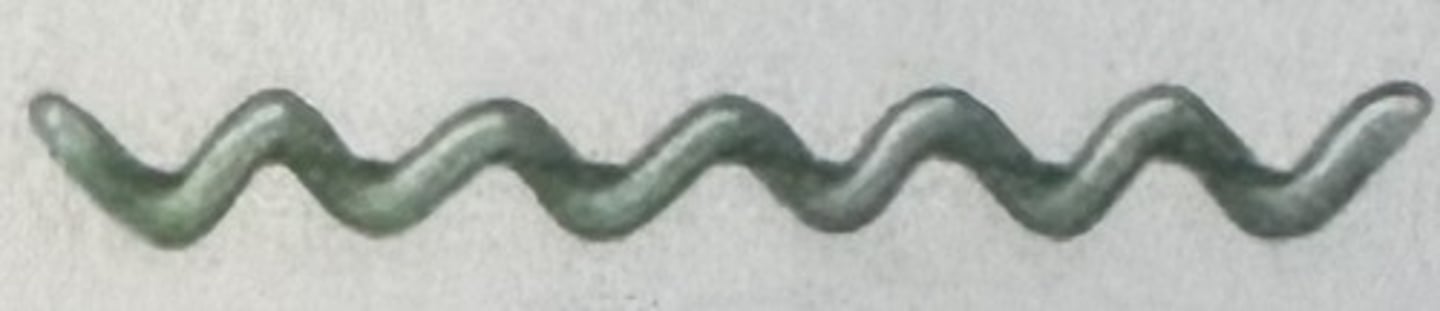
Coccus
Which arrangement of cocci is this?
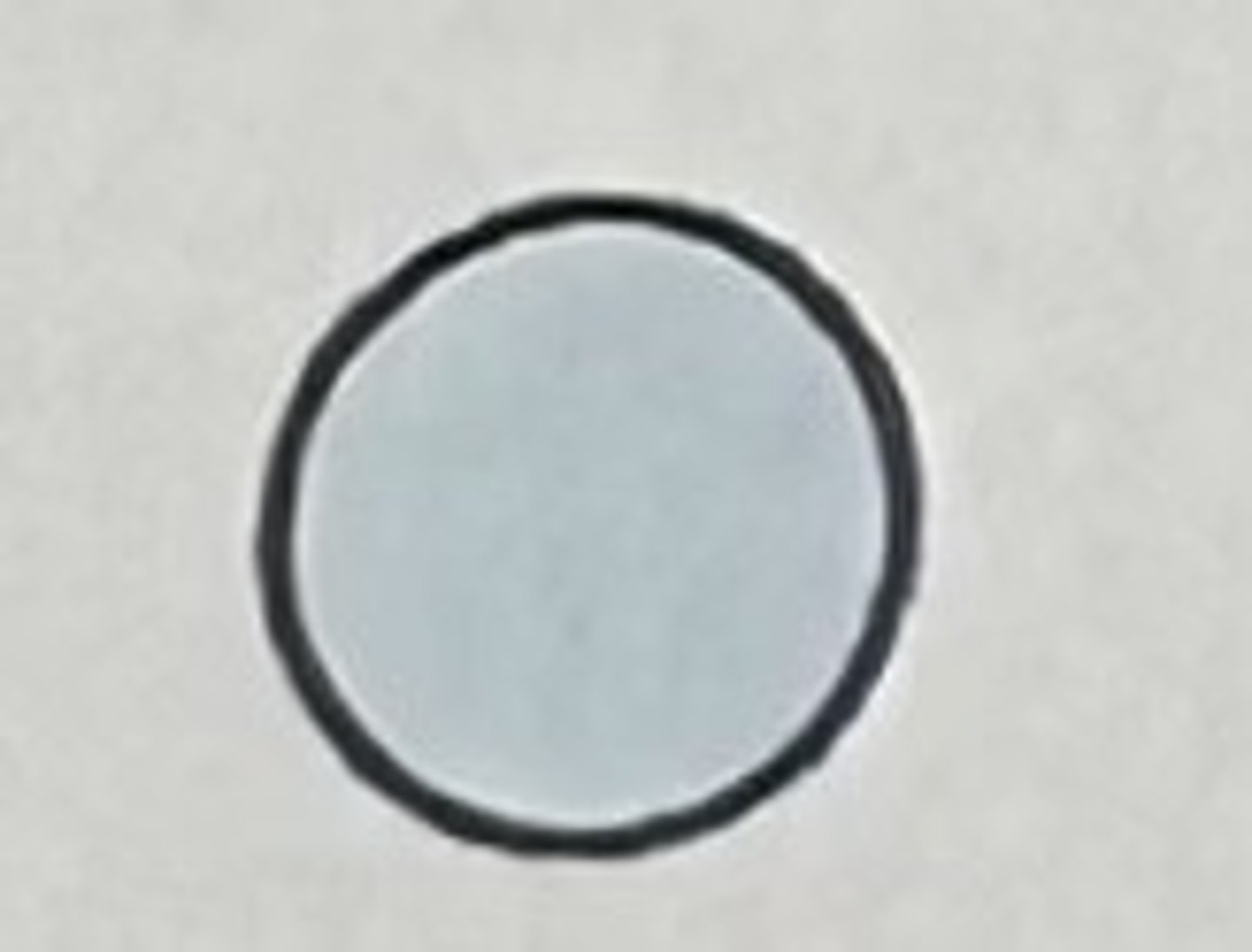
Diplococci
Which arrangement of cocci is this?
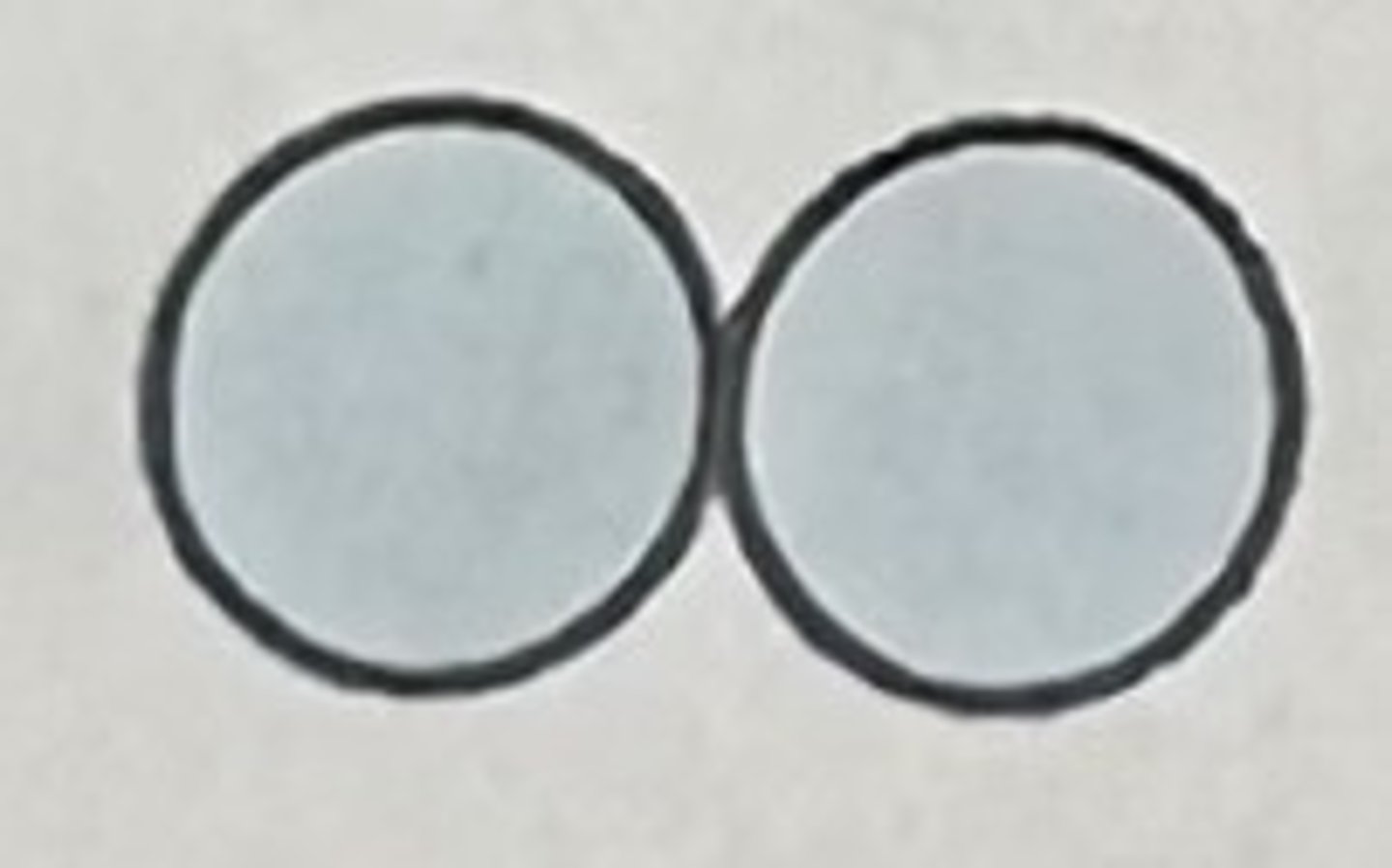
Staphylocci
Which arrangement of cocci is this?
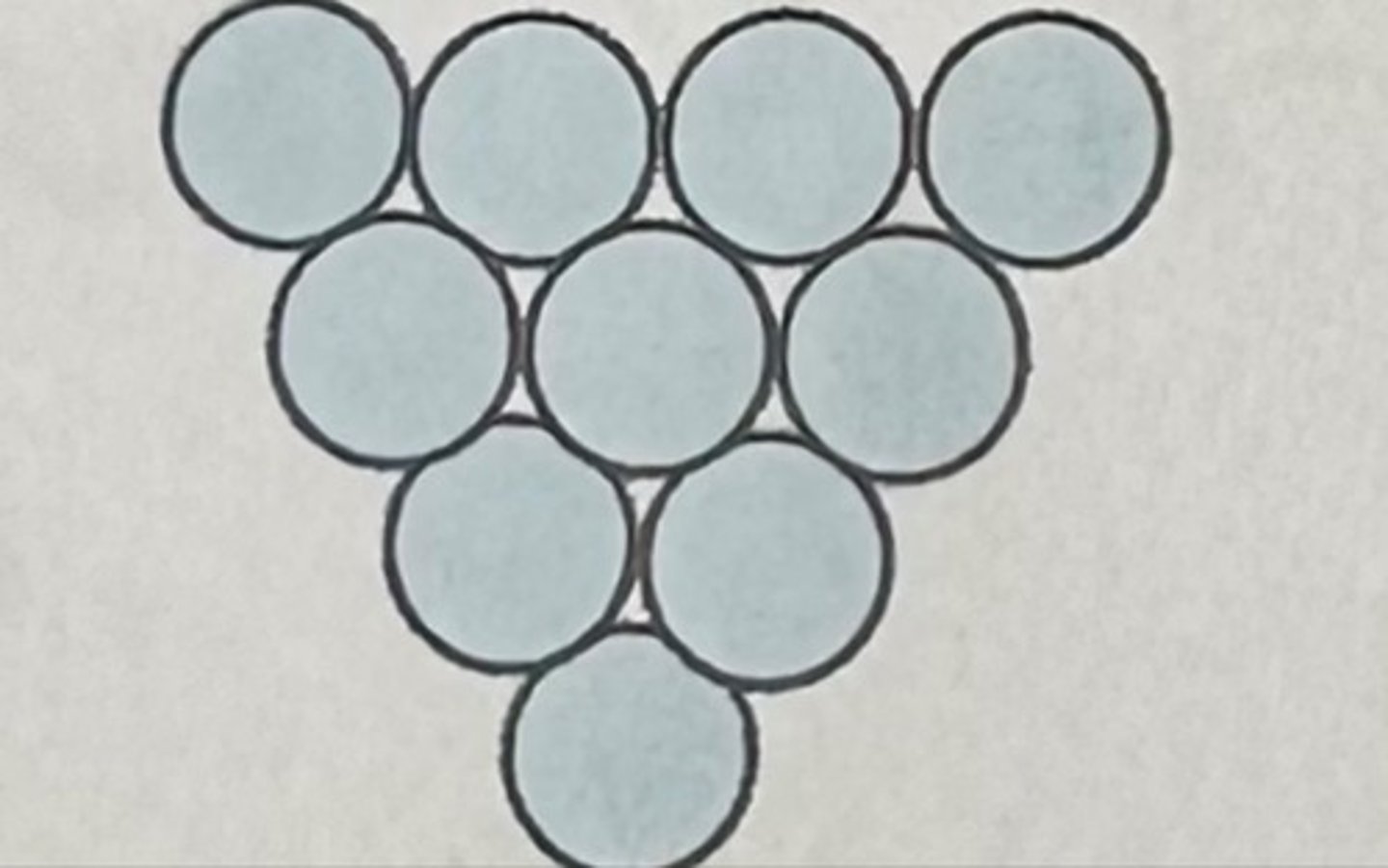
Streptococci
Which arrangement of cocci is this?
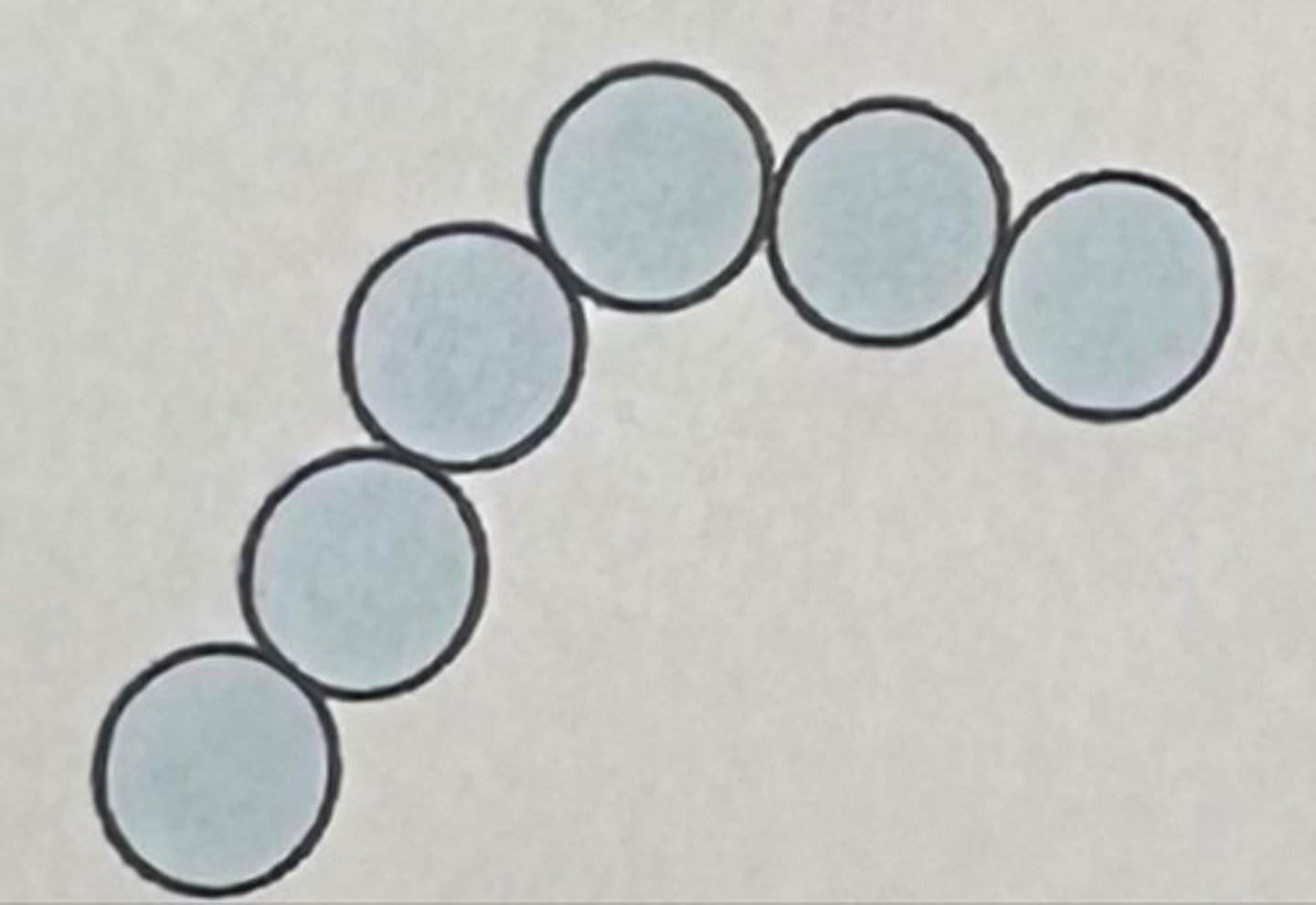
Sarcina
Which arrangement of cocci is this?
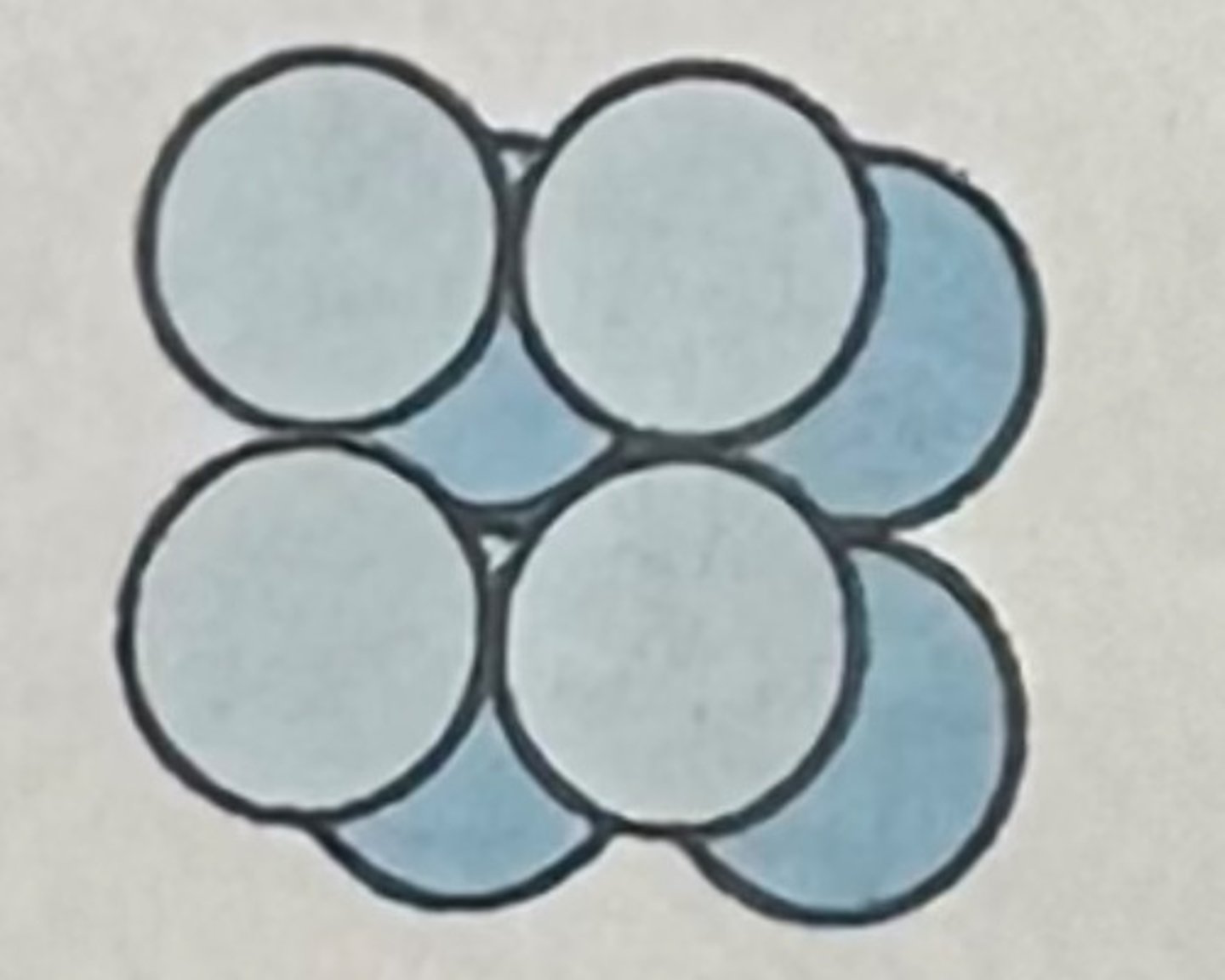
Tetrad
Which arrangement of cocci is this?
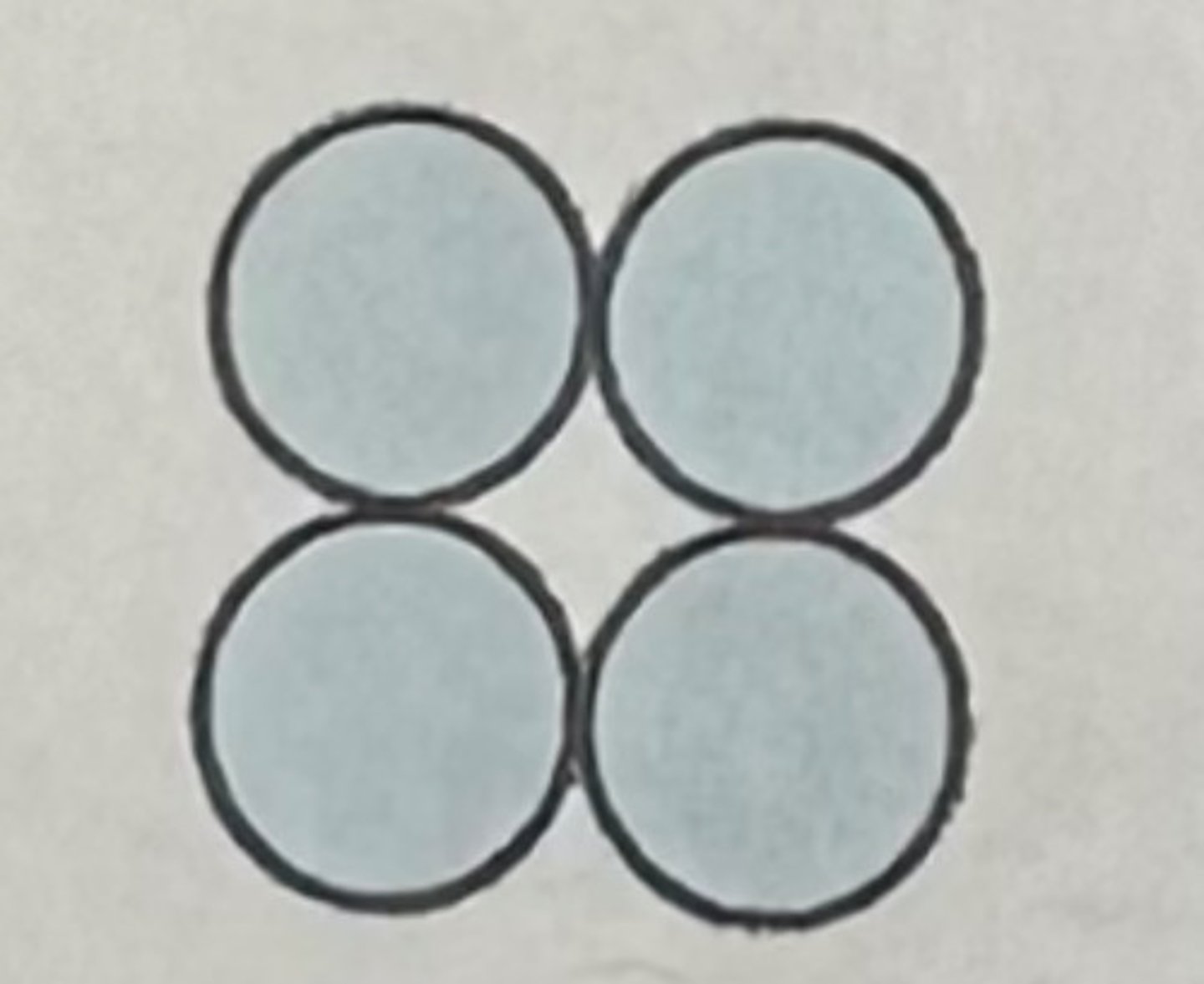
Protists
A eukaryotic organism that cannot be classified as an animal, plant, or fungus.
Protists are a monophyletic group. T or F?
False
In which pond water sample would you expect to find more plant-like (photosynthetic) protists?
In the sample from the sunny part of the pond
Protist Supergroup Excavata
specialized feeding groove, heterotrophs and autotrophs, have acquired plastids through secondary endosymbiosis from green algae, multiple membranes kinetoplastids
Euglena
What organism is this?
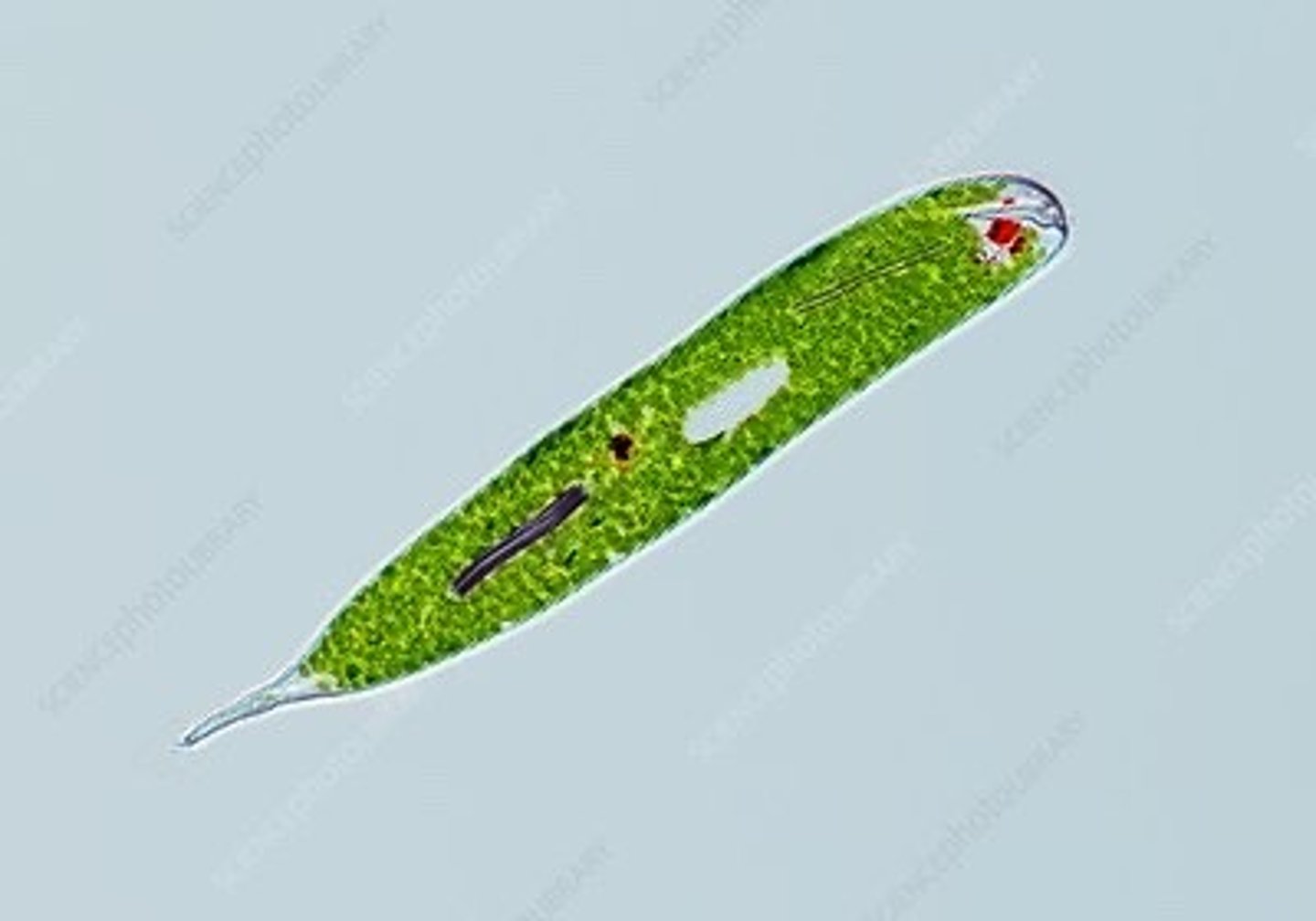
Euglena genus, phylum/supergroup, domain
G: Euglena
S: Excavata
D: Eukarya
How do euglena feed, move, and key characteristics?
Autotrophic and heterotropic; singular flagellum; stigma (colored eyespot near base of the flagellum)
Trypanosoma (T. Brucei)
What organism is this?
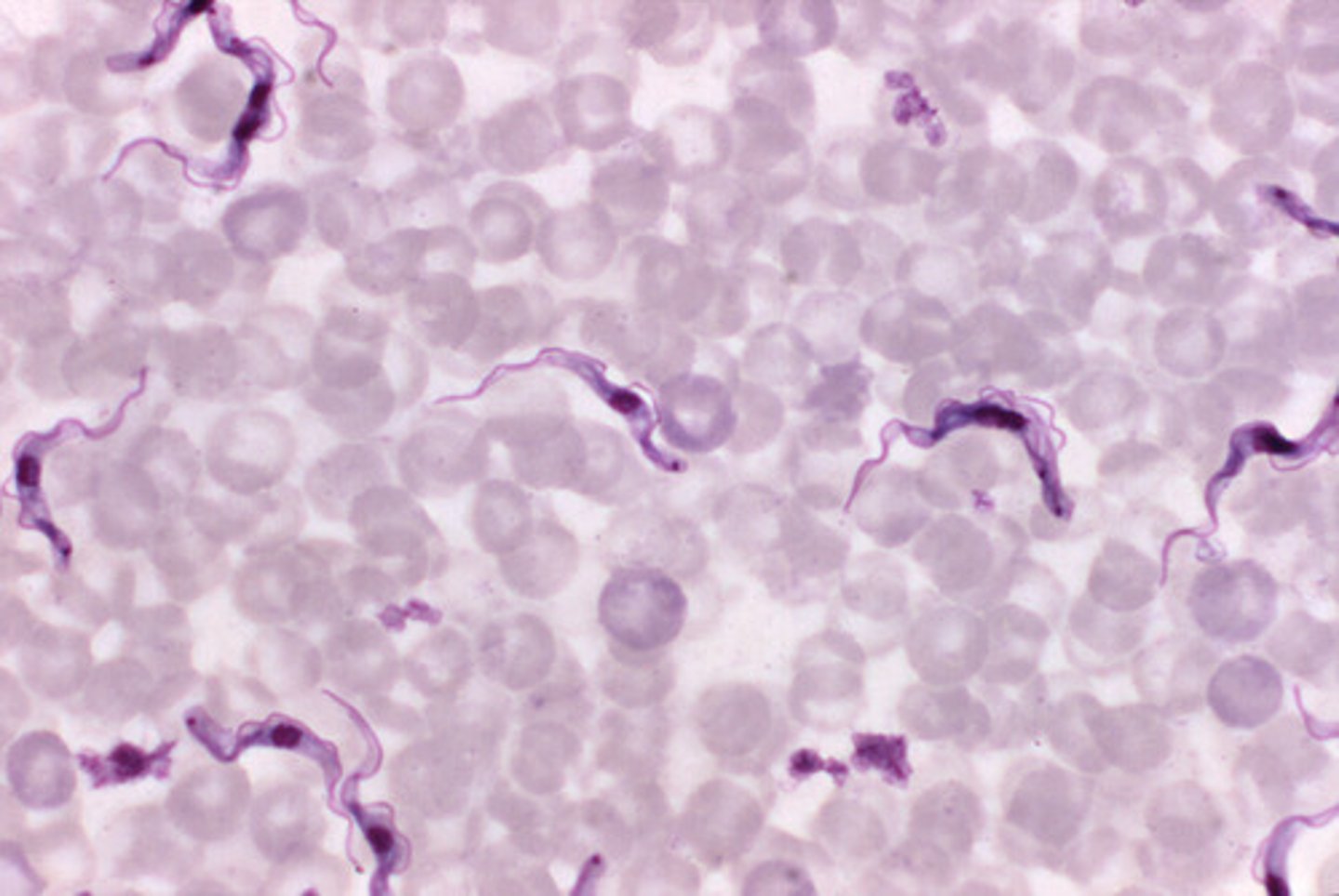
T. Brucei genus, phylum/ supergroup, domain
G: Trypanosoma
S: Excavata
D: Eukarya
How do Trypanosoma feed, move, and key characteristics
Heterotrophs (absorb nutrients); flagellum; cause sleeping sickness, undulating membrane, purple stained nuclei
Giardia lamblia
What organism is this?
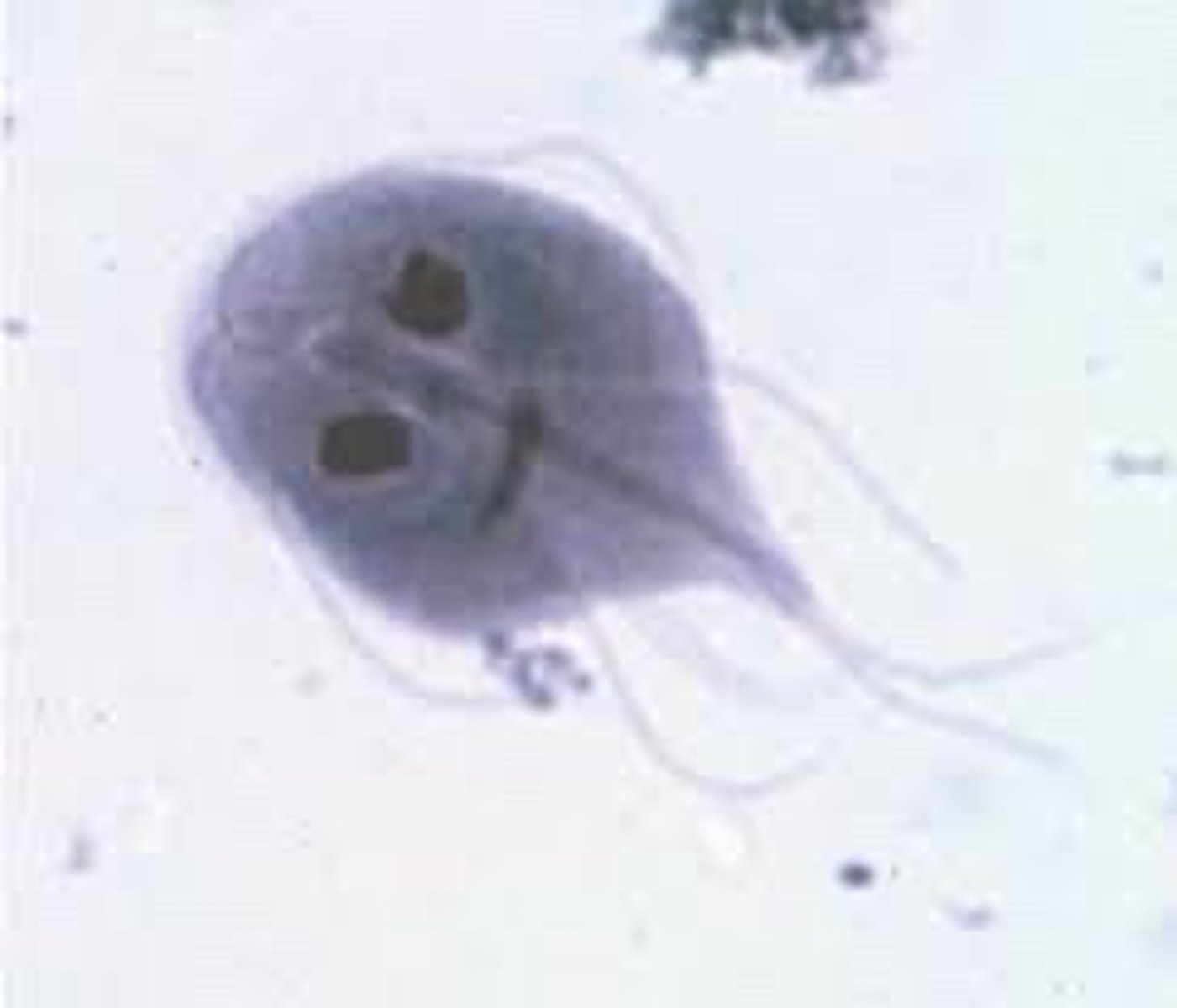
Giardia genus, phylum/ supergroup, domain
G: Giardia
S: Excavata
D: Eukarya
How do Giardia feed, move, and key characteristics
Heterotrophs (absorb nutrients), flagellum, found in feces-contaminated water and cause giardiasis (diarrhea and vomiting)
Protist Supergroup SAR Clade
Stramenopiles, alveolates, rhizarians
Stramenopila (SAR Clade)
Straw-like hairs that line surface of flagella to help them swim faster and more efficiently. Includes diatoms and brown algae
Diatoms
What organism is this?
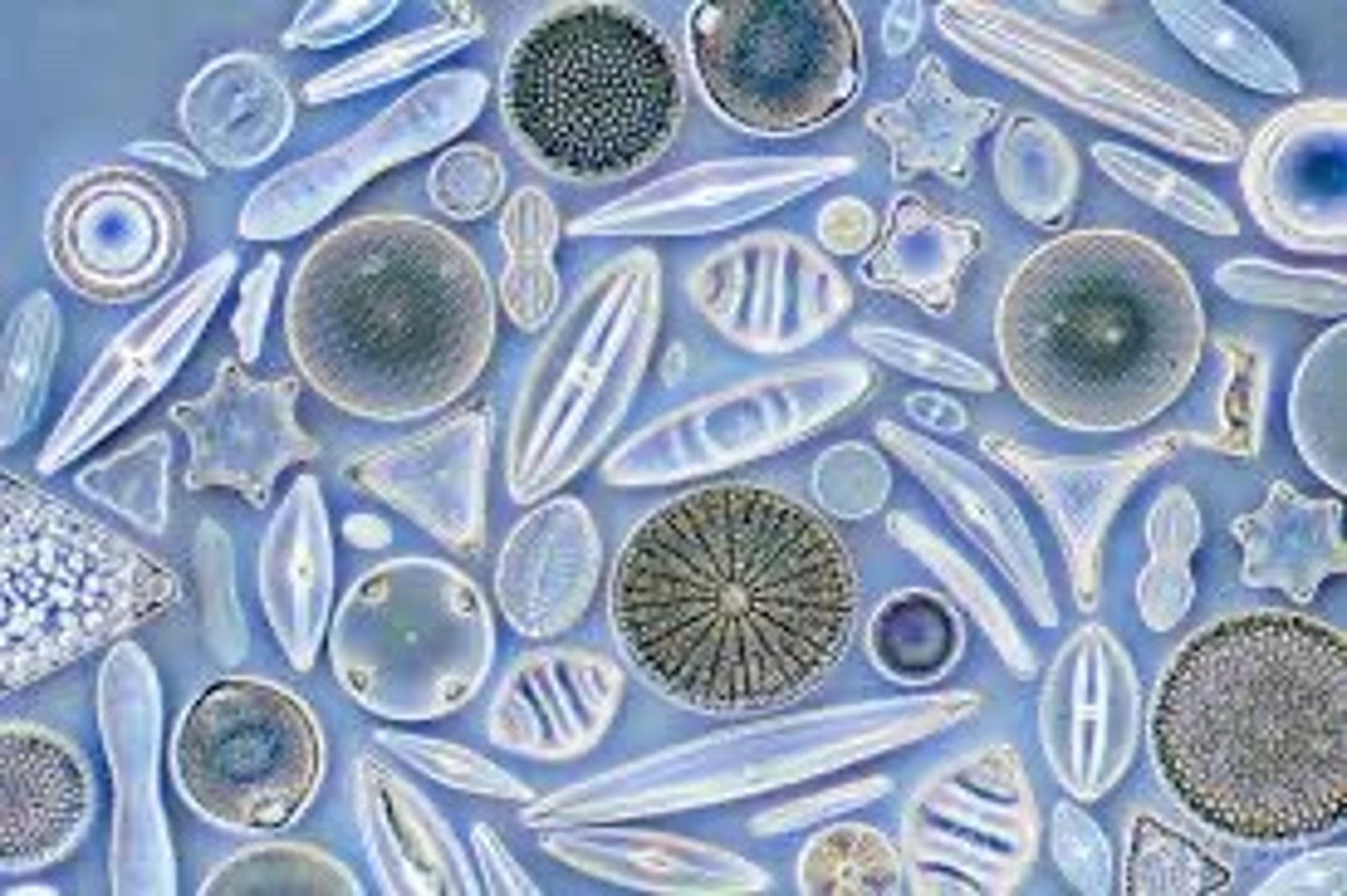
Diatom genus, phylum/ supergroup, domain
G: diatoms
S: Stramenopila
D: Eukarya
How do diatoms feed, move, and key characteristics
Autotrophs (photosynthesis); flagellum (adults lack hairy flagellum); unicellular algae that contain chlorophyll an and c and xanthophyll. Live anywhere there is water. Cell wall made of silicon dioxide
Brown algae (kelp, seaweed)
What organism is this?
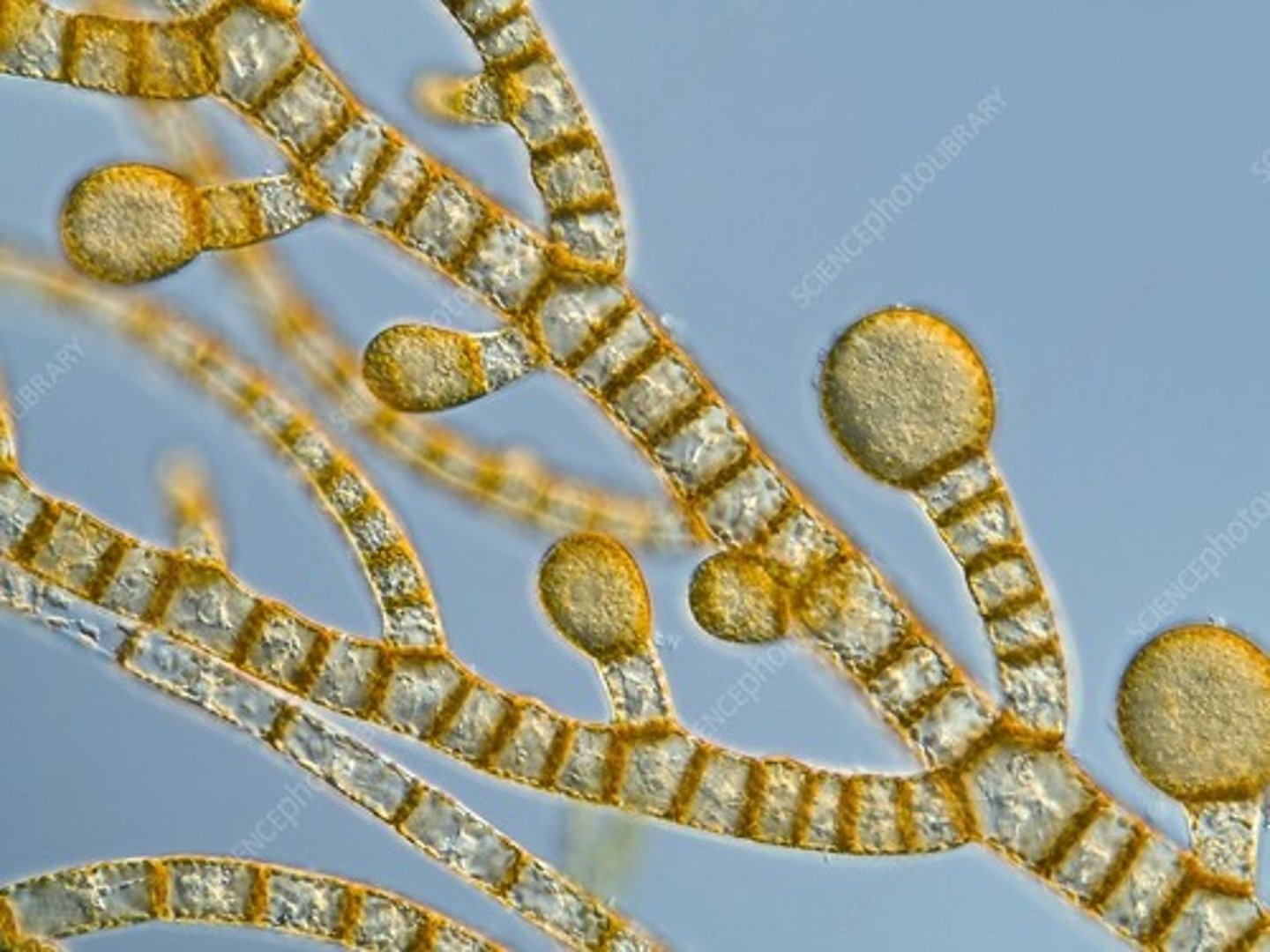
Brown algae genus, phylum/ supergroup, domain
G: Ectocarpus, Fucus, Laminaria
S: Stramenopila (SAR)
P: Phaeophyta
D: Eukarya
How do brown algae feed, move, and key characteristics
Autotrophic; anchored or immobile; multicellular
Alveolata (SAR Clade)
Characterized by sac-like vesicles called alveoli that lie under plasma membrane. May play a role in ion transport and provide structural support.
Dinoflagellates
What organism is this?
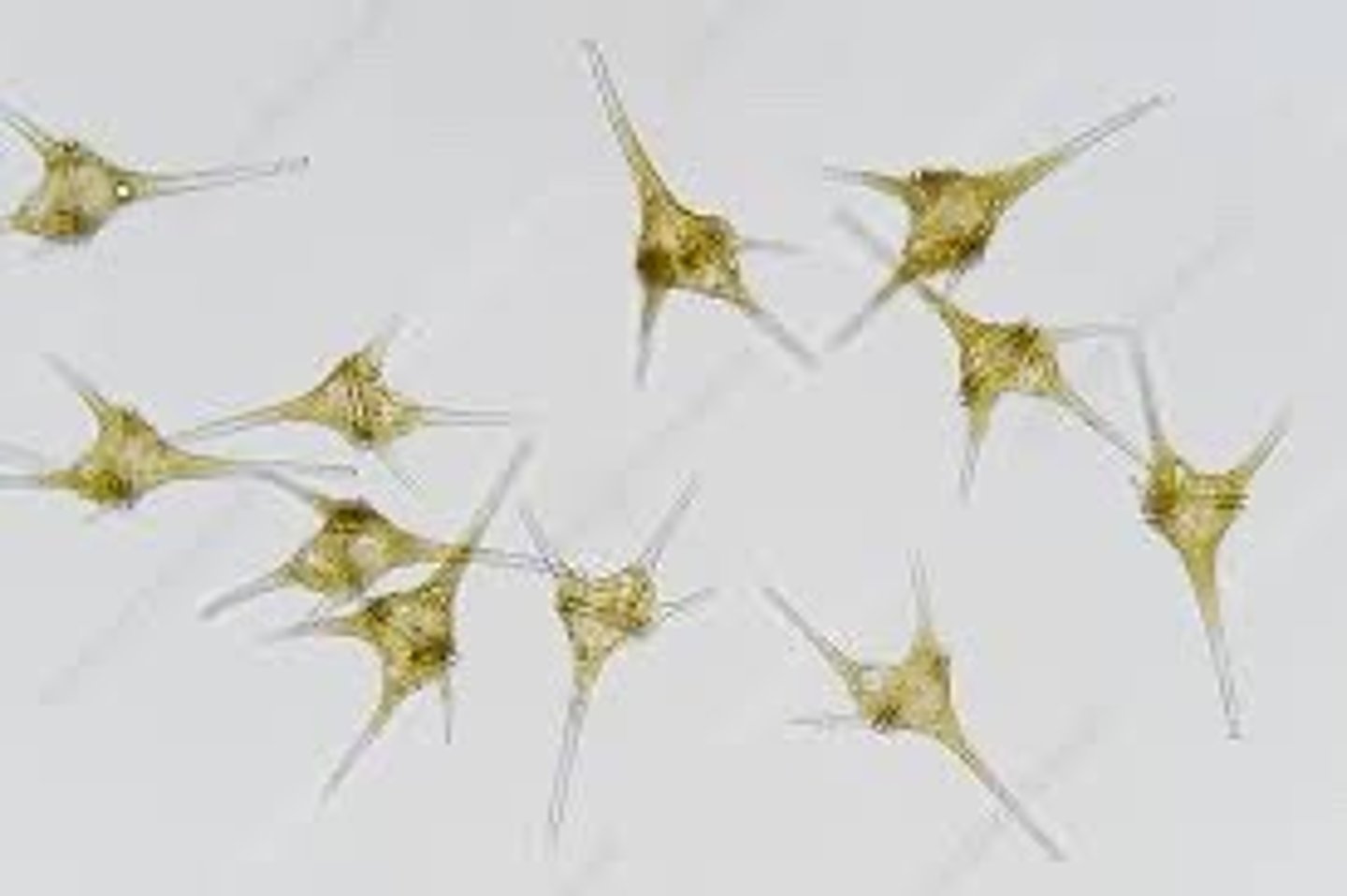
Dinoflagellates genus, phylum/ supergroup, domain
G: Dinoflagellates
S: Alveolata
D: Eukarya
How do dinoflagellates feed, move, and key characteristics
Heterotrophic and autotrophic; have two perpendicular flagella (whirling pattern when swimming); most have cellulose plates, some cause red tide and some are bioluminescent
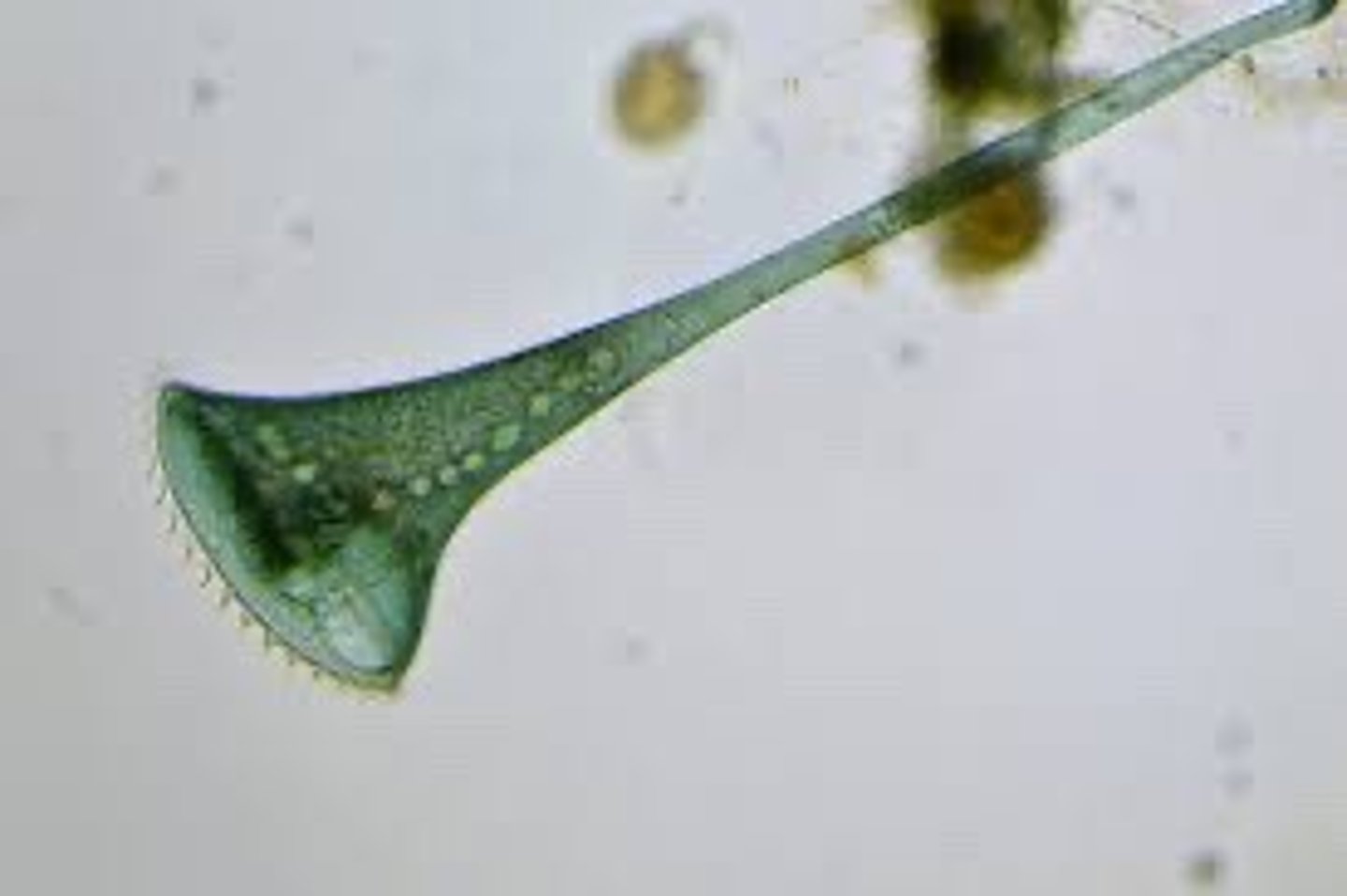
Stentor
Have ciliated corona; Alveolata Supergroup
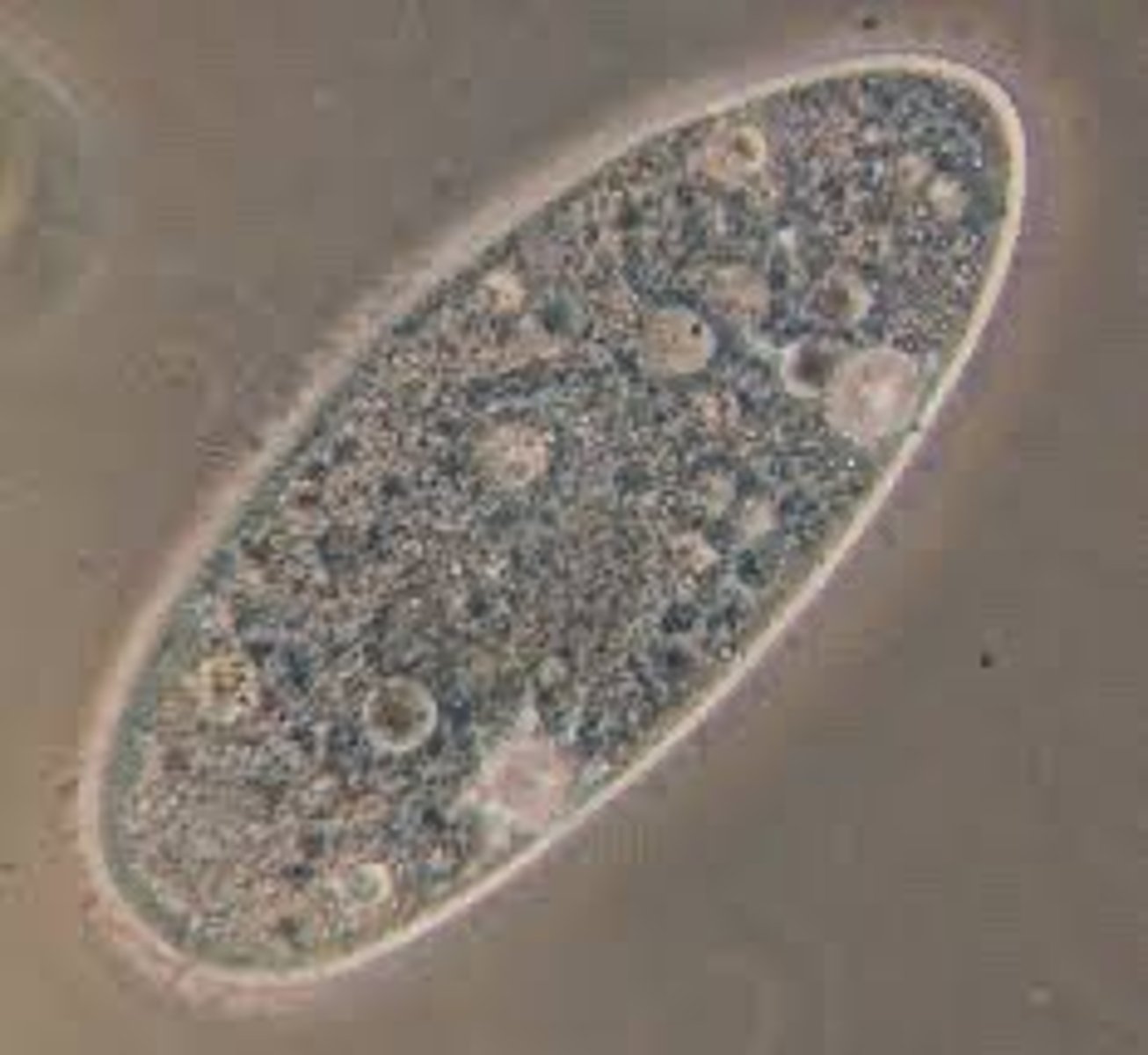
Paramecium
Exhibit taxis (directional response to a stimulus; Alveolata Supergroup
Rhizaria (SAR Clade)
Planktonic heterotrophic marine organisms possessing very narrow pseudopodia (axopodia). Many form symbiotic relationships with photosynthetic algae