IHUM 202 Final: Stirling BYU
 Call Kai
 Learn
Learn Practice Test
 Spaced Repetition
 Match
Match Flashcards
 Knowt Play
1/246

There's no tags or description
Looks like no tags are added yet.
Name | Mastery | Learn | Test | Matching | Spaced | Call with Kai |
|---|
No analytics yet
Send a link to your students to track their progress
247 Terms
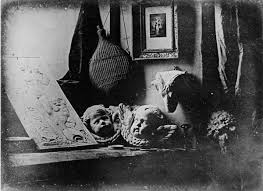
Nature Morte: Intérieur d’un cabinet curiosités
Toward the Modern Era
(Daguerre, photography)
Louis-Jacques-Mandé Daguerre’s oldest known daguerreotype. This groundbreaking still life features a meticulously arranged, dense collection of classical objects—including plaster putti, a bas-relief panel, and other curiosities—designed to validate photography as a fine art form by matching traditional painting hierarchies.
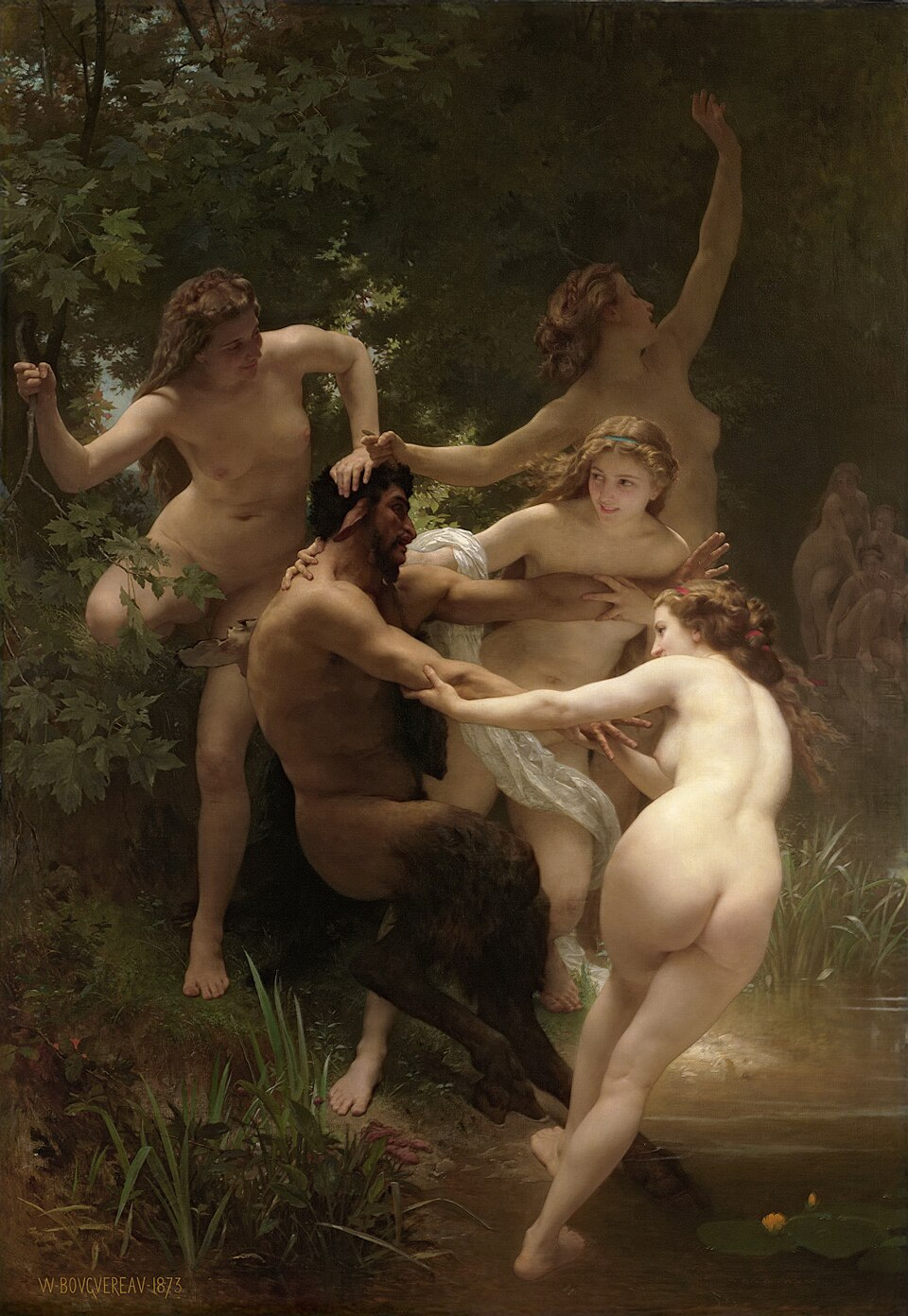
Nymphs and Satyr (Bouguereau)
Toward the Modern Era
Academic Art
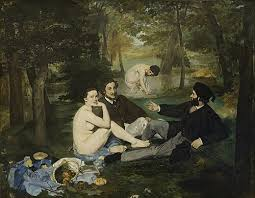
Luncheon on the Grass (Manet)
Toward the Modern Era
Ordinary, identifiable people from the middle class having a picnic in the park - but why is she nude?
His painting style was not Academic
Depth is compressed, not realistic
Created a huge stir
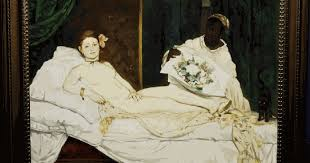
Olympia (Manet)
Toward the Modern Era
Similar to Titian’s Venus of Urbino
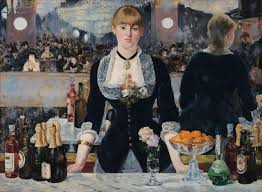
A Bar at the Folies-Bergère (Manet)
Toward the Modern Era
Charles Baudelaire
Toward the Modern Era
Essayist, poet, art critic in France at the same time as Manet
Fleur du Mal (Flower of Evil) which is about the changing nature of beauty in Paris during this time of rapid industrialization
He coined the term “modernité” to describe fleeting experience
of life in an urban area and said it was the responsibility of
artists to capture the experience of “the transitory, the fugitive”-
Modern world is one of “artificial desires” that are only satiated
by commodities: clothing, fashion, pleasure, entertainment,
makeup, sex (prostitution), etc.
Friedrich Nietzsche
Toward the Modern Era
Nietzsche's central philosophy was "life-affirmation". He believed individuals should actively embrace the inherent struggles and suffering of existence rather than relying on religious or societal constructs. To achieve true personal excellence, he challenged people to reject traditional morality and forge their own values
Photography, daguerretype
the world’s first publicly available photographic process. Invented by Louis Daguerre in 1837 and introduced in 1839, it produced highly detailed, one-of-a-kind images on a mirror-polished, silver-plated copper plate. Because it involved no negatives, every daguerreotype is a unique physical object.
Photography was a Democratic equalizer — easy portraits for the growing middle class
Realism
the practice of accepting a situation as it is and being prepared to deal with it accordingly.
War photography
realism in real time
Royal Art Academies
- Académie Royale de Peinture et de Sculpture (Royal Academy of Painting and Sculpture) in Paris, established in 1648 becomes the Académie des Beaux Arts in 1816
- Controlled the art scene of Europe by sponsoring exhibitions (salons) that showcased art that complied with the standards of the academy
- Traditional subjects like history, mythology, nudes
- Had moved to an almost photographic realism as shown by Bouguereau- So realistic, you almost can’t see the “hand” of the artist
Salon de Refusés
Rejected by the salon and presented all together
Banded against the Academy
Modernity (modernité)
describe fleeting experience of life in an urban area and said it was the responsibility of artists to capture the experience of “the transitory, the fugitive”
- Modern world is one of “artificial desires” that are only satiated by commodities: clothing, fashion, pleasure, entertainment, makeup, sex (prostitution), etc.
Übermensch
a foundational concept in the philosophy of Friedrich Nietzsche. It represents an ideal, evolved human who overcomes traditional religious and societal morality to create their own values and meaning in a world without God
“Will to power”
a central concept in the philosophy of Friedrich Nietzsche. It describes the fundamental driving force in all human behavior: not merely the pursuit of physical control over others, but the internal drive for self-actualization, self-mastery, growth, and the realization of one's utmost potential
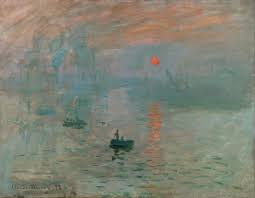
Impression, Sunrise (Monet)
Impressionism
Just an impression, not realism
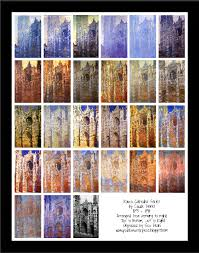
Rouen Cathedral Series (Monet)
Impressionism
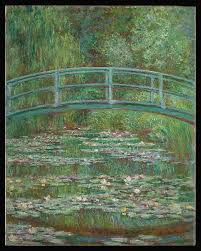
Water Lilies (Monet)
Impressionism
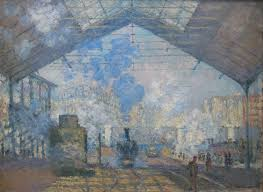
The Gare St. Lazare (Monet)
Impressionism
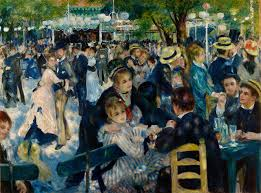
Le Moulin de la Galette (Renoir)
Impressionism
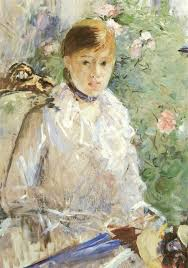
Young Girl by the Window (Morisot)
Impressionism
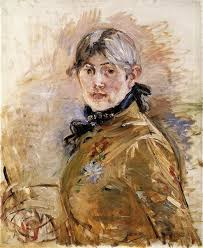
Self Portrait (Morisot)
Impressionism
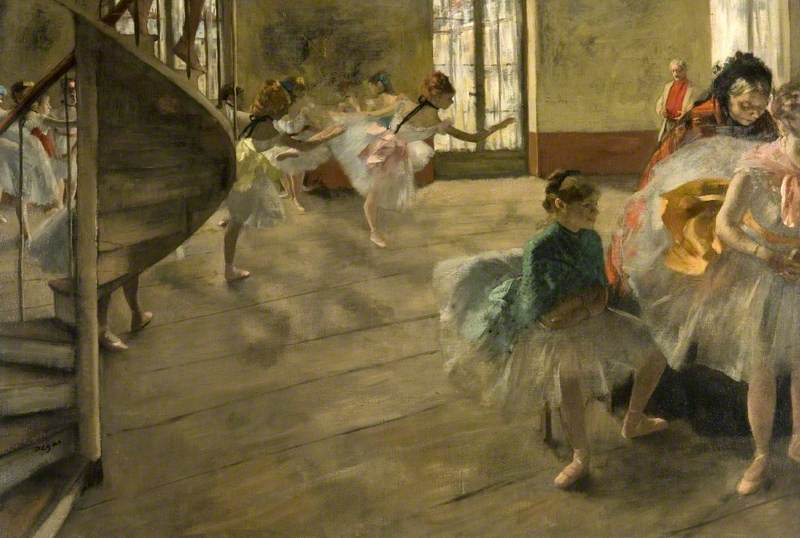
The Rehearsal (Degas)
Impressionism
How is it like Japanese woodcuts and photography? - unusual angles and directional lines of perspective. Everyday urban scenes, close cropped portraits. Intimate domestic scenes
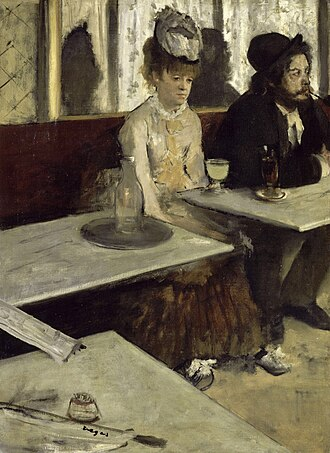
L’Absinthe (Degas)
Impressionism
a stark visual essay on the alienation, emotional coldness, and social isolation that accompanied rapid urbanization and the rise of industrialization in 19th-century Paris.
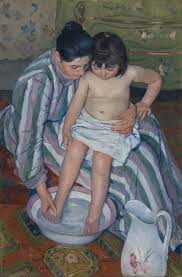
The Child’s Bath (Cassatt)
Impressionism
intimate scene of mother and child - references Mother Mary and Marie Antoinette
Tactile—can feel the pressure of the mother’s hands on the child and child on mother
Japanese influence of intimate scene and close up portrait. Floral aspect
Photography from above
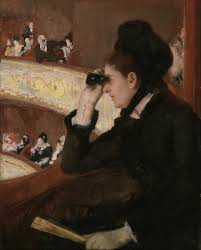
In the Loge (Cassatt)
Impressionism
Opera house was the center of life at this time
Artists would often paint there
Public display of audience before/after performance
See and be seen
Modern Era
constant shift and change to what we see as reality
social and polititcal revolutions had replaced monarchies
Scientific and technological developments had moved people from an agrarian life to industrialized cities
Belle Epoquem = The Beautiful Age
Massive migration to the US
Religion has lost hold over intellectual circles
Women’s movements, especially the right to vote
Impressionism
Often social places of the city, yet showing isolation and reflection
Late 1800s, group of artists banded together against the strictness of the Academy
Often painted outdoors (en plen aire) rather than in a studio
Studied the dramatic effects of light and atmosphere on nature, people, architecture
Studied how colors and their varied juxtapositions could imitate the effects of light
Japonisme/Japanese Woodcuts–influence on Impressionism
Unusual angles and directional lines of perspective
Everyday, urban scenes
Close cropped portraits
Floral motifs
Intimate domestic scenes—especially women with children or a woman’s toilette
Plein Air
painting out in the open
Impressionism
Color Theory
Impressionist color theory shifted away from dark, traditional chiaroscuro in favor of painting subjective light and atmosphere. Artists applied pure, unmixed pigments using scientific optical mixing, complementary contrasts, and high-chroma palettes to make the canvas vibrate with the intensity of natural sunlight
Post-Impressionism
Post-Impressionism
Post-Impressionism
Post-Impressionism
Post-Impressionism
Post-Impressionism
Post-Impressionism
Post-Impressionism
Post-Impressionism
Post-Impressionism
The Turn of the Century
The Turn of the Century
The Turn of the Century
Fauvism
Fauvism
Fauvism
Expressionism
Expressionism
The Old Guitarist (Pablo Picasso, Blue Period)
Blue Period
Acrobat and Young Harlequin (Pablo Picasso)
Rose Period
Les Demoiselles d’Avignon (Pablo Picasso)
Analytic Cubism
Guitar, Sheet Music, and Glass (Pablo Picasso)
Synthetic Cubism
Violin and Candlestick (Georges Braque)
Analytic Cubism
Still Life with Violin and Pipe (Georges Braque)
Synthetic Cubism)
Futurism
Futurism
The Turn of the Century
The Turn of the Century
The Turn of the Century
The Turn of the Century
The Turn of the Century
The Turn of the Century
The Turn of the Century
The Turn of the Century
The Turn of the Century
The Turn of the Century
Opera
“Habanera (L'amour est un oiseau rebelle)”
“Toreador Song”
Turn of the century: opera
Light Opera/Opera Buffa
Light Opera/Opera Buffa
Symphonic music:
Symphonic music:
“Arabian Dance”
“Chinese Dance”
“Russian Dance”
Symphonic music
Symphonic music
Symphonic music
Symphonic music
Symphonic music
Symphonic music