Biology - B2.1 Membranes and Membrane Transport
 Call Kai
 Learn
Learn Practice Test
 Spaced Repetition
 Match
Match Flashcards
 Knowt Play
1/55

There's no tags or description
Looks like no tags are added yet.
Name | Mastery | Learn | Test | Matching | Spaced | Call with Kai |
|---|
No analytics yet
Send a link to your students to track their progress
56 Terms
Phospholipid Bilayer
another name for plasma membrane
comes from the membrane being made up of 2 layers of phosolipids
Phospholipids naturally form bilayers when added to water.
The hydrophilic phosphate heads face water.
The hydrophobic fatty acid tails are in the middle of the bilayer.
All membranes in cells are composed of a phospholipid bilayer.
Phospholipids
what the plasma membrane is made of
has a head and a tail
Two fatty acid chains and a phosphate are bonded to a glycerol molecule.
The fatty acid tails are nonpolar and are hydrophobic.
The phosphate head is charged and is hydrophilic.
Phospholipids are amphipathic, as they have hydrophobic and hydrophilic regions.
Polar
when charge dipoles don’t cancel out in molecules (or polar bonds)
water is polar
hydrophillic when polar?
yes cuz like likes like and like disolves in like
Nonpolar
when bond dipoles cancel out in molecules (non polar bonds also)
Most of the cholesterol molecule is hydrophobic (nonpolar)
Hydrophobic
hydrophobic (uncharged) particles
repels water
not attracted to water
Hydrophilic
Hydrophilic (charged) particles
likes water
attracted to water
Amphipathic
Phospholipids are amphipathic, as they have hydrophobic and hydrophilic regions.
both hydrophobic and hydrophilic
Kinetic Theory
Kinetic theory states that particles are in constant motion.
Particles in gases, liquids and solutes in aqueous solutions move in random directions.
The random movement of particles allows diffusion and osmosis to occur.
Simple Diffusion
Use movement of oxygen and carbon dioxide molecules between phospholipids as an example of simple diffusion across membranes.
Diffusion is the passive transport of particles from a region of high concentration to a region of low concentration. It is called passive because it uses no energy from the cell.
Small uncharged particles (such as O2 and CO2) and fat soluble molecules (such as hydrophobic steroids) can diffuse across plasma membranes.
Oxygen diffuses directly from the alveoli into the blood.
Carbon dioxide diffuses directly from the blood into the alveoli of the lungs.
Hydrophilic, charged particles cannot pass directly through cell membranes
Membrane Selectivity
Simple diffusion is not a selective process, as any small or hydrophobic particle is able to pass through the phospholipid bilayer.
Facilitated Diffusion
Osmosis through aquaporins is an example of facilitated diffusion.
Charged particles cannot diffuse directly through cell membranes.
Charged particles enter and exit cells through protein channels.
Facilitated diffusion is the passive transport of molecules from a region of high concentration to a region of low concentration through channel proteins.
Channel proteins are specific to the molecule that can pass through them, making cell membranes selectively permeable.
Concentration Gradient
The concentration gradient definition is a difference in the concentration of solute across a membrane.
The solute is one part of a solution, the solvent being the other part.
The solute is what is present in a smaller quantity, and the solvent is what is present in a larger quantity.
Osmosis
Diffusion and osmosis are passive processes in cells, as the cell does not provide any energy to move particles.
The random movement of particles allows diffusion and osmosis to occur.
Osmosis is the passive transport of water molecules from a region of low solute concentration to a region of high solute concentration through a semipermeable membrane.
Water is polar, but it is so small that it can move through a phospholipid bilayer.
Solutes in water are charged (polar molecules or ions) and cannot pass through the phospholipid bilayers found in membranes.
Osmosis and Aquaporins
Osmosis moving water directly through membranes is a slow process.
Aquaporins are integral channel proteins that selectively transport water rapidly through membranes.
The presence of aquaporins in a plasma membrane significantly increases membrane permeability to water.
Osmosis through aquaporins is an example of facilitated diffusion.
Passive Transport
It is called passive because it uses no energy from the cell.
Integral Proteins
Integral proteins are permanently attached to the plasma membrane, and penetrate into the centre of the phospholipid bilayer.
Integral proteins contain a hydrophobic section (within the fatty acid tails) and two hydrophilic sections (one at each surface of the bilayer). The hydrophobic section anchors the protein within the bilayer.
Integral proteins can be transmembrane or only partially penetrate the bilayer.
Integral proteins can be glycoproteins, channels, or protein pumps.
Integral proteins can be receptors and enzymes.
Transmembrane Proteins
Transmembrane proteins are defined as membrane proteins that span the cell membrane, playing critical roles in sensing the environment, maintaining homeostasis, detecting signals, and facilitating communication between cells.
transmembrane or only partially penetrate the bilayer.
Peripheral Proteins
Peripheral proteins are temporarily attached to one side of the membrane.
They are attached to the membrane surface or to integral proteins, through electrostatic interactions. The charged peripheral proteins are attracted to the charged sections of the integral proteins and phosphate heads.
Peripheral proteins are hydrophilic and do not penetrate the phospholipid bilayer
Channel Proteins
Aquaporins are integral channel proteins that selectively transport water rapidly through membranes.
the structure of channel proteins makes membranes selectively permeable by allowing specific ions to diffuse through when channels are open but not when they are closed
used for facilitated diffusion
Channel proteins are specific to the molecule that can pass through them, making cell membranes selectively permeable.
Channel proteins have a central pore which allows specific particles to move through.
The pore is lined with hydrophilic R groups from amino acids, that allow one type of molecule to pass through.
Some protein channels are gated, and will only open to allow facilitated diffusion to happen in response to a stimulus.
Sodium and potassium voltage-gated channels open and close based on the potential difference across membranes.
Protein Pumps
ATP provides the energy required to change the shape of protein pumps for active transport in cells.
Active transport is a selective process as protein pumps are specific to the particles that they can transport.
A protein pump is a type of membrane protein that requires energy to move molecules across the cellular membrane against a concentration gradient (from a low concentrated compartment to a high concentrated compartment).
Since protein pumps require energy they are considered to be a type of active transport.
Aquaporins
Aquaporins are integral channel proteins that selectively transport water rapidly through membranes.
The presence of aquaporins in a plasma membrane significantly increases membrane permeability to water.
Osmosis through aquaporins is an example of facilitated diffusion.
Solution
A solution is a homogeneous mixture of one or more solutes dissolved in a solvent.
solvent: the substance in which a solute dissolves to produce a homogeneous mixture.
Solute
Solutes in water are charged (polar molecules or ions) and cannot pass through the phospholipid bilayers found in membranes.
A solute is a substance (solid, liquid, or gas) that is dissolved in a solvent to form a homogeneous solution.
Solvent
A solvent is a substance—usually a liquid—that dissolves solutes (substances like salts, sugars, or proteins) to form a solution.
Solute Concentration
Solute concentration in biology is the amount of solute (particles like salt, glucose, or ions) dissolved in a given volume of solvent (usually water) to create a solution
Semipermeable Membrane
only lets some things in
A membrane that permits selective passage, acting as a "gatekeeper" for cells.
Active Transport
Active transport is the movement of particles from a region of low concentration to a region of high concentration using protein pumps and ATP energy.
Active transport uses ATP energy to transport particles across cell membranes against the concentration gradient.
Active transport involves the following:
A specific particle binds to a binding site on a specific protein pump.
ATP binds to the protein pump and hydrolyzes to become ADP
A phosphate remains attached to the protein pump, and causes the protein pump to change shape.
The particle is moved against the concentration gradient and released.
The phosphate is released, causing the protein pump to return to its original shape.
Active transport is a selective process as protein pumps are specific to the particles that they can transport.
Adenosine Triphosphate (ATP)
ATP provides the energy required to change the shape of protein pumps for active transport in cells.
This is an active process requires ATP Energy.
ATP energy is required to create a concentration gradient for the ion.
Glycoproteins and Glycolipids
Integral proteins can be glycoproteins, channels, or protein pumps.
Phospholipids and membrane proteins can have carbohydrate chains attached by a process known as glycosylation.
Glycoproteins are membrane proteins with a carbohydrate chain attached.
Glycolipids are phospholipids with a a carbohydrate chain attached.
The carbohydrates of glycoproteins and glycolipids are on the outside surface of the cell.
Roles of glycoproteins and glycolipids include:
Receptors: Glycoproteins act as receptors for hormones. When a hormone binds to a specific glycoprotein receptor, it changes metabolism within the cell.
Cell to Cell Communication: Neurotransmitters bind to glycoproteins allowing communication between cells.
Immune Response: Glycoproteins act as markers on cells allowing the immune system to distinguish between self and and non-self cells.
Cell to Cell Adhesion:Glycoproteins interact with glycoproteins on neighbouring cells, allowing the formation of tissues.
Some glycoproteins are cell adhesion molecules, and are responsible for direct attachment between neighbouring cells.
The carbohydrates of glycoproteins and glycolipids can form an extracellular matrix with the glycoproteins and glycolipids of neighbouring cells, leading to stable cell to cell adhesion. The matrix provides structural support for neighbouring cells, and plays an important role in the formation of tissues.
The carbohydrate chains that form on glycoproteins and glycolipids have specific shapes allowing the immune system to recognise the cells as self.
Glycoproteins and glycolipids act as antigens if the carbohydrate chain is not recognized as self by the immune system.
Fluid Mosaic Model
includes peripheral and integral proteins, glycoproteins, phospholipids and cholesterol and hydrophobic and hydrophilic regions.
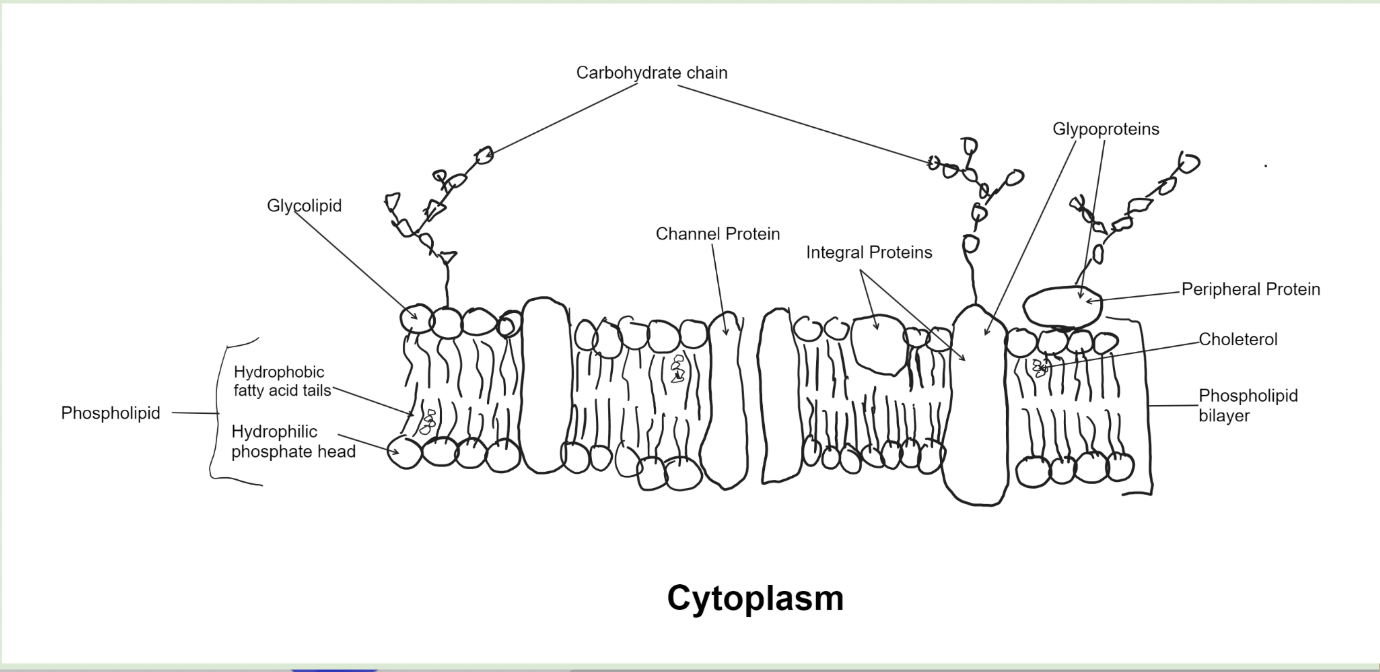
Saturated Fatty Acids
Saturated fatty acids have single bonds between the carbons on the hydrocarbon chain.
Saturated fatty acids are linear.
Triglycerides with saturated fatty acids have higher melting points than triglycerides with unsaturated fatty acids.
Saturated Fatty Acids and Fluidity of Membranes
Saturated fatty acids have no carbon-carbon double bonds resulting in straight fatty acid tails allowing close packing of the phospholipids
These phospholipids have higher melting points, increasing the viscosity of membranes.
Cell membranes with more saturated fatty acid chains have higher viscosity and higher melting points. Saturated fatty acids make membranes stronger at higher temperatures.
Unsaturated Fatty Acids
Unsaturated fatty acids in lipid bilayers have lower melting points, so membranes are fluid and therefore flexible at temperatures experienced by a cell.
Unsaturated fatty acids have at least one double bond between carbons on the hydrocarbon chain.
Unsaturated fatty acids bend at the position of the double bond.
Triglycerides with saturated fatty acids have higher melting points than triglycerides with unsaturated fatty acids.
Cell membranes with more unsaturated fatty acid chains are more fluid (have lower viscosity) and have lower melting points.
Fatty Acids in the Phospholipid Bilayer of Steelhead Trout
As the temperature decreases, the concentration of unsaturated fatty acids increase in all tissues of steelhead trout.
At low temperatures, the high concentration of unsaturated fatty acids maintains the membranes’ fluidity.
At higher temperatures, the higher concentration of saturated fatty acids increases the stability of membranes.
Cholesterol
Cholesterol molecules should be added between the fatty acid chains.
Cholesterol is a steriod located in the membranes of animal cells, and helps regulate the fluidity of the membrane.
Location of Cholesterol in the Phospholipid Bilayer
Most of the cholesterol molecule is hydrophobic (nonpolar) and is located between fatty acid tails of phospholipids in cell membranes.
The hydroxyl group (-OH) on the cholesterol is hydrophilic (nonpolar), and forms a hydrogen bond with the phosphate of a phospholipid.
Cholesterol Regulates Membrane Fluidity
Cholesterol regulates the fluidity of cell membranes in animal cells.
At higher temperatures, cholesterol reduces fluidity and increases melting point of phospholipids, resulting in stable membranes.
At lower temperatures, the presence of cholesterol between phospholipids maintains fluidity of the membrane and prevents crystallization of the phospholipids.
Steroid
Steroids are complex lipophilic molecules that have many actions in the body to regulate cellular, tissue and organ functions across the life-span
Vesicles
Vesicles are small membrane bound structures involved in transporting materials within cells.
The fluid nature of cell membranes allows the formation of vesicles from membranes and the fusion of vesicles with membranes.
Bulk transport (endocytosis and exocytosis) is possible due to the fluid nature of the plasma membrane allowing the formation of vesicles and the fusion of vesicles with the membrane.
Proteins and other materials are transported within vesicles around the cell.
Bulk Transport
Bulk transport (endocytosis and exocytosis) is possible due to the fluid nature of the plasma membrane allowing the formation of vesicles and the fusion of vesicles with the membrane.
bulk transport is thru phagocytosis and pinocytosis
Exocytosis
Exocytosis is the release of large particles from a cell.
Exocytosis involves the fusion of a vesicle with the plasma membrane, releasing the content outside of the cell.
This is an active process which requires ATP Energy.
Endocytosis
Endocytosis is the process by which large particles enter the cell.
The large particles are surrounded by the plasma membrane, which buds off inside the cell to form a vesicle.
This is an active process which requires ATP Energy.
Gated Ion Channels
Ion channels are integral proteins which allow specific ions to pass through by facilitated diffusion. The pore in the ion channels is hydrophobic, allowing specific ions to enter and pass through.
Ion channels may be gated, allowing the movement of ions under controlled conditions.
Gated ion channels play a number of roles in the transmission of nerve impulses. Examples of gated ions include:
Voltage gated channels, which respond to changes in membrane potential difference.
Ligand gated channels, which respond to a ligand attaching to the channel.
Voltage Gated Ion Channels
Voltage gated channels open and close in response to changes in the potential difference (voltage) across a membrane where the channel is located.
Sodium and potassium voltage gated channels are involved in the movement of action potentials along neurons.
Calcium voltage gated channels are involved in synaptic transmission, the transfer of a nerve impulse from one neuron to another.
Sodium and potassium voltage-gated channels open and close based on the potential difference across membranes.
Ligand Gated Ion Channels
Ligand gated channels, which respond to a ligand attaching to the channel.
integral membrane proteins that contain a pore which allows the regulated flow of selected ions across the plasma membrane.
Ion flux is passive and driven by the electrochemical gradient for the permeant ions.
Ligand
Acetylcholine is a ligand which attaches to a sodium ion channel.
a ligand is defined as any molecule or atom that irreversibly binds to a receiving protein molecule, otherwise known as a receptor.
When a ligand binds to its respective receptor, the shape and/or activity of the ligand is altered to initiate several different types of cellular responses.
Acetylcholine
Neurotransmitter Gated Ion Channel
Acetylcholine is a neurotransmitter that opens sodium channels in the postsynaptic membrane of neurons
Acetylcholine is a ligand which attaches to a sodium ion channel.
When acetylcholine is attached to the channel, the channel opens, allowing sodium ions to enter a neuron through the postsynaptic membrane.
Potential Difference (Voltage)
The potential difference is maintained by sodium ions (Na+) being outside the axon of a neuron, and potassium ions (K+) and chlorine ions (Cl-) being inside the axon.
the -70mV and +30mV
Sodium Potassium Pump
The sodium potassium pump actively transports sodium ions out of a cell, and potassium ions into a cell.
The sodium potassium pump maintains resting potential in neurons.
The sodium potassium pump is an exchange transporter, as Na+ and K+ travel in opposite directions.
keeps equalibrim after the voltage is very low (gated ion channels open and flows and the results are very hiw +30 and very low (beblow -70)
Resting Potential and the Sodium Potassium Pump
Neurons are at resting potential (-70mV) when a nerve impulse is not being transmitted.
The potential difference is maintained by sodium ions (Na+) being outside the axon of a neuron, and potassium ions (K+) and chlorine ions (Cl-) being inside the axon.
The sodium potassium pump is involved in transporting Na+ out of the axon, and transporting K+ into the axon.
The sodium potassium pump transports Na+ and K+ against their concentration gradients, and is an example of active transport.
The action of the sodium potassium pump involves the following steps:
Three Na+ attach to the sodium ion binding sites on the sodium potassium pump protein.
ATP attaches to the sodium potassium pump.
ATP is hydrolyzed, with a phosphate remaining attached to the protein pump. ADP is released.
The phosphate causes the pump to change shape, moving the sodium across the axon membrane, releasing Na+ outside the axon.
Two K+ attach to the potassium ion binding sites on the sodium potassium pump protein.
The phosphate is released from the pump.
The pump returns to its original shape moving the K+ into the axon.
The process can be repeated.
The sodium potassium pump is an example of an exchange transporter, as the sodium ions and potassium ions are transported in opposite directions.
Sodium ions (Na+) are actively pumped out of epithelial cells by the sodium potassium pump, resulting in a low concentration of Na+ in epithelial cells.
Exchange Transporter
excahnged onetype of molecule for another! spp
Resting Potential
Neurons are at resting potential (-70mV) when a nerve impulse is not being transmitted.
the neutral state
Axon
Each neuron in your brain has one long cable that snakes away from the main part of the cell.
This cable, several times thinner than a human hair, is called an axon, and it is where electrical impulses from the neuron travel away to be received by other neurons.
Cotransporters
Cotransport is an example of indirect active transport, as ATP energy is required to create a concentration gradient for the ion.
Sodium Dependent Glucose Cotransporters
During the indirect active transport of glucose from the small intestine into epithelial cells the following happens:
Sodium ions (Na+) are actively pumped out of epithelial cells by the sodium potassium pump, resulting in a low concentration of Na+ in epithelial cells.
Na+ and glucose bind to the sodium-dependent glucose cotransporter protein.
The attachment of sodium and glucose causes the protein to change shape, moving both glucose and sodium into an epithelial cell.
The transport of glucose depends on the active transport of sodium out of the epithelial cells.
Glucose Transport
Glucose is transported by two mechanisms from the small intestine into the epithelial cells that line the intestine.
Facilitated Diffusion: Glucose is passively transported through glucose channels from the small intestine into the epithelial cells.
Sodium Dependent Glucose Cotransporters: Cotransport links the movement of an ion (Na+) down its concentration gradient with the movement of a solute (Glucose) against its concentration gradient.
Cotransport is an example of indirect active transport, as ATP energy is required to create a concentration gradient for the ion.
Epithelial Cells
intestine cellls
Epithelial cells are specialized, tightly packed cells that form continuous sheets (epithelium) covering internal and external body surfaces, lining cavities, and forming glands
Epithelial cells are among the most abundant cells covering the skin, body cavities, and blood vessels.
They contribute significantly to several aspects of the human life cycle from embryogenesis to adulthood.
Their highly specialized histologic feature is critical for their physiological functions in different organs.
epithelial cells line the intestine.
Cell Adhesion Molecules (CAMs)
Cell to Cell Adhesion
Some glycoproteins are cell adhesion molecules, and are responsible for direct attachment between neighbouring cells.
The carbohydrates of glycoproteins and glycolipids can form an extracellular matrix with the glycoproteins and glycolipids of neighbouring cells, leading to stable cell to cell adhesion. The matrix provides structural support for neighbouring cells, and plays an important role in the formation of tissues.
There are a range of cell adhesion molecules (CAMs) which are used for different types of cell junctions:
Tight junctions form a seal between cells, preventing substances leaking between the cells.
Gap junctions are channels between cells that allow molecules to pass between cells, allowing cell communication.
Adherens junctions use protein complexes to connect cells together
Desmosomes use protein complexes to form strong connections between cells, providing tissues with structural integrity.
Tissues
A tissue is a group of similar cells and extracellular matrix, derived from the same embryonic origin, that work together to perform a specific function in a multicellular organism.
Cell Junctions
Cell junctions are protein complexes that provide adhesion between animal cells.
CAMs are a range of proteins which are used in different cell junctions.
different types of cell junctions:
Tight junctions form a seal between cells, preventing substances leaking between the cells.
Gap junctions are channels between cells that allow molecules to pass between cells, allowing cell communication.
Adherens junctions use protein complexes to connect cells together
Desmosomes use protein complexes to form strong connections between cells, providing tissues with structural integrity.
Tight Junctions
Tight junctions form a seal between cells, preventing substances leaking between the cells.
Gap Junctions
Gap junctions are channels between cells that allow molecules to pass between cells, allowing cell communication.
Adherens Junctions
Adherens junctions use protein complexes to connect cells together
Desmosomes
Desmosomes use protein complexes to form strong connections between cells, providing tissues with structural integrity.