Types of Studies on the MCAT (Psych/Soc), Psych Soc research methods
 Call Kai
 Learn
Learn Practice Test
 Spaced Repetition
 Match
Match Flashcards
 Knowt Play
1/26

There's no tags or description
Looks like no tags are added yet.
Name | Mastery | Learn | Test | Matching | Spaced | Call with Kai |
|---|
No analytics yet
Send a link to your students to track their progress
27 Terms
Longitudinal
a study that follows the same subjects over a long period of time
Cohort
subset of longitudinal study in which the subjects are picked because they have a shared common characteristic or experience within a defined period
Cross sectional
A snapshot study of a population at a given time.
Case Study
study in which the subjects are hand picked for a detailed analysis
Quantitative data
tangible, hard data, objective info
Qualitative data
Subjective information
Comparative analysis
studies the difference between different populations
between subjects design
participants are randomly assigned to an experimental group in the study, such that a participant only participates in one group
within subjects design
repeated measures design; when every participant is exposed to all conditions, treatments, or levels of an independent variable.
Correlational study
study that attempts to determine if there is simply a relationship between two variables.
Experimental study
(a study where we test to prove a causal relationship between the independent variable and dependent variable. Participants are randomly assigned to different groups or levels of the independent variable. Between-subjects and within-subjects designs are common experimental studies)
Between-subjects design
(participants are randomly assigned to to an experimental group in the study, such that a participant only participates in one group),
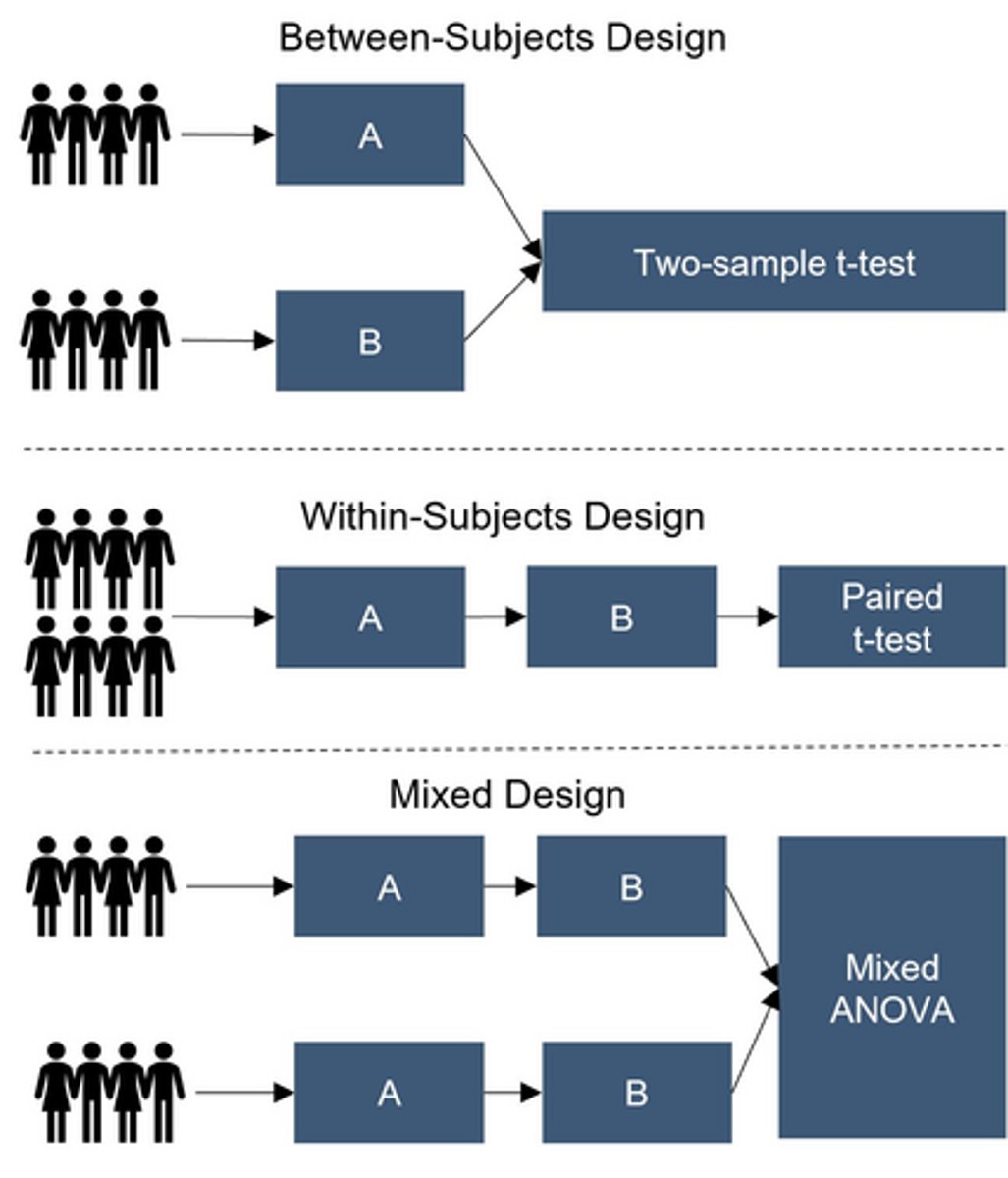
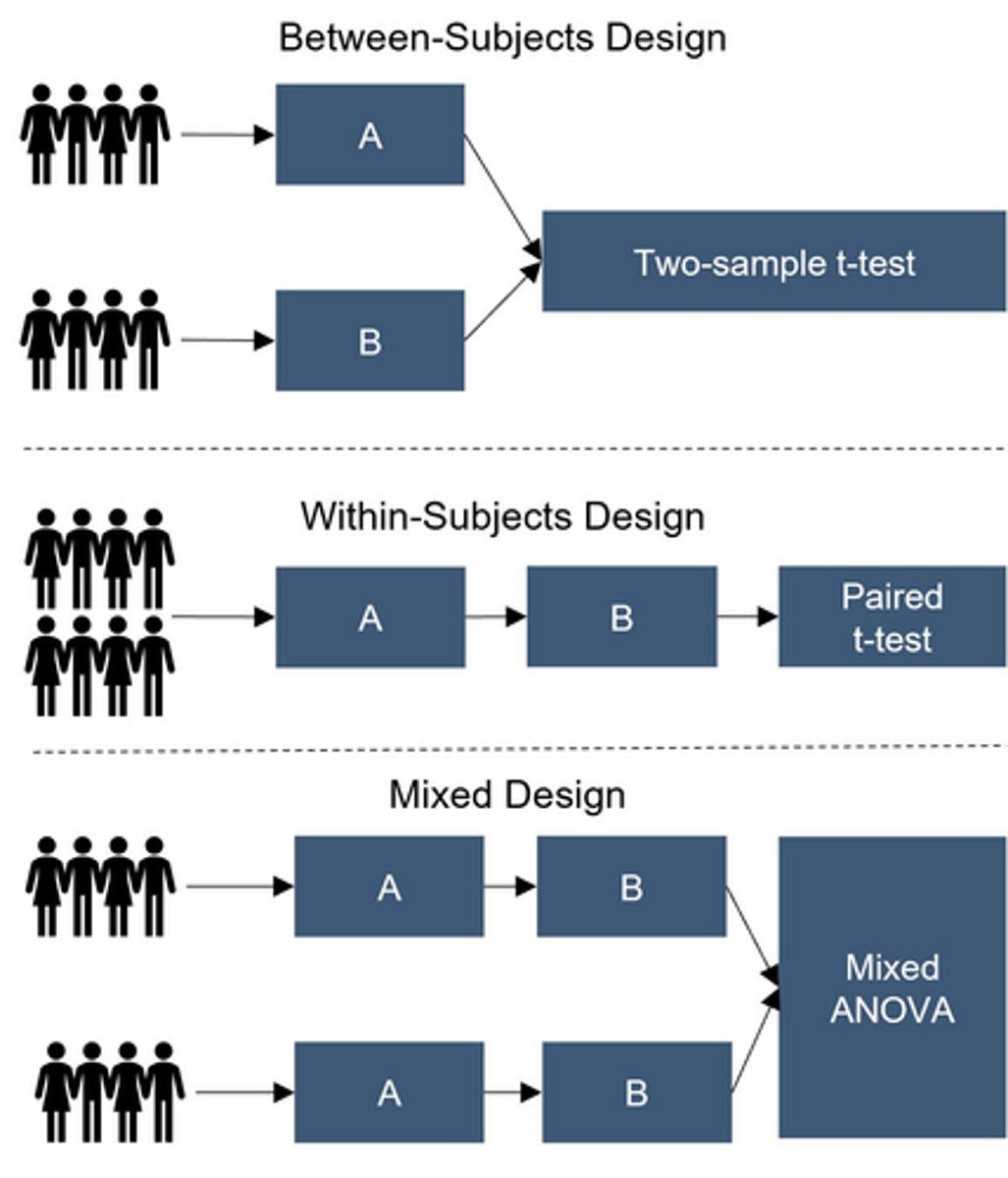
Within-subjects design
(also known as repeated-measures design, it is when a participant is exposed to every level of the independent variable. Gives you higher power because you are using more "subjects" in your study by using the same person in multiple conditions, and that you decrease individual difference effects seen in between-subjects designs.)
Retrospective study
(an observational study type where we look back at information in the past to try and find a trend between events in the past and current outcomes. One example would be conducting an experiment on people who suffer from Alzheimer's disease and looking back at their medical records to set up a relation between factors in the past and the current outcome. This type of study helps to develop and find potential risk factors for disease.)
Prospective study
a study where we follow groups of people and see how their behavior in that time influence future outcomes. This kind of study is looking into the future, while retrospective studies are looking into the past. One popular example of this kind of study is by following nurses to determine long term health outcomes by looking at factors like stress, smoking, and level of exercise.)
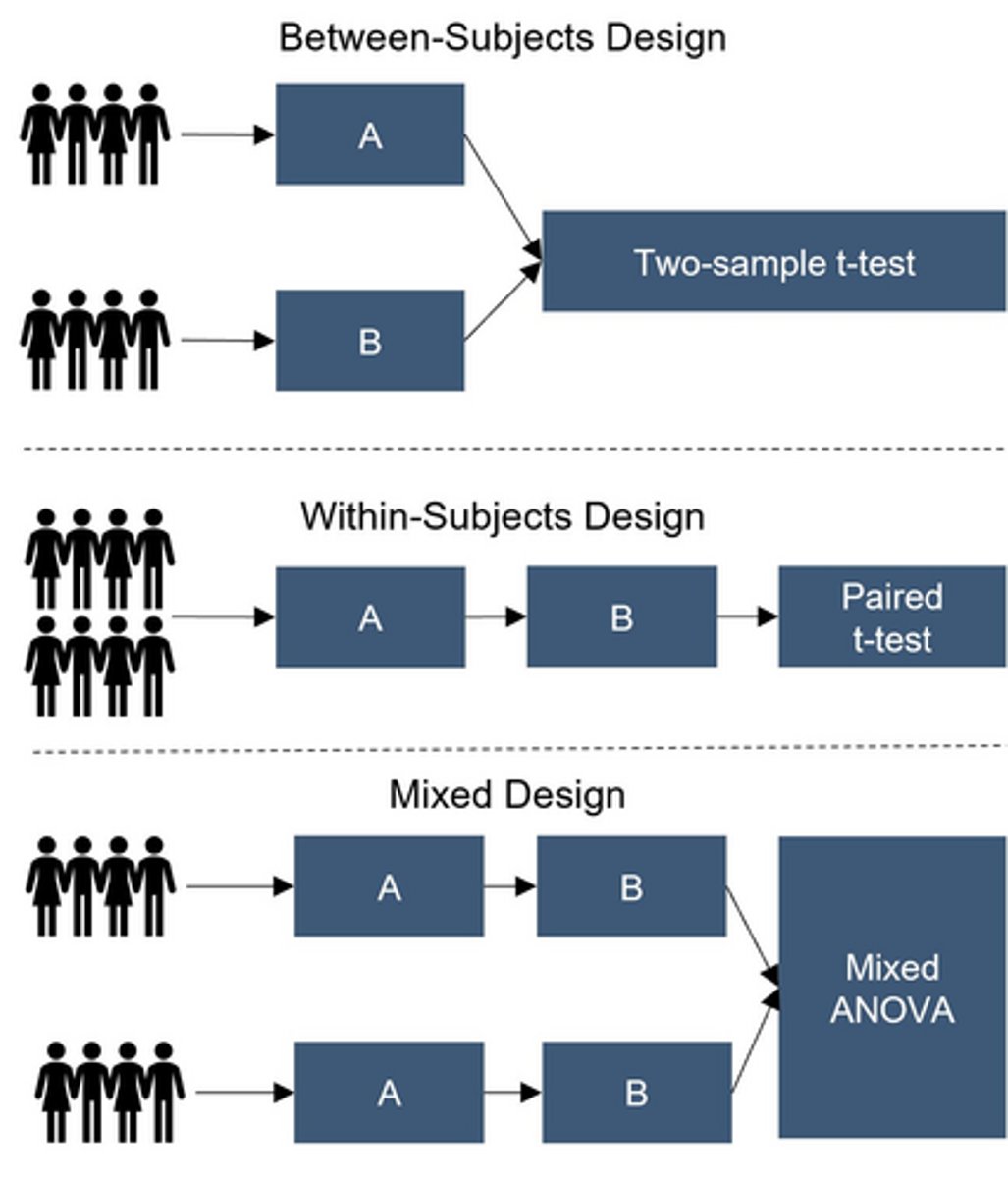
Mixed-method research design
a study where you use both qualitative and quantitative measures to conduct your study. One example would be using quantitative measures like how would you report your like for this product on a scale of 1 through 10, and then later following up with people who answered either negatively or poorly and asking them for their qualitative opinion.)
Base rate fallacy
cognitive bias where people ignore general statistical information (the "base rate") in favor of specific, often recent or vivid information
Public verfiability
the capability of a finding, data, or claim to be verified, checked, or challenged by third parties rather than relying on the original actor
Observer bias
occurs when researchers consciously or unconsciously allow their expectations, beliefs, or subjective opinions to influence the observation, recording, or interpretation of data
glass escalator
refers to the faster promotion and advancement of men into leadership roles in female-dominated occupations
overconfidence effect
a cognitive bias where a person's subjective confidence in their knowledge or abilities exceeds their objective accuracy
Labeling theory
that deviance is not inherent in an act, but rather a consequence of society applying labels to individuals, creating a self-fulfilling prophecy
(if we label someone a criminal they will become one)
naming explosion
rapid acceleration in word acquisition occurring in toddlers, typically around 18-24 months, where they move from slow, gradual learning to adding dozens of new words monthly
Overextension
a common language development error where toddlers use a single word to cover a broader category of objects than is appropriate (e.g., calling all animals "doggy")
Categorical perception
the tendency to sort some form of stimuli into groups or categories by the ways they relate to each other
Bootstrapping
developmental and cognitive processes where existing, limited knowledge is used to acquire more complex skills
Medicalization
human, or social problems (such as shyness, aging, or hyperactivity) are defined and treated as medical conditions, disorders, or illnesses