External attention lecture 3
 Call Kai
 Learn
Learn Practice Test
 Spaced Repetition
 Match
Match Flashcards
 Knowt Play
1/41

There's no tags or description
Looks like no tags are added yet.
Name | Mastery | Learn | Test | Matching | Spaced | Call with Kai |
|---|
No analytics yet
Send a link to your students to track their progress
42 Terms
What is vigilance or alerting?
Signifies achieving and maintaining a state of high sensitivity to incoming stimuli.
Involves a change in internal state of the body and brain in preparation for sensing and processing a stimulus (e.g. heart rate changes).
What two signals are related to vigilance and alerting?
Warning signal and sustaining alert state
What is a warning signal?
Phasic response of the system: Tell us when something will occur and increase the speed of focus on or response to the input signal but not accuracy.
What is sustaining alert state?
Tonic response of the system: Critical for optimal performance in tasks of higher cognitive function.
Which areas in the brain are involved in the alerting network?
Temporoparietal junction, pulvinar thalamus, right frontal area and locus coeruleus.
Which area of brain releases norepinephrine?
Locus coeruleus
What is the modulator for alerting?
Norepinephrine
How did Posner and Boies study cueing task as measuring function of warning?
Double cue vs no cue- warning signal (provides information of when but not where the target will appear.
Found no cue condition had faster reaction times than double cue in experience with interpretation in bilinguals.
How did Roberston et al measure sustained attention using continuous performance task?
Observers see rapid, rapid series of visual stimuli and are required to press a response key for every digit (go) except rare, designated digit (no go).
High frequency of go trials intended to create an automatic response pattern, making inhibition for no go trials a measure of sustained attention and inhibitory control.
What is phasic alertness (warning signal)?
Momentary, rapid increase in response readiness triggered by an external warning stimulus.
Transient, system wide increase in gain driven by task related decision processes.
Burst of release of Norepinephrine.
What is tonic alertness (sustained signal)?
Baseline, intrinsic level of wakefulness and arousal maintained over a long period.
Enduring and less discriminative increase in gain.
Slowly degrades performance within the current task but facilitates disengagement of performance from this task and thereby sampling of other stimuli.
How does slow release of norepinephrine (low tonic LC activity) affect task performance?
Drowsiness. Performance is poor at low levels of Locus Coeruleus tonic activity.
How does rapid release of norepinephrine (high tonic LC activity) affect task performance?
Hyperactivity. Performance is poor at high levels of Locus Coeruleus tonic activity.
For best task performance what is the ideal tonic LC activity?
Middle, firing in between low and high
What are targets of attention mechanisms?
Space based
Feature or object based
Point in time
What orientations of attention are there?
Top down or goal driven: voluntary or endogenous (looking for keys), involuntary or exogenous (seeing your friend)
Bottom up or stimulus driven: Voluntary or endogenous (fearful face amongst neutral grabs attention), involuntary or exogenous.
What is alignment with gaze?
Overt aligned with gaze
Covert- not aligned with gaze
How does attention become oriented/focused?
Objects in visual scene compete for access to visual STM.
Competition is biased by top down signals that promote access of behaviourally relevant objects.
These top down signals are characterised as working memory, LTM or action related interact with sensory signals produced by objects in visual scene
These interaction enabling the desired object to be selectively perceived and entered into memory at the expense of unimportant objects.
Exogenous and endogenous orienting.
What is the process of reorienting/shifting attention?
Objects outside of current focus of attention, i.e. do not match current setting for selecting stimuli and responses.
These objects we are looking for may appear with different features than we expected or at a different location.
New object may appear that requires different course of action.
May be presented with new events requiring a response while we are engage in internally directed activities that do not involve an interaction with environment.
Can happen reflexively based on high sensory salience or behavioural relevance.
E.g. sense that someone is watching you on the bus, sudden movement, etc.
What does orienting and reorienting signify?
Selecting what, when and where to process input.
What does orienting and reorienting involve?
•Improving detection, recognition accuracy
•Improving detection, recognition response time
•enhancing selection in primary sensory cortices
•improving neuronal tuning
•modulating spatial properties of receptive fields
•Enhances stimulus discrimination
Which network is responsible for orienting?
Dorsal attentional network.
•Sensitive to sensory stimuli based on internal goals or expectations and salient uninformative and unimportant stimulus
Which network is responsible for reorienting?
Ventral attentional network
•Sensitive to behaviorally relevant stimuli in the environment.
What is the main modulator for orienting and reorienting?
Acetylcholine
What is spatial based attention?
Enhances the efficiency and accuracy of processing information within the attended location.
These mechanisms evolved to guide and control eye movements. Attention and eye movements are tightly interlinked.
What are the three different types of spatial based attention?
Focused, spotlight
Divided, split across multiple non contingent locations
Distributed, spread across space
How can focused attention be measured?
Cueing task, measure accuracy between no cue and cue condition or valid and invalid cues.
How do endogenous and exogenous spatial cues affect performance on focus attention tasks?
Endogenous spatial cueing → cue in central position, voluntary, effects slower 300-500ms, sustained up to 1200ms, cue validity dependent
Exogenous spatial cueing → show cue exactly where stimulus will appear, involuntary, effect is rapid 90-120ms, transient dissipates after 300ms
What is inhibition of return?
Attention is biased away from a location recently focused resulting in slower re-attending to that location and faster to notice new things.
Spatial cueing can produce parallel facilitatory and inhibitory signals.
Responses to subsequent targets may reflect effects arising from the interaction of the two signals during target processing.
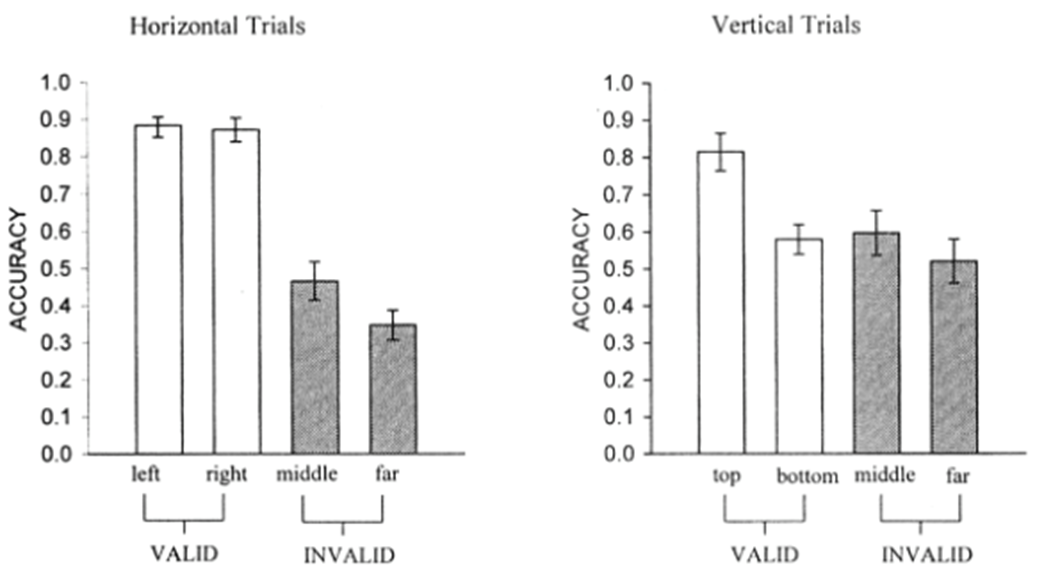
What did Awh and Pashler study divided attention using cueing task with grid of letters and asked to identify two digits?
Accuracy much higher for valid cues
Accuracy for horizontal trials much higher than vertical trials
Hemifield division → more capacity to optimise across hemifield than within hemifields.
Upper field of visual display better than bottom field.
What did Pylyshyn and Annan (2006) find in a study tracking multiple objects across space?
Limitations are within a hemifield → Can track lots of objects if presented on different screens
What did Chong and Treisman find in a study of distributed attention?
Cued, then looking for target that is odd one out. Either engaged in serial or parallel search. Asked to discriminate which circle represents mean circumference of circles or which circle they had seen (member)
Focused search → hard to determine both member and mean, higher RT times
Distributed search → faster RT
What is found in feature based attention studies when cueing location or direction?
d’ higher for location …
What did Anderson et al find in attentional capture task where observers complete training task rewarding them highly for responding to orientation in red circles then capture task using high value, low value or neutral distractors?
High value distractor increased RT on main task
Higher impulsivity and lower WM with higher RT’s for high value distractors
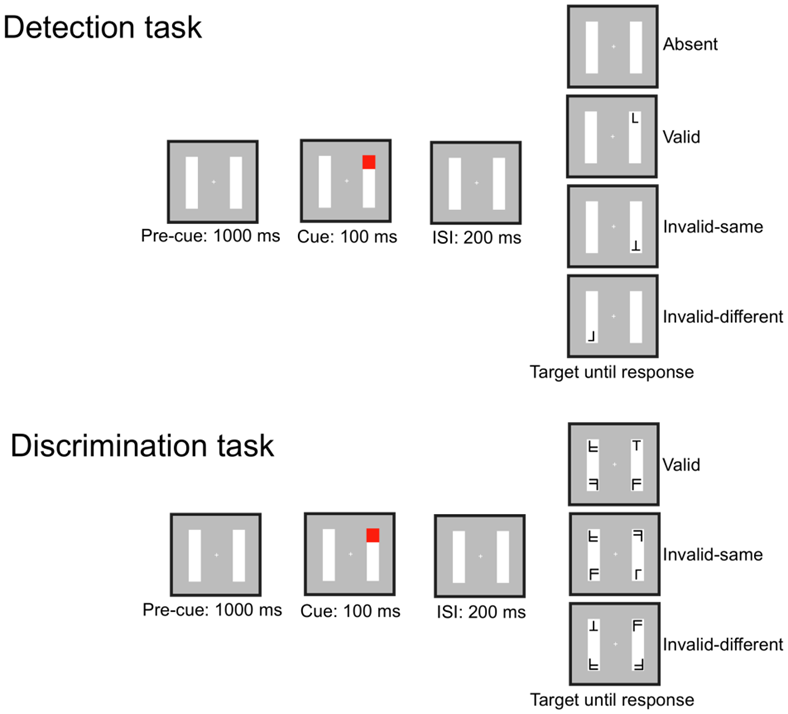
What did Egly et al find in a study of object based attention using detection and discrimination task?
Attention spreads to all parts of a recognised object
All features of attended object are processed faster and more accurately than features of other objects
What did Evans and Treisman find in attentional blink study of time based attention
Orienting attention to specific time point leads to faster reaction times and/or higher accuracy for events occurring at expected time
When we select and process information across time, we can see limitations as in space.
Increased blink when two targets from different categories
What did Strayer et al find in a driving simulator study where ppts drove under single task (only driving) and dual task (driving and conversing on cell phone) conditions?
Phone conversations divert attention away from driving → impairing explicit and implicit memory for visual info, slower to brake, braking longer
In car conversations do not seem to have same impact → 12% fail task to park in layby compared to 50% with hands free conversation → passengers pick up on cues
What did Dingus et al find in naturalistic driving studies?
Driver related factors (error impairment, fatigue, distraction) present in nearly 90% of crashes.
Distraction, particularly from handheld electronic devices is identified as significant risk factor.
What is focused processing in spatial attention?
Localize items in a display
Bind the features correctly
Explicitly recognize the object
What is distributed processing in spatial attention?
Global image properties - the gist of an image
Summary statistics of a set of items
Disjunctive features
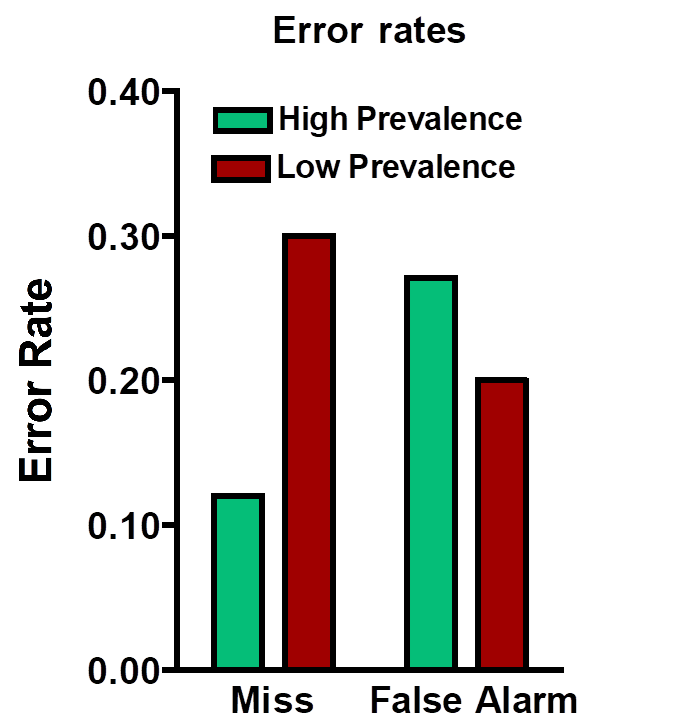
What did Evans, Birdwell and Wolfe (2013) find in a study of finding cancer and prevalence effects?
50 positive, 50 negative cases inserted into normal workflow and then brought radiologists into lab and asked them to do same thing with 10 cases
Low prevalence causes observers to miss targets that they would find at high prevalence
Same effect occurs for trained radiologists engaged in breast cancer screening in clinic
Perhaps half of routine miss errors may be accounted for by this behavioural effect and we have ideas how to counteract it.
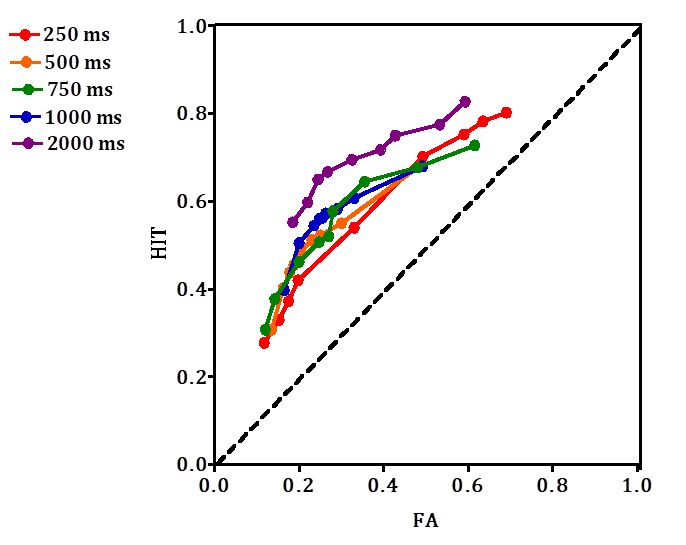
What did Evans et al find in distributed attention and cancer detection?
Able to detect very subtle cancers in ¼ of a second.
At 250ms
Detecting gist of the abnormal
Can detect cancer 3-5 years before onset and in opposite breast.