T4a - Regenerating places
 Call Kai
 Learn
Learn Practice Test
 Spaced Repetition
 Match
Match Flashcards
 Knowt Play
1/29

There's no tags or description
Looks like no tags are added yet.
Name | Mastery | Learn | Test | Matching | Spaced | Call with Kai |
|---|
No analytics yet
Send a link to your students to track their progress
30 Terms
What the 4 types of places?
Near places
Far places
Experienced places
Media places (seen on the media & have an opinion)
What are the 4 functions of a place that matter?
Administrative (making decisions on how to organize surrounding areas so have a large influence)
Commercial (Strong business influence with many TNCs)
Retail (Attractive retail facilities like markets, shopping centers)
Industrial (Where economy & reputation is based on industrial capacity)W
What is the difference between a commercial and retail area?
A commercial area is more varied & diversified in services & banking whereas a retail area is just for direct sales shops
What is an insider and what are their characteristics?
Insider - People who feel at home within a place
Characteristics
Born in the place
Hold citizenship
Fluent & conform with idioms
Conform with social norms
What is an outsider and what are their characteristics?
Outsider - A person not from the area
Characteristics
Don’t belong to the main ethnic group
Not accustom with the culture, social norms & dialect
Hard to find particular foods from their country of origin
The architecture & vehicles
This changes as a family becomes more accustom to the area, their kids will be more accustom
What is the primary sector?
Collection of raw materials like mining
Production of essential goods like fishing
It is the most essential sector as the population relies on food, electricity and water
Labour intensive giving physical health risks
Mental health risks from repetitive work like isolation and depression
What is the secondary sector?
Manufacturing of raw materials into commercial goods & machinery
More regular income than primary as it is working in a factory
Can be liable to exploitation from long hours & dangerous chemicals
A victim of mechanisation
What is the tertiary sector?
Services like education, managing a business or selling a product
More progression & promotions
Office-based with regulated hours and limited outdoor interaction
What is the quaternary sector?
Technology based employment
Scientific research, finance IT & programming
Skill demanding & you need a degree normally
Can be office-based so limited environmental & social interactions
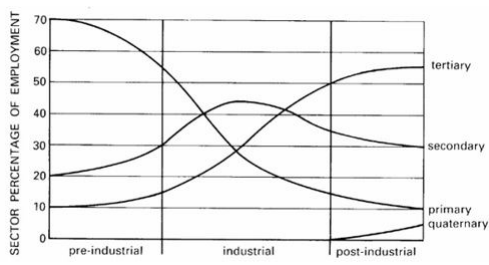
What is the Clarke-Fisher model?
Illustrates how a country’s employment structure changes over time as a country develops
Pre-industrial
Primary sector jobs, small percentage in the secondary industry
Lacking infrastructure of investment so a country can’t construct factories & establish a manufacturing industry
Industrial
Employees in the primary sector declines as land is taken up by manufacturing
More imports
Rural-urban migration occurs as families seek a better QoL
Post-industrial
Primary decreases significantly
Secondary declines but at a slower rate
Large increase in tertiary & quaternary sectors
Due to the demand for entertainment from disposable income increasing
What is place character?
The specific qualities, attributes or features of a location that make it unique
What is an endogenous factor?
A factor that originates within the place
Examples
Land use
Topography
Infrastructure
Demographic
Location
Economic characteristics
What is an exogenous factor?
A factor that originates outside a place & links to other places
Examples
Investment
Migration
Resources
Knowledge & information
How do characteristics of a location change from endogenous and exogenous factors?
Proximity to large cities encourage economic development
Reputation of an area influences investment
Infrastructure allows flows of people & goods to increase
TNCs relocating to certain regions leads to competition
Government strategies to restructure the economy may change like increasing students or less reliance on domestic food
The function may change (administrative, commercial, retail or industrial)
How can you measure changes in a location?
Index of Multiple Deprivation
Land use changes
Employment changes
Migration patterns
Economic productivity
What is inequality?
The unequal distribution of something
What are examples of inequality?
Income - Employment sectors, seasonal vs reliable, skills & education required for each role
Life expectancy & general health - type of employment, affordability of food, stereotypical lifestyles
Educational achievement - Linked to income, low income parents are more likely to get their children working early
What are examples of regeneration strategies in the UK?
Infrastructure - HS2, Heathrow expansion
Retail - Liverpool water, Whitefriars
Culture - Glastonbury for music, Notting hill Carnival, New Year fireworks in London
Housing - like Milton Keynes
Sustainable communities - BedZED
4 government departments and how they can be involved in regeneration:
Local councils - Improve their borough by attracting new businesses & increasing housing & rebranding
Department for culture, media and sport (markets the UKs image) - Sporting events to make the UK look modern & visitable like Olympics
DEFRA (improve declining rural villages) - Protect eroding coastlines, bring investment, improve the agricultural industry
UK Trade & Investment - Attract FDI & workers
Give 2 examples of UK infrastructure projects:
HS2
High speed rail network from London to Birmingham then Manchester then Leeds
Expected to cost £43Bn
Gone over budget already and not functional for 20 years
Estimated 60,000 jobs to be created
Expansion of Heathrow
3rd runway
£20Bn privately funded
70,000 new jobs
Many MPs, locals, NGOs opposite it for increasing traffic & pollution
What are the benefits & costs of infrastructure regneration?
Benefits
Lots of jobs especially in construction
Improves everything else like migration, trade, FDI etc
Costs
Lots of money
Price of supplies may change
Not sustainable & wont have everyone on board
4 reasons for social & affordable housing decreasing:
Thatcher’s Right to Buy scheme had lots of social housing bought less than market value
Empty & derelict properties sit on brownfield land where it is more expensive to develop so private investors sit on land for land price
Overseas investors buying properties which are then left empty or rented out
More affluent people buy second properties to rent out & the rise of airbnb
What are the benefits and costs of housing construction?
Benefits
Fixes a major issue in the UK
Construction jobs are created
Affordable housing caters for all people
Costs
Greenfield developments are more profitable so environments are damaged
Limited projects still
To be affordable it can be up to 80% of the average house price which changes by area and can stop it from being ‘affordable’ and just cheaper
What is gentrification?
Renovating deteriorating buildings or areas to attract rich people or businesses
What is the trickle-down theory of gentrification?
Investors will spend money in services & local businesses
Workers may spend this disposable income on other businesses
Investors and businesses will pay more tax so the local council gets more money
Benefits and costs of gentrification:
Benefits
Economic growth from the trickle-down effect
The local council gets more money
Costs
Lack of variety in housing so first-time buyers don’t benefit
Gentrification schemes don’t build social housing so it is still an issue
What are the benefits & costs of rebranding?
Benefits
Uses disused land
Benefits everyone normally from more footfall to the area
Costs
Can take a long time
Expensive & needs lots of planning
Can be disruptive to locals
Why are rural areas more deprived than urban areas?
Lack of opportunities for young people
Lack of education
Social isolation of minority groups
Physical isolation from services & public transport
Primary industry has declined
How does government policy change the economy at a national & local scale?
Encouraging migration will fill gaps in employment & attract investment
Restricting migration will avoid strain on public services & housing
Deregulating markets will allow privatisation to occur and increase competition in that industry
More industry parks will encourage businesses to move to an area, investors will be attracted to that region
How can you measure regeneration?
Economically compare employment rates, economies size, industrial productivity
Socially compare life expectancy, literacy rates, less social housing need, less social tension, changes to lifestyle
Environmentally, reduced air pollution, less abandoned land
Sustainably, volume of co2 emitted, proportion of green:brownfield land used, jobs created, benefits to locals