BZ3220 - Week 7 (Rare Things)
 Call Kai
 Learn
Learn Practice Test
 Spaced Repetition
 Match
Match Flashcards
 Knowt Play
1/38

There's no tags or description
Looks like no tags are added yet.
Name | Mastery | Learn | Test | Matching | Spaced | Call with Kai |
|---|
No analytics yet
Send a link to your students to track their progress
39 Terms
What is the Most Consistent Pattern in Ecological Communities.
Rarity is common. This means most species are rare, few are abundant.
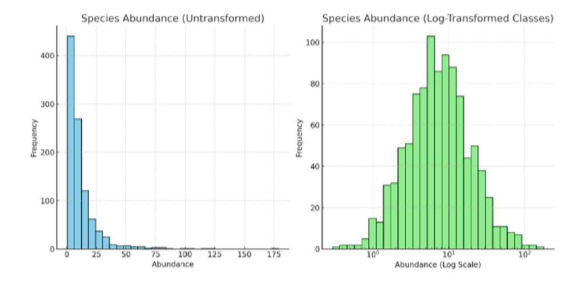
What Distribution often Describes Species Abundance
A log-normal distribution.
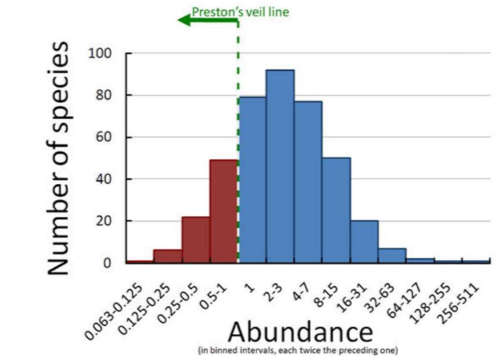
What is Preston’s Veil
The idea that rare species are often missed due to limited sampling.
How is Rarity Defined
By low abundance and/or restricted distribution relative to other species.
What are the Main Dimensions of Rarity
Geographic range size
Abundance/density (local or total)
Patchiness/ubiquity
Ecological specialization
How can Rarity be Quantitatively Defined
Using quantiles (e.g., lowest 10–25% of range size or abundance).
What is the Fundamental Niche
The full range of conditions a species could occupy.
What is the Realised Niche
Where a species actually occurs, limited by interactions and constraints.
What is the Difference between Extent of Occurrence and Area of Occupancy
Extent of occurrence: shortest continuous imaginary boundary of total distribution.
Area of occupancy: actual area occupied within that boundary.
What are the two Causes of Rarity
Natural
Imposed
Examples of Natural Causes
Ecological
Narrow niche
High trophic level
Vulnerability to natural biological change
Historical/geographic constraints
Recently evolved
Poor dispersal relative to historical limits
Examples of Imposed Causes
Habitat loss/fragmentation/isolation
Pollution
Exploitation
Climate change
What is Pseudo-Rarity
A species appears rare due to:
Scale (e.g., locally rare but globally common)
Detectability issues
Why are Rare Species more Vulnerable to Extinction
Small populations
Limited distribution (fragmentation)
Greater sensitivity to disturbance
What is the Strongest Predictor of Extinction Risk
Small geographic range size (i.e., rarity).
Are Rare Species Functionally Unimportant
No, they can be disproportionately important.
Why are Rare Species Important for Ecosystem Function
They often occupy and perform unique functional and ecological roles.
What happens if Rare Species are Lost First
There is a disproportionate loss of:
Functional richness (the range of functional traits in a community)
Functional originality (how unique a species’ role is compared to others)
Functional specialisation (how different species are from the average function)
What are Dominant Species
Highly abundant species with strong influence.
What are Rare Species
Low abundance species with potentially unique roles.
What is a Keystone Species
A species with a disproportionately large ecological impact relative to its abundance. The role of keystone species may be to create or modify habitats or to influence the interactions between other species.
What happens if a Keystone Species is Removed
Major changes in community structure and significant loss of diversity.
What is the Rivet Hypothesis
Each species contributes to ecosystem function. Therefore losing species weakens the system.
What is Redundancy
Some species can replace others functionally.
Why is this Important
Determine show much species loss affects ecosystems.
Why is Monitoring Rare Species Important
To track population trends and extinction risk.
What is the Threatened Species Index (TSX)
A tool used to measure changes in abundance of threatened species over time.
Why is TSX useful
Tracks conservation status
Informs policies
Guides management decisions
Why is Rarity important for Biodiversity Patterns
Many species are rare, meaning they contribute heavily to total richness.
Why might Common Species drive Biodiversity Patterns instead
In some systems (e.g., birds), common species dominate spatial patterns.
Why are Rare Species hard to Conserve
Limited data
Detection difficulty
Small populations
You are Assessing Extinction Risk, what Key Variable should I Prioritise
Geographic range size.
A Species if rare Locally, but Common Globally, what is this
Pseudo-rarity.
Why Might Losing Rare Species be more Serious than Losing Common Ones
Loss of unique ecological functions.
You suspect a species is rare due to poor sampling, what concept applies
Preston’s veil (sampling bias).
You want to map species distribution, what metrics do you use
Extent of occurrence and area of occupancy.
Why is long-term monitoring essential for rare species
To detect trends over time and evaluate conservation success.
You are managing a fragmented species, what risk is highest
Local extinction.