Urban Issues and Challenges
 Call Kai
 Learn
Learn Practice Test
 Spaced Repetition
 Match
Match Flashcards
 Knowt Play
1/38

There's no tags or description
Looks like no tags are added yet.
Name | Mastery | Learn | Test | Matching | Spaced | Call with Kai |
|---|
No analytics yet
Send a link to your students to track their progress
39 Terms
Urbanisation
The process by which an increasing percentage of a country's population comes to live in towns and cities
Patter of urban change
HICs show highest levels of urbanisation with the lowest levels being Africa and SE asia
More people now live in towns and cities than in rural areas
World population double between 1950 and 2015 and urban population more than tripled
decline in industry in developed countries as it moved towards NEE/LICs
to take advantage of cheaper workforce/tax brackets
Which led to industrial growth in NEE and ‘pulled’ people from rural regions to urban areas with the hope of a better life and employment
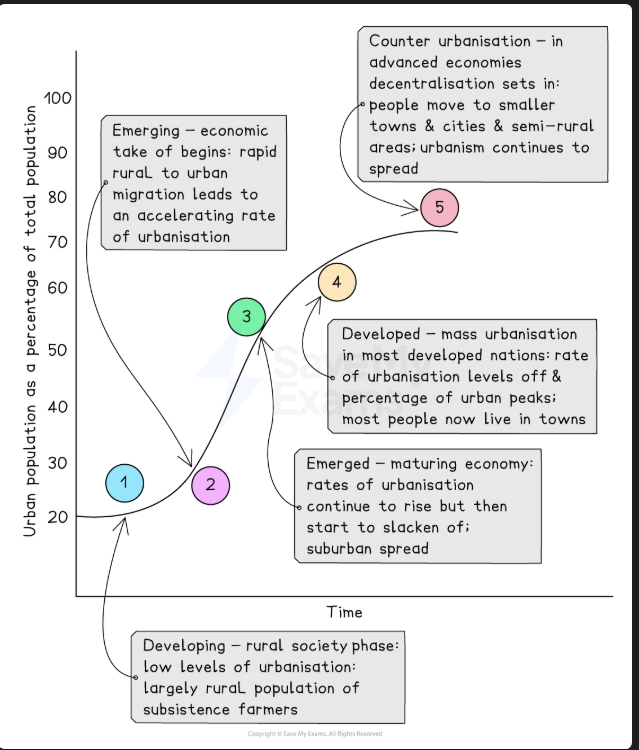
Urbanisation pathway
1 - Developing rural society phase where there is low levels of urbanisation and largely rural population of subsistence farmers
2 - Emerging economic take of begins rapid rural to urban migration leads to an accelerating rate of urbanisation
3 - Emerged maturing economy rate of urbanisation continue to rise but start to slacken (suburban spread)
4 - Develop mass urbanisation rate of urbanisation levels off and percentage of urban peaks most people live in towns
5 - Counter urbanisation in advanced economies decentralisation sets in people move to smaller towns and cities and semi rural areas urbanism continues to spread
Megacities
City with over 10 million people
Around 41 predicted in the world today a rise from 33 in 2018 and 15 in 2000
Modern transport and communication → urban areas are sprawling into rural regions to create conurbations (adds to growth of urban area)
Urban trends in HICs
Rate of urban growth : slowly declining / 1%
More economically developed and have already experienced urbanisation (80% in urban areas)
Industrial revolution ‘pulled’ the population into developing urban areas at the time
HICs population is being ‘pushed’ away from overcrowded cities to rural settlements
eg. UK/Japan/Germany
Urban trends in NEEs
Rate of urban growth : Rapid 2%
Economic development increasing rapidly - investments from TNCs/government
Urban population around 50% (however countries experiencing rapid urban growth this figure can be much higher)
Trade such as finance, electronics and manufactured goods
eg. Lagos - Nigeria/Mumbai - India (not capital but very developed due to trade)
Urban trends in LICs
Rate of urban growth : Fastest rate of urbanisation 6%
Less economically developed so most new economic development concentrated in densely populated cities through investment in low cost manufacture etc.
Cities are experiencing higher levels of natural increase in population
Only 30% of population live in urban areas
eg. Sub Saharan countries like Ethiopia
Factors affecting urbanisation
Speed of economic development
Drives urbanisation/faster the growth of secondary and tertiary sectors faster the growth of urbanisation
Rate of population growth
Economic growth needs supply of labour/rural urban migration meets this
Natural increase
Accounts for roughly 60% of urban population growth
Due to decreases death rates and higher birth rates~
Due to increase in life expectancy
eg. young people get jobs (move - pull) then have children in urban area so increased population of living there
Rural urban migration
Movement of people from countryside to cities
Affected by combination of push factors (leave) and pull factors (move to)
Push factor
Reality of the current situation for the migrant; it is what makes the person consider moving from the place of origin
Pull factor
Perceived outcome; it is what the migrant imagines the move will bring to the place of destination
Push Factors (4 Types and example + cause and effect)
War / Conflict (Political)
Cause: Country becomes unsafe.
Effect: People flee to avoid violence and death.
Unemployment (Economic)
Cause: No jobs or very low wages.
Effect: People leave to find work elsewhere.
Poor Healthcare & Education (Social)
Cause: Low quality services.
Effect: Families move for better life chances.
Drought / Natural Disasters (Environmental)
Cause: Crops fail or homes destroyed.
Effect: People migrate to survive.
PULL Factors (4 Types and example + cause and effect)
Job Opportunities (Economic)
Cause: More jobs and higher wages available.
Effect: Migrants move to improve income and living standards.
Peace & Safety (Political)
Cause: Stable government and low crime.
Effect: People move to feel secure.
Better Healthcare & Education (Social)
Cause: Good schools and hospitals
Effect: Families move for better future prospects and higher life expectancy
Good Climate / Fertile Land (Environmental)
Cause: Reliable weather for farming/living.
Effect: Attracts migrants seeking stability.
Megacities Extra
Megacities are urban areas with over 10 million residents
In 2007, more people lived in an urban environment than a rural one
By 2050 it is thought that more than two-thirds (7 billion) of the world's population will live in urban areas
This scaling up of the urban environment is the fastest in human history
The largest growth of megacities is seen in Asia
Four Main factors for growth in megacities
Economic development
Population growth
Economies of Scale
Multiplier Effect
Economic development - Megacities
Encourages population growth, which leads to the desirability of goods and services
All megacities act as service centres within the formal economic sector
Megacities in NEEs are also important manufacturing centres (Mumbai in India or Dhaka in Bangladesh) with thousands working in the informal economy
Population growth - Megacities
Young people are drawn to live in megacities with their vibrancy, fast pace and opportunities
There is also ‘internal growth’, where people who have moved into the cities have children, thus sustaining population growth
Economies of scale - Megacities
It's cheaper to provide goods and services in one place than spread across several cities
Financial savings for local governments in respect of infrastructure provision
Communication and transport are centralised, making savings in time and money
Multiplier effect - Megacities
As city prospers it acts as a beacon to people and businesses
This encourages inward investment
Leading to more development and growth
Generating further need for skills and labour and job growth
Cycles multiples the positive effects and growth continues
eg. San Francisco and digital development
Categories of Megacities
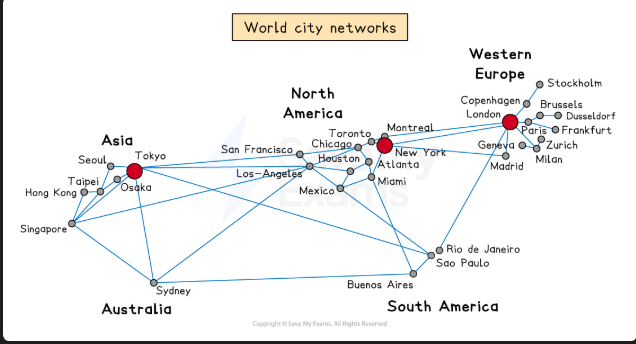
World/global cities can be any size but exert particular influences around the globe - Critical hubs in global economy
Alpha ++ - Connected to world cities network more than any other city have a high level of connectivity (smaller network of world cities feed them)
(London and New York)
Alpha + - Provide advanced services
Alpha and beta world cities - connect major economic regions and states to global economy
Gamma world cities - smaller states or regions to world economy or their main global industry is not as advanced
Cape Town/Bristol
Urban sustainability
Urban sustainability is when a city is managed in a way that meets the needs of people today without damaging the environment or limiting future generations’ needs
Living in a way that doesn’t irreversibly damage the environment or use up resources faster than they can be replaced
Large cities require so many resources that it is unlikely they will every be truly sustainable however there are schemes to make it better
Water Conservation Schemes
Only as much water should be taken from the environment that can be naturally replaced
Examples of methods to reduce water usage:
Wastewater treatment
Collecting rainwater for use in gardens/flushing toilets
Encouraging use of low-flow flush toilets or grey water systems
Installation of water meter so people pay for amount of water they use
Educate people about water use and waste
Water conservation scheme example
Curitiba Brazil government introduced various policies to promote sustainable water usage
Installation of water meters/hosepipe bans
City has separate systems for non drinking water so less drinking water is used
Schemes have successfully reduced Curitiba’s water consumption as it is around half that other Latin America Cities
Challenges of Bad Water Transfer Schemes
Lack of infrastructure investment.
Effect: Dirty water spreads diseases (e.g. cholera).
Poverty / low government funding.
Effect: High death rates and poor quality of life.
Rapid urbanisation (cities grow too quickly).
Effect: Sewage systems become overloaded.
Energy Conservation Schemes
Burning fossil fuels to generate power is not sustainable because they are non renewable and will run out
They contribute to climate change by producing greenhouse gases
Energy conservation schemes reduce usage by:
Promoting renewable energy wind or solar over coal (pollution so health issues) and gas
Encouraging people to make homes more energy efficient by using energy saving appliances and generating electricity from renewable sources (solar panels)
Sell excess energy to national grid
Encouraging people to reduce car use and use public transport
Energy Conservation Schemes Example
In 2009, Curitiba renovated Green Line transport system
Now included dedicated bus lanes for biofuel buses
Scheme is present to replace all of the city street lights with energy efficient bulbs
City gets 84% energy from renewable hydroelectrical power
Curitiba’s CO2 emission from electricity are 65% less than other Latin America Cities
What is Urban Greening
Manage economic and environmental factors to improve quality of life
Involves
Offers green space for families to enjoy
Brownfield instead of greenfield sites
Engaging local communities that offer various job opportunities
Urban Greening - Environmental Benefits
Vegetation and soil hold water, reducing flooding by preventing it from going to drains and rivers
Improve air quality with trees and plants that filter the air, reducing pollution and its impact on people
Gardens and green areas boost biodiversity in cities
Reduces urban temperatures as materials in urban areas (concrete) absorb heat making cities hotter than countryside (urban heat island effect)
Urban Greening - Social Benefits
Cities are noisy/dirty/busy and unsustainable because people find them unpleasant and stressful
Creating green space within urban areas ensures that they remain in place4s where people want to live and work
This is because:
Provide naturally cooler areas where people can relax in very hot weather
Encourage people to exercise more to use alternative transport making people healthier and less stressed
Make people happier due to its aesthetic appeal and break from noise and bustle of city
Urban Greening - Example
In 2007, Curitiba launched a government scheme that encouraged landowners to preserve green areas limiting urban sprawl
People who created parks were exempt for local taxes
28 parks in the city including 1.4 million square meter Barigui Park
which is designed to absorb flood waters so flood defences are not required
Waste recycling
More recycling means fewer resources are used
Less waste is produces which reduces the amount that goes to landfill
Landfill is unsustainable as it wastes resources that could be recycled and eventually there will be nowhere left to bury the waste
Decomposing landfill also releases GHGs
Waste recycling schmes:
Kerbside collections of recyclable materials
Building recycling facilities to deal with larger items
Websites (Freegle) where items are offered for free so they can be reused instead of thrown away
Example of waste recycling
Curitiba is one of eight cities in the world which collects 100% of its waste
70% which is recycled
‘The Green Exchange Programme’ in 1989 where resident receive 1kg of food or bus tickets for every 4kg of recyclable waste collected
Scheme has lead to 6800 tonnes of waste collected each year
Wate recycling
Processing used materials to make new products, reducing landfill and conserving resources.
Why is traffic congestion a big problem for urban areas?
Traffic congestion from cars and lorries cause problems in urban areas
Environmental problems - lots of traffic increases air pollution and the release of green house gases contributing to climate change
Economic Problems - congestion can make people late for work and delay deliveries causing companies to lose money
Social problems - Higher chance of accidents. Congestion also causes frustration for drivers health issues for pedestrians (breathe in polluted air)
Can delay emergency vehicles
How can traffic congestion be managed?
Public transport encourages people to not travel by car
In London:
Dockland light railway is automatic train system that connects east London to the city centre
Operates mostly on tracks above the street level though parts are underground
Used by 120 million people each year
Oyster cards - allow people to easily access travel on London transport
How can traffic pollution be managed?
London has a strict congestion charge and has reduced its levels of pollution by approximately 25% and stopped 13,500 cars a day entering the city centre
Self service bicycles are available to hire and are cheaper than other forms of public transport
bike lanes and special bike signals improve safety
Invest in Park and Ride to cut car usage in the city centre and improve the environment
How can traffic flow be managed?
Reducing traffic flow reduces congestion
Can be done by:
Ring roads and pedestrian shopping streets to keep traffic away from city centre
Making it less polluted and safer and preventing congestion of narrow city centre roads
Bus priority lanes - stop buses being held up in traffic making them more attractive then driving
Parking restriction - make sure parked cars do not block traffic (urban clearways are major roads along which stopping/parking is limited)
Example of traffic flow scheme
Curitiba’s Bus Rapid Transit System uses a series of bus lanes to ensure journeys are quick
80% of travellers (700k) use the Bus Rapid Transport system and no one lives more than 400 metres from the bus stop
Passengers can recycle plastic and glass bottles to pay for a bus fare
Curitiba’s emissions are 25% lower per capita than the average Brazilian city
City centre main shopping centre is also pedestrianised further encouraging people to leave their cars at home