30.1 - Russian Revolution
 Call Kai
 Learn
Learn Practice Test
 Spaced Repetition
 Match
Match Flashcards
 Knowt Play
1/9

There's no tags or description
Looks like no tags are added yet.
Name | Mastery | Learn | Test | Matching | Spaced | Call with Kai |
|---|
No analytics yet
Send a link to your students to track their progress
10 Terms
The Autocratic Romanov Dynasty
Authoritarian state of Alexander III (clung to the principles of autocracy)
No questioning of authority (divine right)
Consolidation of power
Worship of only the state religion (Russian Orthodox)
Censorship of published materials
Attempted to wipe out revolutionaries
Secret police force used to control and intimidate subjects
Russian was the only permitted language
Russification: tried to establish a uniform Russian culture by oppressing other national groups within Russia
Pogroms: organized, violent riots targeting Jewish communities in the Russian Empire
Nicholas II became czar and continued the tradition of Russian autocracy
Russian Marxists: Mensheviks and Bolsheviks
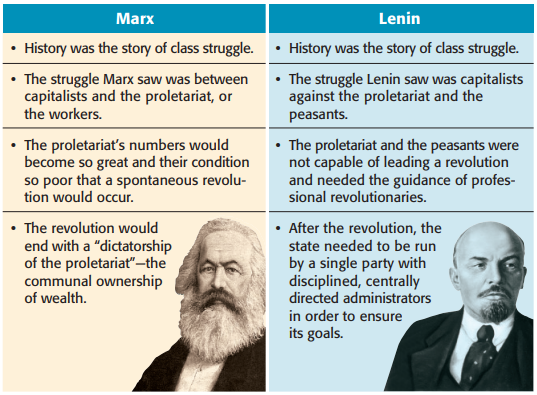
Marxism — “a dictatorship of the proletariat”
The Marxist revolutionaries believed that the industrial class of workers would overthrow the czar, and then rule the country
The Marxists split over revolutionary tactics
Russian Marxists Split:
Mensheviks (more moderate): orthodox beliefs; thought a revolution would be spontaneous, and wanted a broad base of popular support for the revolution
Bolsheviks (more radical): Marxist-Leninist beliefs; the leader was Vladimir Lenin
Vanguard — disciplined party that will implement the revolution (members included Stalin and Trotsky)
Peasants (incorporated them into the proletariat)
Dictatorship of the party
Fall of the Old Order — The Three Events
Three events weakened the czar and paved the way for revolution.
Russo-Japanese War: competed for control of Korea and Manchuria. Russia lost and was humiliated
The Great War: the homefront sacrificed food and resources (led to famine and suffering) for the war effort, and there were also huge casualties
Bloody Sunday (Revolution of 1905): workers wanted better working conditions, more personal freedom, and an elected national legislature. Soldiers fired on the crowd. This provoked a wave of strikes and violence across Russia. People called for reform and a constitutional monarchy (they got the Duma — parliament)
World War I & Rasputin
World War I:
Russia was unprepared to handle the military and economic costs
Weak generals and poorly-equipped troops (no match for the German army)
Russia’s involvement in the war revealed the weakness of czarist rule and military leadership
Rasputin:
Mysterious man who influenced the Romanov Dynasty government
Claimed to have magical healing powers
Had an increasing role in government affairs
Murdered by a group of nobles
The March Revolution (1917) & The Rule by Moderates
Czar Nicholas II abdicated, and the Romanov Dynasty collapsed
Duma created a provisional government, led by Alexander Kerensky
Their mistake: continued the war effort
Soviets from and Lenin returns to change Russian society
Soviets
Local councils consisting of workers, peasants, and soldiers.
In many cities, the soviets had more influence than the provisional government.
Bolshevik Revolution
“All power to the soviets”
“Peace, land, and bread”
Provisional government toppled — no longer a liberal democracy
Bolshevik monopoly of power
Distributed farmland to all peasants
Signed the Treaty of Brest-Litovsk, deemed to be humiliating by many
Murdered the Romanov Dynasty
Russian Civil War
The White Army: made up of many groups that opposed the Bolsheviks
The Red Army: the Bolsheviks
The Bolsheviks won, seized power, and maintained it
10 million Russian died
Post-Russian Civil War & Lenin
Trade at a standstill, and Russia isolated (other nations wouldn’t recognize them)
Industrial production dropped, and skilled workers fled to other countries
Vladimir Lenin:
In years prior, Lenin was forced to flee to Western Europe to avoid the czarist regime (maintained contact with the Bolsheviks)
Small-scale version of capitalism implemented (New Economic Policy)
Allowed peasants to sell their surplus crops instead of turning them over to the government
Government kept control of major industries, communications, and banks
Encouraged foreign investment
In a communist society, the government holds the means of production
Leninist Political Reforms:
Saw nationalism as a threat to unity and to the party
Created self-governing republics to combat nationalism (USSR)
Established a dictatorship of the Communist Party, not a dictatorship of the proletariat
Joseph Stalin
Lenin suffered a stroke and survived, but this set off a flurry of competition to be his successor
Leon Trotsky and Joseph Stalin (“man of steel”) emerge
Stalin slowly accumulated power as the General Secretary of the Communist Party — worked behind the scenes to appoint his loyal supporters to positions of power
Lenin died and Stalin eventually took complete control of the Union of Soviet Socialist Republics (USSR), a centralized communist state led by the Communist Party that formed after the Russian Revolution