Lecture 1 - Nutrients, Water & The Cell
 Call Kai
 Learn
Learn Practice Test
 Spaced Repetition
 Match
Match Flashcards
 Knowt Play
1/78

There's no tags or description
Looks like no tags are added yet.
Name | Mastery | Learn | Test | Matching | Spaced | Call with Kai |
|---|
No analytics yet
Send a link to your students to track their progress
79 Terms
GIT / GI / Alimentary Tract
Long tube from mouth to anus through which feed passes following consumption as it is subjected to various digestive processes
Prehension
Taking in of feed or water (grasping of food)
Structures: lips, tongue (some ruminants)
Mastication
Reduction of feed particle size; generally by chewing.
Structures: teeth, hard palate of mouth
Regurgitation
Casting up of undigested material
Digestion
Break down of feed particles into suitable products for absorption
Types of Digestion
Mechanical force
Chemical reactions
Enzymatic activity
Absorption
Transfer of substances from the GIT to the circulating blood or lymph system
Excretion
Removal of wastes
Anabolism
Growth or buildimg process
Catabolism
Breakdown or destruction reactions
Metabolism
Combination of anabolic and catabolic reactions occuring in the body with the liberation of energy
Substrate
A substance used in the support of nourishment
Glucose, fiber, protein, peptide
Enzyme
A substance produced by a living organism which acts as a catalyst to bring about a specific biochemical reaction (usually the breakdown of substrates)
Nutrition
The process of gathering, processing, using, and responding to nutrients for health and growth
Nutrient
Any feed constituent that functions in the support of life
Malnutrition
Lack of PROPER nutrition
Causes of Malnutrition
Not having enough to eat
Not having enough of the right things to eat
Not being biologically able to use the nutrients consumed
Bioavailability
The proportion of a substance that is able to be absorbed into general circulation
What % does livestock animal diet account for in production costs?
~70%
Why do we feed nutrients?
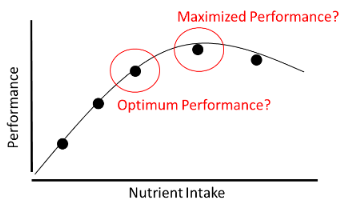
To get a desired response—performance
Most responses to nutrients are?
Quadratic
Measures of Growth
Pounds gained, feed efficiency, days on feed, average daily gain
Measures of Reproduction
Body reserves/condition, Conception rate, Milk production, Dystocia, Pregnancy abortion, egg/young production
Measures of Work/Fiber
Equine performance, hair/wool production
Measures of Immunity
Immune response and recovery rate
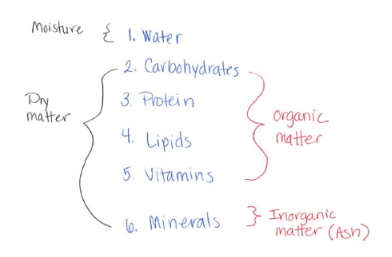
What are the 6 classes of Nutrients?
Water - Moisture
Carbohydrates - Dry matter, organic
Protein - Dry matter, organic
Lipids - Dry matter, organic
Vitamins - Dry matter, organic
Minerals - Dry matter, inorganic (ash)
Organic Matter
Compounds that contain carbon or carbon-hydrogen bonds
Produced by or associated with living organisms
Compounds that contain C, H, O, and N are classified as Organic.
Inorganic matter
Does not contain carbon.
Produced or created by non-living organisms
What is ash?
The inorganic residue that remains after a feed sample is completely burned (combusted) at high temperatures.
Also the principle behind the ashes collected after cremation
Of the 6 nutrient classes, water is the what? (3 notable things)
Cheapest
Most abundant
Most essential
Deficiency of H2O is the last nurtient to cause death and performance reduction
FALSE!
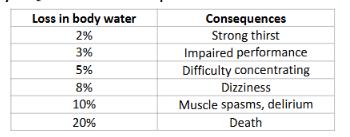
Deficiency will cause reduced performance and death before ANY other nutrient deficiency
Loss of 20% of the body’s water reserve will result in death
Water content of body tissues (muscle, fresh bone, adipose)
Muscle - 75%
Fresh bone - 30%
Adipose - 15%
Is water stored?
No, it is “turned over”
How long does a complete turn-over of water take?
~3 days
Daily excretion must be matched with daily intake
How is water balance achieved?
By regulating electrolyte (mineral) concentration:
Sodium, Chloride, Potassium, Magnesium, Calcium
What % of water is intracellular?
66%
Water is the principal component of the cytosol of every cell in the body.
True
In intracellular water, volume is ___ (tightly/loosely) regulated
Tightly
In intracellular water, concentration of what mineral(s) is high?
Potassium (K+)
What % of water is extracellular?
33%
Where is extracellular water located?
Between the cells (interstitial fluid) and in the fluid component of blood plasma
The volume of extracellular water is also tightly controlled with little fluctuation.
False—volume fluctuates with the total body water balance (dehydration/rehydration)
In extracellular water, concentration of what mineral(s) is high?
Sodium (Na+) and Chloride (Cl-)
Water sources in order of importance
Fresh drinking water
Water contained in food
Metabolic water
Metabolic water
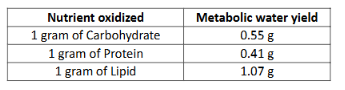
Water produced from the catabolism (oxidative breakdown) or carbohydrates, lipids, or protein into energy
C6H12O6 + 6O2 → 6CO2 + 6H2O + ~38ATP
Where does oxidative brakdown of nutrients for metabolic water creation take place?
Within the mitochondria of the cell
Recall that oxidative breakdown creates energy and water, and the mitochondria are the primary energy producers of the cell!
Is metabolic water produced intracellularly or extracellulary?
Intracellularly, but is diffused into the extracellular space via concentration differences (high to low)
Nutrient molecules with greater ___ density produce greater metabolic water
Hydrogen (H)
Although lipids produce the most metabolic water/g of nutrient, there is greater heat production from lipid oxidation.
What animals typically derive their water from free water (drinking water)?
Livestock, companion, humans
What animals typically derive their water from food?
Marine mammals, fish, desert packrat, raptors
What animals typically derive their water from metabolic creation?
Desert kangaroo rat, birds during migration
Rare, only occurs in highly specialized species (desert animals) or in specific situations
Functions of Water (6)
Transporter of nutrients and waste
Part of many metabolic reactions and dictates osmolality
Gives shape to cells as a constituent of cytoplasm
Lubricates and cushions joints and organs
Acid-base regulation
Maintenance of normal body temperature
Sensible water loss
Can be easily measured and detected
Urine
Feces
Lactation
Insesible water loss
Cannot be easily measured; “water vapor”
Lungs (ventilation)
Skin (perspiration/sweating)
Increased dietary intake, protein, salt/mineral, and indigestible fiber cause an (increase/decrease) of water intake
Increased
The only dietary increase that causes a decrease in water intake is an increase of dietary what?
Moisture
What environmental or physiological factors cause an increase in water intake?
Temperature (hot and cold), gestation, lactation, work, disease
Sweat is species dependent
What physiological factor can cause an increase and decrease in necessary water intake?
Age
As age increases, water requirement increases
Lactating animals will require a much (less/greater) intake of water.
Greater as to recover the water loss that occurs during milk production
Only the quantity of water is important, not the quality.
False—both are important
What factors reduce water quality?
Inorganic toxins (nitrates/nitrites, fluoride, heavy metals, some salts)
Organic toxins (pesticides, hydrocarbons)
Pathogenic organisms (bacteria, blue/green algae)
Total dissolved solids
Measures the proportion of minerals in water and should be tested when new wells are used.
<1,000 ppm - safe for livestock and poultry
some animals may refuse or drink less
1k-3k ppm - satisfactory for livestock
may cause temporary mild diarrhea, animals may drink less
3k-5k ppm - unsatisfactory for poultry
will cause diarrhea and increase mortality for poultry
may cause diarrhea for livestock
5k-7k ppm - not suitable for poultry
high mortality for poultry
can be used with reasonable safety for livestock (not lactating or preg. females)
7k-10k ppm - avoid if possible
can be used for cattle, sheep or goats not subject to heat stress or water loss
Do not use for poultry, swine, horses or lactating/preg. females
>10k ppm - not suitable for livestock
What factors reduce water quantity?
Facility factors (confined animals—capacity, guarding/dominance, flowrate)
Enviromental factors (drought, high heat → evaporation, freezing temperatures)
Animals faced with defiencies or restrictions in water may be subject to what?
Reduced feed intake and, thus, lower productivity (noticable differences in 24 hours)
Weight loss, constipation, stiff gate
Increased excretion of nitrogen and electrolytes such as Na and K (cellular shrinkage and reduced cellular metabolism?
Death within a few days
Dehydration is the primary reason for neonate and young animal death.
True
From failure to nurse and separation from dam (mother) or water source
How is water absorbed in the GI?
Via passive diffusion
Water flows from solutions of low osmolarity to high osmolarity (water follows salt)
Large amounts of water are secreted into the GI each day and reabsorbed to follow the flow of nutrients
Cell Membrane
Selectively-permeable barrier that controls the entry and exit of substances.
Entry and exit is controlled by the lipid bilayer, concentration gradients & membrane bound transporters
Cytosol
The fluid portion of the inner cell, mostly water (does not include the organelles or other insoluble materials).
Allows for easy movement of molecules.
Nucleus
One per each cell. Contains hereditary material (DNA) and thus controls cell activities (via transcription) and mitosis (via DNA replication)
Nucleolus: Site of the production and assembly of ribosome components
Ribosome
Complexes of RNA and protein that are responsible for polypeptide synthesis (eukaryotic ribosomes are larger than prokaryotes - 80S).
The site of protein synthesis in the cell.
Makes other organelles, enzymes & cell wall!
There can be many of these in a single cell.
Mitochondria
A double membrane bound organelle. Site of aerobic respiration, which produces large quantities of chemical energy (ATP) from organic compounds like glucose.
Mitochondria are only found in multicellular organisms.
There can be many of these in a single cell.
A typical animal cell may have 1,000 to 2,000 mitochondria present.
The greater the density of mitochondrion in a cell from a particular bodily tissue, the greater the energy requirement that tissue has for productive purposes.
Ex: a heart cell has approximately 5,000 mitochondria per cell.
Endoplasmic Reticulum
A system of membranes involved in the transport of materials between organelles and shares part of it’s membrane with the nucleus.
Smooth ER: Involved in the synthesis and transport of lipids and steroids, as well as metabolism of carbohydrates
Rough ER: Studded with ribosomes and involved in the synthesis and transport of proteins to the Golgi apparatus.
Golgi apparatus
An assembly of vesicles and folded membranes involved in the sorting, modifying and packaging of proteins that can be used by the cell (in a lysosome) or secretes enzymes that can leave the cell by exocytosis.
Lysosome
Produced by the Golgi, the lysosome is an organelle of over 50 hydrolytic enzymes that degrade material taken up from outside the cell or digest obsolete components of the cell itself.
The lysosome releases important enzymes in the process of Glycolysis as well as protein degradation.
Peroxisome
An organelle crucial for fatty acid synthesis and oxidation (when the body is using fat as a fuel source).
Produces hydrogen peroxide (H2O2), a free radical, from oxidation, which is then decomposed by catalase to water and oxygen.
Catalase
An enzyme important for the control of free radicals by decomposing them into harmless substances, such as water and oxygen
Centrioles
Microtubule-organizing centers involved in cell division (mitosis)
Nutrition is intimately tied to the cell in the transfer of energy from one form to another for productive purposes.
True
The law of conservation of energy states that energy can neither be created nor destroyed - only converted from one form of energy to another.
True