W4 Droughts and Wildfires
 Call Kai
 Learn
Learn Practice Test
 Spaced Repetition
 Match
Match Flashcards
 Knowt Play
1/32

There's no tags or description
Looks like no tags are added yet.
Name | Mastery | Learn | Test | Matching | Spaced | Call with Kai | Chat |
|---|
No analytics yet
Send a link to your students to track their progress
33 Terms
Why is drought important ?
An estimated 55 million people globally are directly affected by droughts every year, making it the most serious hazard to livestock and crops in nearly every part of the world (WHO, 2021)
Droughts have deep, widespread, and underestimated impacts on societies, ecosystems, and economies, with only a portion of the actual losses accounted for (UNDRR, 2021)
Drought Characteristics
Usually develop slowly as opposed to floods
Can last for decades
Effects can linger for years - even after the termination of the event
The onset and end of drought are difficult to determine
Large spatial scale: can affect entire countries/ continents
Difficult to measure societal impacts of drought
Drought definition
a prolonged absence or marked deficiency of precipitation (rainfall) that results in water shortage’
Drought causes
high temperatures → very low humidity → less rainfall
poor water management
loss of soil moisture → influences agriculture
Drought impacts
impact on agriculture → can lead to famine sometimes
vanishing streams, lakes, and water tables → drinking water shortage
risk of wildfires
This can lead to major loss of life of people and animals, loss of livelihoods and loss of habitats.
What re the different types of droughts?
Agricultural
Meteorological
Hydrological
Socioeconomic
Meteorological drought definition
definition based on:
Degree of dryness or lack of rainfall with respect to “normal” or “average” for that region
Duration of the dry period: Number of days with precipitation less than some specified threshold (<1 mm/day).
What do meteorological droughts depend on?
for example, no rain in summer in the Mediterraean in normal, not a drought.
applicable only for regions which have year-round precipitation
Definition and characteristics of Agricultural droughts
Links meteorological drought to agricultural impacts (e.g. less rain, soil water deficit, reduced groundwater)
Characteristics:
Water amounts are lower than what is needed by crops
Conditions that hinder crop growth and agricultural production
Not enough soil moisture to meet the needs of a particular crop at a particular time - e.g. less topsoil moisture at planting → hinder germination.
AGRICULTURAL DROUGHT HAPPENS AFTER A METEOROLOGICAL DROUGHT BUT BEFORE A HYRDROLOGICAL DROUGHT.
Hydrological Drought characteristics
Reduced rainfall has impacts on the water supply
Deficiencies in surface and subsurface water supplies (e.g. lake, reservoir, and groundwater) levels
Not the earliest indicator of drought – time lag between lack of rain and low water
Takes longer for precipitation deficiencies to show up
The frequency and severity of hydrological drought are often defined on a small scale (watershed or river basin scale) (not large continental scale but sometimes that happens too!). When would that happen?
This happens due to a lack of precipitation however hydrologists are more concerned with how this deficiency plays out through the hydrologic system.
Indicators: flow, soil moisture, groundwater, etc.
Socio-economic drought definition
Occurs when physical water shortage starts to affect people: individually and collectively
Demand > Supply
Characteristics of socio-economic droughts
Differs from the other types of drought - occurrence depends on supply and demand to identify or classify droughts. The supply of many economic goods, such as water, forage, food grains, fish, and hydroelectric power, depends on the weather.
Because of the natural variability of climate, water supply is ample in some years but unable to meet human and environmental needs in other years.
Drought Indices
•Percent of Normal
•Percentiles
•Standardized Precipitation Index (SPI)
•Palmer Drought Severity Index (PDSI)
Planners may consult one or more indices before making decisions
How do we measure drought intensity?
Measuring Rainfall
Understanding averages
Comparing rainfall
% of normal equation
dividing actual precipitation by normal precipitation (typically 30-year mean)
what do percentiles help with ?
Help us understand how a particular value compares to others in a dataset
Gives a sense of ranking in a group
Standardised Precipitation Index (SPI) Overview
Measures how likely the observed level of precipitation is compared to long-term data
Very low probability à Rare precipitation deficit
The SPI index is based on the likelihood of precipitation (only) for any time scale
SPI advantages
The SPI can be computed for different time scales, from days to months
Can provide early warning of drought, and assess drought severity
Less complex than the Palmer Drought index
Normalized index so it is possible to compare drought in different regions
Gamma distribution to the data to show skewness
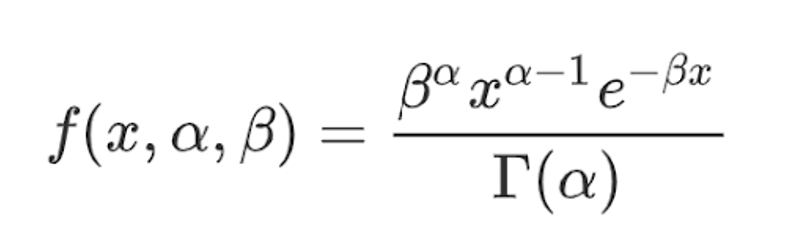
Values in Gamma distribution meaning
α (shape parameter) controls the skewness.
β (rate parameter) controls the scale.
Γ(α) Γ(α) is the Gamma function, which generalizes the factorial function.
The Gamma distribution parameters (α and β) are estimated using statistical methods such as the maximum likelihood estimation (MLE).
SPI Parameter Meanings
An index of zero indicates the median precipitation amount
Negative values mean dry
Exceptionally dry: -2 and below
Positive values mean wet
Exceptionally wet = +2 and above
Palmer Drought Severity Index (PDSI) Definition
A soil moisture index that differs with region
Based on the concept of water balance: water supply (precipitation), demand (evapotranspiration), and loss (runoff)
Many US government agencies and states rely on the Palmer to trigger drought relief programmes.
Pros and cons of PDSI
Pros
The first comprehensive drought index was developed in the US (1965)
Cons
Palmer values may lag emerging droughts (meteorological), by several months; complex
Calculation of P (avg moisture)
P = ET + RO + SS
P → precipitation
ET → Evapotranspiration
RO → Runoff
SS → Soil-water storage
Calculation of PDSI

Other drought factors
Overpopulation → many people living in an area and using more water than can be provided reliably
Over-cultivation → more agriculture than can be sustained during the dry years
Over-extraction → use of stores at a faster rate than they can be replenished e.g. for irrigation
Inefficient use → pollution or wastage of water
Degradation of soil and landscape → leading to reduced capacity of soil/ ecosystems to provide water to agriculture or urban populations.
Definition of wildfire
An unplanned, uncontrolled, and unpredictable fire that burns in combustible vegetation such as forests, grasslands, or bushlands.
Causes of wildfires
Very dry and warm conditions can also lead to wildfires
Natural phenomena such as lightning can start forest fires, however, wildfires are often caused by human activity (e.g. campfires, smoking, arson etc.)
Out of 50% of wildfires recorded, it is not known how they started
Direct impacts of wildfires
loss of life - animals and people
disruption in transportation
communications
power and gas services
water supply
deterioration of the air quality
water pollution
loss of property, crops, resources
biodiversity + natural habitats
Indirect impacts of wildfires [from smoke and ash]
Burns and injuries
Eye, nose, throat, and lung irritation, decreased lung function, including coughing and wheezing
Pulmonary inflammation, bronchitis, exacerbations of asthma, and other lung diseases
Release significant amounts of mercury into the air, which can lead to impairment of speech, hearing, walking, muscle weaknesses, and vision problems for people of all ages
What’s the problem in progressively longer summers in Australia ?
Increases the length and intensity of the bushfire season
Long periods of high temperature → dries out soil and moisture in the environment → increasing fire danger
Forest Fire Danger Index
estimates the fire danger on a given day
based on observations of temperature, rainfall, humidity, and wind speed