Economics Unit 3 Study Guide
 Call Kai
 Learn
Learn Practice Test
 Spaced Repetition
 Match
Match Flashcards
 Knowt Play
1/33

There's no tags or description
Looks like no tags are added yet.
Name | Mastery | Learn | Test | Matching | Spaced | Call with Kai |
|---|
No analytics yet
Send a link to your students to track their progress
34 Terms
Stockholder
An owner of one or more shares of a corporation. They own a small part of the company.
Dividend
check that transfers a portion of the company profits to stockholders, usually quarterly
Liability
An amount owed by a business. Unlimited Liability means that an owner is personally and fully responsible for all losses and debts of a business; this applies to proprietorships and general partnerships.
Cash flow
The sum of net income and noncash charges, such as depreciation. This represents the total amount of after-tax income generated from operations.
Horizontal merger
the combination of two or more firms competing in the same market with the same good or service.
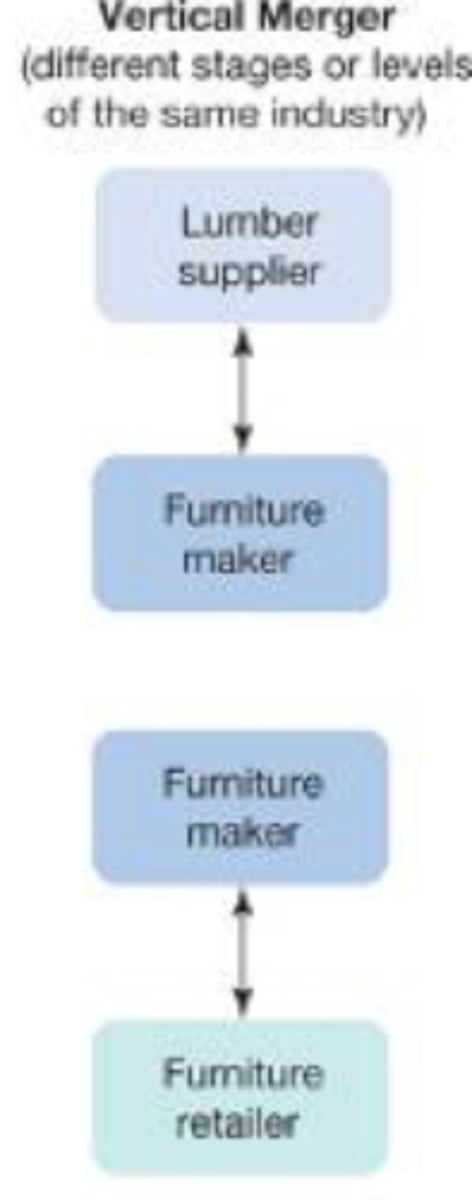
Vertical merger
the combination of two or more firms involved in different stages of producing the same good or service
Conglomerate
firm with four or more businesses making unrelated products, with no single business responsible for a majority of its sales
Multinational
corporation producing and selling without regard to national boundaries and whose business activities are located in several different countries
Why do mergers take place?
-Grow faster
-Become more efficient
-Eliminate a rival
What are the forms of entrepreneurial funding for start-ups?
- Start-up incubators: Places where potential entrepreneurs can get training and potential financing.
- Venture Capitalist: Providor of investment funds to a new or unproven business in exchange for equity (ownership) share.
-Angel Investors: informal and usually affluent investors who provide funds to less-promising start-ups
- Crowdfunding: Raising money from interested investors on a social media platform (Ex. Kickstarter)
Nonprofit organization
Institution that functions much like a business, but does not operate for the purpose of generating profits
Professional associations
Groups of individuals who share a common profession and are often organized for common purposes related to that profession. Ex. American Medical Association and American Bar Association
Chamber of commerce
nonprofit organization of local businesses whose purpose is to promote the interests of those local businesses
What are the types of cooperatives?
Cooperatives generally are a type of business in which ownership is shared among those who use or produce the goods and services
Consumer Coops - Owned by the people who purchase the good or service. REI, Credit Unions
Worker Coops - Owned by the people who work at the business. Cheeseboard in Berkeley
Producer Coops - Owned by the businesses who produce a specific item. Farmers, artisans, etc
How does the government at all levels operate as a nonprofit organization?
1. Government directly distributes goods and services to consumers like a nonprofit. Example: US Postal Service delivering mail.
2. Government indirectly intervenes in the economy. Examples: Antitrust laws, college scholarships, socal security payments.
Right-to-work laws
state law making it illegal to require a worker to join a union
AFL-CIO
Joining of two infulential unions: American Federation of Labor and Congress of Industrial Organizations
How did the courts and employers treat labor unions before the 1930s?
Employers actively fought unions through lockouts (refusing to let employees work until they agree to management demands), employee contracts that required employees not to join unions, firing labor organizers, and hiring strikebreakers. Courts generally sided with companies.
Starting in 1932, how has the US government protected labor union activity?
- Legislation prevented courts from ruling against unions in peacefull strikes, picketing or boycotts.
- Collective Bargaining established as right
- National Labor Relations Board- Federal agency that polices unfair labor practices.
wage rate
a standard amount of pay given for work performed.
collective bargaining
Negotiations between representatives of labor unions and management to determine pay and acceptable working conditions.
mediation
A method of settling disputes outside of court by using the services of a neutral third party, called a mediator. The mediator acts as a communicating agent between the parties and suggests ways in which the parties can resolve their dispute.
arbitration
A method of settling disputes outside of court by using the services of a third party, called an arbitrator. They use information from both sides to create a legally binding final decision that both sides must accept.
fact-finding
an agreement between union and management to have a neutral third party collect facts about a dispute and present nonbinding recommendations
injunction
A court order instructing one side to act or not act. Ex. Court can make an injunction commanding a union not to strike.
seizure
Extreme circumstance where the government temporarily takes over operations while the government negotiates with the union.
Unskilled Labor
labor that requires no specialized skills, education, or training. Example: farmworkers and dishwasher
semi-skilled labor
work that requires minimal specialized skills and education. Example: lifeguard and line cook.
skilled labor
labor that requires specialized skills and training. example: electrician, plumber, and mechanic
professional labor
labor that requires advanced skills and education. Example: Lawyers and doctors.
What are the explanations for differences in wage rates?
Noncompeting Categories of Labor- People with more education/training are paid more
Market Theory of Wage Determination - set by the intersection of labor demand and supply, where the price of labor (compensation) is treated like any other market commodity.
Theory of Negotiated Wages - Labor unions play a key role in raising wages.
Signaling Theory - theory that employers are willing to pay more for people with certificates, diplomas, degrees, and other indicators of superior ability
Why have unions declined since the 1950s?
Union's reputation damaged: Featherbedding - negotiations that kept unnecessary workers on payroll and corruption chanrges.
Taft-Hartley Act (1947) Allows states to pass right-to-work laws, which ban mandatory union membership.
Structural changes in workforce: Fewer blue-collar jobs (in manufacturing, for instance) and Offshoring
What reasons explain lower pay for women in the labor market?
Women are more likely to be in professions that have lower pay
Women are more likely to take time off work for childcare and eldercare
Mothers may be passed over for career advancements
Women are less likely to negotiate salary
What are the arguments for and against the minimum wage?
For Minimum Wage: Equity and economic security. Must value the hard work of people. Give americans money to spend and bolster the economy.
Against Minumum Wage: Does to support economic freedom for businesses. Makes it more expensive for businesses and may lead to layoffs.