Biology: Topic 5: Catabolism
 Call Kai
 Learn
Learn Practice Test
 Spaced Repetition
 Match
Match Flashcards
 Knowt Play
1/14

There's no tags or description
Looks like no tags are added yet.
Name | Mastery | Learn | Test | Matching | Spaced | Call with Kai |
|---|
No analytics yet
Send a link to your students to track their progress
15 Terms
What is the first law of thermodynamics?
Energy can be transferred or transformed, but it cant be created or destroyed
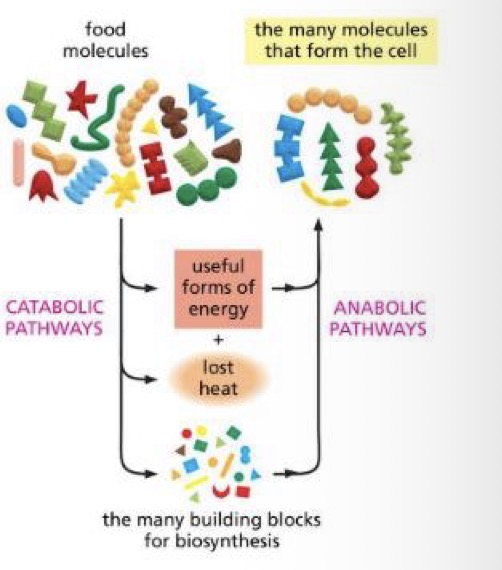
metabolism:
Anabolism- make things and use energy - reduce disorder
Catabolism - break down things and release energy - increase disorder
What is the second law of thermodynamics?
in the universe the degree of disorder (entropy) can only increase
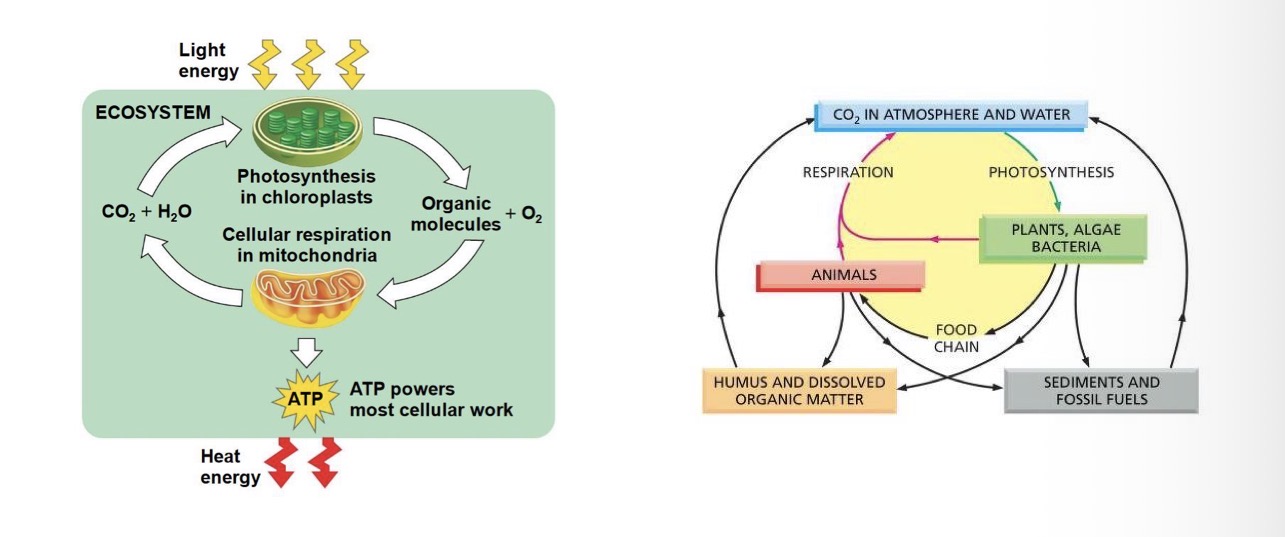
How to photosynthesis and respiration work together?
Complementary processes
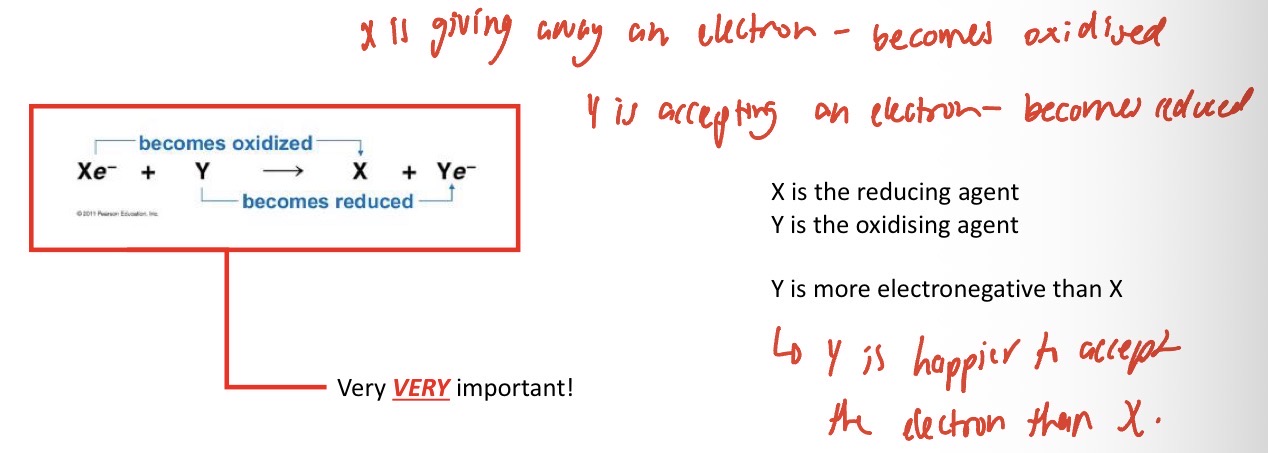
What does it mean to become oxidised?
giving away an electron
The substance that becomes oxidised and gives away an electron is the reducing agent
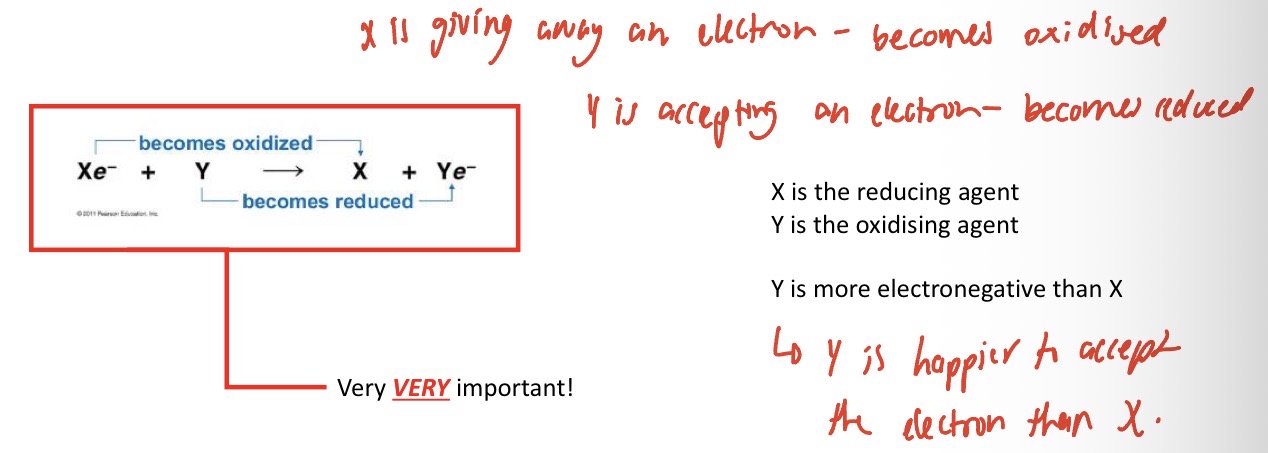
What does it mean to become reduced?
the substance that accepts an electron becomes reduced
It is also the oxidising agent
This is more electronegative than the other substance, meaning its happier to accept the electron
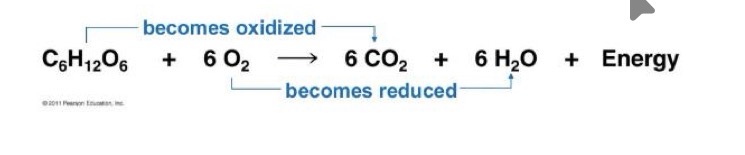
What is the equation for cellular respiration, and what becomes oxidised/reduced?
Glucose (C6H12O6) + 6 O2 → 6 CO2 + 6H2O + energy
Glucose gives away electrons and becomes oxidised - its more unstable, contains more energy - becomes CO2, more stable, less energy
O2 is accepting the electrons and becomes reduced
Energy can be stored temporarily in certain molecules such as a NADH or ATP
How is glucose stored in cells?
as starch (plants)
As glycogen (animals)
What are the main steps of aerobic respiration?
Glycolysis
Pyruvate oxidation
Citric acid cycle
Oxidative phosphorylation
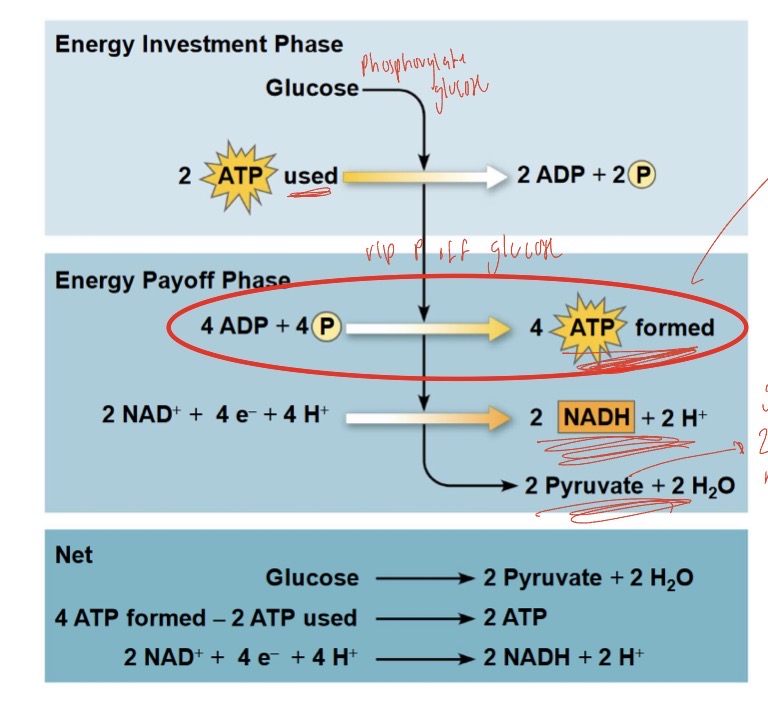
Explain the steps of glycolysis
occurs in cytosol
Energy investment phase - glucose + 2 ATP invested - output 2ADP + 2P
Hexokinase enzyme converts glucose to glucose 6-phosphate using ATP to phosphorylate glucose
Glucose 6-phosphate continues to be broken down in multiple steps - the main regulatory enzyme is phosphofructokinase - 1 more ATP molecule needed
Ending up with 2 × 3carbon molecules
Energy payoff phase - 2 NADH, 4 ATP, 2H+, 2 pyruvate, 2H2O made- 2NAD+ invested
An enzyme is used to take 2H+ (and 2 electrons) from each 2× 3 carbon molecules (partially oxidising glucose) and gives it to NAD+ carriers reducing them to NADH (2 total- accepts 2 electrons, 1 H, and 2H+ is released) - P is also added to 3c molecules
The P is cut from the 3c molecules and uses substrate level phosphorylation to make 2 ATP using an enzyme
3c molecules are converted again and again- releasing water
The 3c molecules undergo substrate level phosphorylation again to make 2 ATP
End w 2 × 3c molecules called pyruvate
Net = 2 pyruvate, 2 ATP, 2 NADH, 2H+, 2H2O
doesn’t require O2- likely evolved before photosynthesis
Limitations
NAD+ stores
If O2 not present, NADH accumulates, cells runs out of NAD+
What is substrate level phosphorylation?
simplest way to make ATP
Enzyme is used to add a single P to ADP
Not efficient but its simple
Done in all cells
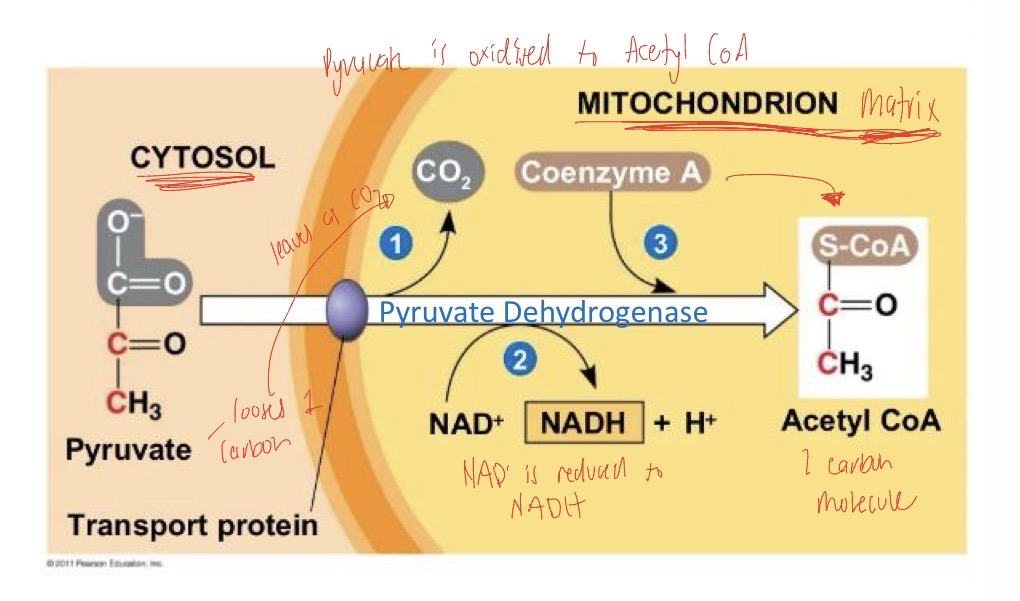
Explain the steps of pyruvate oxidation
Pyruvate from glycolysis travels from the cytosol to the mitochondrial matrix
Oxidised further into 2× 2C molecules called Acetyl CoA
For each pyruvate molecule- One C molecule is lost as CO2, NAD+ is reduced to NADH, H+ is released
How did mitochondria originate?
Thought to have originated from an endosymbiosis event where an aerobic heterotrophic prokaryote was engulfed by a host cell
How did the chloroplast develop?
Endosymbiosis event where a photosynthetic prokaryote was engulfed
What happens during the citric acid cycle (krebs cycle)
Acetyl CoA enters the cycle, the CoA leaves, and acetyl is joined by 4C oxaloacetate (final product of the cycle)
Forms 6C citric acid
Citric acid loses 2x carbons as 2 CO2 molecules
3 NAD+ are reduced to 3 NADH - 3H+ released
FAD is reduced to FADH2
Substrate level phosphorylation makes 1 ATP
Oxaloacetate - final product that enters the cycle again
This is for 1 pyruvate molecule- output is double for 1 glucose molecule
series of oxidation reaction steps to completely oxidise glucose
Explain oxidative phosphorylation
Electron transport chain + chemiosmosis
high energy electron transporters travel form the matrix to the inner membrane with a series of proteins embedded
6NADH donate their electrons to protein complex I - becomes re-oxidised to 6NAD+ (replenishing stores to recycle)
2FADH2 donates electrons to protein complex II - becomes re-oxidised to 2FAD
Electrons travel along the electron transport chain from complexes I to IV - from least to most electronegative - The final electron acceptor at the end of the ETC is O2 - which is reduced to water
ubiquinone (Q) and cytochrome c (Cyt c) move within the inner membrane to pass electrons between complexes
At each step electrons are losing energy that the cell can use to do work - Complexes I, III, IV use this energy to pump H+ against its concentration gradient from the matrix into the intermembrane space
Chemiosmosis: ATP synthase uses this H+ gradient to diffuse H+ back into the matrix down its conc gradient, powering the rotor, and creates ATP from ADP by oxidative phosphorylation
Approx 28 ATP produced from 1 glucose at the end of chemiosmosis