Duke ECS 101 Exam 3 Spring 2026
 Call Kai
 Learn
Learn Practice Test
 Spaced Repetition
 Match
Match Flashcards
 Knowt Play
1/118

There's no tags or description
Looks like no tags are added yet.
Name | Mastery | Learn | Test | Matching | Spaced | Call with Kai |
|---|
No analytics yet
Send a link to your students to track their progress
119 Terms
Metamorphic Rock Lecture: What is metamorphic rock?
formed by heat and pressure applied to other types of rocks (sedimentary, igneous)
Metamorphic Rock Lecture: What are the two kinds of physical deformation to metamorphic rocks?
compression -> foliation
shear stress -> grains skewed, become enlarged
Metamorphic Rock Lecture: What are the four kinds of metamorphic change?
recrystallization, phase change, neocrystalization, polymorphs
Metamorphic Rock Lecture: What is recrystallization?
- smaller crystals to bigger crystals
- minerals change in size and shape but not composition
Metamorphic Rock Lecture: What is Phase Change?
- within the solid state
- "solid state phase charge"
- crystals of same material but with different atomic structures are known as polymorphs
- crystals under heat and [] and structure by which their atoms are bonded together are changed
Metamorphic Rock Lecture: What is Neocrystallization?
- something new, wasn't there before forms
- during metamorphism, atoms are mobilized from existing minerals and combine to form completely new minerals
Metamorphic Rock Lecture: What are polymorphs?
Metamorphic Rock Lecture: What is pressure solution?
at low temp and pressure, minerals dissolve at pressure surfaces between grains, causing grains to fuse together
Metamorphic Rock Lecture: what is foliated metamorphic rock
- exhibit some form of mineral alignment due to shear or normal stress
Metamorphic Rock Lecture: What is slate (cleavage foliation)?
- extremely fine grained
- grains aligned by compression (slaty cleavage)
- minor mineralization due to pressure solution
- dark, dull surface
- slate breaks nicely (flat)
Metamorphic Rock Lecture: What is a phyllite (crenulation foliation)?
- fine grained
- significant neo-crystallization of micas alongside deformation
- significantly sheared compressed grains (crenulation)
- shiny, "satin-sheen" surface
- 0.5 mm thin section
Metamorphic Rock Lecture: What is schist (schistose foliation)?
- fine to coarse grained
- heavily sheared grains (schistosity)
- significant neo-crystallization of micas and other minerals
- shiny, sparkly mineral surface
- high temps and pressures, mountain event
Metamorphic Rock Lecture: What is gneiss (banded foliation)?
-
Metamorphic Rock Lecture: What is a protolith?
Metamorphic Rock Lecture: What is marble and its protolith?
Metamorphic Rock Lecture: What is quartzite and its protolith?
Metamorphic Rock Lecture: What are hornfels?
Metamorphic Rocks Review: What is the definition of a metamorphic rock?
formed from heat and pressure applied to other types of rocks
Metamorphic Rocks Review: What is "normal stress" and what kind of deformation does it result in?
grains begin to be aligned because they are in a pressured direction. physical deformation, compression, and extension
Metamorphic Rocks Review: What is "shear stress"? How does this geometrically deform the grains?
- grains skewed and become elonged, physical deformation
- melts and has bendy crystalline structure
Metamorphic Rocks Review: Explain recrystallization, being mindful of whether the final chemical composition is the same as the protolith or not
- smaller crystals to bigger crystals
- minerals change in size and shape but not composition
Metamorphic Rocks Review: Explain phase change, being mindful of whether the final chemical composition is the same as the protolith or not
- within the solid state there is a "solid state phase change"
- crystals under heat and pressure and structure by which their atoms are bonded together and changed
- chemical composition stays the same
Metamorphic Rocks Review: How can polymorphs of minerals be used to determine temperatures and pressures experienced by a metamorphic rock?
**
Metamorphic Rocks Review: Explain neocrystallization. How does it result in new minerals? What conditions must be met for neocrystalline metamorphic rocks to be of the SAME bulk composition of the protolith, OR differ from it?
- during metamorphism, atoms are mobilized from exiting minerals and combine to form completely new minerals
- something new, wasn't there before forming
- adding hot fluid steals elements and moves together to create new minerals
Metamorphic Rocks Review: Explain the low grade metamorphic change of "pressure solution"
- at low temps minerals dissolve at pressure surfaces between grains causing grains to fuse together
Metamorphic Rocks Review: What two pressure variables contribute to a rock forming a foliation?
**
Metamorphic Rocks Review: Other than deformation of grains, what else contributes to the presence of aligned grains we call foliation?
shearing forces, differential pressure, mineral orientation, tectonic activity
Metamorphic Rocks Review: Differentiate between slate, phyllite, schist, and gneiss in terms of metamorphic grade, final grain size, type of layering, and types of metamorphic change (neocrystallization, recrystallization, etc)
slate:
- extremely fine grained
- grains aligned by compressure (slaty cleavage)
- minor mineralization due to pressure solution, dark dull surface, 1mm thin section, internal layers
Phyllite:
- fine grained
- significantly sheared and compressed grains (crenulation)
- significant neo-crystallization of micas alongside deformation
- shiny, "satin-sheen" surface
- 0.5 mm thin section
schist:
- fine to coarse grained
- heavily sheared grains (schistosity)
- significant neo-crystallization of micas and other minerals
- shiny, sparkly mineral surfaces
gneiss:
- medium to cause grained
- crystalline grains separated into dark and light bands
- heavily
Metamorphic Rocks Review: Are all non-foliated metamorphic rocks evidence of low pressure regimes during metamorphism? Why or why not?
**
Metamorphic Rocks Review: What is the primary metamorphic change that takes place to create marble from limestone?
during metamorphism, recrystallization usually coarsens the grains and fossils are largely if not completely, destroyed. marble retains the original composition of calcium carbonate. unless fluids bring in new elements from elsewhere no neocrystallization takes place.
Metamorphic Rocks Review: What two primary metamorphic changes take place to create a quartzite from a quartz sandstone?
recrystallization combined with pressure solution causes individual sedimentary quartz grains to fuse together into an interlocking texture
Metamorphic Rocks Review: What is a hornfels? Why can it have multiple protoliths? Explain
- the term hornfels is used to describe non-foliated metamorphic rocks that are the results of heating and little to no pressure. This encompasses protoliths of a variety of rock types.
- hornfels are commonly formed as the result of "baking" by an igneous intrusion into shallow crustal rocks (less than 3km deep)
- the protolith can vary from sedimentary rocks as well as fine grained mafic intrusive igneous rocks
Metamorphic Rocks Review: Can non-foliated and foliated metamorphic rocks form in the same area under the same conditions? Explain why or why not.
**
Deformation Review: What kind of deformation (what geologist call "structure") is formed as a result of compression (ductile)?
Folds
Deformation Review: Explain why the deformation of layers may or may not influence the surface of the landscape
Synclines, Anticlines, Monoclines
Deformation Review: Define: fault trace, fault scarp, fault plane, fault block
Fault Trace:
intersection of a geological fault with the Earth's surface, which leaves a visible disturbance on the surface, usually looking like a crack in the surface with jagged rock structures protruding outward.
Fault Scarp:
A fault scarp is a small step-like offset of the ground surface in which one side of a fault has shifted vertically in relation to the other. Shelf-like.
Fault Plane:
the flat surface of rock along which a geological fault occurs
Fault Block:
Fault blocks are very large blocks of rock, sometimes hundreds of kilometers in extent, created by tectonic and localized stresses in Earth's crust.
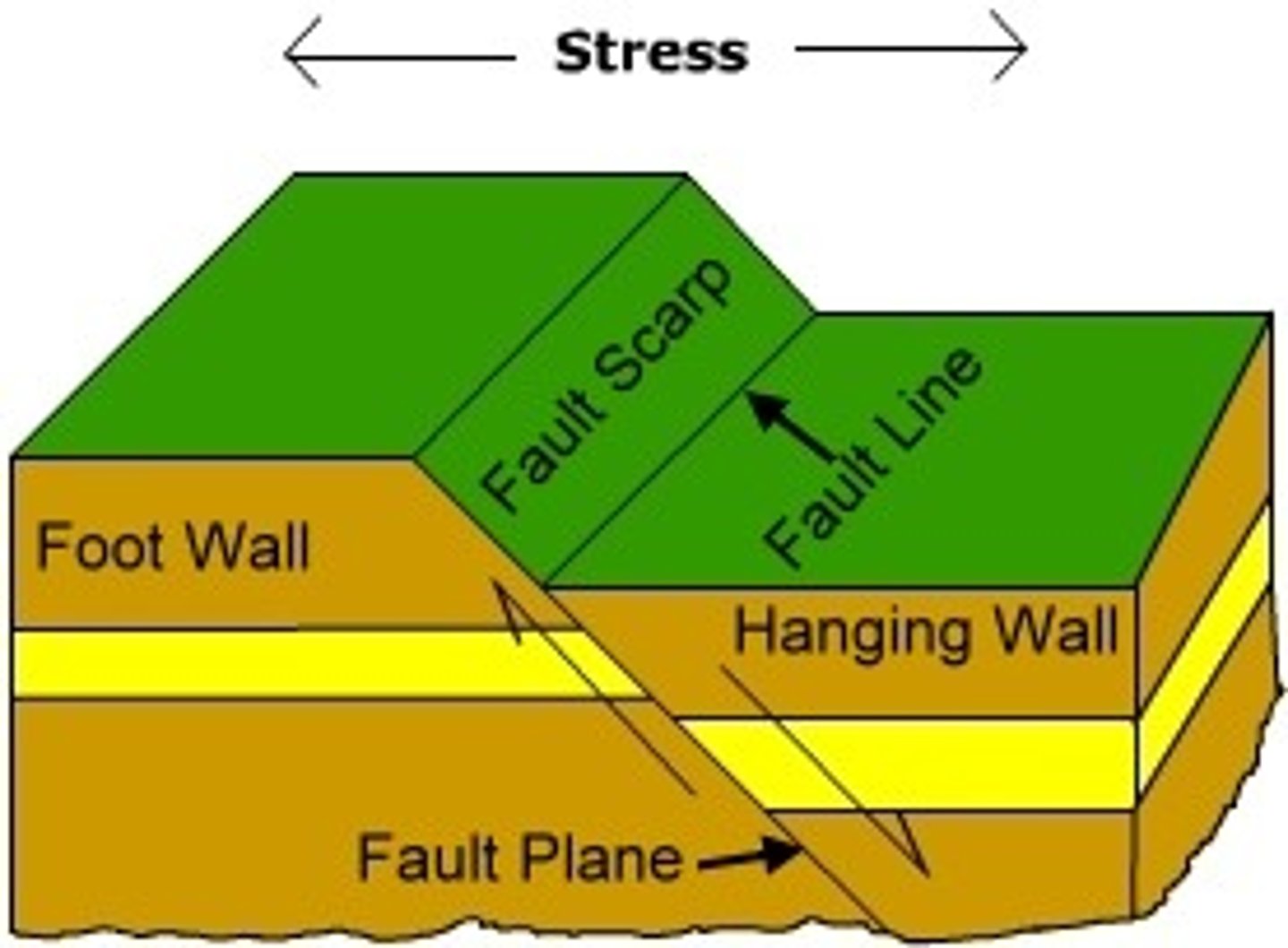
Deformation Review: Explain how miners label fault blocks on each side of a fault plane as either hanging or foot wall
hanging wall is the wall the lantern hangs on when a miner is mining. the footwall is the wall that is stood on by miners.
Deformation Review: Explain and define normal faults, reverse faults, and transform faults
normal fault: extensional stress; footwall goes up, hanging wall goes down, dip-slip
reverse fault: compression stress, distance between faults is decreased; hanging wall goes up, footwall goes down, dip-slip
transform fault: shear stress; slide against each other, strike-slip
Deformation Review: How do geologist designate the motion of transform faults in cross-section and two dimensions?
2 dimensions: strikes slip
cross section: slides each other but stay in same place
shear stress
Deformation Review: Explain the difference between dip slip and strike slip, and which goes with which fault
Dip slip: normal & reverse slips; move along direction of dip plane
Strike Slip: transform fault; move horizontally
Deformation Review: What kind of stress is associated with each type of fault?
Normal: Extensional stress
Reverse: Compression stress
Transform: Shear stress
Deformation Review: Define and explain a thrust fault
Special reverse fault, thrust faults are gently dipping reverse faults
Intro to Earthquakes: What are the names we give to energy propagating when it goes through water, solids, and gas, respectively?
Intro to Earthquakes: What are the four major sources of NATURAL earthqakes?
Intro to Earthquakes: What is the difference between earthquake causes and triggers? Give some examples
Intro to Earthquakes: Describe and explain all the different settings/sources of tectonic earthquakes
Intro to Earthquakes: What are intraplate quakes and how are these possible?
Intro to Earthquakes: Explain the difference between stress and strain
Intro to Earthquakes: Explain the difference between elastic, ductile, and brittle deformation
Intro to Earthquakes: Explain how elastic deformation builds up in rocks
Intro to Earthquakes: Define: ray path, epicenter, wave front, focus
Intro to Earthquakes: What is the particle motion for shear waves, orbital waves, and compressional waves?
Intro to Earthquakes: What are the four types of seismic waves and what types of waves are they?
Intro to Earthquakes: What is the difference between body waves and surface waves?
Intro to Earthquakes: Explain how ray path analysis was used to detect the outer core
Intro to Earthquakes: Explain why ray paths curve (be sure you know which way depending on what they move through)
Intro to Earthquakes: What significance does the fact that different seismic waves travel at different velocities have to earthquake warnings?
Intro to Earthquakes: Explain how the ground shakes beneath a building for each of the four types (S, P, R, L) of waves
Intro to Earthquakes: Explain and draw a simple seismograph
Intro to Earthquakes: What is the minimum number of seismic stations that are needed to figure out where the earthquakes epicenter was?
Intro to Earthquakes: Explain how P-Wave and S-Wave arrivals are used in early warning systems
Earthquake Hazards and Prediction Review: What structural building feature ended up being a death trap for many during the 1994 Northridge, CA quake?
Most of the welds that failed in 1994 were located where vertical steel columns and horizontal steel beams connect, an important location in the structural system. These welds did not perform as expected in the earthquake. Instead of distributing a building's movement throughout the structural system as intended, the welds fractured and concentrated damage at the connections between vertical columns and horizontal beams.
Earthquake Hazards and Prediction Review: Explain the four major ways in which buildings are retrofitted to withstand earthquake shaking better
Bracing: take older buildings and build around or on the inside, allows to move and sway without falling apart.
Anchoring: Prevents homes from detaching from their foundation.
Tuned Mass Damper: helps building sway to help against brittle cracking
Base Isolation: for large buildings and skyscrapers, building sits on series of platform of rollers that lets them to slide without collapsing.
Earthquake Hazards and Prediction Review: What earthquake hazard is particularly dangerous in areas with steep-sided mountains or terrane?
landslide: earthquake-triggered landslides are particularly common in mountainous terrane and steep coastal areas
Earthquake Hazards and Prediction Review: Explain the nature of the landslide that was triggered by the Great Alaska Earthquake
ice rafted debris caused landslides in Turnagain heights which had to be abandoned due to the destabilization in the ground which led to clay failure and slippage motion.
Earthquake Hazards and Prediction Review: How do landslides and rockfalls exacerbate the hazardous conditions after an earthquake?
** people can be buried and fast moving debris
Earthquake Hazards and Prediction Review: Explain how liquefaction works and how sand volcanoes are related
ground shaking cause water-logged soil and clayey sediments to become a slurry of mud and water. during and after a quake, sediment can build up as "sand volcanoes"
Earthquake Hazards and Prediction Review: Give examples of how earthquake damage makes fire-fighting especially difficult
casualties and property damage even after the quake. blocked streets thwart firefighting efforts. fire remains one of the most dangerous and difficult earthquake hazards to mitigating and prepare for.
Earthquake Hazards and Prediction Review: What is another "earthquake hazard" that becomes a threat only after the quake?
Disease: disruption of infrastructure, lack of sanitation, food shortages, and contaminated drinking water can quickly lead to outbreaks of disease. ~750,000 were killed by earthquakes-related across the globe 1998-2017
Earthquake Hazards and Prediction Review: Explain how the Mercalli Intensity Scale works
defines the intensity of an earthquake by the amount of damage it causes, intensity ranges from I to XII (1 to 12). Italian. Giuseppe Mercalli made it.
Earthquake Hazards and Prediction Review: What influences how high the numbers of the Mercalli Intensity Scale might be judged? Explain.
Property damage and amount of motion. People's perspective.
Earthquake Hazards and Prediction Review: What does the Richter Scale fail to do accurately?
Any earthquake larger than 7.0 will be measured as 7.0
Earthquake Hazards and Prediction Review: What is the relationship between magnitude and energy in both the Richter and Moment Magnitude Scale?
Richter: an increase of one unit of magnitude equals about 33 times more energy! so a magnitude 8 earthquake does not release twice as much energy as a magnitude 4 quake but 1 million times as much.
MMMS: Measures the total energy released by a quake more precisely by including length of fault rupture, area of rupture surface, shear strengths of rocks in the calculator of energy.
Earthquake Hazards and Prediction Review: How is the Moment Magnitude Scale better than the Richter Scale? What additional factors does it take in to consideration?
MMMS measures the total energy released by a quake more precisely than the historical Richter scale and can precisely measure very large earthquakes, including >8.9
Earthquake Hazards and Prediction Review: Define: seismic zone, seismic gap, recurrence interval
Seismic Zone: distance to active fault zones, distance to active plate boundaries, 95% of earthquakes occur near plate boundaries
Seismic Gap: areas of a known fault on which no major earthquake has occurred in a long time.
Recurrence Interval: the avg time between successive earthquakes on a particular section of a fault
Earthquake Hazards and Prediction Review: What is fault creep?
Earthquake Hazards and Prediction Review: Explain how recurrence intervals are calculated
Earthquake Hazards and Prediction Review: Explain how old fault scarps are useful to the paleoseismologist
Earthquake Hazards and Prediction Review: How are "Ghost Forests" on the West Coast indicators of past earthquake activity?
Earthquake Hazards and Prediction Review: Provide four examples of methods that show potential promise in being able to "predict" earthquakes, at least within a short period of time before the quake?
Earthquake Hazards and Prediction Review: Explain why the claims of "earthquake lights" and "unusual animal behavior" as earthquake predictors are suspect
Earthquake Hazards and Prediction Review: How have scientists established that there is no statistical correlation between earthquake activity and local gravitational forces?
Glaciers and Ice Ages Review: Provide two major geographic locations with continental glaciers on them
Glaciers and Ice Ages Review: Can mountain glaciers exist in the hot tropics? Explain
Glaciers and Ice Ages Review: What are the four ingredients necessary to make and sustain a glacier? Explain
Glaciers and Ice Ages Review: Explain how snow forms glacial ice
Glaciers and Ice Ages Review: How do mountain glaciers move (two means)?
Glaciers and Ice Ages Review: How do continental glaciers move (a little different from mountain glaciers)?
Glaciers and Ice Ages Review: Explain how glacial crevasses form (be sure to use the words ductile and brittle in your explanation)
Glaciers and Ice Ages Review: What exacerbates glacial sliding?
Glaciers and Ice Ages Review: Explain glacial ice dynamics using the concepts of zone of accumulation and zone of ablation
Glaciers and Ice Ages Review: Explain "glacial retreat" and "glacial advance"
Glaciers and Ice Ages Review: What are two sediments that are found where glaciers once covered the landscape?
Glaciers and Ice Ages Review: What is a glacial sediment that can be found miles from where glaciers actually covered the landscape?
Glaciers and Ice Ages Review: Define and be able to explain the following glacial landscapes features: lateral moraine, medial moraine, terminal moraine, outwash plain, kettle, esker, drumlin, roches moutonnée, mega ripples, glacial potholes, cirque, tarn, u-shaped valley, arête, horn, hanging valley, fjord
Glaciers and Ice Ages Review: What is meant by an "Ice Age". Why is it not the same thing as a "glacial period"? Explain
Glaciers and Ice Ages Review: What do geologist call the periods of time during which glaciers retreat?
Glaciers and Ice Ages Review: What was the last major Ice sheet, that covered the Northern Hemisphere, called and during which "glacial period" did that happen?
Glaciers and Ice Ages Review: When did the last glacial period end?
Glaciers and Ice Ages Review: Explain three tectonic conditions required for the Earth to enter cold intervals that allow for the build-up of ice sheets?